This is the quick cement quality-control formula sheet. It covers loss on ignition (LOI), silica modulus, alumina modulus, lime saturation factor (LSF), liquid phase, Bogue compounds, degree of calcination, sulphur/alkali ratio and clinker conversion factors.
Key cement QC equations in readable text
- Lime saturation factor (LSF, %): LSF = 100 × CaO / (2.8 × SiO₂ + 1.18 × Al₂O₃ + 0.65 × Fe₂O₃).
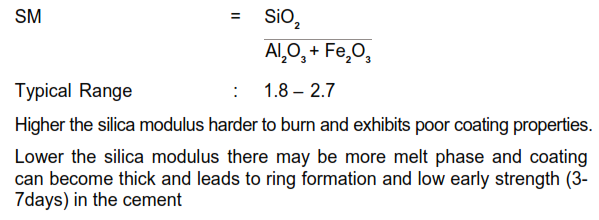
- Silica modulus (SM): SM = SiO₂ / (Al₂O₃ + Fe₂O₃).
- Alumina modulus (AM): AM = Al₂O₃ / Fe₂O₃.
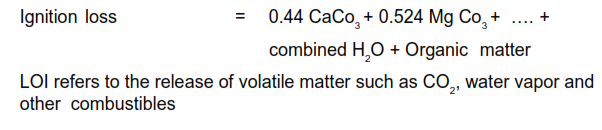
- Loss on ignition (LOI, %): LOI = 100 × (dry sample mass − ignited residue mass) / dry sample mass, using the applicable laboratory test method.
For LSF, SM and AM, use oxide mass percentages from the same analytical basis. The LSF equation above is one widely used convention; coefficient variants and sulfate/free-lime adjustments exist, so compare results only against your plant-approved calculation method. LOI is a mass loss on ignition and can include CO₂, water and other volatile matter; it is not automatically a direct CO₂ measurement. These equations supplement, rather than replace, the illustrated formulas and laboratory procedures below.
Technical references: FLS O&M KPI Handbook (LSF, SM, AM definitions) and Cement benchmarking: quality-control formulas and LOI.
For the complete process-engineering formula handbook, use Cement Formula: LSF, Bogue, LOI & Kiln Calculations. For the organized engineering files and Excel tools, inspect the 931-file package inventory and real document previews.

Loss on ignition (LOI) (CO2 from Calcination)
Silica Modulus/Ratio (SM)
Alumina Modulus/Alumina iron ratio (AM)
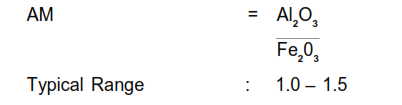
Clinker with higher the Alumina modulus results in cement with high early strength
Lime saturation factor (LSF)

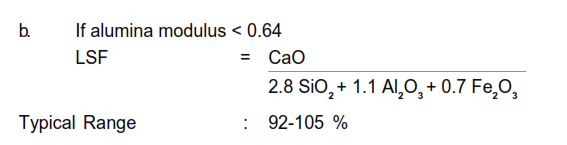
When the LSF approaches unity, the clinker is hard to burn and often shows the excessive free lime contents.
% Liquid

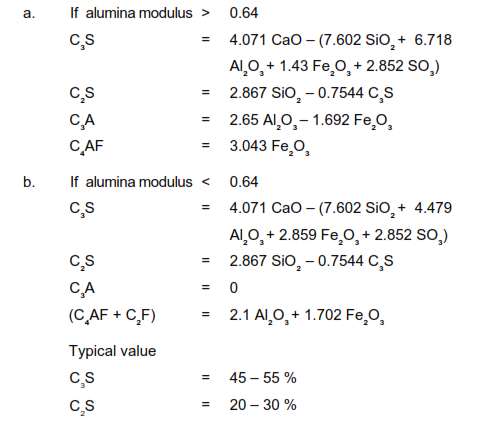
Bogue’s Formula for Cement Constituents
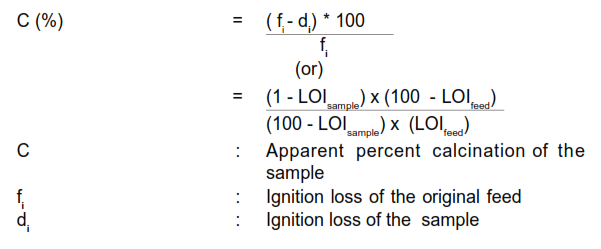
Degree of Calcination
Sulphur to Alkali Ratio
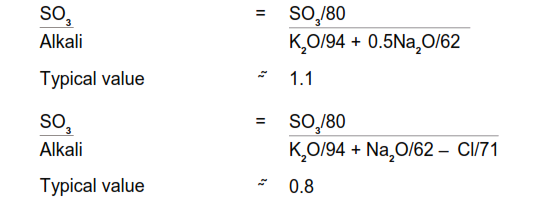
Higher sulphur to alkali ratio leads to pre-heater buildups affecting the kiln operation
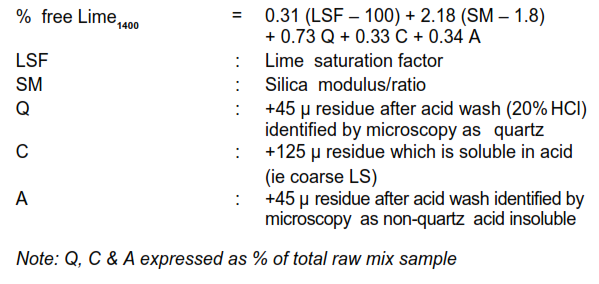
Free Lime
Excess sulphur (gm SO3/ 100 kg clinker)

Above these limits, sulphur gives rise to coating problems in Pre-heater tower.
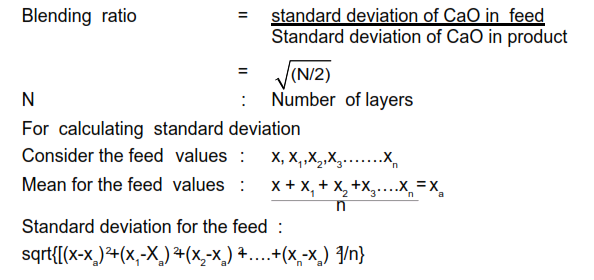
Blending ratio
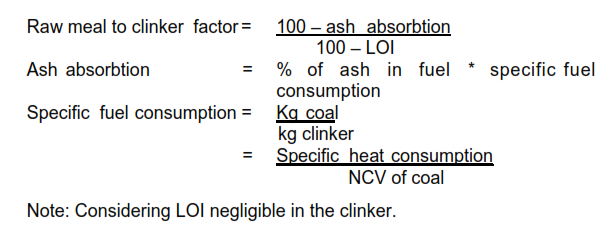
Raw meal to clinker factor
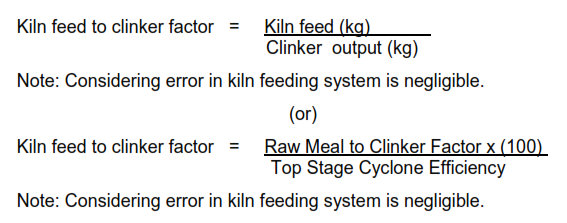
Kiln feed to clinker factor
Clinker to cement factor

Insoluble residue
Insoluble residue can be used to measure amount of adulteration or contamination of cement with sand. Cement is soluble in dilute HClwhere as sand is insoluble. The amount of insoluble material determinesthe level of adulteration. In PPC (Fly-ash) cement; insoluble residue is used to estimate the percentage of fly-ash present in the cement.
Quite informative.
I like very much for these information
I like very much for these information
I find it interesting and informative
Hi how are you
I am Jagdish Thakrshibhi saratanpara.
I am supply of Calcium Silicate Insulation blocks-sonasil 1100 Quality…
My company is AARATi Insulation blocks & powder.
Welcome inquries ?
Email [email protected].
Internal Laboratory test satratifieay…
09429709799..
Rifacatri dipatament Mey us hot hey my matiriyal..
Hysil Blocks.
Thanks..
Yours faithfully..
CMD.
J.t. saratanpara.
hi
my name is Ali
I ma working in cement Company as chemist
my question is about factors using in LSF ort C3S formulas
like in C3S formula 4.071CaO -7.60 SiO2 + 6.718 +…………..
From where these facotrs come from ? in detail
Thanks
my question is about factors using in LSF ort C3S formulas
like in C3S formula 4.071CaO -7.60 SiO2 + 6.718 +…………..
From where these facotrs come from ? in detail
Thanks, I am a Chemist in a cement company, this information will be a great tool for me.
I’m a cement plant worker and I always I attend your fruitful posts and I respect more. My question, can proof those formulas rather final stichiometry formula.