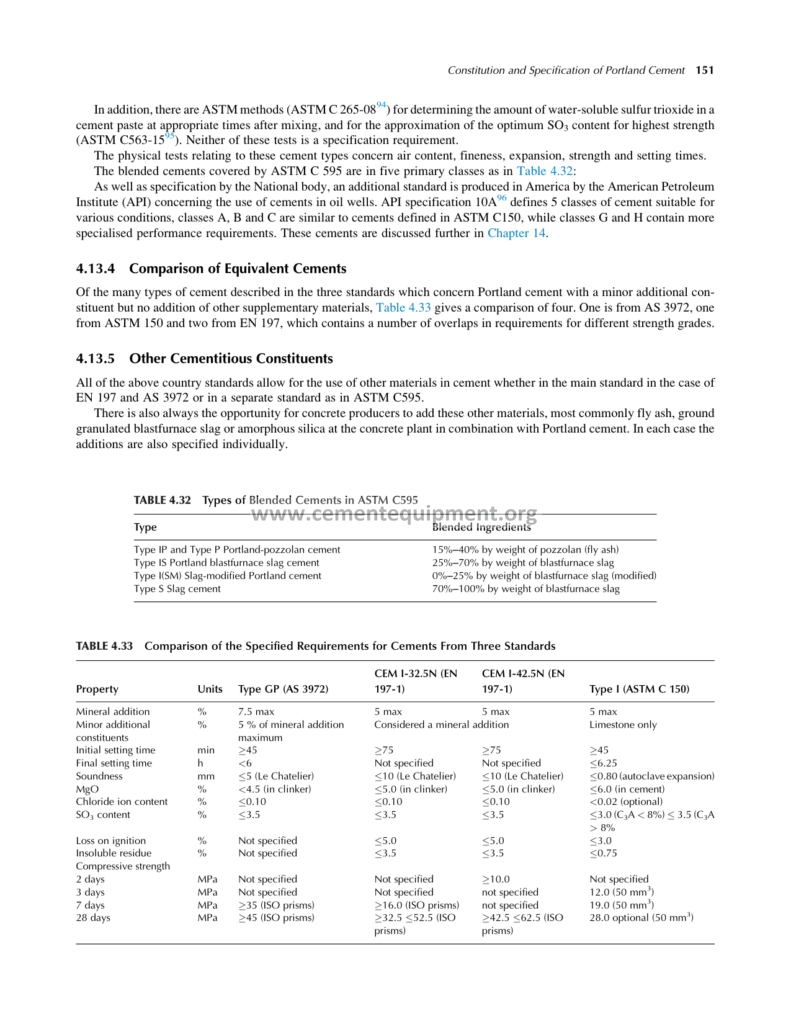
intro (answer paragraph)
IS 4032 (“Method of chemical analysis of hydraulic cement”, first published 1968, revised as IS 4032:1985) is the Indian Standard that tells a cement QC laboratory exactly how to analyze a cement sample by wet chemistry: which reagents, which gravimetric/volumetric steps, what quantities, and what quality limits the result must meet. In India every OPC/PPC/PSC batch certificate carries test results reported per IS 4032 — the same role IS 4031 holds for physical (strength/concrete) tests; the two are the twin pillars of Indian cement certification.
This article explains what IS 4032 actually measures (SiO2, Al2O3, Fe2O3, CaO, MgO, SO3, LOI, insoluble residue, free lime), maps each to its method, and shows how the numbers feed into the clinker/cement quality control loop described in the cement chemistry articles. The method descriptions follow the published standard text, cross-checked against Lea’s Chemistry of Cement and Concrete (5th ed., 2019) analysis chapter.
2. What IS 4032 covers (scope)
- Applies to: ordinary (OPC), Portland pozzolana (PPC), rapid-hardening, low-heat, sulfate-resisting and the other hydraulic cements of IS 269, IS 1489, IS 8041–8043, IS 12269…
- Sets: sampling, reagents, and one method per oxide/determination, with two accepted procedures for several (e.g., Fe2O3 by dichromate or complexometric) and the preference notes.
- Companion: IS 4031 (physical tests — fineness, setting, compressive strength, soundness).
3. The determinations in the standard (tree)
- Loss on ignition (LOI) — 900–950 °C
- Insoluble residue (IR) — HCl + NaOH digestion
- SiO₂ — gravimetric (evaporation + ignition) / fusion route
- Al₂O₃ — from the R₂O₃ precipitate minus Fe₂O₃, or direct
- Fe₂O₃ — titrimetric (K₂Cr₂O₇) after HgCl₂ / or gravimetric
- CaO — oxalate-permanganate / EDTA titration
- MgO — difference or DPEDTA procedure
- SO₃ — gravimetric (BaSO₄) from the soluble part
- Free lime (f-CaO) — specific methods (see Section 5)
- Cl / CO₂ / alkalies — when required (e.g., IS 6452 prestressed).
The precision of each step (repeatability bands) is tabulated in the standard — the aluminum oxide etc. derived values feed the Bogue calculations (gone into the cement chemistry article).
Sampling clause (with IS 3535): sample from silo outlet, wharf, truck or bag (scoop auger for bags, pipe sampler for bulk wind); take a gross sample of ~1–2 kg, reduce by quartering/riffle to a ~100 g lab sample, crush to pass the 90 µm sieve, and record identity, date and moisture at sampling. An unrepresentative sample invalidates all results — this is the standard’s opening discipline.
4. Key methods — what the laboratory actually does (condensed table)
| Determination | Sample prep | Method core | Standard basis |
|---|---|---|---|
| LOI | 1 g, crucible | ignite 900–950 °C to constant mass | LOI to 0.1% |
| SiO₂ | HCl digestion | evaporate to dryness, ignite the silica residue | gravimetric; ammonia follow |
| Fe₂O₃ | filtrate after silica | reduce to Fe²⁺, titrate with K₂Cr₂O₇ | indicator DPS |
| Al₂O₃ | after Fe₂O₃ | R₂O₃ − Fe₂O₃ (or direct) | calc |
| CaO | aliquotly | oxalate + KMnO₄ (or EDTA) | ±0.01 precision |
| MgO | Ca-rich filtrate | DPEDTA or difference | |
| SO₃ | HCl leach | BaCl₂ → BaSO₄, ignite, weigh | gravimetric |
| IR | HCl then NaOH cold | filter + ignite | gravimetric |
The permitted variants are chosen to avoid mutual interference (MgO against phosphate, precipitation temperature for Fe/Al, chloride in the estado matrix) — the laboratory manual must quote them verbatim from the standard.
What the numbers govern:
- Conformance limits — every cement brand must keep LOI/IR/SO₃/MgO inside the base standard’s limits (IS 269: SO₃ max 3.0%; IS 1489: PPC LOI out-of-limit at 5%, etc.); exceedance = rejection + penalty report.
- Bogue back-feed — the oxide report feeds the C3S/C2S/C3A/C4AF computations in the cement-chemistry article; the plant sizes kiln settings and feed accordingly.
Routine IS 4032 analysis is rapid but skill-dependent (weighing to 0.001 g, titration to 0.05 mL). Automation (XRF) is calibrated against the IS 4032 wet values — the classic was the official reference even in automated labs.
5. Free lime (f-CaO) — the critical issue
IS 4032 requires the ethanol–ammonium acetate (or the rapid EDTA/alcoholic glycol flame) method for free lime. The clinkering rule from the article: f-CaO target < 1.5–2%; above that clinker is under-burned and the cement risks unsoundness (free lime fields in the set concrete, expands, cracks). f-CaO is the fastest daily “is the kiln healthy” number — precision ±0.05%.
6. How IS 4032 teams up with the physical standard IS 4031
The two Indian Standards work as a pair in every QC facility:
- IS 4032 (chemical): oxide composition, LOI, IR, SO₃, f-CaO — the recipe audit.
- IS 4031 (physical): fineness (45µm/sieve), setting time (Vicat), soundness (Le Chatelier/autoclave), compressive strength at 3/7/28 days.
A batch certificate has both halves: chemistry proves composition (IS 4032), physics proves performance (IS 4031). Many lab plans publish the oxide sums with Bogue-derived phases on the same sheet — see the “types of cement box” table in the brand comparison from the cement chemistry article.
Automated (XRF) labs note: XRF fused-bead rapid methods are calibrated against the IS 4032 wet values; the wet method stays the referee when a result is disputed or outside limits.
7. Typical oxide limits per Indian grade (what the report is compared against)
The chemical report means little unless you can read it against the grade limits. The indicative table below is what a certified batch must satisfy per the current editions of IS 269 / IS 12269 / IS 1489:
| Property (by IS 4032) | OPC (IS 269/12269) | PPC (IS 1489 Pt.1) | PSC | Purpose |
|---|---|---|---|---|
| SO₃ | ≤ 3.0 % | ≤ 3.0 % | ≤ 3.0 % | set/time control |
| MgO (clinker basis) | ≤ 6 % | ≤ 3 % | ≤ 7 % | soundness / expansion |
| LOI | ≤ 2.0–4 % | ≤ 5 % | ≤ 4 % | adulteration/fly check |
| Insoluble residue | ≤ 4 % | — | ≤ 4 % | adulteration flag |
| f-CaO (cement) | ≤ 2 % | ≤ 2 % | ≤ 1.0–1.5 | unsoundness |
| Chloride (if tested) | ≤ 0.25 % | ≤ 0.25 % | ≤ 0.25 % | rebar/prestress |
The exact maxima follow the current editions of the standards — the table above is the study picture; for design use the edition in force.
Bogue back-feed example (common OPC): CaO 63%, SiO₂ 21%, Al₂O₃ 5.5%, Fe₂O₃ 3.2%, SO₃ 2.3% → C₃S ≈ 56%, C₂S ≈ 17%, C₃A ≈ 9%, C₄AF ≈ 10% — a typical ordinary clinker derived from the IS 4032 oxide report and the Bogue equations in the cement-chemistry article.
8. Where the numbers feed the plant (the clinker control loop)
The same lab sheet does double duty:
- Kiln chemistry: the CaO value is a direct driver of LSF and burnability; a day-to-day shift of 0.1 in CaO changes the computed C₃S by about 0.4 percentage points (see the Bogue section in the clinkering article).
- Raw mix control: 4-hourly SiO₂/Al₂O₃/Fe₂O₃ of the raw mix (sampled and digested at the quarry/ blending stage) feed the LSF/SR/AR targets.
- Corporate quality: the weekly IS 4032 numbers are the cited evidence in the batch certificate, mirrored with the IS 4031 strength curve from the 28-day article.
The loop — sample, analyze per IS 4032, compute Bogue/LSF, correct the kiln, re-sample — is the quality system a plant runs to keep every batch inside the class limits above.
8b. Interference notes every analyst should keep handy
The classic mistakes in a wet-chemical suite (and why the standard prescribes precise routes):
- Silica loss: incomplete double evaporation leaves SiO₂ in solution — high iron results follow.
- R₂O₃ carry-over: aluminum hydroxide precipitates near-neutral pH weakly; a too-hot filtration melts the cake into the filtrate — the cause of “Al too high / Ca too low” patterns.
- CaO over-blank: oxalate + Mg interference; the standard keeps the Ca separation ahead of the Mg determination for exactly this reason.
- Chloride contamination: wash-water and acid grade must be controlled — chlorides shift the SO₃ and retention numbers in the matrix.
- Weighing discipline: every ignition step takes place on the same balance, calibrated monthly; the standard quotes the repeatability the method expects, and the lab QC (control chart on the same in-house standard 8.a sample) monitors drift.
Good labs run a plant control standard (a homogeneous clinker/cement powder) with every batch: same value day after day → the method is under control; a shift ≥ 2× the repeatability band → investigate before reporting. That discipline is what makes IS 4032 numbers comparable between plants and labs.
11. FAQ — IS 4032 (short answers)
What is IS 4032? The Indian Standard (1985) for chemical analysis of hydraulic cement (wet chemistry methods + limits reporting) — companion to IS 4031 physical tests.
Is IS 4032 mandatory? For Indian-market cement certification yes — BIS license/cons-life production must report per IS 4032 (with IS 4031 physical) and fall within IS 269/1489 etc. limits.
What tests are in IS 4032? LOI, insoluble residue, SiO₂ Al₂O₃ Fe₂O₃ CaO MgO SO₃ free lime and optional CP. CO₂/alkalies/ chlorides plus a preference max table.
How differs IS 4032 from IS 4031? IS 4032 = chemical analysis; IS 4031 = physical (fineness, soundness, setting, strength).
What is the free lime limit? Quality production: generally ≤1.5–2% f-CaO in clinker (unsound beyond); IS 4032 is the method used to measure it on clinker and cement.
Do modern plants still do wet chemistry? On the certificate, yes — the reference is IS 4032; in practice most Indian plants run XRF for speed and keep the wet IS 4032 checks for referee/reporting and calibration.
How long does an IS 4032 suite take? A full oxide suite by an experienced analyst: roughly a working day (with overnight ignitions); a targeted f-CaO + SO₃ run is about 1–2 hours — that speed is why f-CaO is the operator’s favorite.
What is the difference between IS 4032 and ASMT C114 / EN 196-2? The same chemistry in different editions: the Indian standard pairs with the Indian grade limits; you will meet C114 and EN 196-2 in imported-lab or export contexts. Lea’s Ch.4 (part of this site’s technical package) maps all three side by side.
Is IS 4032 used for clinker too? Yes — the plant grinds a clinker sample and runs the same suite; the LOI and f-CaO of the clinker are the burn-quality flags (the clinkering article uses exactly those numbers).
How do I prepare a cement sample for IS 4032? Take 1–2 kg representative sample, reduce to ~100 g, dry, crush to pass 90 µm; store airtight until analysis — moisture pick-up shifts LOI and all weight-based results.
Where do I get a copy? Purchase from the Bureau of Indian Standards (BIS) — this page is educational and the official text is copyright.
Deep-dive extras from the technical package
The full wet-analysis chemistry (individual methods, interferences, precision data) parallels Lea’s Chemistry of Cement and Concrete (5th ed., 2019) Ch.4 Analysis, of which pp.177–190 cover acid-soluble methods, free lime procedures, and the standards map (ASTM C114, EN 196-2, BS, IS). A screenshot of Lea’s p.181 (analysis section) is the feature of this article. The package also includes the course “Chemical & Physical Analysis of Cement” references in the same folder.