Cement properties
Answer first: Portland cement properties are controlled by both oxide composition (mainly CaO, SiO2, Al2O3, Fe2O3, SO3 and MgO) and clinker/mineral phases such as C3S, C2S, C3A and C4AF. These are related but not interchangeable: Bogue equations estimate potential phase composition from oxide analysis, while XRD/Rietveld analysis is used when actual phase abundance matters.
Chemical Composition of Cement
| Property / result | What it can indicate | First engineering check |
|---|---|---|
| High LOI | Prehydration/carbonation, or legitimate limestone/addition contribution depending on cement type | Storage history, sample condition, additions and the applicable product standard |
| High free CaO | Raw-mix/burning/cooling imbalance and potential soundness concern | LSF/raw mix, burning-zone conditions, clinker cooling and free-lime trend |
| SO3 / sulfate balance | Strong influence on setting and early hydration; optimum is system-specific | C3A/reactivity, sulfate form, mill temperature, fineness and governing standard |
| MgO / periclase | Potential delayed expansion when unfavorable mineralogy/reactivity is present | Clinker mineralogy, soundness test and product specification |
| C3S / C2S balance | Influences strength-development profile together with fineness and hydration conditions | Phase analysis, fineness/PSD and strength trend—not chemistry alone |
Plant-side next steps: use the free cement engineering calculators, review the C3S/C2S/C3A/C4AF phase guide, diagnose free lime in cement plants, compare the cement formulas and Bogue calculations, or use the XRD analysis guide when calculated potential phases are not enough.
Cement chemistry abnormal-result checklist
- Confirm the data first: verify sampling, sample preparation, XRF calibration and test repeatability before changing the process.
- Trend the result: compare against the same product and stable-process baseline; one isolated analysis should not drive a kiln or mill adjustment.
- Separate oxide chemistry from mineralogy: use Bogue calculations for potential phases and XRD/Rietveld when actual phase abundance or polymorphism matters.
- Correlate chemistry with process and performance: check raw-mix targets, burning/cooling conditions, sulfate addition, fineness, setting and strength together.
Need the underlying cement chemistry, QC and process references? Get the Cement Technical Package via PayPal.
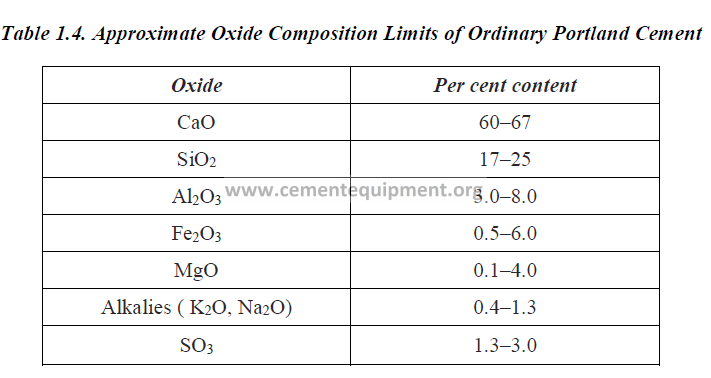
The raw materials used for the manufacture of cement consist mainly of lime, silica, alumina and iron oxide. These oxides interact with one another in the kiln at high temperature to form more complex compounds. The relative proportions of these oxide compositions are responsible for influencing the various properties of cement; in addition to rate of cooling and fineness of grinding. Table 1.4 shows the approximate oxide composition limits of ordinary Portland cement.
The identification of the major compounds of cement is largely based on Bogue’s equations and hence it is called “Bogue’s Compounds”. The four compounds usually regarded as major compounds are listed in table 1.5.
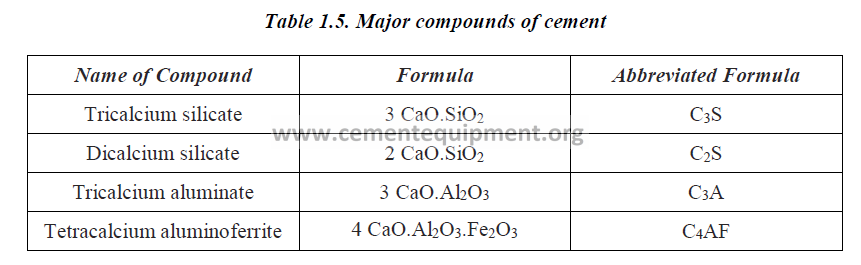
It is to be noted that for simplicity’s sake abbreviated notations are used. C stands for CaO, S stands for SiO2, A for Al2O3, F for Fe2O3 and H for H2O. The equations suggested by Bogue for calculating the percentages of major compounds are given below.
C3S = 4.07 (CaO) – 7.60 (SiO2) – 6.72 (Al2O3) – 1.43 (Fe2O3) – 2.85 (SO3)
C2S = 2.87 (SiO2) – 0.754 (3CaO.SiO2)
C3A = 2.65 (Al2O3) – 1.69 (Fe2O3)
C4AF= 3.04 (Fe2O3)
In addition to the four major compounds, there are many minor compounds formed in the kiln. Two of the minor oxides namely K2O and Na2O referred to as alkalis in cement are of some importance and Expressed in terms of Na2O. These alkalis basically react with active silica in aggregate and produce what is called alkali-silica gel of unlimited swelling type under favourable conditions of moisture and temperature in voids and cracks and further it causes disruption and pattern cracking.
Tricalcium silicate (C3S) and dicalcium silicate (C2S) are the principal silicate phases governing strength development. Their proportions vary materially with clinker design and cement type, so a single universal “average” should not be used as a plant target. C3S generally contributes more strongly to early strength, while C2S contributes more slowly at later ages; fineness, sulfate balance and curing conditions also affect the measured strength response.
The calculated quantity of the compounds in cement varies greatly even for a relatively small change in the oxide composition of the raw materials. To manufacture a cement of stipulated compound composition, it becomes absolutely necessary to closely control the oxide composition of the raw materials.
SO3 in finished cement comes mainly from calcium sulfate added during finish grinding, with additional contribution possible from clinker and other constituents. There is no single universal SO3 target for every cement: the appropriate level depends on cement type, C3A/reactivity, sulfate form, fineness, mill temperature and the governing specification. Plant control should optimize sulfate for setting and strength while confirming compliance with the applicable standard.
MgO originates mainly from magnesium-bearing raw materials. Its significance depends not only on total MgO but also on the mineralogical form and reactivity of periclase; delayed hydration can contribute to expansion. Use the applicable cement specification and soundness/mineralogical evidence rather than a universal plant limit copied from another standard.
An increase in lime CaO content beyond a certain value makes it difficult to combine with other compounds and free lime will exist in the clinker which causes unsoundness in cement.
Insoluble residue is that part of the Cement non-soluble in hydrochloric acid HCl and arise mainly from non active silica to form cement compounds dissolved in this acid therefore it express the completeness of the chemical reactions inside the rotary kiln.
Loss on Ignition
Loss on ignition (LOI) is determined by heating a cement sample under the specified test method and measuring the mass loss. A high LOI can indicate prehydration or carbonation, but limestone and other permitted constituents can also contribute depending on cement type. Interpret LOI against the applicable product/test standard and the known cement constituents rather than applying one universal percentage limit.
Setting and Hardening of Cement
Setting Process: The process of losing plasticity with time and becoming dense, which is formed by mixing the cement and water. It happened in two stage initial setting and final setting.
Hardening Process: The process of forming hardening cement paste, which loses plasticity and its strength increases with time.
Factors such as fineness and types of cement, blend of gypsum, age, water content, temperature and humidity which influence setting and hardening of Portland cement.
Setting is important in concrete work to keep fresh concrete plastic for enough time which helps the processes of transporting, casting, and compaction.
There are four stage occurs during setting of cement, First : when mixing cement with water, a rapid heat evolution, lasting a few minutes, This heat evolution is probably due to the reaction of cement compounds then, heat evolution ceases quickly. Second: this stage called “dormant period” and last (1-4) hours. Also cement particles start to form initial layer of hydration product. Bleeding and sedimentation appear in this stage. Third: Next heat evolution is on account of dissolution of weak gel which formed first on surfaces of C3S crystals so water will reach these surfaces and starts to form new gel. This stage last about 6 hours. Forth: in this stage cement begin to harden and gain strength.
False and flash Setting
False setting is the rapid development of rigidity in freshly mixed Portland cement paste, mortar, or concrete occurs after few minutes of mixing cement with water without the generation of much heat. It can be controlled by re-mixing without additional water or strength loss. Causes of false setting are:
1. Drying of gypsum: when gypsum (CaSO4.2H2O) gridding with hot clinker it loss 75% of its water and formed (CaSO4.1/2 H2O) and if temperature of clinker increase gypsum loss all water in its composition and formed CaSO4. When water add to cement CaSO4 react causes rapid setting.
2. Bad storage: alkalis in cement react with carbon dioxide forming Alkali carbonate which reacts with calcium hydroxide forming CaCO3 causing setting of cement paste.
3. Activate effective C3A exposed to humidity: during bad storage water adhere on cement particles surface and during mixing these active surface combined rapidly with water within minutes.
Flash setting is a rapid development of rigidity in freshly mixed Portland – cement paste, mortar, or concrete. Further mixing can’t dispel this rigidity, and a large amount of heat is produced in the process. It happened Due to rapid reaction of aluminates – when insufficient sulfate present so to prevent It A small amount of gypsum (CaSO4·2H2O) gridding with the cement clinker retards the hydration reaction of tricalcium aluminate so that the calcium silicates can set firstly.
Soundness of Cement
It refers to the ability of a hardened cement paste to retain its volume after setting without delayed destructive expansion. This destructive expansion is caused by excessive amounts of free lime (CaO), (SO3) or magnesia (MgO).
The hydrating speed of the over burnt CaO or MgO is slow, CaO or MgO begins to hydrate after cement hardening and causes the hardened cement to expand and crack.
When added in excess or when the sulfate/aluminate balance is unfavorable, sulfate-bearing hydration products can contribute to damaging expansion. Diagnose the actual cement chemistry and soundness evidence rather than relying on an old universal rule.
Need the full cement chemistry and quality-control reference library?
it is good subject you shared to me