Cement Mill Maintenance: Practical Reliability Guide
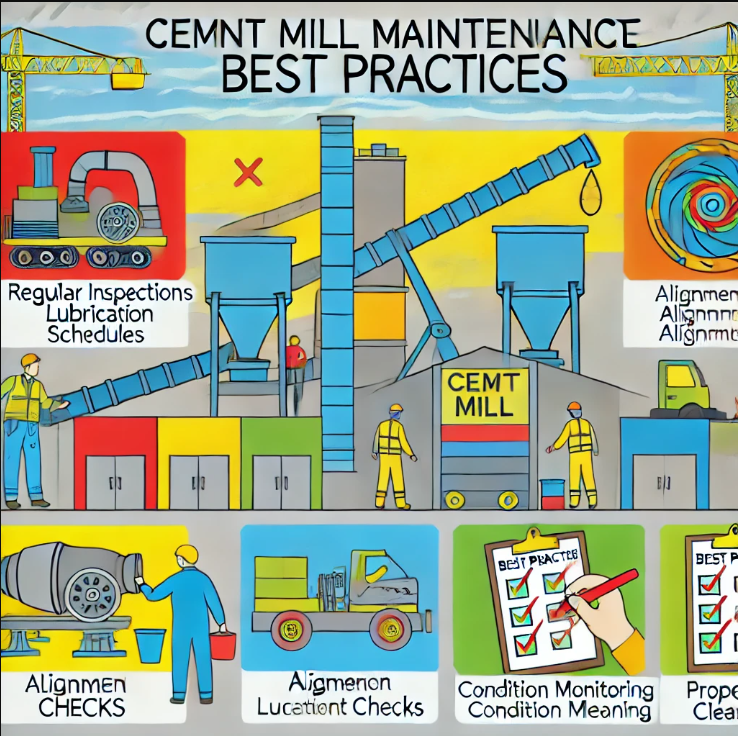
Cement mill maintenance works best when the team separates online condition checks from shutdown inspection. During operation, trend bearing and lubrication condition, drive behavior, vibration/noise and leakage. During a safe locked-out mill entry, inspect liners, bolts, diaphragm condition, grinding-media distribution, shell condition and feed/discharge wear. The objective is not simply to complete a checklist: it is to detect deterioration early enough to plan the intervention before it becomes an unplanned stop.
Cement mill maintenance schedule: what to check and when
| Interval | Priority checks | Escalate when |
|---|---|---|
| Each shift / daily | Bearing and oil-system trends, leaks, abnormal noise/vibration, motor/drive condition and operating stability | A reading departs materially from the established normal trend or OEM operating limit. |
| Weekly / condition route | Drive train, lubrication condition, vibration trends, fasteners visible externally and recurring leakage | A worsening trend repeats across inspections rather than appearing as a single transient reading. |
| Planned shutdown | Linings, liner bolts, diaphragm slots/plates, media distribution, shell, inlet/discharge and internal wear | Measured wear threatens the next planned run, openings exceed design limits, or cracking/looseness is found. |
| Major outage | Detailed drive/alignment condition, structural inspection and overhaul items defined by the mill OEM and site history | Condition history, measurements or OEM criteria require repair/replacement. |
Use trends and the mill manufacturer’s limits rather than generic alarm numbers. Bearing arrangement, lubricant, drive design, liner system and diaphragm geometry vary by mill.
For the actual shutdown route, use the ball mill inspection procedure. For component identification before inspection, open the ball mill diagram and component map. Diaphragm findings can be diagnosed with the cement mill diaphragm troubleshooting guide, while calculation checks are available in the ball mill calculation formulas.
Need the deeper maintenance library? The Cement Technical Package contains the collected cement-industry books, Excel sheets, technical notes and presentations used across the site. Get the Cement Technical Package via PayPal.
Cement Mill Maintenance Best Practices: A Comprehensive Guide
Effective maintenance of cement mills is crucial for ensuring high levels of productivity, reliability, and operational efficiency. By following best practices, cement plant operators can minimize downtime, reduce costs, and extend the lifespan of their equipment. Below is a guide on the best practices for maintaining cement mills, along with sources and links for further reading.
1. Develop a Preventive Maintenance Program
- Best Practice: A well-structured preventive maintenance program helps in identifying and addressing potential issues before they escalate into major problems. This approach reduces unplanned downtime and extends the life of equipment.
- Actionable Steps:
- Schedule regular inspections and maintenance activities for all critical components.
- Use checklists to ensure that all necessary tasks are completed during each maintenance cycle.
- Prioritize maintenance tasks based on the criticality of the equipment and the potential impact of a failure.
- Source: Maintenance Technology – Preventive Maintenance Strategies
2. Implement Predictive Maintenance Techniques
- Best Practice: Predictive maintenance uses advanced monitoring technologies to predict when equipment failures are likely to occur. This allows for timely maintenance interventions, reducing unexpected downtime.
- Actionable Steps:
- Use vibration analysis, thermography, and oil analysis to monitor the condition of critical components.
- Implement a condition monitoring system that continuously tracks the health of the equipment.
- Train maintenance staff to interpret the data collected by these systems and take appropriate action.
- Source: Reliabilityweb – Predictive Maintenance in Cement Plants
3. Regularly Calibrate and Align Equipment
- Best Practice: Proper calibration and alignment of equipment are essential for optimal performance and longevity. Misalignment can lead to excessive wear, energy inefficiency, and premature failure.
- Actionable Steps:
- Schedule regular calibration and alignment checks for all rotating equipment, including gears, shafts, and motors.
- Use laser alignment tools to ensure precise alignment.
- Document the alignment and calibration data for future reference and continuous improvement.
- Source: Cement Equipment – Calibration and Alignment Best Practices
4. Use High-Quality Lubricants and Regularly Monitor Lubrication Levels
- Best Practice: Proper lubrication is critical for reducing friction and wear in moving parts. Using high-quality lubricants and maintaining optimal lubrication levels can significantly extend the life of equipment.
- Actionable Steps:
- Select lubricants that meet or exceed the manufacturer’s specifications for each piece of equipment.
- Implement a lubrication management system that tracks lubrication schedules and levels.
- Regularly test the lubricant for contamination and replace it as needed.
- Source: World Cement – Lubrication Best Practices
5. Conduct Root Cause Analysis After Failures
- Best Practice: When equipment failures occur, it’s important to conduct a thorough root cause analysis (RCA) to identify and address the underlying issues. This prevents recurring problems and improves overall reliability.
- Actionable Steps:
- Develop a standardized RCA process that involves cross-functional teams.
- Use tools like the “5 Whys” or fishbone diagrams to identify root causes.
- Implement corrective actions based on the RCA findings and monitor their effectiveness.
- Source: Reliabilityweb – Root Cause Analysis in Cement Plants
6. Maintain a Well-Organized Spare Parts Inventory
- Best Practice: Having the right spare parts readily available is crucial for minimizing downtime during maintenance activities. An organized inventory system ensures that critical parts are always on hand when needed.
- Actionable Steps:
- Categorize spare parts based on criticality and usage frequency.
- Implement an inventory management system that tracks parts usage and automatically reorders when stock is low.
- Establish relationships with reliable suppliers to ensure quick delivery of parts.
- Source: World Cement – Inventory Management for Cement Plants
7. Train and Empower Maintenance Staff
- Best Practice: Well-trained maintenance staff are essential for executing maintenance tasks effectively and efficiently. Continuous training and skill development help them stay updated on the latest maintenance techniques and technologies.
- Actionable Steps:
- Provide regular training on maintenance best practices, safety protocols, and the latest industry standards.
- Encourage staff to obtain certifications in relevant maintenance disciplines.
- Create a culture of continuous improvement where staff are encouraged to share insights and suggest process improvements.
- Source: Cement Equipment – Training Programs for Maintenance Staff
8. Monitor and Optimize Energy Consumption
- Best Practice: Efficient energy use not only reduces operational costs but also minimizes wear and tear on equipment. Monitoring energy consumption can help identify inefficiencies and areas for improvement.
- Actionable Steps:
- Install energy meters to track energy consumption in real-time.
- Analyze energy data to identify trends and anomalies.
- Implement energy-saving measures such as optimizing motor speeds, improving ventilation, and upgrading to energy-efficient equipment.
- Source: IEEE Xplore – Energy Management in Cement Industry
Conclusion
Adopting best practices in cement mill maintenance is key to ensuring high operational efficiency, minimizing downtime, and extending the lifespan of your equipment. By following the strategies outlined in this guide, cement plant operators can enhance the reliability and performance of their mills, leading to cost savings and improved productivity.
Sources and References
- Maintenance Technology – Preventive Maintenance Strategies. Available at: https://www.maintenancetechnology.com/preventive-maintenance-strategies/
- Reliabilityweb – Predictive Maintenance in Cement Plants. Available at: https://www.reliabilityweb.com/articles/entry/predictive-maintenance-in-cement-plants
- Cement Equipment – Calibration and Alignment Best Practices. Available at: https://www.cementequipment.org/articles/calibration-alignment/
- World Cement – Lubrication Best Practices. Available at: https://www.worldcement.com/lubrication-best-practices/
- Reliabilityweb – Root Cause Analysis in Cement Plants. Available at: https://www.reliabilityweb.com/articles/entry/root-cause-analysis-in-cement-plants
- World Cement – Inventory Management for Cement Plants. Available at: https://www.worldcement.com/inventory-management/
- Cement Equipment – Training Programs for Maintenance Staff. Available at: https://www.cementequipment.org/training-programs/
- IEEE Xplore – Energy Management in Cement Industry. Available at: https://ieeexplore.ieee.org/document/9010481
Next step: If you need the supporting cement-maintenance books, Excel sheets, technical notes and presentations, get the Cement Technical Package via PayPal.