Cement Manufacturing Process: A Comprehensive Technical Guide
The cement manufacturing process typically involves a kiln temperature of 1450°C to produce clinker, which is then ground into cement with a specific surface area of 300-400 m²/kg.
The cement manufacturing process is a complex and highly energy-intensive process that involves the transformation of raw materials into cement, a binding agent used in construction. The process involves several stages, including quarrying, raw material preparation, pyroprocessing, and grinding. One of the critical stages in the cement manufacturing process is the kiln process, where the raw materials are heated to high temperatures to produce clinker, a key component of cement.
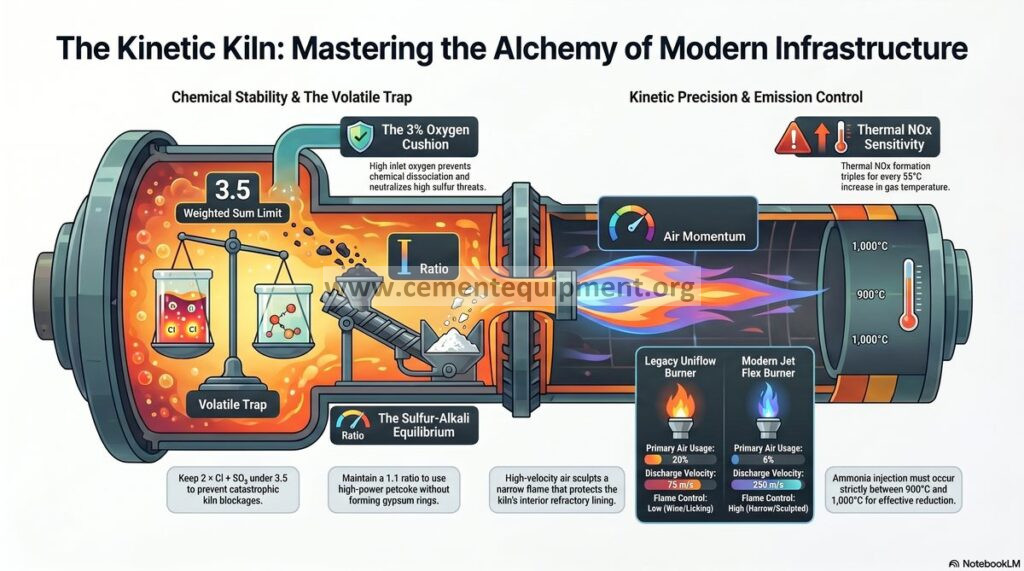
The kiln process involves the use of a rotary kiln, a large cylindrical vessel that is inclined at a small angle and rotates slowly. The raw materials are fed into the kiln at one end, and the clinker is produced at the other end. The kiln is heated by a flame that is produced by burning fuel, such as coal or oil. The temperature in the kiln is typically around 1450°C, which is necessary to produce clinker. The residence time of the raw materials in the kiln is typically around 20-30 minutes, which is sufficient to produce clinker with a high quality.
The quality of the clinker is critical in determining the quality of the cement. The clinker is typically composed of four main compounds: tricalcium silicate (C3S), dicalcium silicate (C2S), tricalcium aluminate (C3A), and tetracalcium aluminoferrite (C4AF). The ratio of these compounds can affect the strength and durability of the cement. The limestone saturation factor (LSF) is a critical parameter in determining the quality of the clinker, and it is typically in the range of 0.9-1.0.
| Parameter | Unit | Typical Value |
| Kiln Temperature | °C | 1450 |
| Residence Time | minutes | 20-30 |
| Limestone Saturation Factor (LSF) | 0.9-1.0 | |
| Clinker Free Lime | % | 1-2 |
To produce high-quality cement, it is essential to monitor and control the cement manufacturing process closely. This involves monitoring the kiln temperature, residence time, and LSF, as well as the quality of the clinker and cement. The specific surface area of the cement is also critical, and it is typically in the range of 300-400 m²/kg.
Here are the steps to follow to monitor and control the cement manufacturing process:
- Monitor the kiln temperature and adjust the fuel feed rate as necessary to maintain a temperature of 1450°C.
- Monitor the residence time and adjust the kiln rotation speed as necessary to maintain a residence time of 20-30 minutes.
- Monitor the LSF and adjust the limestone feed rate as necessary to maintain an LSF of 0.9-1.0.
- Monitor the quality of the clinker and cement, and adjust the process parameters as necessary to produce high-quality cement.
What is the significance of the limestone saturation factor (LSF) in the cement manufacturing process?
The limestone saturation factor (LSF) is a critical parameter in the cement manufacturing process, as it affects the quality of the clinker and cement. The LSF is a measure of the amount of limestone in the raw materials, and it is typically in the range of 0.9-1.0. If the LSF is too low, the clinker may not be of high quality, and if it is too high, the clinker may be over-calcined, which can affect the quality of the cement.
How does the kiln temperature affect the cement manufacturing process?
The kiln temperature is a critical parameter in the cement manufacturing process, as it affects the quality of the clinker and cement. The kiln temperature is typically around 1450°C, which is necessary to produce clinker with a high quality. If the kiln temperature is too low, the clinker may not be of high quality, and if it is too high, the clinker may be over-calcined, which can affect the quality of the cement.
What is the significance of the specific surface area of the cement?
The specific surface area of the cement is a critical parameter, as it affects the strength and durability of the cement. The specific surface area is typically in the range of 300-400 m²/kg, and it is measured using a Blaine air permeability test. If the specific surface area is too low, the cement may not be of high quality, and if it is too high, the cement may be too fine, which can affect its workability.
How does the residence time affect the cement manufacturing process?
The residence time is a critical parameter in the cement manufacturing process, as it affects the quality of the clinker and cement. The residence time is typically around 20-30 minutes, which is sufficient to produce clinker with a high quality. If the residence time is too short, the clinker may not be of high quality, and if it is too long, the clinker may be over-calcined, which can affect the quality of the cement.
What are the common problems that can occur in the cement manufacturing process?
There are several common problems that can occur in the cement manufacturing process, including kiln blockages, cyclone blockages, and problems with the quality of the clinker and cement. These problems can be caused by a variety of factors, including poor raw material quality, inadequate process control, and equipment failures. It is essential to monitor and control the cement manufacturing process closely to prevent these problems from occurring.