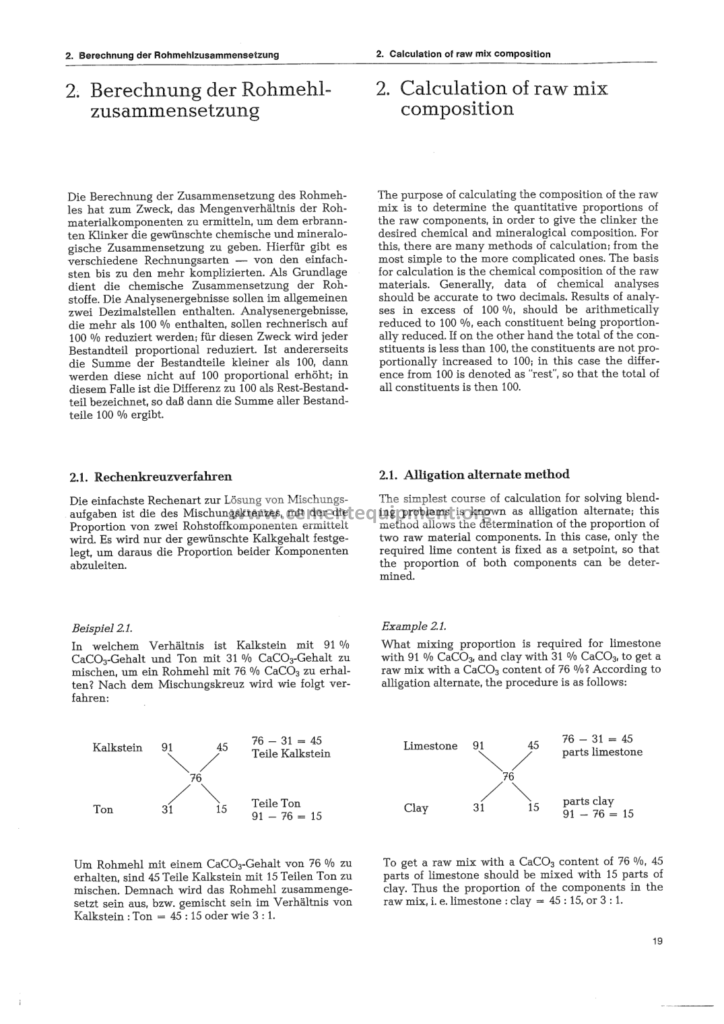
Calculation Of Raw Mix Composition: Complete Guide & Downloa
Calculation of raw mix composition (module 02 of the cement course series, 20 pages) is the training module of the arithmetic behind the raw feed: the same question that every quality engineer opens every morning: what proportion of limestone, clay, iron and correctives do we feed today so that the raw meal reaches the targeted moduli? The module teaches the famous four pillars: the lime saturation factor (LSF or KST), the silica ratio (SR), the alumina ratio (AR), and the calcareous saturation of the mix: then it applies the proportional arithmetic of the two and three-component mixes: the deposits, the examples, the final check: the module closes with the control of the calcined feed: the sulfur, the alkali, the chloride: the complete arithmetic of the raw department.
The Complete Cement Technical Package (931 files, $249.99 one-time, instant download via PayPal) delivers this module with its series and the Excel raw mix design tool that performs every calculation of these pages live: this guide presents the content of the module: the moduli, the formulas, the proportions and the worked cases of the textbook of the mix.
1. Why the Mix Calculation Is the Center of the Plant
Every tone of the cement starts its life as a grain of the raw feed, and the grain comes with assigned chemistry: the raw mix composition is the instruction sheet of the feed: it says: the limestone at 74%, the clay at 22%, the iron at 2.5%, the silica sand at 1.5%: with these percentages the raw meal leaves the mill with the LSF of the target, enters the kiln and burns into the clinker of the requested phases. If the feed deviates, the kiln shows the deviation in the hour of the day: the coating, the temperature, the free lime, and at the end of the week the cement: the mix calculation is not a paperwork of the laboratory; in the module it is the process itself: the raw meal is the first product, and its quality is decided by arithmetic before the kiln sees one particle.
The module positions itself inside the series right after the raw materials module: the first module described the materials and their analysis; this module describes the numbers: the two modules together form the entrance of the process training: the trainee who can do the calculation of the mix by hand (as the module teaches) is prepared for the kiln, the mill, the quality and the control: this is the foundation skill of the profession.
2. The Three Moduli: LSF, SR, AR
The module installs first the dictionary of the feed: the three moduli that condense the whole chemistry of the mix into three numbers:
The lime saturation factor (LSF or KST)
The LSF expresses how close the lime content of the mix is to the maximum that the silica, the alumina and the iron can saturate: the classic formula of the module:
LSF = 100 × CaO / (2.8 + 1.2 + 0.65 × sand) = 100 × CaO / (2.8 SiO2 + 1.2 Al2O3 + 0.65 Fe2O3)
The typical target of the OPC clinker: 90–102%: the module calls the zones: the low LSF feeds (fast burning, less alite, more belite, easier burn but lower 28-day strength) and the high LSF feeds (the alite above, the burner taxed, the free lime risk): the LSF is the thermostat of the burnability and the strength together.
The silica ratio (SR)
SR = SiO2 / (Al2O3 + Fe2O3): the ratio of the silica against the flux: module values: the typical SR of 2.0-2.6 for the ordinary cement: the high SR: the hard-burning mix, the less liquid, the risk of the dust; the low SR: the abundant melt, the coating and the ring tendencies, the lower strength: the module: the SR is the key of the burning behavior.
The alumina ratio (AR or AM)
AR = Al2O3 / Fe2O3: the ratio inside the flux: the typical AR 1.2-5.0: the cement low-alkali: the AR decides the C3A content of the clinker (the fast-setting phase) and the ferrite side: the module gives the applications: the AR of 1.2 for the seawater cement (the sulfate-resistant), the AR of the white cement in the special chapter: the sea and the sulfate cases of the module.
These three numbers are the language of the raw mix all over the world: the trainee of the module learns to read a mix in one line: “LSF 96, SR 2.4, AR 1.4”: the module repeats the reading until the reflex: the numbers open every further chapter of the package: the kiln course, the clinker, the cement types.
3. The Fourth Pillar: The Literal CaO and the Components
Beyond the moduli, the module sets the four direct checks of the mix:
- The CaO of the mix (42-46% typical): the total lime: the direct arithmetic that every plant quotes in the board meeting.
- The loss on ignition: the carbonates and the water of the raw: the LOI of the feed (32-38% for the limestone-rich mix) versus the calcination: the module shows the conversion: the meal MeCa, the kiln feed vs the clinker: the feed tonnage and the clinker tonnage: the mass balance of the kiln: the simplest of the module’s balances.
- The MgO, the alkalis (Na2O+K2O), the chloride, the sulfate: the control lists of each: the module: the alkalis of the mix below the 1.0-1.5%, the MgO below the 5, the chloride as low as the process cycles permit: the plant limits of the module.
- The burning phase: the free lime of the clinker (the shot of the quality) and the lookback: the high free lime exposes the wrong LSF or the burning: the correlation of the module closes the quality loop.
The module keeps the four checks of the raw: the ratios for the design, the literals for the control: the two languages of the raw quality: the calc from the design, the adherence: the module trains both.
4. The Two-Component Mix: The Basic Calculation
The teaching core of the module: the arithmetic of the mix with the two materials (classically the limestone and the clay/marl): the module follows the steps:
The data: the analysis of the limestone (e.g. CaO 52.3, SiO2 2.5, Al2O3 0.7, Fe2O3 0.4) and the clay (CaO 5.8, SiO2 48.4, Al2O3 12.6, Fe2O3 4.1), plus the target of the LSF or the SR they must meet.
The equations. The module solves the balance: let x be the parts of the limestone and 100-x the parts of the clay in the mix of the hundred: two equations for the two unknowns: the first on the CaO (the target CaO of the mix) and the second the SiO2+Al2O3+Fe2O3 (the oxides that saturate the lime): or the direct resolution by the LSF formula: the module shows the two routes: the trainee appreciates the same result.
The check. The LSF, SR and AR of the proposed mix computed and compared: if the AR of the mix misses the target (the clay carries too much silica, too little iron) the module opens the case of the correctives: the third material: the next chapter.
The module rounds the basic case with the numerical example fully worked (the composition bars and the result): the trainee reproduces the calculation the same day: the confidence of the module: the hand calculation before the spreadsheet: the foundation of the critical understanding.
5. The Worked Example of the Module: The Full Case
The module runs a complete numerical case, and it is worth reproducing its shape here so the reader sees the arithmetic of the pages at work. Consider the classic data of the module:
| Raw material | CaO % | SiO2 % | Al2O3 % | Fe2O3 % | LOI % |
|---|---|---|---|---|---|
| Limestone | 52.4 | 2.6 | 0.9 | 0.5 | 42.1 |
| Clay | 6.1 | 46.8 | 13.4 | 4.2 | 8.5 |
| Laterite (iron ore) | 0.5 | 8.0 | 6.0 | 72.0 | 10.0 |
Step 1 — the targets. The quality of the plant has fixed: LSF = 96, SR = 2.40, AR = 1.40 (a classic OPC recipe).
Step 2 — the proportions. The module solves the three equations: let the mix be l parts of limestone, c of clay and r of the laterite, totalling 100. The mean CaO of the mix must satisfy the LSF equation; the ratio of SiO2 over (Al2O3+Fe2O3) must give 2.40; the Al2O3 over the Fe2O3 must give 1.40. Solving the linear system (the module shows the elimination by hand) gives the answer of the page:
Limestone 76.5 %, clay 21.8 %, laterite 1.7 %.
Step 3 — the check. Multiply the analyses by the proportions: the mix shows CaO 41.1, SiO2 12.9, Al2O3 3.6, Fe2O3 2.6, LOI 33.9 (rest 5.9): verify: LSF = 100 × 41.1 / (2.8×12.9 + 1.2×3.6 + 0.65×2.6) = 95.4: SR = 12.9 / (3.6+2.6) = 2.08: AR = 3.6/2.6 = 1.38: the AR within the target: the LSF slightly high: the module adjusts the iron dose by the second run: the laterite raised to 2.0, the clay to 21.5: the final: the loop.
This worked case is the exact shape of the page of the module: the data, the equations, the residue, the check, the adjustment: the trainee of the module repeats the case with the numbers of his own plant: the module gives the dozens of the examples in the annex and the quiz of the series checks the same: the practice that the Excel tool of the package multiplies in seconds.
5. The Three-Component Mix: The Correctors
The realistic case of the plant: the limestone, the clay and one (or two) correctives: the module extends:
The iron corrective (the laterite, the ore, the mill scale): when the two-component mix leaves the AR or the SR too high (the liquid too little): the corrective adds the Fe2O3 without the lime penalty: the module solves the mix with the three unknowns: the mass balance and the two target equations (typically the LSF and the AR): the module explains the algebraic short-cut: fix the SR target, fix the AR target, the LSF follows the caesium: the three equations of the chemistry.
The silica corrective (the sandstone): the clay short on the silica (often the high-clay plants): the corrective works the SR upward: the sand of the grind rejected by the plants of the low-silica deposits: the module: the dose of the percent small: the mill housing: the economics.
The alumna corrective (the bauxite): the AR of the low-alumina deposit: the specialized products.
The module organizes the cases in the tables: column the components, column the oxides, the last row the mix: the standard spreadsheet of the raw mix design that the package includes with the Excel tool: the module is the manual; the spread tool is the machine: the package delivers both.
6. The Adjustments: The Correction Feedback of the Day
The mix is not set once: the module teaches the correction loop of the plant:
The face of the quarry changes (the analysis of the limestone: the header of the pile drifts): the module: the daily correction is computed by the same arithmetic: the observed deviation: the change in the proportion: the module quantifies the actions: how much of the iron to add when the SR rises by the 0.2; how the mix control the right hand: the module keeps the correction examples: the controller of the raw mill: the module completes the LSF the free lime and the kiln indication: the prediction and the response: the raw mix module is the operational manual of the quality controller.
The module also sets the sampling correctness: the frequency and the representative of the samples: the same mix computed from a bad sample is a bad mix: the module teaches the cot of the sampling: the laboratory procedure, the quartering of the meal, the moisture: the small lesson that protects the big arithmetic.
7. The Excel Raw Mix Design: The companion calculation
The traditional companion of the module (delivered in the package with it): the Excel raw mix design tool: what the module teaches by hand, the tool does in seconds: the user pastes the analyses of the materials, proposes the targets (LSF, SR, AR), presses the solve, and reads the mix of the tonne: the tool shows the sensitivity: the targets the allowed range: the LSF 90-100, the SR the AR per the cement: and calculates the mix of the day: the same numbers of the module, in the production speed.
The module and the tool meet at the quality door: the module man verifies the tool: the tool runs the plant: the trainee of the module owns both: the manuscript, the machine: the double mastery of the raw quality.
The calibration habit
One practical habit the module drills into its trainee: every time the quarry sends a new batch of the analysis, recalculate: the mixer of the plant that trusts last week’s numbers feeds the kiln with the old chemistry: the module: the constant verification, the weekly analysis, the monthly audit: the raw mix calculation of the module is not a course, it’s the ritual of the quality: the discipline that the plant teaches its operators and the module records in its pages: the numbers fresh, the feed correct, the kiln quiet.
6. The Errors of the Mix: The Effects of the Deviations
The module devotes the practical pages to the consequences: when the LSF and SR leave the range, the plant pays in the hearth and the quality: the module traces the deviations:
- The LSF too high: the alite demand of the burning rises, the free lime persists in the clinker, the energy per tone of the clinker rises, the strength delayed: the module: the correction of the LSF by the limestone dose: up the lime, the harder: the control.
- The LSF too low: the belite clinker: the easy burning but the weak early strength, sometimes the false sense of the good burn: the module: the silent thief: the plant must check the clinker microscope, not the temperature alone.
- The SR too high: the lack of the melt, the dusting, the under-burned clinker and the alite formation stalls: the flame sees no liquid and the clinker refuses: the iron corrective is the medicine: the SR is the lever of the burnability.
- The SR too low: the liquid abundance: the coating and the rings in the kiln, the snowmen on the grate, the flushes: the module: the silica correctives gently up the SR: the burnability: the cycle.
- The AR wrong: the C3A control: the high AR the fast cement the heat of the hydration: the sulfate balance: the AR of the sea (1.0-1.2) and the heat: the module: the AR is the recipe of the special.
Each deviation of the module carries: the symptom, the cause, the action, the verification: the troubleshooting language that the operator and the engineer share: the module is in part a diagnostic course of the raw: the chemistry of the feed explains most of the kiln events: this is the message of the module pages.
The economy of the correction: the module closes
The module parks the constants of the economy: the correctives cost: the iron ore more than the clay: the module reminds: the composition that meets the chemistry at the minimum cost is the economic optimum: the module teaches the constrained optimization in the words of the plant: the cheapest mix inside the quality box: the engineers of the purchasing and the operators of the mix: the module makes them the same discussion.
7. The daily numbers: the quick look-up of the module
The annex of the module provides the constant tables that the plant quotes every day:
- The typical moduli of the OPC: LSF 90-102, SR 2.0-2.6, AR 1.2-5.0 (the cover of the page);
- The dosage ranges: the limestone 70-85%, the clay 15-28%, the iron 0-4% of the raw mix;
- The typical analyses: the limestone (CaO 48-54), the marl, the clay, the laterite: the regional variations of the page;
- The conversion factors: the LOI to the clinker (feed kg to clinker kg: about 1.55 to 1.65 kg per kg of the clinker), the meal vs the feed;
- The limit lists: MgO 5, the SO3 3.5 of the cement, the alkalis 1.0 (Na2O equivalent) of the cement of the low-alkali: the chloride 0.01-0.03 of the meal: the module of the safe ranges;
These tables are the daily look-up of the quality: printed, the module page: on the desk of the controller: the reference of the raw: the module becomes the handbook of the raw department (the 20-page equivalent of the thick books of the module series: the whole ladder grows from the tables).
8. The Module in the Formation: The Objectives
The objectives of the module set the level of the trainee at the end of the session:
- to compute the LSF, SR and AR of any feed from its analysis;
- to solve the two and three-component mix by the hand method;
- to read the drift of the quarry and to compute the corrective action;
- to check the mix against the limits (MgO, alkalis, chloride, LSF range);
- to use the companion Excel tool and to verify its answers by the hand;
the last in particular structure the module: the verification by hand of the machine: the reviewer of the raw design: the module trains the pair: the profession: the numbers: the trainee: the first dozen of the home problems: the module heads to the quiz: the module of the 20 pages is complete in the two hours: the formation plan of the plant keeps the half-day for the exercise: the package: the module: the files: the practice.
9. The open calculations of the related modules
The raw mix does not live alone: the module of the clinker (the KST, the Bogue formula) and the module of the kiln (the heat and the free lime) use the same arithmetic: the series continuation: 01 raw materials described the materials: this module used the numbers: the next modules compute the meal, the kiln: the package organizes the modules in the ladder: the raw: then the burn: the grind: the test: and the complete: the professional: the top: the end of the ladder: the full formation from the face to the sample.
The books of the package deepen each of these equations: the Lea’s Cement Chemistry (the phase) and the standard handbooks of the industry: the module opens the arsenal: the books hold the depth: the trainee of the series has the two in the same package: the equation and the theory: the practice and the documentation.
10. The Typical Questions of the Exam: How the Module Tests Its Student
The series closes each module with the quiz, and the raw mix exam does not escape the rule: the module itself is the exam’s perspective, and the trainee can go to the check knowing the shape of the questions:
- Compute the LSF, SR and AR of the mix given on the page (10 points): the routine of the module, the three formulas verbatim;
- Adjust the mix with the iron corrective when the SR is 2.9 and the target 2.4 (15): the corrective chapter of the module;
- Explain the effect of the LSF of 105 on the burnability and the free lime (10): the error table of the module;
- Plan the sampling of the quarry for the mix of the week (5): the sampling discipline;
- Check if the MgO and the alkalis of the proposed mix exceed the limits (5): the limit list of the annex.
These five shapes exhaust the module: formulas, corrections, consequences, sampling, limits: the student who masters the five masters the raw arithmetic of the plant: the trainer of the series and the trainee share the same exam: the package’s module and quiz files are ready to use in the classroom: the plant prints the exam of its own: the module has already taught the answers.
10. Frequently Asked Questions
How precise must the hand calculation be?
The module: the hand method delivers the basis of the 0.1-0.2 LSF: the decisive in the education: the plant adjusts with the tool, but the operator must hold the 0.1: the difference between the good and the marginal: the hand tracking the fortnightly sampling: the module trains the decimal.
Why do the plants of the same region use different LSF?
The module explains: the LSF is the target of the local case: the fuel, the raw, the cement of the local market: the Algerian and the German plants read a different optimum (oil vs clinker demand, the export cements): the module teaches the balance: the LSF is chosen, not forgotten: the choice requires the calculation: hence the module.
Does the module include the low-alkali and sulfate-resistant mixes?
Yes: the module treats the special clinkers: the low-AR (1.0 1.2) clinkers of the sea environment, the alkali-limited mixes with the iron corrective: the relation with the cement of the BS-EN 197 suites and the ASTM types: the basis of the ASTM at the module’s page: the sister modules of the package (the special cements) continue with the full recipes.
Does the module explain why the plants use dry-process XRF and the wet slide?
Partially: the module insists on the XRF as the daily instrument of the oxide analysis (the most common analyzer in the cement laboratory of the world) but the series reserved the wet-chemical methods for the laboratory courses: the module keeps the focus: the XRF output is the starting input of every calculation on its pages: the operator with XRF numbers and the module’s arithmetic does the raw job of the whole plant.
Can a personal laptop handle the Excel tool of the module?
Easily: the tool is a lightweight Excel workbook that opens on the office machines without installation: the user enters the analyses of its own plant, the tool solves in the instant: the use of the module is not limited to the plant sites: the engineering offices, the students and the consultants of the cement run the same calculation of the module: the whole raw design of a deposit in the laptop of a single engineer.
How do I get the raw corner of the package?
The finished-product purchaser with the clinker buying (the blending plants, the terminals) still needs the LSF of the clinker-chemistry to evaluate the quality of the purchase: and the trader who sells, and the chemist who writes the report: the pure arithmetic of the module applies to any clinker-chemistry inside the doors: the check of the incoming material is a quality act of the module: the application of many buyers.
9. Conclusion
The calculation of the raw mix composition is the calculator of the cement factory: the module of 20 pages that teaches how the philosophy of the process (the LSF, the two ratios) transforms the pile of the quarry into the feed target of the kiln: the module’s step: the analysis, the ratio, the equation, the check: the trainee: the number of the day: the mix of the tonnes: the quality of the year: the Complete Cement Technical Package delivers this module with its formula manual, the Excel raw mix tool and the whole series (from the raw materials to the clinker and the cement test): the one-time payment 249.99 — the PayPal: the installation: the profession forever.
For the reader who joins the raw department of a cement plant tomorrow, this module is the highest-value 20 pages of the first week: the language of the LSF is the language the plant speaks in every meeting, and the module gives that language to the newcomer in a single session: the calculation by hand, the check of the tool, the correction of the day: after the module the trainee stands at the desk of the quality, reads the analysis of the day and computes the mix that the kiln will burn tonight: that is the promise of the module, and that is the promise of the package that carries it.
Get this module + the full 931-file package
$249.99 — one-time purchase, instant download, lifetime access
This file is part of the Complete Cement Technical Package (931 files) available from cementequipment.org. Contents © respective rights holders; library copy for the licensed single user.