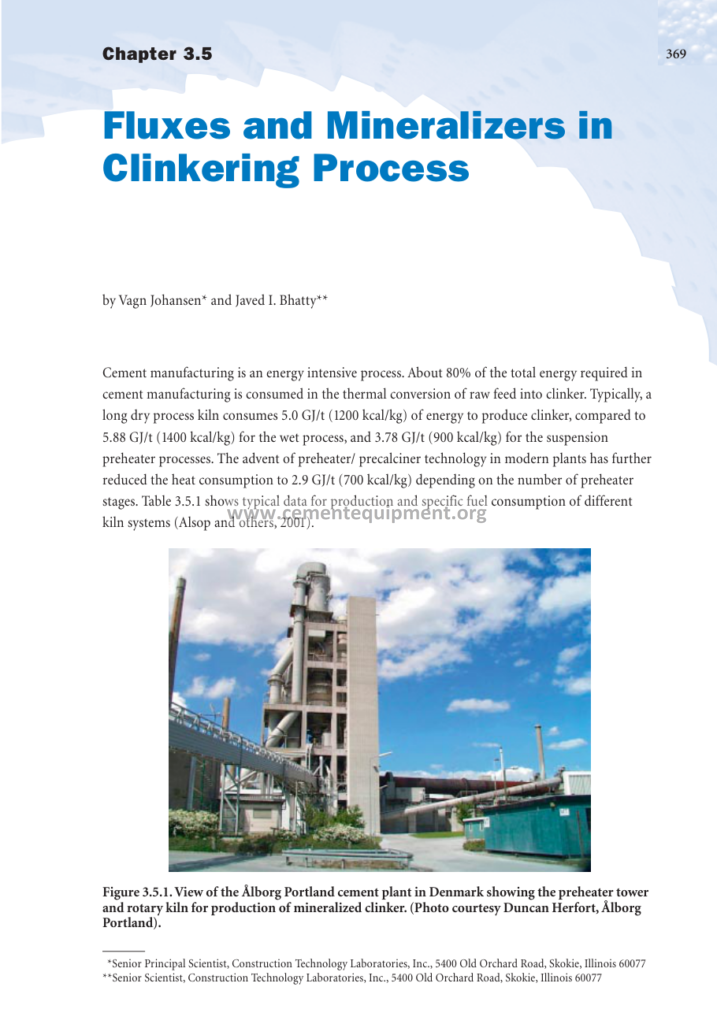
Fluxes And Minrelizers In Clinker Processing: Complete Guide
Fluxes and mineralizers are the quiet chemists of the cement kiln: they enter the raw mix in percentages of a few tenths, and they decide whether the clinker forms at 1400°C or at 1500°C, whether the kiln burns easily or fights every seam, and whether the cement of the plant gains its strength in days or in weeks: the flux lowers the melting point of the clinker system and increases the liquid phase, the mineralizer accelerates the formation of the phases themselves: together they are the most powerful minor lever of the entire clinker process.
The Complete Cement Technical Package (931 files including the books, the courses, the Excel tools and the presentations: $249.99 one-time: instant download via the PayPal payment) includes this fluxes and mineralizers guide with the phase diagrams, the burnability tables, the dosage calculations and the Excel raw mix tool: the article walks the file: the chemistry of the clinker phases, the classical fluxes of iron and alumina, the mineralizers of fluorine and sulphur, the minor alkalis and chlorides, the mechanisms of the liquid formation, the burnability and quality effects, the process consequences and the industrial practice of the mineralized clinker: the engineer finishes the page with the complete map of the minor chemistry of his kiln.
This page is organized as a chemistry-to-plant journey: the theory of the melt comes first, the agents second, the mechanisms third, and the industrial practice last: the two tables of the article summarize the agents and their effects on the clinker phases, and the FAQ answers the questions that the quality and the kiln engineers ask when the mineralizers enter the conversation of the plant.
1. The Role of the Flux and the Mineralizer in the Clinkering
The clinker formation is a high-temperature diffusion process: the calcium oxide and the silica react in the solid state to build the phases, and the reactions only accelerate when the liquid phase appears: the classic Portland clinker reaches its characteristic state when the melt of the alumina, the iron, the magnesia and the alkalis carries the reaction at the burning zone temperature of 1350 to 1450°C: the flux and the mineralizer are the components that tune exactly this liquid phase.
- The flux: a component that lowers the melting point of the mixture and increases the quantity of the liquid phase at the burning temperature: the flux makes the clinker formation thermodynamically and kinetically easier;
- The mineralizer: a component that accelerates the formation of the clinker minerals, especially the alite, by the changes of the crystal nucleation and the diffusion: the mineralizer works through the chemistry, not only through the melt;
- The overlap: the same component usually acts as both: the iron oxide is a flux, the fluorine is a mineralizer, and the classification is a question of emphasis rather than a rigid boundary;
- The quantity scale: the effects appear at the levels of 0.1 to 3% of the clinker, far below the major oxides, which is why the chemistry textbooks call them the minor components;
- The economic leverage: a burnability gain of 30 to 50°C translates into the fuel savings of 1 to 3% and the capacity gains of 2 to 5%, which is why the plants that master the minor chemistry run cheaper than their neighbors;
The two words of the title are often confused in the field, and the file spends its first pages on the exact definitions: the flux is the enabler of the liquid, the mineralizer is the accelerator of the crystal, and the practical plant thinks of the two as one tool with two handles: the reduction of the burning temperature and the improvement of the alite formation: the sections of this guide follow the two handles through the chemistry, the process and the quality of the clinker.
The history of the discovery is worth a paragraph, because it explains why the minor chemistry is treated with the respect that the textbooks reserve for the major oxides: the industrial knowledge of the fluxes is as old as the cement itself, since the early kilns of the nineteenth century learned by trial that the iron-rich clays burned more easily than the pure limestones, but the systematic understanding arrived only with the phase diagram work of the early twentieth century, and the deliberate mineralizer additions belong to the second half of the century: the fluorspar campaigns of the 1970s were driven by the energy crisis, and they proved in the industrial scale what the laboratory had shown for decades: the kiln temperature is a dial, not a constant, and the minor chemistry is the hand on the dial: the file tells this history with the dates and the numbers, because the engineer who knows why the tool exists knows when to use it.
2. The Basic Clinkering Chemistry: The Phases and the Melt
The Portland clinker is a four-phase material, and the formation of each phase has its own temperature window and its own rate: the alite (C3S) forms above about 1250°C and dominates the strength, the belite (C2S) forms earlier and contributes the later strength, the aluminate (C3A) and the ferrite (C4AF) crystallize from the melt and set the early reaction with the water: the liquid phase is the carrier of the last act of the clinkering.
- The solid-state prelude: up to about 1200°C the calcination, the clay decomposition and the first belite formation proceed in the solid state, slowly but without the need for the melt;
- The melt appearance: above 1250 to 1300°C the first liquid appears between the alumina, the iron and the lime particles, and the liquid content grows with the temperature;
- The alite formation: the alite forms by the dissolution of the lime in the melt and the crystallization of the C3S: the rate of the formation is set by the quantity and the viscosity of the liquid;
- The typical melt content: the ordinary Portland clinker carries 20 to 30% of the liquid phase at 1400°C, and the range of 15 to 35% covers the practical compositions;
- The burnability: the case of the clinker formation is measured by the burnability index, the free lime after the standard burn at 1400°C, and the flux reduces exactly this number;
The liquid phase is the key of the whole story: too little liquid, and the alite formation starves, the free lime stays high and the kiln must burn hotter; too much liquid, and the kiln floods, the coating turns unstable and the rings grow: the art of the clinker chemistry is the positioning of the melt content inside the operating window, and the fluxes and the mineralizers are the fine instruments of this positioning: the file presents the phase diagram of the clinker system with the liquid content curves, the working tool that turns the qualitative talk of the melt into the numbers of the laboratory.
The transport physics inside the melt completes the picture: the lime dissolves at the melt-solid interfaces and diffuses through the liquid to the growing alite crystals, and the diffusion coefficient in the melt at 1400°C is roughly a thousand times higher than in the solid state, which is why the melt presence is the switch that turns the sluggish solid reactions into the fast liquid-mediated ones: the viscosity of the melt at 1400°C runs from about 1 to 5 pascal-seconds depending on the composition, and the iron-rich thin melts carry the diffusion faster: the file includes the viscosity calculation method and the tables of the measured values, because the plant engineer who reads the phase diagram without the viscosity column sees only half of the story: the quantity of the melt decides how much room the reaction has, and the viscosity decides how fast the room is used, and the fluxes tune both numbers.
3. The Classical Fluxes: The Iron and the Alumina Balance
The iron oxide and the alumina are the two classical fluxes of the Portland system, and their balance is described by the alumina ratio (AR) of the raw mix: the ratio of Al2O3 to Fe2O3 in the clinker, which typically runs from 1.3 to 1.7: the two oxides build the melt together with the lime, and their relative quantities shape the melt properties.
- The iron oxide (Fe2O3): the strongest classical flux: it enters the ferrite phase and the melt, lowers the melting temperature and reduces the viscosity of the liquid: the iron-rich mixes are the traditional easy burners;
- The alumina (Al2O3): the second classical flux: it builds the aluminate phase and raises the melt content, but the alumina-rich melts are more viscous and more sticky;
- The alumina ratio: the ratio of Al2O3 to Fe2O3 of 1.3 to 1.7 is the standard window: below 1.3 the melt is thin and the coating unstable, above 1.7 the melt is viscous and the alite formation slows;
- The silica ratio: the companion ratio of SiO2 to the sum of Al2O3 and Fe2O3, at 2.0 to 3.0, sets the total melt quantity: the two ratios together position the liquid phase of the clinker;
- The practical lever: the plant moves the iron with the clay and the iron corrective, and the alumina with the clay selection: the flux tuning of the raw mix is a quarry decision as much as a laboratory one;
The classical flux management is the daily routine of every raw mix engineer: the mix that burns cold and leaves the high free lime moves the alumina ratio down, the mix that floods the kiln with the sticky melt moves it up, and the operating window of the plant is learned within a few shifts: the file includes the raw mix adjustment procedures and the worked examples that show how a 0.1 change of the alumina ratio moves the free lime at 1400°C, because the flux balance of the raw mix is the cheapest energy investment of the plant: it costs nothing, it is already in the quarry, and it changes the heat consumption by percentage points.
4. The Classical Mineralizers: Fluorine and Sulphur
The fluorine and the sulphur compounds are the two classical mineralizers of the industrial practice: the fluorine in the form of the fluorspar (CaF2) and the sulphur in the form of the natural or the recycled gypsum and the pyrite, the agents that the textbooks call the mineralizers in the strict sense:
| Agent | Action class | Typical addition (% clinker) | Main effect on the process |
|---|---|---|---|
| Iron oxide (Fe2O3) | Flux | 2.0 – 4.0 | Lowers the melting point, thins the melt, eases the burning |
| Alumina (Al2O3) | Flux | 4.0 – 6.0 | Raises the melt content, increases the melt viscosity |
| Fluorine (CaF2) | Mineralizer | 0.1 – 0.5 (as F) | Accelerates the alite formation, lowers the burning temperature |
| Sulphur (SO3) | Mineralizer / flux | 0.3 – 1.5 (from fuel and mix) | Stabilizes the alite, modifies the melt, feeds the alkali cycles |
| Alkalis (K2O + Na2O) | Minor flux | 0.2 – 1.5 | Lower the melting point, raise the melt, damage the late strength |
| Phosphorus (P2O5) | Inhibitor at high levels | < 0.5 for normal cement | At low levels a mineralizer, above about 1% it stabilizes the belite and blocks the alite |
The fluorine is the most powerful single mineralizer of the industry: 0.2 to 0.5% of the fluorine in the clinker lowers the burning temperature by 50 to 100°C, accelerates the alite formation and enables the production of the mineralized clinker that burns at 1300 to 1350°C: the sulphur works more gently, stabilizing the alite at the slightly lower temperatures and modifying the melt properties through the sulphate: the file documents the historical experiments and the industrial campaigns of both agents, with the tables of the free lime reductions and the energy savings, so the plant can evaluate the addition with the numbers of its own raw materials.
5. The Minor Components: Alkalis, Chlorides and Phosphates
Beyond the deliberate additions, the raw materials and the fuels bring the minor components that act as the natural fluxes and mineralizers: the alkalis, the chlorides, the phosphates, the titania and the manganese arrive uninvited, and the plant must know their chemistry because they act on the melt whether the plant wants it or not.
- The potassium and the sodium: the strongest natural fluxes: the total alkali content of 0.3 to 1.0% lowers the melt temperature by 50 to 100°C, but the alkalis also weaken the cement strength if they exceed the clinker limit of about 1.0 to 1.5%;
- The chlorine: a powerful flux that never enters the clinker: it volatilizes in the burning zone and condenses in the preheater, feeding the blockages and the chloride cycles, and the raw mix limit of 0.015 to 0.025% is one of the strictest of the industry;
- The phosphorus: at the contents below about 0.3% it acts as a mild mineralizer, above 0.5% it stabilizes the belite at the expense of the alite, and the white cement and the special clinkers of the high phosphorus are the classical examples;
- The titania (TiO2): a mild flux that dissolves in the clinker phases: the contents up to 0.5% are harmless, and the higher contents belong to the special raw materials;
- The manganese (Mn2O3): a flux of the iron family that darkens the clinker and modifies the ferrite: the contents above 0.1% become visible in the cement color;
The natural minor components explain the regional character of the cement plants: the kilns of the iron-rich regions burn easily, the kilns of the high-alkali limestones fight their raw material, and the plants on the phosphate limestones produce the distinctive low-alite clinkers: the file presents the minor component balance sheet of the typical raw materials and the adjustment rules, because the plant that understands its natural mineralizers can exploit them instead of fighting them: the raw mix optimization starts from the natural gift of the quarry, and the deliberate additions build on top.
The rarer trace elements close the minor component list with their specific signatures: the barium and the strontium substitute for the calcium in the clinker phases and act as the mild stabilizers of the alite at the low contents, the vanadium and the molybdenum enter the cement as the traces of the alternative fuels and the steel slags and act as the mild fluxes, and the zinc in the wastes of the galvanizing industry inhibits the setting at the parts-per-thousand levels: the file includes the trace element balance sheet of the modern plants with the enrichment factors of the dust cycles and the limits of the product standards, because the alternative fuels of the circular economy deliver the trace chemistry in the feed whether the plant ordered it or not: the minor component analysis of the raw materials and the fuels, run on the quarterly rhythm, is the early warning system of the trace element surprises.
6. The Mechanism of the Mineralization: How the Melting Point Falls
The mechanism of the flux action is a story of the phase diagram: the pure clinker components melt at their individual high temperatures, but the mixture of the alumina, the iron and the lime forms the eutectic compositions that melt far below the melting points of the individual oxides: the fluxes move the eutectic down the temperature axis, and the mineralizers move the reaction kinetics along the time axis.
- The eutectic concept: the mixture of the lime, the alumina and the iron forms its first liquid at 1250 to 1350°C, well below the 2570°C melting point of the pure lime: the melt appears because the mixture, not the oxide, defines the melting;
- The flux mechanism: each percentage of the flux oxide adds to the liquid quantity and lowers the liquidus temperature: the melt content at 1400°C rises from about 20% at the standard mix to 25-30% with the flux-rich mix;
- The viscosity: the iron lowers the melt viscosity, the alumina raises it: the thin melt wets the lime particles faster, the viscous melt drags the reactions: the viscosity, not only the quantity, is the flux’s second lever;
- The mineralizer mechanism: the fluorine enters the melt and the reaction interfaces, destabilizes the intermediate compounds and seeds the alite nucleation: the alite forms faster at the same temperature;
- The kinetic picture: the combination of the flux and the mineralizer shifts the reaction curve: the free lime at 1400°C falls from 3-5% to 1-2%, and the same burnability is reached 30 to 100°C cooler;
The mechanism explains the numbers of the practice: the flux shortens the distance the lime must travel by the wetting, and the mineralizer speeds the crystal the lime must join by the nucleation: the two effects multiply, which is why the industrial mineralized mixes combine the iron flux with the fluorine mineralizer and reach the burnability that neither achieves alone: the file includes the calculated liquid content curves for the standard and the mineralized mixes, the quantitative backbone of the entire chapter: the mechanism, once understood, turns the dosage of the mineralizer from a gamble into a calculation.
7. The Quantitative Effects: Burnability, Temperature and Free Lime
The effect of the fluxes and the mineralizers is measured by the burnability tests, the laboratory standard of the raw mix evaluation: the raw meal is pressed into the test cylinders, burned at the fixed temperatures of 1350, 1400 and 1450°C, and the free lime of each burn is measured: the burnability curve is the fingerprint of the mix, and the flux moves the fingerprint.
| Effect | Standard mix | Flux-added mix | Mineralized mix (F, SO3) |
|---|---|---|---|
| Free lime at 1400°C, % | 2.5 – 4.5 | 1.5 – 3.0 | 0.8 – 2.0 |
| Liquid content at 1400°C, % | 20 – 24 | 24 – 30 | 22 – 28 |
| Burning temperature for equal burnability | Reference | 30 – 50 °C lower | 50 – 100 °C lower |
| Alite content trend | Baseline | Slight gain | Higher, better crystallized |
| Kiln heat consumption effect | Baseline | −1 to −2% | −1 to −3% |
The numbers of the table are the argument of every mineralization study: the free lime at 1400°C is the single most quoted number of the raw mix chemistry, and the mineralized mixes deliver the 1 to 2% free lime at 1350 to 1400°C where the standard mix needs 1450°C: the kiln consequence is the cascade of the savings: the lower burning temperature reduces the fuel, the lower heat load protects the refractory, and the easier burnability raises the kiln throughput: the file presents the full burnability test procedure, the interpretation rules and the worked examples, so the laboratory of the plant can run its own mineralization study on its own raw materials before the plant commits to the addition.
The kiln operator sees the burnability gain through the daily control numbers: the fuel rate falls by 1 to 3% for the same clinker, the burning zone temperature holds with the lower fuel input, the free lime of the production clinker becomes the stable 0.5 to 1.5% instead of the swinging 1 to 4%, and the kiln exit oxygen window widens because the case of the clinker no longer dictates the temperature: the measured plants report the capacity gains of 2 to 5% on the constrained lines, and the refractory campaigns extend because the peak temperatures of the zone drop by the 30 to 100°C of the mineralizer effect: the file translates the laboratory free lime curves into the operator language of the fuel rate, the kiln temperature and the campaign length, the numbers that the shift report carries and the plant manager reads: the burnability of the table becomes the economy of the plant, and the file builds the bridge row by row.
8. The Effects on the Clinker Phases and the Cement Quality
The minor chemistry does not stop at the burnability: the fluxes and the mineralizers change the phases of the finished clinker, and through the phases they change the cement: the alite content, the crystal sizes, the belite polymorphism and the reactivity of the aluminate all carry the signature of the melt in which they were born.
- The alite: the mineralized clinker shows the larger and better crystallized alite grains of 30 to 60 microns against the 15 to 40 microns of the standard clinker, and the crystallization improves the early strength development;
- The belite: the mineralized belite stabilizes in the hydraulically more reactive polymorphs, the alpha and the alpha-prime modifications, which raises the late strength contribution of the belite;
- The aluminate: the cubic aluminate of the standard clinker is partly replaced by the orthorhombic modification in the alkali-rich melts, changing the setting behavior and the early hydration;
- The free lime: the lower free lime of the mineralized clinker improves the soundness and the uniformity of the cement, and the mills can grind the harder mineralized clinker with the confidence of the stable chemistry;
- The grinding: the mineralized clinker is harder and denser, and the grindability tests show the 5 to 15% higher energy demand, the trade-off that the mills must budget;
The quality accounting of the mineralization has both sides of the ledger: the strength gains of the better alite against the grinding costs of the harder clinker, and the plants that use the mineralizers run the full study before the addition: the file includes the microscopy procedures for the phase analysis, the strength development curves of the standard and the mineralized cements, and the finish mill consequences with the numbers: the honest conclusion of the chapter is that the mineralization is not a free lunch, it is a trade, and the plants that make the trade well gain the burning temperature and accept the grinding cost with the open eyes.
9. The Process Consequences: Coating, Cycles and Refractories
The melt that the fluxes create is the same melt that forms the coating of the burning zone, feeds the alkali and the sulphur cycles of the kiln, and attacks the refractories: the process consequences of the mineralization are the operating reality that the chemistry textbooks abbreviate:
- The coating behavior: the flux-rich mixes form the thicker and more stable coating because the melt quantity and the stickiness are the coating materials: the plants with the coating problems often find their answer in the raw mix;
- The ring formation: the excessive melt, the companion of the over-fluxed mixes, builds the rings at the transition zone and the kiln inlet: the ring frequency is the first warning of the melt excess;
- The alkali and sulphur cycles: the sulphur mineralizer feeds the sulphur cycle, and the sulphur and the alkalis circulate between the kiln and the preheater, concentrating in the dust and the build-ups: the cycle management is the daily partner of the mineralization;
- The refractory attack: the low-viscosity melts penetrate the brick pores and accelerate the chemical erosion: the flux-rich operation demands the alkali-resistant refractories and the honest wear budgets;
- The build-ups: the chlorine and the sulphur compounds condense in the preheater cones and the riser ducts, and the mineralized operation must include the by-pass and the cleaning discipline;
The process consequences set the operating envelope of the mineralization: the kiln with the stable coating, the clean preheater and the moderate refractory wear can exploit the full benefit of the lower burning temperature, while the kiln that fights the rings and the build-ups must reduce the flux content back to the balanced level: the file presents the operating matrix that links the flux content to the kiln symptoms, the trouble-shooting tables of the rings and the build-ups, and the by-pass design considerations for the mineralized operation: the process knowledge is the bridge between the laboratory idea and the plant reality, and the file builds the bridge with the field examples.
10. The Industrial Applications: The Mineralized Clinker in Practice
The industrial history of the mineralized clinker is the story of the energy and the raw material challenges: the fluorspar-mineralized clinker was developed in the 1970s and 1980s for the kilns that struggled with the hard raw materials, and it found its permanent home in the plants of the difficult limestones and the low-temperature cement technologies:
- The low-temperature cements: the mineralized clinker burned at 1300 to 1350°C became the basis of the special cements with the low energy consumption, the family that includes the alinite and the ferro-aluminate cements of the research literature;
- The white cement: the white clinker, which burns without the iron flux and therefore fights the high temperature and the high free lime, is the classical beneficiary of the fluorine mineralizers;
- The alternative raw materials: the plants on the high-free-lime residues and the waste-derived raw meals use the mineralizers to restore the burnability that the feed composition destroys;
- The kiln capacity release: the measured plants report the capacity gains of 2 to 5% after the burnability improvement, because the kiln follows the case of the clinker formation;
- The CO2 perspective: the lower burning temperature reduces the fuel share of the CO2 emissions, the modest but real contribution of the mineralization to the decarbonization of the cement process;
The practical cases of the file cover the full spectrum: the plant that added the fluorspar to the high-lime mix and lowered the free lime from 4% to 1.5%, the white cement plant that could not burn without the fluorine, and the plant that abandoned the mineralizer after the chloride and the sulphur cycles outweighed the burnability gain: the three cases teach the same lesson: the mineralization is a tool of the specific plant, applied on the evidence of its own burnability tests, not a universal recipe: the file provides the decision procedure that leads each plant through the study, the trial and the full-scale conversion.
The mineralizer chemistry is also the gateway to the alternative cement families that the research of the low-carbon era revived: the calcium sulfoaluminate cements and the alinite cements are built on the mineralized melts as the design principle, not the accident: the sulfoaluminate clinker forms at 1250 to 1300°C on the strength of the sulphur and the fluoride fluxing, and its 30 to 40% lower process CO2 makes it one of the serious candidates of the low-carbon concrete: the file explains the alternative clinker chemistries with the same tools of this guide, the phase diagrams and the burnability logic, because the cement engineer of the coming decades will meet the mineralized systems beyond the Portland clinker: the fluxes and the mineralizers are not a corner of the Portland chemistry, they are the key of the whole family of the reactive calcium silicates, and the file positions them accordingly.
11. The Dosage, the Raw Mix and the Quality Control
The practical question of every plant is the dosage, and the file answers it with the procedure instead of the recipe: the dosage follows from the burnability gap of the plant, the cost of the agent and the process tolerance, and the three are measured, not assumed:
- The burnability baseline: the plant runs the burnability tests of its current mix at 1350, 1400 and 1450°C and documents the free lime curve: the baseline is the zero point of the study;
- The laboratory trial: the test mixes with the 0.1, 0.3 and 0.5% fluorine or the equivalent flux additions are burned and the free lime curves are compared: the dose-effect curve of the plant’s own materials;
- The economic check: the fuel and the capacity savings of the dose are compared with the agent cost and the grinding penalty: the payback of the mineralizer is calculated before the silo order;
- The process trial: the kiln runs the candidate dose for the campaign of 2 to 4 weeks, with the ring and the build-up monitoring, the coating observations and the quality series;
- The quality control: the added agent is dosed into the raw mix with the weigh feeders, the fluorine or the flux oxide is analyzed in the daily clinker samples, and the control charts track the dose against the setpoint;
The dosing discipline is the condition of the success: the fluorspar is dosed at 0.2 to 0.5% of the clinker, the dust of the silo and the weigh feeders must be maintained, and the dose variations of plus-minus 0.05% are the difference between the stable burnability and the kiln surprises: the file includes the dosing systems of the industry, the analysis methods of the fluorine and the sulphur in the raw meal and the clinker, and the control charts of the mineralized operation: the plant that doses like a process and analyzes like a laboratory treats the mineralizer as what it is, one more controlled raw material of the mix.
12. The Risks and the Limits of the Mineralization
An honest guide must close the ledger on the dark side of the minor chemistry, and the file does it without the euphemisms: the mineralizers and the fluxes carry the risks that the over-enthusiastic studies forget to mention:
- The fluorine emission: the fluorine leaves the kiln partly with the gas and the dust, and the limits on the fluoride emissions bind the dosage: the fluorine balance of the kiln must be measured, not assumed;
- The clinker soundness: the over-mineralized clinker can hide the unstable lime in the glassy phases and release it later in the concrete: the autoclave expansion tests are the guard;
- The cement hydration: the alkali-fluxed cements show the faster setting and the lower late strength, and the concrete of the alkali-rich cement faces the alkali-silica reaction risk with the reactive aggregates;
- The cycle overload: the sulphur and the chlorine cycles can overwhelm the preheater within weeks when the raw material limit is crossed: the by-pass capacity is the safety valve;
- The commercial risk: the mineralized clinker can behave differently in the customer’s concrete, and the product certification and the customer approval are part of the conversion project;
The limits are not the reasons to avoid the mineralizers, they are the borders of the tool: the plant that measures the fluorine balance, watches the autoclave expansion, manages the cycles and certifies the product can exploit the burnability benefit for years, and the plants of the file prove it: the conclusion of the chapter is the professional balance: the mineralization is a powerful lever with the measured boundaries, and the engineer who respects both is the engineer the package serves: the risks of the section are not the speculations, they are the recorded field experiences of the industry, and the file documents each with the case and the measurement.
The economic arithmetic of the mineralization closes the risk chapter with the honest numbers: the fluorspar of the industrial grade costs on the world market roughly 300 to 600 US dollars per ton, and the 0.3% fluorine addition translates into about 5 to 9 kg of the fluorspar per ton of clinker, or 1.5 to 5 US dollars per ton at the market range: against the cost stands the fuel saving of 1 to 3% of the 600 to 800 kilograms of the coal equivalent per ton, the capacity gain and the refractory extension, and the simple payback of the mineralizer addition lands between six months and two years in the documented cases: the file includes the full cost comparison worksheet with the price input fields, because the mineralizer decision is a commercial decision like every other: the chemistry is fascinating, but the board room reads the numbers, and the worksheet gives them the numbers.
13. The Frequently Asked Questions
What is the difference between a flux and a mineralizer?
The flux lowers the melting point and increases the liquid phase of the clinker system, while the mineralizer accelerates the formation of the clinker minerals, especially the alite: the same component usually does both, and the industry uses the two words for the emphasis: the iron and the alumina are the classical fluxes, the fluorine and the sulphur are the classical mineralizers.
How much can the mineralizers lower the burning temperature?
The measured reductions are 30 to 50°C for the classical flux adjustments and 50 to 100°C for the fluorine-mineralized mixes: the free lime at 1400°C falls from the 2.5-4.5% of the standard mix to the 0.8-2.0% of the mineralized mix, and the kiln pays the difference in the fuel, the refractory life and the throughput.
Are the fluxes and the mineralizers added to every cement plant?
No: the fluxes are already part of the raw mix design of every plant through the alumina ratio control, while the deliberate mineralizer additions are the tool of the specific cases: the hard-burning raw materials, the white cement and the capacity-constrained kilns: the standard plant tunes its natural fluxes first and reaches for the mineralizers only when the burnability gap persists.
What is the safe fluorine content in the clinker?
The industrial practice operates in the range of 0.1 to 0.5% of the fluorine in the clinker, with the emissions and the product quality controls binding the upper end: the fluorine is dosed with the weigh feeders, analyzed daily in the clinker, and watched through the kiln gas balance: the dosage is a process parameter, not a recipe number.
Do the mineralizers change the cement strength?
They change the phases, and the phases change the strength: the well-mineralized clinker shows the larger alite crystals and the higher early strength, while the alkali over-fluxed clinker loses the late strength: the net effect depends on the dose and the raw material, which is why the file insists on the strength development study before the full-scale conversion.
14. Conclusion
The fluxes and the mineralizers are the fine chemistry of the clinker process: the tenths of a percent that decide the melting point, the burnability and the alite crystal: the plant that masters the minor components burns cooler, runs easier and produces the stronger cement, and the plant that ignores them fights its own raw material every shift.
The Complete Cement Technical Package includes this fluxes and mineralizers guide with the phase diagrams, the burnability tables, the dosage calculations and the Excel raw mix tool: the one-time price of $249.99: the instant download: the library of the cement engineer: the minor chemistry of the package, the major leverage of the plant: the clinker of your kiln, made easier by the numbers.
Get this Fluxes and Mineralizers file + the full 931-file package
$249.99 — one-time purchase, instant download, lifetime access
This file is part of the Complete Cement Technical Package (931 files) available from cementequipment.org. Respective rights holders; library copy for the licensed single user.