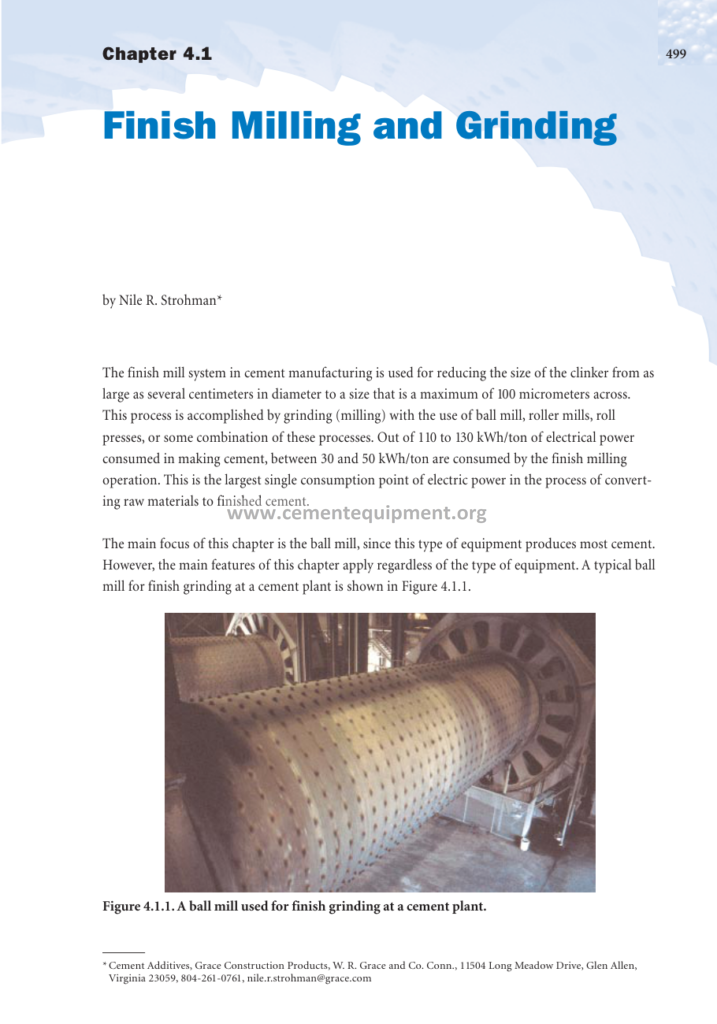
Finish Mill And Grinding: Complete Technical Guide
The finish mill is the last machine of the cement plant and the largest consumer of its electricity: the final grinding of the clinker into the finished cement, with the gypsum and the additions, at the fineness and the distribution that the market will buy: the finish grinding draws 25 to 40 kWh/t of the cement, more than any other department of the plant, and the quality of its product decides the strength, the setting and the reputation of every bag and every silo the plant ships: the finish mill is where the plant’s chemistry becomes the customer’s concrete.
The Complete Cement Technical Package (931 files including the books, the courses, the Excel tools and the presentations: $249.99 one-time: instant download via the PayPal payment) includes this guide with the finish circuit designs, the operating parameter tables, the quality control procedures and the energy data of the grinding plants: the practical reference for the mill operators, the quality engineers and the production managers: this article walks the file: the mission of the finish grinding, the circuits, the clinker and the gypsum conditions, the charge and the ventilation, the classification, the quality control and the optimization: every section with the numbers of the industry.
The finish mill sits at the crossroads of the whole plant: it feeds on the clinker of the kiln, the gypsum of the store and the additions of the purchasing office, and it delivers to the silos, the dispatch and the customers: this page follows the file, so the reader inherits the complete picture of the finish department: the machine, the chemistry and the quality, in one walk.
1. The Mission of the Finish Grinding: From Clinker to the Product
The finish mill converts the clinker (the hard, grey nodules of the kiln) into the cement powder of the market: the conversion is defined by the fineness (the Blaine surface of 2,800 to 4,500 square meters per kilogram depending on the grade), the particle size distribution (the shape of the curve between 1 and 100 micrometers), the temperature of the product (below the limits that degrade the gypsum and the strength) and the composition (the clinker, the gypsum and the additions in the exact recipe): the four definitions are the mission statement of the department, and the file’s first chapter expands each one with the numbers and the standard references.
| Product parameter | Typical values | Controlled by |
|---|---|---|
| Blaine specific surface | 3,000 to 4,200 m2/kg (OPC 42.5) | Mill power, charge, separator |
| Residue R45 | 4 to 10% | Separator sharpness, mill outlet |
| Residue R90 | 0.5 to 2% | Separator cut, charge gradation |
| SO3 of the cement | 2.0 to 3.5% | Gypsum dosing, clinker SO3 |
| Temperature at dispatch | below 65 to 80 C | Mill ventilation, cooling, silo practice |
The mission has its economics: the grinding of one ton of the clinker to the OPC 42.5 fineness costs 25 to 35 kWh of electricity, and each 100 m2/kg of the extra fineness raises the specific energy by roughly 2 to 3 kWh/t: the quality targets and the energy budget are the two ends of the finish mill, and the art of the department is the balance between them: the file’s first chapter quantifies the balance (the fineness curves, the strength relation and the energy tables) so the mill team knows exactly what each quality point costs.
2. The Circuits of the Finish Grinding: Open, Closed and the Pre-grinding Stages
The finish grinding systems of the industry divide into the classical families, and the choice between them is the first layout decision of the plant: the open circuit ball mill (simple, coarse distribution, the classic of the smaller plants), the closed circuit ball mill with the dynamic separator (the standard of the mid-size industry), and the modern combinations with the pre-grinding stages (the roller press or the vertical roller mill before the ball mill, halving the energy): the file compares the families with the design data:
| Circuit type | Specific energy kWh/t (OPC 42.5) | Product distribution | Typical application |
|---|---|---|---|
| Open circuit ball mill | 32 to 40 | wider, coarser tail | Small plants, simple products |
| Closed circuit ball mill | 28 to 34 | sharper, narrower | Standard mid-size industry |
| Roller press + ball mill | 16 to 22 | sharpest with the static-dynamic classification | Modern large plants |
| Vertical roller mill (finish) | 18 to 26 | narrow, steep curve | Modern plants, blended cements |
The circuit choice is an investment with the fifty-year consequences, and the file’s comparison chapters examine each family with its operating windows, its maintenance reality and its product flexibility: the roller press systems win on the energy and lose on the complexity; the closed-circuit ball mills win on the reliability and the flexibility and lose on the energy; the VRM finish grinding wins on the integration with the drying of the wet additives and demands the strongest process control: the selection tables of the file walk the decision maker through the trade-offs with the numbers of the operating plants, not the brochures.
3. The Clinker and the Feed Conditions: The Inputs the Mill Cannot Choose
The finish mill takes what the kiln and the store give it, and the conditions of the feed are the first parameters of the grinding performance: the clinker temperature (60 to 120 C at the mill feed in the normal plants, hotter after the cooler problems), the clinker chemistry and its grindability (the work index of 13 to 16 kWh/t), the moisture of the additives and the gypsum (2 to 10%), and the feed size distribution from the clinker crushing and the storage: each condition enters the mill’s energy and its stability:
- The clinker temperature: the hot clinker above 100 C heats the mill outlet and the cement, degrades the gypsum prematurely and wastes the grinding efficiency: the plants water-cool the clinker or hold it in the storage to the 60 to 80 C feed window: the file’s temperature chapter quantifies the losses of the hot feed: each 10 C of the feed temperature costs about 0.5 to 1.0% of the mill output;
- The feed size: the clinker arrives at 25 to 40 millimeters from the cooler and the crusher, and the finer feed (below 20 millimeters) saves 1 to 2 kWh/t in the first compartment: the pre-grinding stages of the modern circuits compress this gain further;
- The moisture: the gypsum and the dry additions carry the moisture into the mill: the moisture above the ventilation envelope condenses, coats the internals and drops the output: the moisture budget of the feed and the drying capacity of the mill are the paired numbers of the design;
- The grindability variation: the clinker of the hard burning (the high free-lime, the low-lime saturation) grinds harder: the plants track the work index of the clinker weekly and plan the mill load against the trend: the file’s grindability chapter provides the test protocol and the trend sheet;
The feed conditions are the boundary conditions of the finish mill, and the file’s message is the honest one: the mill cannot compensate the upstream sins, it can only document them: the energy audit of the finish department (the measured kWh/t against the Bond requirement of the actual feed) separates the mill’s own inefficiency from the feed’s hardness, and the file’s audit chapter shows how the plant reads the split: the clinker quality and the grinding efficiency, accountable separately.
4. The Gypsum and the Sulfate: The Chemical Control of the Setting
No other single ingredient carries the responsibility of the gypsum: the calcium sulfate added at the finish mill (3 to 5% of the cement, typically) controls the setting time of the concrete, and its dehydration state inside the mill decides whether it works: the gypsum must dehydrate partially in the mill into the hemihydrate (the form that dissolves fast enough to control the setting), and the mill’s temperature window is set around this chemical requirement:
- The gypsum forms: the dihydrate (CaSO4 2H2O) of the natural gypsum stone, the anhydrite of the natural deposits, and the chemical gypsums of the industry (the gypsum from the flue gas desulfurization, the phosphogypsum, the titanium gypsum): each form dissolves differently and the dosing recipe accounts for the differences;
- The dehydration in the mill: the mill temperature of 100 to 115 C partially dehydrates the dihydrate into the hemihydrate, and the overheated cement above 120 C converts the gypsum too far toward the soluble anhydrite: both the under-heating and the over-heating disturb the setting control: the temperature window is the chemical instrument of the finish mill;
- The SO3 target: the cement’s total SO3 (the gypsum sulfate plus the clinker sulfate) is set by the product: the 2.0 to 3.5% of the OPC comes from the clinker’s own SO3 (0.5 to 1.5%) and the gypsum dosing: the control of the SO3 is the daily quality loop of the finish mill, verified by the X-ray and the wet analysis of the product;
- The optimum sulfate: the strength optimum of the cement lies at the specific SO3 for its C3A content: the too-low sulfate triggers the flash set and the early stiffening, the too-high sulfate weakens the late strength and risks the expansion: the plants titrate the optimum with the mortar tests, and the file’s chemistry chapter documents the titration protocol;
The gypsum control is the interface between the finish mill and the concrete “behavior” of the product: the mill’s temperature, the gypsum’s form and the SO3 of the product form one triangle, and the file treats the triangle as the chemistry chapter of the finish department: the operators read the product’s temperature, the laboratory reads its SO3, and the quality engineer connects both to the setting tests of the concrete: the triangle closed daily is the difference between the controlled cement and the lucky cement.
5. The Charge and the Internals of the Finish Mill: The Grinding Engine
The finish mill’s charge follows the doctrine of the ball mill family: the first compartment with the large balls (60 to 90 millimeters) for the feed reduction, the second compartment with the graded media (15 to 40 millimeters) for the surface grinding, the filling at 28 to 34%, and the liners that lift and classify: the finish circuits add the fine-grinding refinements that the raw mills do not need: the tighter gradations, the finer top sizes and the classifying liners of the second compartment tuned for the cement distribution:
| Charge / internal item | Finish mill typical | Effect on the product |
|---|---|---|
| First compartment top size | 70 to 90 mm (feed 20 to 30 mm) | Feed breakage speed |
| Second compartment gradation | 15 to 40 mm, balanced surface | Fineness and the distribution shape |
| Degree of filling | 30 to 33% | Power draw, output |
| Second compartment classifying liners | stepped or spiral profile | Sorted grinding, lower coarse tail |
| Diaphragm slot size | 6 to 12 mm with the cleaning | Material passage, material level |
The internals of the finish mill are the engine of the fineness, and the file’s maintenance chapters pair each item with its wear budget and its audit interval: the first compartment liners checked at the annual stop, the classifying liner steps measured quarterly, the diaphragm blinding cleaned at the annual sort: the finish mill is the highest-wear machine of the plant (the media consumption of 60 to 120 grams per ton in the OPC grinding), and the charge management of the finish department is the direct economics of the product cost: the file’s charge chapter repeats the doctrine with the finish-mill numbers, and the reader of the ball charge guides recognizes the discipline with the cement-specific values.
6. The Ventilation and the Cooling of the Finish Mill: The Temperature Budget
The finish mill grinds with the heat of the friction, and the temperature of the cement is the first constraint of the operation: the mill must ventilate (the gas velocity of 0.8 to 1.0 m/s) to carry the fines, remove the vapor of the feed moisture and extract the grinding heat, and the mills of the modern plants add the water injection (0.3 to 1.5 t/h) and the mill outlet cooling to hold the cement below the dispatch limits:
- The heat sources: the grinding friction converts roughly 25 to 35 kWh/t of the electrical energy into the heat of the material: the energy of the mill is the energy of its cooling task, and the ventilation is the heat carrier;
- The temperature limits: the mill outlet held at 100 to 115 C for the gypsum dehydration, the cement leaving the mill cooled toward 90 to 100 C, and the cement entering the silos below 65 to 80 C: the storage temperature above the limits degrades the strength (the stored cement packs and the quality drops with the age and the heat);
- The water injection: the fine water spray at the mill inlet (or the second compartment) evaporates in the hot air and absorbs the heat: the injection control holds the outlet temperature in the window, and its discipline (the clean nozzles, the atomization quality, the moisture limit of 0.5 to 1.0% of the product) is the seasonal routine of the operators;
- The cooling methods: the mill outlet coolers (the water-cooled screws and the aerated pipes), the separator air cooling, and the silo aeration: the cooling chain of the finish department brings the cement from the mill temperature to the dispatch temperature, and its design capacity must match the hottest month of the site;
The temperature budget of the finish mill is the link between the process and the chemistry: the gypsum needs the 100 to 115 C window, the cement quality needs the cool silos, and the ventilation carries both: the file’s temperature chapter assembles the full budget (the heat in, the heat out, the water evaporation, the losses) with the worked example, and the plant uses the balance to design the summer operations: the temperature is the finish mill’s second chemistry, and the file treats it with the respect it earns in the dispatch quality of the product.
7. The Classification of the Finish Circuit: The Quality Gate
The closed circuit of the finish mill is completed by the dynamic separator, and the classification of the finish circuit deserves the emphasis that the classifier guides of the package give it: the finish separator runs at the cuts of 30 to 50 micrometers, the circulating loads of 150 to 250%, and the bypass below 10 to 12%: its setting is the direct control of the product quality, and its tuning is the fastest gain available to the finish department:
| Classifier parameter | Finish circuit range | Product effect |
|---|---|---|
| Rotor tip speed | 22 to 30 m/s | Blaine and the fineness level |
| Cut size d50 | 25 to 45 micrometers | Fineness of the product |
| Sharpness d75/d25 | 0.5 to 0.65 | Distribution width, water demand |
| Bypass | below 12% | Wasted fines, coarse tail |
| F / R ratio (fines to rejects) | 1.2 to 2.0 | Circuit balance, energy |
The finish classification is where the strength of the cement is decided: the particle size distribution with the sharp curve (the controlled fraction of the fine and the coarse ends) produces the higher strength at the same Blaine, the lower water demand and the stable setting: the file’s quality chapter presents the influence of the distribution shape on the mortar strength with the measured examples, and the separator tuning chapter gives the trial matrix and the verification protocol of the finish circuits: the classification, tuned, is the cheapest quality investment of the plant, and the file documents it as such.
8. The Grinding Aids: The Chemical Assistants of the Grinding
The modern finish mills run with the grinding aids: the liquid additives sprayed at the mill inlet in the tiny doses of 150 to 500 grams per ton of the cement: the aids reduce the surface energy of the ground particles, prevent the re-agglomeration of the fines, reduce the coating on the media and the liners, and in the good formulations improve the flowability of the cement: their effects are measured in the output, the energy and the product quality, and the file’s additive chapter separates the marketing claims from the measured benefits:
- The mechanism: the aid molecules adsorb on the fresh surfaces of the particles and lower the energy needed to fracture and to separate them: the result is the less over-grinding and the faster discharge of the fines: the physical picture explains why the aids work best in the fine grinding of the closed circuits, where the fines dominate the residence;
- The typical formulations: the glycols, the amines and the mixed recipes of the industry, dosed at 0.02 to 0.05% of the feed: the formulation choice follows the cement type and the mill conditions, and the file’s selection table maps the formulations to the products;
- The measured effects: the honest reports of the industry quote the 3 to 8% output increases and the 2 to 5 kWh/t savings on the well-tuned circuits, with the effects concentrated in the fine products: the poorly run circuits show the smaller gains, because the aid cannot replace the lost charge or the blunt classification;
- The side benefits: the reduced coating extends the runs between the internal cleanings, the improved powder flow eases the silo discharge and the dispatch, and the packed density of the cement falls slightly (the flow aid effect): the file quantifies each side effect and warns against the overdose, which only costs the money without the gains;
The additive trials follow the same discipline as the rest of the mill: the baseline run, the aided run at the constant quality, and the verified comparison of the output and the energy: the file’s trial protocol takes the two-week period and the rotating product schedule into account, so the plant accepts or rejects the aid on the evidence of its own mill: the grinding aids are the flight instruments of the finish department: useful, not magic, and the file keeps them in their honest place between the chemistry and the energy budget.
9. The Quality Control of the Finish Product: The Laboratory at the Gate
The finish mill’s product is the final deliverable of the plant, and the quality control of the finish department is the gate that every ton passes: the file’s quality chapter organizes the control pyramid of the modern plants: the online instruments at the mill, the shift laboratory at the silos and the certified laboratory for the product release:
| Control stage | Measurements | Frequency |
|---|---|---|
| Online at the mill | fineness (Blaine or laser), temperature, moisture | continuous |
| Shift laboratory | Blaine, R45, SO3, LOI, setting, free lime | every 2 hours |
| Composite sampling | full chemical panel, physical tests | daily composite |
| Product release | standard suite to the EN/ASTM grade | per batch or per silo |
The release discipline of the finish product follows the standards (the EN 197, the ASTM C150 families and the local codes): the composite samples of each silo and each production run are tested against the full suite (the fineness, the setting, the soundness, the strengths at 2, 7 and 28 days, the chemical limits), and the release of the product to the dispatch waits for the passing results: the file’s quality chapter documents the sampling plans, the test methods and the release criteria of the industry, with the blank forms that the plants use: the finish department is the last gate of the plant, and the file equips it with the gatekeeper’s instruments.
10. The Storage and the Dispatch: The Product after the Mill
The cement leaves the finish mill into the silo park and the dispatch, and the storage practice completes the quality chain: the cement of the silos is the same chemistry the mill produced, and the aging, the moisture and the temperature of the storage decide whether it arrives at the customer in the shipped condition: the file’s storage chapter covers the silo practice of the modern plants:
- The silo blending: the cement silos mix the product of the shifts and the days: the homogenizing discharge of the silo bases smooths the fineness and the chemistry variations, and the plant’s release samples average the silo’s content, not the mill’s hour;
- The moisture protection: the cement is a hygroscopic powder: the silo aeration must be dry (the compressed air with the coalescing filters), and the dispatch of the moist cement destroys the strength: the file’s moisture chapter documents the dew point discipline of the silo air systems;
- The temperature decay: the hot cement from the mill (85 to 100 C) ages in the silo: the stock rotation (the first-in first-out) and the aeration cool the product toward the ambient, and the dispatch of the warm cement in the bulk trucks is the seasonal compromise of the industry;
- The packing and the shipping: the packers at 2,000 to 3,000 bags per hour per spout, the palletizing and the bulk loading: the final quality control at the loading (the sample of every truck or every batch) closes the chain that started at the quarry;
The storage and the dispatch turn the production into the delivery, and the file’s final chapters of the finish department close the loop with the customer: the complaints of the field (the setting anomalies, the strength shortfalls, the bag weights) trace back through the dispatch records, the silo identity and the mill logs to the day’s operations: the traceability of the finish department is the insurance of the whole plant’s reputation, and the file’s documentation templates make the trace possible: from the quarry sample of the years ago to the truck of the afternoon, the numbers connect.
11. The Energy of the Finish Department: The Economics of the Grinding
The finish grinding is the largest single cost center of the cement plant: at 25 to 35 kWh/t and the plant capacity of 1 million tons a year, the department spends 25 to 35 million kilowatt-hours annually, worth 2 to 3 million US dollars at the industrial tariffs: the energy economics of the finish mill is the economics of the plant’s competitiveness, and the file’s energy chapter assembles the full picture:
| Saving measure | Typical effect kWh/t | Capital intensity |
|---|---|---|
| Circuit tuning (charge, separator, ventilation) | 2 to 6 | low |
| Grinding aids | 2 to 5 | operating cost |
| Finer feed from the pre-grinding | 3 to 8 | high (press or VRM) |
| Separator upgrade to the third generation | 2 to 4 | medium |
| Full conversion (ball mill to VRM) | 8 to 14 | very high |
The energy ladder of the file ranks the measures from the cheap tuning to the capital conversions, and the payback tables show the honest economics at the plant’s own tariff: the tuning and the aids pay back in the months, the partial upgrades in the years, and the full conversions in the decade: the finish department’s energy plan is the financial plan of the milling plant, and the file’s final chapter combines the measures into the multi-year roadmap that the plants actually follow: the energy of the finish grinding is not the cost to be accepted but the cost to be engineered, and the file provides the engineering.
12. The Frequently Asked Questions
Why does the finish grinding consume more energy than the raw grinding?
Because the product is far finer: the raw meal stops at 10 to 14% R90, while the cement of the OPC 42.5 reaches the Blaine of 3,000 to 3,800 m2/kg with the majority of the particles below 45 micrometers: the energy of the fine grinding grows steeply below 50 micrometers, and the finish mill pays the steep part: the specific energy of the finish grinding (25 to 35 kWh/t) is roughly double the raw grinding at the same tonnage, and the modern pre-grinding circuits exist precisely to move the coarse work to the cheap machines.
What is the ideal particle size distribution of the cement?
The ideal distribution fills the strength bands without the wastes: the particles of 3 to 30 micrometers contribute the bulk of the early strength, the fines below 3 micrometers hydrate fast but raise the water demand, and the coarse above 63 micrometers hydrate slowly and dilute the strength: the practical goal is the steep distribution with the small coarse tail (the R45 at 4 to 10% for the OPC 42.5) and the controlled fines: the sharp classifiers produce the distributions near the ideal, and the open circuits produce the wider curves that the industry benchmarks against.
Why is the cement cooled before the storage?
The heat of the grinding remains in the powder, and the hot cement in the silo degrades in three ways: the gypsum continues the dehydration and the setting control drifts, the moisture of the plant air condenses on the cooled material and triggers the lumps, and the strength of the stored hot cement ages faster: the dispatch limit of 65 to 80 C balances the cooling investment against the quality risk, and the silo practice (the aeration, the stock rotation) keeps the stored cement inside its window.
How much gypsum does the finish mill need?
The optimum dosing sits between the chemistry of the clinker and the product grade: the 3 to 5% of the natural gypsum (as the SO3 of 2.0 to 3.5%) controls the setting of the OPC, and the plants titrate the exact optimum for their clinker’s C3A with the mortar setting and strength tests: the too-little gypsum risks the flash set, the too-much weakens the strength and inflates the cost: the laboratory of the finish department owns the titration, and the daily SO3 control of the product is its routine.
Can a plant run the finish mill without a classifier?
Yes: the open circuit mills grind directly to the product, and the smaller plants of the industry still run them: the price is the wider distribution, the coarser tail and the 20 to 30% higher specific energy at the equal fineness: the closed circuit’s classifier recovers what the open mill over-grinds, and the payback of adding the separator to an open mill is one of the classic upgrades of the older plants: the decision table of the file helps the owner compare the energy saved against the capital spent.
13. Conclusion
The finish mill and the grinding department form the last act of the cement plant: the clinker becomes the product, the chemistry becomes the concrete, and the kilowatt-hours become the cost: the discipline of the finish department, the feed conditions, the gypsum control, the temperature budget, the classification, the additives and the quality gate, together deliver the cement that the market receives: the file documents the whole department with the numbers, and the engineer who masters it masters the interface between the plant and its customer.
The Complete Cement Technical Package includes the finish mill guide with the circuit designs, the parameter tables, the quality procedures and the energy data: the one-time $249.99 purchase, the instant download and the lifetime access: the finish grinding knowledge of the industry, documented end to end: the last machine of the plant, run with the mastery: the product of the plant, delivered with the quality.
Get this finish mill and grinding guide + the full 931-file package
$249.99 — one-time purchase, instant download, lifetime access
This file is part of the Complete Cement Technical Package (931 files) available from cementequipment.org. Respective rights holders; library copy for the licensed single user.