Calculations Of Gas And Material Balance For T Cl: Complete
The gas and material balance of a 5,000-tonne-per-day clinker production line is the fundamental engineering calculation of the cement plant: it quantifies every stream that enters and leaves the system — raw meal, fuel, combustion air, kiln gas, cooler air, clinker, dust and CO2 — and it is the basis for sizing the preheater, the kiln, the cooler, the fans, the ducts, the filters and the waste heat recovery equipment. Every equipment supplier, every process engineer and every plant auditor works from the same balance, and the difference between a well-balanced design and a guessed one is measured in fan capacity, kiln diameter and millions of dollars. This article presents the complete calculation of the gas and material balance for a 5,000-tonne-per-day line, step by step: the production basis, the raw material chemistry, the fuel demand, the combustion air, the kiln and preheater gas flows, the cooler balance, the dust recirculation, the fan sizing and the reconciliation of the numbers into a single consistent sheet.
1. The Basis of the Calculation
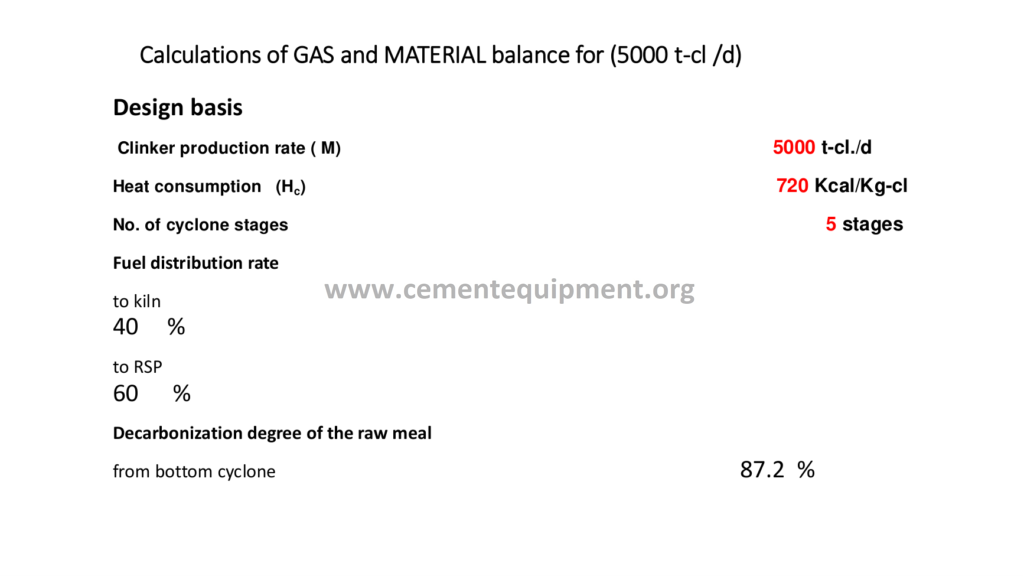
Every balance starts with the production basis. For a 5,000-tonne-per-day line, the basis is a clinker production of 5,000 tonnes per day at 100 percent operation, which corresponds to 208.3 tonnes per hour or 57.9 kilograms per second, and the design availability, typically 92 percent, which raises the design capacity to about 5,435 tonnes per day at full hours. The balance is normally calculated per hour, because the equipment sizes — the fan flows in cubic meters per hour, the fuel in tonnes per hour — are hourly quantities, and the per-day figure is used only for the production report.
The second basis is the raw material chemistry. A typical Portland cement raw mix contains about 79 percent limestone, 15 percent clay and 6 percent corrective materials, and its loss on ignition — the CO2 and water driven off in the kiln — is 34 to 36 percent. The clinker-to-raw-meal factor, the kilograms of raw meal needed per kilogram of clinker, is therefore 1.52 to 1.56. For the calculation below we take a raw meal factor of 1.54 and a loss on ignition of 35 percent. The kiln feed at 5,000 tonnes per day is then 7,700 tonnes per day or 320.8 tonnes per hour, and the CO2 from the raw material is 0.35 x 320.8, or 112.3 tonnes per hour, of which essentially all reports to the kiln exit gas.
The third basis is the fuel and its combustion chemistry. We take a standard coal with a net calorific value of 25 MJ per kilogram, a carbon content of 68 percent, a hydrogen content of 4 percent, a moisture content of 3 percent and an ash content of 12 percent. The thermal energy demand of the line, including the cooler and preheater losses, is taken at 3,100 kJ per kilogram of clinker, a typical value for a modern preheater-calciner line. The fuel rate follows directly: 3,100 kJ/kg x 5,000,000 kg/day = 15.5 TJ per day, divided by 25 MJ/kg gives 620 tonnes of coal per day or 25.8 tonnes per hour.
2. Combustion Air and Flue Gas from the Fuel
The combustion of the coal produces a defined quantity of flue gas, calculated from the fuel analysis. The oxygen demand is the sum of the oxygen for carbon to CO2, hydrogen to H2O and sulfur to SO2, less the oxygen in the fuel. For our coal, the carbon at 68 percent gives, per tonne of fuel, 680 kilograms of carbon requiring 1,813 kilograms of oxygen; the hydrogen at 4 percent gives 40 kilograms of hydrogen requiring 320 kilograms of oxygen; the sulfur at 1 percent gives 10 kilograms requiring 10 kilograms; and the oxygen in the fuel at 1.5 percent credits 15 kilograms. The total oxygen demand is then 2,128 kilograms per tonne of fuel, and the stoichiometric air at 23.2 percent oxygen by mass is 9,172 kilograms per tonne of fuel. The actual combustion is run with excess air, and the design excess for the kiln system is 10 to 15 percent, giving a total combustion air of about 10,100 to 10,500 kilograms per tonne of fuel.
The flue gas from the fuel is the sum of the products: CO2 at 2,493 kilograms per tonne of fuel, H2O at 360 kilograms plus the fuel moisture at 30 kilograms, SO2 at 20 kilograms, and the nitrogen from the air at 6,900 to 7,200 kilograms, with the excess oxygen at 260 to 340 kilograms. The total wet flue gas from the fuel is then about 10,700 to 10,900 kilograms per tonne of fuel, and at 25.8 tonnes per hour of fuel, the fuel combustion products are 276 to 281 tonnes per hour of wet gas. The gas quantities are converted to volumetric flows at the temperatures and pressures of each point in the system, using the gas constant and the molecular weights: at 1,000 degrees Celsius and atmospheric pressure, one tonne of the kiln gas occupies about 3,500 to 3,700 cubic meters.
3. The Kiln and Preheater Gas Balance
The gas entering the preheater system is the sum of the fuel combustion gas, the CO2 from the raw material calcination, the water from the raw meal and the fuel, and the leakage air drawn into the system. The calcination CO2 is 112.3 tonnes per hour from the raw meal, the fuel gas is 276 tonnes per hour wet, the raw meal moisture at 0.3 percent adds 1.0 tonne per hour, and the infiltration air at 5 to 8 percent of the total adds about 20 to 25 tonnes per hour. The total gas leaving the preheater tower is then approximately 410 to 420 tonnes per hour of wet gas.
The gas temperature profile determines the volumes and therefore the fan sizes. The kiln exit gas enters the riser at 950 to 1,050 degrees Celsius; after the calciner and the first cyclone stages it is 850 to 900 degrees; each subsequent stage cools the gas by 50 to 100 degrees while heating the meal; and the tower exit gas is at 300 to 340 degrees Celsius. The volumetric flows follow: at the tower exit, 415 tonnes per hour of gas at 320 degrees Celsius occupies about 620,000 to 650,000 cubic meters per hour at actual conditions, and this is the sizing flow of the main ID fan, the kiln bag filter and the stack. Table 1 summarizes the gas balance by stream.
| Stream | Mass (t/h) | Temperature (deg C) | Volume (Nm3/h) |
|---|---|---|---|
| Fuel combustion gas (wet) | 276 | Flame to 900 | 215,000 |
| Calcination CO2 | 112 | 850-900 | 57,000 |
| Raw meal moisture | 1 | — | 1,200 |
| Infiltration air | 22 | 20-100 | 17,000 |
| Total preheater exit gas (wet) | 411 | 320 | 290,000 (normalized) |
4. The Cooler Balance
The clinker cooler is the second gas system of the line. The hot clinker enters the cooler at 1,300 to 1,400 degrees Celsius with a heat content that must be recovered: the combustion air for the kiln and the calciner is drawn through the cooler, recovering 60 to 75 percent of the clinker heat, and the remaining heat leaves with the cooler vent air, the clinker and the radiation losses. The cooling air flow for a 5,000-tonne-per-day line with a modern grate cooler is 1.9 to 2.2 kilograms of air per kilogram of clinker, which gives 400 to 460 tonnes per hour of cooler air at full load.
The cooler air splits into four streams. The secondary air enters the kiln hood at 900 to 1,050 degrees Celsius with a flow of 0.45 to 0.55 kilograms per kilogram of clinker; the tertiary air goes to the calciner at 800 to 950 degrees with 0.35 to 0.45 kilograms per kilogram; the mill air used for coal drying takes 0.05 to 0.10; and the remaining air leaves as vent air at 350 to 420 degrees Celsius with 0.9 to 1.2 kilograms per kilogram of clinker. The vent air flow is then 190 to 250 tonnes per hour, and it is the sizing flow of the cooler vent filter and, in waste heat recovery plants, the source of the power plant steam. The clinker leaves the cooler at 80 to 120 degrees Celsius above ambient, which sets the clinker transport and the cement mill feed temperature.
5. The Material Balance Around the Kiln System
The material balance closes the loop between the raw meal, the fuel, the clinker and the dust. The inputs to the kiln system are the kiln feed at 320.8 tonnes per hour, the fuel at 25.8 tonnes per hour and the combustion air at 250 tonnes per hour. The outputs are the clinker at 208.3 tonnes per hour, the preheater exit gas at 411 tonnes per hour, the cooler vent air at 220 tonnes per hour, and the dust losses. The dust system is the reconciliation: the raw meal dust entrained in the tower gas is collected in the kiln filter and returned to the raw mill or the kiln feed; at a filter outlet dust of 20 mg per cubic meter and a gas flow of 650,000 actual cubic meters per hour, the stack emission is 13 kilograms per hour, and the internal dust recirculation between the preheater and the filter is 5 to 15 percent of the kiln feed — 16 to 48 tonnes per hour — which must be accounted in the elevator and the silo sizing.
The reconciliation of the material balance is the audit of the plant: the measured flows — the kiln feed scale, the fuel scales, the clinker production and the gas analysis — must close the balance within 2 to 3 percent, and the difference is investigated as measurement drift, dust loss or an unaccounted stream. The balance is also the basis of the specific consumption figures: the raw meal factor of 1.54, the fuel consumption of 124 kilograms per tonne of clinker, the specific thermal energy of 3,100 kJ per kilogram and the specific cooler air of 2.0 kilograms per kilogram, all of which are the plant’s benchmark numbers.
6. Fan Sizing from the Balance
The gas balance directly sizes the fans of the line, and each fan is a balance in miniature. The main ID fan draws the preheater exit gas: its flow is the tower exit volume at the operating temperature, its pressure is the sum of the preheater pressure drop at 450 to 600 millibar, the filter at 15 to 25 millibar, the ducts and the stack, and its power follows from the flow and the pressure. The cooler vent fan takes the vent air at its temperature. The tertiary air fan, where used, delivers the calciner air at 700 to 900 degrees Celsius. The coal mill fan and the kiln feed fan complete the gas system, and the total fan power of a 5,000-tonne-per-day line is 12 to 15 percent of the total electrical energy, with the ID fan alone at 2,500 to 3,500 kilowatts.
The balance also sizes the ducts: the riser duct between the kiln outlet and the calciner at 10 to 14 meters per second gas velocity, the tower connecting ducts at 12 to 16 meters per second, and the filter inlet duct sized to avoid dust settlement at a minimum velocity of 15 to 18 meters per second. The pressure drop of each duct is added to the fan duty, and the fan is selected on the volume at the design temperature with a margin of 10 to 15 percent for the gas temperature excursions that occur with high alternative fuel substitution.
7. The Gas Analysis and the O2 Control
The balance determines the gas composition, and the gas analysis verifies it. The preheater exit gas at full load contains approximately 28 to 30 percent CO2, 8 to 10 percent O2, 4 to 6 percent H2O and 55 to 60 percent nitrogen, with SO2 at 50 to 400 milligrams per cubic meter and NOx at 200 to 500 milligrams per cubic meter depending on the burner and the calciner operation. The oxygen content is the operator’s combustion index: the design O2 at the kiln inlet is 1.0 to 2.0 percent, at the tower exit 2.5 to 3.5 percent, and the difference between the two is the oxygen consumed in the calciner. The control loop holds the tower exit O2 within its band by adjusting the ID fan, and the excess air must be minimized, because every 1 percent of excess O2 at the tower exit costs about 1 percent of the fuel energy in the form of heated nitrogen.
The gas analysis also validates the balance: the measured CO2 at the tower exit multiplied by the gas flow must equal the calcination CO2 plus the fuel CO2, within the measurement tolerance. The reconciliation of the gas analysis with the balance is the daily process audit, and it is the fastest detector of measurement drift, air leakage and fuel metering errors, which is why the gas analyzers are calibrated on the schedule defined by the plant’s quality system.
8. The Energy Balance and Its Interaction with the Gas Balance
The gas balance and the energy balance are the two halves of the same calculation. The thermal input is the fuel at 15.5 TJ per day, and the outputs are the clinker formation enthalpy at about 1,750 to 1,800 kJ per kilogram, the evaporation and heating of the meal moisture, the preheater exit gas enthalpy, the cooler vent air enthalpy, the radiation and convection losses of the kiln shell at 2 to 4 percent, and the clinker heat at the cooler discharge. The reconciliation of the energy balance is the heat audit, and its typical findings are the same each year: the preheater exit gas at 300 to 340 degrees Celsius carries 25 to 30 percent of the input energy, the cooler vent air carries 8 to 12 percent, and the radiation losses 2 to 4 percent, with the balance being the process requirement.
The two balances interact through the temperatures: a change in the kiln gas temperature changes the gas volume and therefore the fan duty; a change in the cooler recovery changes the secondary air temperature and therefore the flame; and a change in the raw meal moisture changes the gas flow and the energy demand. The integrated calculation — the mass balance, the gas balance and the energy balance solved together — is the complete design calculation of the line, and the spreadsheets that perform it are the working tools of every process engineer. The modern version solves the same equations dynamically, so that the plant can predict the fan loads and the gas temperatures of any operating scenario before it happens.
9. The Effect of Alternative Fuels on the Balance
Alternative fuels change the gas and material balance in four measurable ways, and the balance must be re-run for each fuel scenario. First, the fuel mass flow changes with the calorific value: a fuel at 14 MJ per kilogram requires 44 percent more mass than coal at 25 MJ per kilogram for the same energy, and the ash and moisture change the material balance and the gas moisture. Second, the combustion air changes with the fuel composition: the hydrogen and moisture of the fuel set the combustion air demand, and the wet alternative fuels raise the gas water content and the gas volume. Third, the volatile load — chlorine, sulfur and alkalis — changes the cycle concentrations and, in the limit, the bypass flow, which draws a defined percentage of the kiln gas out of the system and changes the tower balance. Fourth, the ash changes the clinker composition and the raw mix correction, feeding back into the raw meal factor.
The plant operating at high substitution therefore maintains a fuel library in its balance: the gas and material balance is calculated for the fuel blend in use, and the control set-points — the ID fan speed, the O2 band and the cooler vent flow — are derived from the balance of the day. The reconciliation of the daily measured data against the balance of the fuel blend is the discipline that keeps the substitution high and the process stable.
10. The Dust and the Filter Balance
The dust system is the smallest mass stream of the line and the largest source of maintenance. The gas leaving the preheater carries 60 to 100 grams of dust per cubic meter at the tower exit, which at 650,000 cubic meters per hour is 40 to 65 tonnes per hour of dust. The filter collects 99.9 percent of it, and the dust is returned to the raw mill or the kiln feed silo. The filter balance is therefore a large recirculation: the tower gas, the dust load, the filter collection and the return are all measured, and the filter’s pressure drop across the bags is the maintenance indicator, rising with the dust load and the bag wear.
The dust loop also affects the material balance: the return dust at 5 to 15 percent of the kiln feed is mixed with the raw meal, changing the effective feed composition and the calcination behavior. The modern plants meter the return dust and account it in the raw mix control, because a changing return dust rate is a changing raw mix quality. The balance closes with the stack emission at 10 to 30 milligrams per cubic meter, and the annual dust measurement is the legal verification of the whole filter system.
11. Reconciliation, Accuracy and the Daily Audit
The value of the balance depends on the accuracy of the measured data, and the reconciliation is the process of making the measured data consistent. The daily audit collects the kiln feed, the fuel flows, the gas analysis, the clinker production and the dust data, and the reconciliation closes the mass balance within its tolerance, typically 2 to 3 percent. The instruments are the audit’s foundation: the weigh feeders are calibrated by test weights, the gas analyzers by span gas, the flow meters by the stack measurements, and the production figures by the clinker silo inventory. The balance that is reconciled daily is the plant’s early warning system: a feed scale that drifts shows as a raw meal factor excursion, a fuel scale that drifts shows as an energy reconciliation error, and an analyzer that drifts shows as an impossible O2-CO2 combination.
The reconciliation also produces the plant’s true specific figures — the kiln feed factor, the specific heat consumption and the specific fan power — and these are the numbers that go into the monthly report and the annual energy audit. The plants that report stable, believable specific figures are the plants that run the daily reconciliation; the plants that report erratic figures are the plants whose balances have drifted, and whose equipment decisions are therefore made on fiction.
12. From Balance to Equipment Design
The completed balance is the specification of the line. The kiln diameter and length follow from the production and the heat load, with the kiln volume per tonne per day in the 0.9 to 1.1 cubic meters per tonne per day range for a preheater-calciner line. The preheater stages follow from the gas temperature profile, with the pressure drop budget distributed across the stages. The cooler follows from the air requirement and the clinker load. The fans follow from the gas volumes and the pressure drops. The filter follows from the gas volume and the dust load. The bypass follows from the volatile balance. And the waste heat recovery plant, where installed, follows from the exit gas and vent air quantities. Every one of these is a number from the balance, which is why the balance is the first calculation of the design and the last calculation of the audit.
Frequently Asked Questions
What is the raw meal factor for a typical Portland line?
The raw meal factor is 1.52 to 1.56 kilograms of kiln feed per kilogram of clinker, set by the loss on ignition of the raw meal, typically 34 to 36 percent. A 5,000-tonne-per-day line therefore needs about 7,700 tonnes per day of kiln feed.
How much gas does a 5,000 t/d line produce?
The preheater exit gas is approximately 410 to 420 tonnes per hour of wet gas, which at the exit temperature of 320 degrees Celsius is about 650,000 cubic meters per hour. The cooler vent air adds another 190 to 250 tonnes per hour.
Why is the tower exit O2 held between 2.5 and 3.5 percent?
Because the excess oxygen is needed for the calciner combustion and the safety margin against reducing conditions, while every extra percent of oxygen is nitrogen that is heated and exhausted, costing about 1 percent of the fuel energy. The band is the economic compromise.
What is the typical thermal energy demand used in the balance?
A modern preheater-calciner line is designed at 2,900 to 3,200 kJ per kilogram of clinker. At 3,100 kJ per kilogram, a 5,000-tonne-per-day line consumes 15.5 TJ per day, or about 620 tonnes per day of coal at 25 MJ per kilogram.
How accurate must the reconciled balance be?
The daily reconciliation should close within 2 to 3 percent of the total mass flow. Larger residuals are investigated as instrument drift, dust loss or an unaccounted stream, because the balance is the basis of every equipment and economic decision.
Summary
The gas and material balance of a 5,000-tonne-per-day clinker line is the complete quantitative description of the plant: the raw meal at 320 tonnes per hour, the fuel at 26 tonnes per hour, the combustion air at 250 tonnes per hour, the preheater exit gas at 411 tonnes per hour, the cooler air at 400 to 460 tonnes per hour, and the clinker at 208 tonnes per hour, all reconciled into one consistent sheet. The balance sizes every piece of equipment from the ID fan to the stack, it verifies the operation through the gas analysis and the daily reconciliation, it evaluates every scenario from alternative fuels to oxygen enrichment, and it produces the specific figures that benchmark the plant. The engineer who masters the balance masters the plant: every number in the design, every reading on the control screen and every claim in the monthly report is a child of the same calculation, and the balance is the discipline that keeps them all true.
13. The 5000 t/d Plant Reference Data Set
The gas and the material balance calculations of the 5000 tonnes per day clinker plant start from the reference data set: the raw meal feed of the 8500-9000 t/d at the 1.65-1.75 raw meal to clinker ratio, the kiln feed moisture of the 0.5-1%, the fuel demand of the 3000-3400 MJ per tonne of clinker (the 110-130 kg/t of the 26 MJ/kg coal), the preheater exit gas of the 1.2-1.5 Nm3 per kg of clinker, the false air of the 8-15% of the gas flow, and the dust loads of the cyclones and the filters. The reference data set anchors every balance calculation: the material balance must close within the 1-2% and the gas balance within the 3-5%, and the deviations from the closure identify the measurement errors or the unaccounted streams.
14. The Gas Balance Methodology of the Kiln System
The gas balance of the kiln system follows the stepwise methodology: the total gas volume at the preheater exit from the fuel combustion stoichiometry and the excess air (the 10-15% excess O2 for the kiln, the 3-5% for the calciner exit), the gas composition from the complete combustion calculation (the CO2 from the fuel and the carbonate, the H2O from the fuel and the raw meal moisture, the N2 from the combustion air, the SO2 and the dust gases), the temperature-corrected volumes at each system point, and the pressure-based leakages from the O2 measurements across the system sections. The complete gas balance produces the gas volumes for the fan sizing, the duct design, the heat exchanger performance and the emission calculations: the gas volumes of the 5000 t/d line reach the 600,000-800,000 Nm3/h at the preheater exit, and the balance verification uses the measured O2 and the temperature profiles of the system.
15. The Energy Benchmarks and the Loss Identification
The material and the energy balance of the 5000 t/d kiln closes with the energy benchmarks: the theoretical heat demand of the clinker burning (the 1750-1850 kJ/kg for the ideal process), the actual heat consumption of the modern 5-stage preheater lines (the 3000-3300 kJ/kg), and the loss distribution (the preheater exit gas 15-25%, the cooler exhaust 5-10%, the shell radiation 8-12%, the clinker sensible heat 2-4%, the conversion losses the remainder). The balance calculation identifies the improvement potentials: the false air reduction, the cooler efficiency improvement, the shell insulation and the waste heat recovery: each identified loss carries its quantified savings potential, and the balance sheet of the kiln system becomes the roadmap of the energy optimization projects.
13. The 5000 t/d Plant Reference Data Set
The gas and the material balance calculations of the 5000 tonnes per day clinker plant start from the reference data set: the raw meal feed of the 8500-9000 t/d at the 1.65-1.75 raw meal to clinker ratio, the kiln feed moisture of the 0.5-1%, the fuel demand of the 3000-3400 MJ per tonne of clinker (the 110-130 kg/t of the 26 MJ/kg coal), the preheater exit gas of the 1.2-1.5 Nm3 per kg of clinker, the false air of the 8-15% of the gas flow, and the dust loads of the cyclones and the filters. The reference data set anchors every balance calculation: the material balance must close within the 1-2% and the gas balance within the 3-5%, and the deviations from the closure identify the measurement errors or the unaccounted streams.
14. The Gas Balance Methodology of the Kiln System
The gas balance of the kiln system follows the stepwise methodology: the total gas volume at the preheater exit from the fuel combustion stoichiometry and the excess air (the 10-15% excess O2 for the kiln, the 3-5% for the calciner exit), the gas composition from the complete combustion calculation (the CO2 from the fuel and the carbonate, the H2O from the fuel and the raw meal moisture, the N2 from the combustion air, the SO2 and the dust gases), the temperature-corrected volumes at each system point, and the pressure-based leakages from the O2 measurements across the system sections. The complete gas balance produces the gas volumes for the fan sizing, the duct design, the heat exchanger performance and the emission calculations: the gas volumes of the 5000 t/d line reach the 600,000-800,000 Nm3/h at the preheater exit, and the balance verification uses the measured O2 and the temperature profiles of the system.
15. The Energy Benchmarks and the Loss Identification
The material and the energy balance of the 5000 t/d kiln closes with the energy benchmarks: the theoretical heat demand of the clinker burning (the 1750-1850 kJ/kg for the ideal process), the actual heat consumption of the modern 5-stage preheater lines (the 3000-3300 kJ/kg), and the loss distribution (the preheater exit gas 15-25%, the cooler exhaust 5-10%, the shell radiation 8-12%, the clinker sensible heat 2-4%, the conversion losses the remainder). The balance calculation identifies the improvement potentials: the false air reduction, the cooler efficiency improvement, the shell insulation and the waste heat recovery: each identified loss carries its quantified savings potential, and the balance sheet of the kiln system becomes the roadmap of the energy optimization projects.
Get this cement file + the full 931-file package
$249.99 — one-time purchase, instant download, lifetime access
This file is part of the Complete Cement Technical Package (931 files) available from cementequipment.org. Respective rights holders; library copy for the licensed single user.