Cement Plant Safety Management: Complete Guide
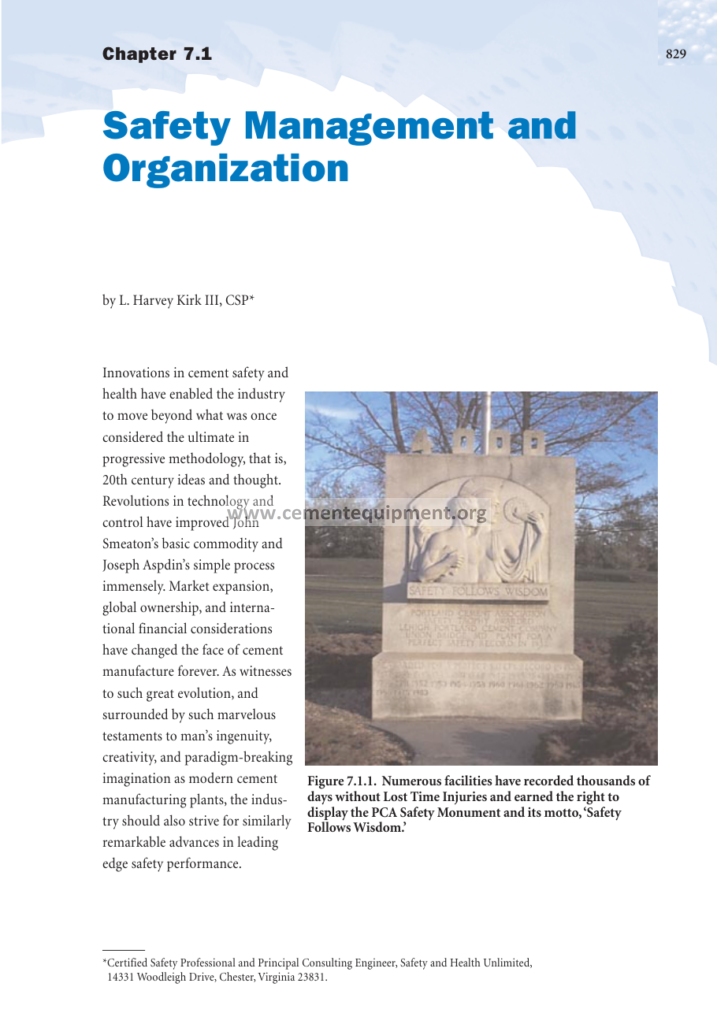
Innovations in cement safety and health have enabled the industry to move beyond what was once considered the ultimate in progressive methodology, and the modern cement plant operates with a safety management system as sophisticated as its process control system. Revolutions in technology and control have transformed cement manufacture, and the industry’s safety performance has evolved in parallel: numerous facilities have recorded thousands of days without lost time injuries, and the Portland Cement Association’s industry safety program, with its motto that safety follows wisdom, has demonstrated that world-class safety performance is achievable in an industry that combines quarries, high-temperature kilns, heavy machinery, and dusty environments. Achieving that performance is not an accident. It is the product of a management system that defines the safety organization, sets policy and objectives, identifies and assesses hazards, trains the workforce, controls the work through permits and procedures, investigates every incident, measures performance with defined indicators, and drives improvement through audit and review. This article provides a complete technical treatment of safety management in the cement industry: the management system frameworks, including ISO 45001, OSHA, and ILO practice, the organizational structures, the core processes of risk assessment, training, and incident investigation, the performance metrics, and the culture that makes the system work.
The Business Case for Safety Management
Safety management in the cement industry is justified by three arguments that reinforce each other. The humanitarian argument is absolute: the workforce has a right to return home uninjured, and the industry’s history of serious incidents, including falls from height, machinery entrapment, mobile equipment collisions, and kiln-related events, demonstrates the cost of neglect in human terms. The business argument is equally concrete: injuries cost the plant directly in medical costs, compensation, and legal liability, and indirectly in lost production, replacement staffing, morale damage, and reputation; the industry’s experience is that the cost of prevention is a small fraction of the cost of incidents. The regulatory argument completes the case: plants operate under occupational safety and health law in every jurisdiction, with obligations to provide safe workplaces, and the modern framework of enforcement, corporate criminal liability, and supply chain safety requirements makes safety performance a license-to-operate issue.
The strongest business case is found in the relationship between safety and operational performance. The safest plants are typically the most reliable plants, because both outcomes are driven by the same disciplines: hazard awareness, procedure adherence, preventive maintenance, and management attention. A plant that controls its permit-to-work system controls its maintenance quality; a plant that enforces lockout/tagout protects its equipment from the damage of unintended energization as well as its workers from injury; a plant that investigates near misses finds the weaknesses that would otherwise produce failures. The safety management system and the reliability management system are therefore two views of the same control discipline, and the industry’s best performers manage them together.
The Safety Management System Framework
The modern safety management system follows the plan-do-check-act cycle, and the international standard ISO 45001 provides the current framework. The system comprises: a defined safety policy and leadership commitment; the identification of hazards and assessment of risks, with the hierarchy of controls applied; the legal and other requirements register; objectives and programs; operational control, including procedures, permits, and training; emergency preparedness and response; performance evaluation through monitoring, auditing, and management review; and continual improvement. The ILO’s guidelines on occupational safety and health management systems, the basis of many national regulations, follow the same structure, as does the OSHA framework of standards and the OHSAS 18001 predecessor that ISO 45001 replaced.
The value of the framework is its completeness and its auditability. A plant that operates only the visible elements of safety, PPE, training, and incident response, lacks the systemic elements, risk assessment, operational control, and review, that prevent incidents before they occur. The framework compels the plant to document its hazards, its controls, and its results, and the documentation is what allows the system to be audited and improved. Certification to ISO 45001 is increasingly required by customers and contractors, and the certification audit is a genuine test of the system’s operation, not merely of its paperwork.
Safety Organization, Leadership, and Accountability
The safety organization defines who does what, and its design is the first decision of the safety management system. The structure is a triangle: at the top, the plant management and the safety department set policy and provide resources; in the middle, the department managers and supervisors execute the program in their areas; at the base, the workforce operates the safety processes, participates in the hazard identification, and holds the front line of defense. The safety department’s role is professional support and verification: it does not own safety, because ownership by an isolated department is the classic failure mode; instead, each manager owns the safety of their operation, and the safety professionals advise, audit, and measure.
Leadership is the differentiator between average and excellent safety performance. The plant manager’s behavior sets the standard: visible involvement in safety activities, personal participation in incident reviews, visible enforcement of the rules, and the allocation of resources demonstrate that safety is a priority in practice rather than in rhetoric. Accountability is the mechanism that converts leadership into performance: each level is accountable for the safety results of its area, safety objectives are part of the performance management of managers and supervisors, and the review of safety performance is a standing item of the plant’s management meetings. The industry’s experience is unambiguous: plants with active, visible leadership achieve results that the same workforce, the same hazards, and the same systems cannot achieve without it.
Safety Policy, Objectives, and Programs
The safety policy is the plant’s public statement of its safety commitment: the policy defines the principles, the responsibilities, and the resources, and it is signed by the plant management and communicated to the workforce and the contractors. The policy is more than a document: it is the reference point for decisions, and the test of the policy is whether it survives a conflict between production and safety, because a policy that yields to production pressure on the first test is worthless from then on. The objectives translate the policy into measurable targets: lost time injury frequency, total recordable rate, number of completed safety audits, percentage of the workforce trained, and the completion of the corrective actions from incident investigations.
The programs are the vehicles for the objectives: the training program, the permit-to-work program, the contractor management program, the ergonomics program, and the emergency preparedness program are each defined with scope, responsibilities, and schedules. The program management is disciplined: each program has an owner, a budget, and a review cycle, and the progress is reported at the management review. The objectives are reviewed annually, and the review is honest: targets that were missed are analyzed for the cause, and the system is adjusted, because a safety objective that is repeatedly set and missed is evidence of a system failure, not a statistical anomaly.
Hazard Identification and Risk Assessment
Risk assessment is the intellectual core of safety management: it converts the hazard inventory into prioritized control decisions. The process begins with hazard identification, the systematic enumeration of the hazards in each task and area, using walk-through surveys, task analysis, incident history, and the experience of the workforce. The methods range from the simple, such as the job safety analysis (JSA), which breaks a task into steps and identifies the hazards and controls of each step, to the sophisticated, such as HAZOP studies for the process systems, quantitative risk assessment for the major hazards, and the risk assessment matrix used to rank the identified risks by likelihood and consequence.
The risk assessment output is the risk register, the prioritized list of risks with their controls, owners, and review dates, and the register is the basis of the plant’s improvement plan. The assessment is repeated whenever the process changes, because the management of change and the risk assessment are linked: a change in fuel, a new raw material, or a modified procedure is assessed before implementation, not after the first incident. The workforce participates in the assessments as the experts on their own work, and the assessments are reviewed periodically, because the hazards of a plant are not static: new equipment ages, new chemicals arrive, and the risk profile shifts with the seasons and the production schedule.
| Likelihood \ Consequence | Minor injury | Serious injury | Fatality |
|---|---|---|---|
| Rare | Low | Medium | High |
| Possible | Medium | High | Extreme |
| Likely | High | Extreme | Extreme |
The ranking drives the control decision: extreme risks are controlled immediately or the task is stopped; high risks are controlled to acceptable levels within a defined period; medium and low risks are controlled within the planned maintenance and improvement cycles. The residual risk after control is reassessed, and the acceptance of residual risk is a documented management decision, not a default.
Training and Competency Development
Training is the transfer of the risk assessment into the workforce’s competence, and its scope covers the whole hierarchy: general induction for all employees and contractors, task-specific training for each job, specialized training for the high-hazard activities such as confined space entry, hot work, work at height, and mobile equipment operation, and refresher training at defined intervals. The training is documented, tested, and recorded, and the competence of each worker is tracked in the training matrix, which maps the required training to the jobs and identifies the gaps.
The effectiveness of training is measured by behavior, not by attendance. The plant verifies that the training changed the way the work is done: supervisors observe the work, the safety inspection program checks the practices, and the incident and near-miss records reveal the gaps between the training and the practice. The training program is therefore reviewed against the incident data: a pattern of incidents in a task identifies the training gap, and the corrective action is specific training for the task, followed by verification. The emergency response training, including fire response, first aid, and the evacuation drills, is exercised on a schedule, because the emergency procedures that are never practiced fail exactly when they are needed.
Operational Control: Permits, Procedures, and Rules
Operational control is the safety system at the point of work. The permit-to-work system is its centerpiece: for the defined high-hazard tasks, including hot work, confined space entry, work at height, excavation, and work on energized or process-connected systems, the work proceeds only under a permit that specifies the hazard, the controls, the isolation, the gas testing where applicable, the standby arrangements, and the time validity. The permit is issued by an authorized person after verification, and it is canceled when the work is complete and the area is returned to service. The discipline of the permit system is its strictness: a permit that is signed without verification is a decoration, and the plant’s audits check the permits against the actual work.
The safe operating procedures cover the routine and the non-routine work: the standard operating procedures for the process operation, the maintenance procedures for the equipment, and the safe work procedures for the tasks that combine the two. The rules complete the control: the plant rules for PPE, driving, smoking, and housekeeping are few, clear, and enforced, because the credibility of the system depends on the uniform application of its rules. The enforcement is consistent and documented: the discipline process addresses the violations, the analysis of the violations feeds the training and the procedure review, and the workforce sees that the rules apply to everyone, including the management.
Incident Reporting and Investigation
The incident management process covers the full spectrum: near misses, first aid cases, recordable injuries, lost time injuries, serious incidents, and the events that could have been serious, because the lessons are in the near misses. The reporting culture is the foundation: workers report incidents and near misses without fear of blame, and the analysis focuses on the causes, not on the person. The reporting rate is itself a performance indicator, because a plant with a high near-miss reporting rate and a low injury rate is learning from its experience, while a plant with a low reporting rate and a low injury rate may simply be blind to its risks.
The investigation follows a defined method. The incident is analyzed to its root causes: the direct causes, the physical conditions and unsafe acts at the moment of the event; the contributing causes, the equipment, procedures, training, and supervision that allowed the conditions; and the root causes, the management system weaknesses in design, resources, or culture. The methods include the five-why analysis, the cause tree, and the fault tree for the complex events, and the investigation team includes the affected area, the safety professionals, and the workforce representatives. The output is the corrective action plan, with actions, owners, and deadlines, and the verification of the actions’ completion and effectiveness is part of the system, because an investigation that produces actions that are never implemented is a ritual, not a process.
Safety Performance Metrics and Benchmarking
Safety performance is measured with a defined set of indicators, classified as lagging and leading. The lagging indicators measure the results: the lost time injury frequency rate (LTIFR), the total recordable injury rate (TRIR), the severity rate, and the fatalities, expressed per million hours worked. The leading indicators measure the prevention activity: the number of safety inspections and audits completed, the near-miss reports per period, the percentage of planned training completed, the permit compliance rate, and the completion of the corrective actions. The balanced scorecard uses both: the lagging indicators tell the plant where it stands, and the leading indicators tell it where it is going.
| Indicator | Definition | Typical good performance |
|---|---|---|
| LTIFR | Lost time injuries x 1,000,000 / hours worked | Below 1.0 |
| TRIR | Total recordable injuries x 200,000 / hours worked | Below 2.0 |
| Severity rate | Lost days x 1,000,000 / hours worked | Below 30 |
| Near-miss reporting | Reports per 100 employees per year | Above 20 |
| Safety audits completed | Planned audits executed / planned | 100% |
| Corrective action closure | Actions closed on time / total | Above 95% |
| Training completion | Training delivered / planned | 100% |
Benchmarking compares the plant with the industry: the PCA and the Global Cement and Concrete Association publish industry safety data, and the plant’s position in the distribution indicates its standing and its potential. The benchmarking is used constructively: the target is set from the industry’s best practice, the gap analysis identifies the systems that the best performers operate and the plant does not, and the improvement plan closes the gap. The metrics are reviewed at the management review with the same rigor as the production metrics, and the safety performance is reported to the corporate level with the same transparency.
Contractor Safety Management
Contractor work is a major fraction of the high-hazard activity in cement plants: the relining of the kiln, the maintenance of the process equipment, and the capital projects are largely contracted, and the contractors’ workforce faces the same hazards as the plant’s own workers. The contractor safety management process covers the whole contract life cycle: the prequalification, which verifies the contractor’s safety record and management system; the contract requirements, which define the safety obligations, the PPE, the training, and the reporting; the induction, which introduces the contractor’s workers to the plant’s rules and hazards; the supervision, which verifies that the work is performed to the requirements; and the evaluation, which feeds the contractor’s performance into the future decisions.
The relationship between the plant and the contractor is the key success factor. The best practice is partnership: the plant’s safety professionals and the contractor’s supervision review the high-risk tasks together, the permits are issued with joint verification, and the incident reporting applies to both workforces without distinction. The plant audits the contractor’s work with the same tools as its own: inspections, observations, and incident investigations, and the contractor’s safety performance is a decision factor in the award of the next contract. The mutual goal is defined in the contract: zero harm to both workforces, with the plant providing the environment and the contractor providing the discipline.
Emergency Preparedness and Response
The emergency preparedness program plans for the events that the risk assessment cannot eliminate: fires, explosions, chemical releases, structural collapses, major accidents, and the natural events that can strike the site. The program comprises: the emergency plan, which defines the organization, the responsibilities, the communication, and the evacuation routes; the resources, the firefighting equipment, the first aid and rescue capability, the spill kits, and the external emergency services agreements; the training and exercises, which test the plan against the scenarios; and the review, which corrects the plan from the exercise results and from the actual emergencies.
The emergency plan is scenario-based: the fire scenarios for the kiln area, the coal mill, the fuel storage, and the electrical systems; the rescue scenarios for the confined spaces, the silos, and the work at height; the medical scenarios for the injuries and the heat and chemical exposures; and the community scenarios for the events that can affect the neighborhood. The exercises are scheduled and realistic: the full-scale exercise annually, the tabletop exercises for the management team, and the drills for the response teams. The review after each exercise is disciplined: the gaps are documented, the corrective actions are assigned, and the plan is updated, because an emergency plan is a living document that is proven by its exercises, not by its cover.
Safety Culture and Behavioral Programs
The safety culture is the shared set of beliefs and behaviors about safety in the plant, and it is the layer beneath the system that determines whether the system works. A positive safety culture is characterized by: leadership visibly committed; open communication about hazards and errors; the workforce empowered to stop unsafe work; the reporting of near misses without blame; and the belief that all injuries are preventable. The culture is built by behavior: the leaders model the behavior, the supervisors reinforce it, the rules are applied consistently, and the recognition and the discipline are both used honestly. The culture is measured by surveys and by the behavioral indicators, and it is strengthened by the behavioral safety programs, in which the workforce observes the work and provides feedback, and by the workforce participation in the hazard identification and the incident investigation.
The culture is the answer to the paradox of safety management: the system can be perfect on paper and still fail on the floor, because the workers’ behavior follows the culture, not the documentation. The plants with the industry’s best records demonstrate the culture in their daily practice: the workers stop the job when the conditions are not right, the supervisors thank them for it, the management investigates why the conditions were not right, and the improvement loop closes. The culture takes years to build and moments to destroy, and its maintenance is the continuing task of the plant’s leadership.
Management of Change and Process Safety
The management of change (MOC) procedure is the bridge between the routine safety system and the process safety of the plant’s major hazards. The cement plant’s process hazards, the kiln fuel systems, the coal grinding and storage, the ammonia and fuel handling, and the compressed gas systems, are managed under the process safety disciplines: the process hazard analysis, the operating procedures, the critical equipment maintenance, the management of change, and the emergency planning. The MOC procedure requires that any change to the process, the equipment, the materials, or the procedures is reviewed for its safety impact before implementation, and the review covers the hazard identification, the procedure updates, the training, and the commissioning of the change.
The MOC discipline addresses the industry’s most instructive failures. The coal mill explosion, the fuel tank fire, and the kiln gas incidents share a pattern: a change in fuel, in operating mode, or in equipment was implemented without the assessment of its safety consequences. The plant’s procedure therefore treats every change as a project: the change is described, the hazards are assessed, the controls are specified, the procedures and training are updated, and the change is reviewed after implementation. The process safety management, applied with the same rigor as in the chemical industry, is the industry’s defense against the low-frequency, high-consequence events.
Audits, Reviews, and Continual Improvement
The safety management system is closed by its verification elements: the monitoring, the audit, and the management review. The monitoring is continuous: the inspections, the observations, the permit checks, and the incident reporting operate daily. The audit is periodic and independent: the internal audits are conducted by trained auditors against the ISO 45001 requirements and the plant’s own procedures, and the external audits, for certification and for the corporate programs, provide the independent verification. The audit findings are classified by severity, and the corrective actions are tracked to closure with the same discipline as the incident actions.
The management review completes the cycle: at defined intervals, the plant management reviews the safety policy, the objectives, the performance data, the audit results, the incident analysis, and the improvement actions, and it decides the resources and the priorities for the next period. The review is the moment when the system demonstrates its honesty: the performance that did not meet the objectives is discussed openly, the causes are identified, and the corrective actions are resourced. The continual improvement is the outcome: each cycle raises the standard, and the plant’s safety performance, measured by the lagging and the leading indicators, moves toward the industry’s best practice. The review also re-examines the fundamentals: the hazards may have changed, the industry practice may have advanced, and the objectives may need to be set higher, because the safety management system, like the process it protects, is never finished.
Frequently Asked Questions
What is a safety management system?
A safety management system is the organized set of policy, organization, procedures, and controls that a plant uses to manage its safety risks, following the plan-do-check-act cycle. ISO 45001 is the international standard, and ILO guidelines and OSHA requirements provide the national frameworks.
What are leading and lagging safety indicators?
Lagging indicators measure results, such as the lost time injury frequency rate and the total recordable injury rate. Leading indicators measure prevention activity, such as audits completed, near-miss reports, and training completion. Both are needed: lagging indicators show where the plant stands, leading indicators show where it is going.
What is the permit-to-work system?
A permit-to-work is the formal authorization for high-hazard tasks such as hot work, confined space entry, work at height, and work on energized systems. It documents the hazards, the isolations, the gas testing, and the standby arrangements, and it is issued by an authorized person and canceled when the work is complete.
Why is contractor safety management important in cement plants?
Because a large share of the high-hazard work, including kiln relining and major maintenance, is performed by contractors. The plant must prequalify contractors, induct their workers, supervise their work, and evaluate their performance, because contractor incidents are plant incidents.
How is a safety incident investigated?
By a structured investigation that identifies the direct causes, the contributing causes, and the root causes of the event, using methods such as five-why and cause tree analysis. The output is a corrective action plan with owners and deadlines, and the verification that the actions were implemented and effective.
What is the difference between safety and process safety?
Safety addresses the routine hazards of the workplace, such as falls, machinery, and vehicles. Process safety addresses the major hazards of the process itself, such as fires, explosions, and toxic releases, and is managed with hazard analysis, management of change, and emergency planning.
How does a plant build a safety culture?
By consistent leadership behavior, open reporting without blame, the workforce empowered to stop unsafe work, consistent rule enforcement, and recognition. Culture is measured by surveys and behavioral indicators and is maintained by daily practice, not by documentation.
Summary
Safety management in the cement industry has matured into a complete management discipline, and the industry’s best performers have demonstrated that world-class safety is achievable in its demanding environment. The system is the foundation: ISO 45001, ILO guidance, and OSHA compliance provide the framework of policy, organization, risk assessment, operational control, training, incident management, measurement, and review. The leadership is the engine: visible commitment, accountability, and the consistent application of the rules determine whether the framework operates. The processes are the substance: hazard identification and risk assessment define the controls; permits and procedures apply them at the point of work; training and supervision build and verify the competence; incident investigation and near-miss analysis feed the learning; and the audit and the management review drive the continual improvement. The metrics are the evidence: the balanced scorecard of lagging and leading indicators, benchmarked against the industry, shows the plant where it stands and where it is going. And the culture is the outcome: the workforce that believes all injuries are preventable, reports its hazards, and stops its unsafe work is the workforce that achieves the industry’s best records. This article has provided the complete technical framework for building, operating, and improving a safety management system in a cement plant.
Get this cement file + the full 931-file package
$249.99 — one-time purchase, instant download, lifetime access
This file is part of the Complete Cement Technical Package (931 files) available from cementequipment.org. Respective rights holders; library copy for the licensed single user.