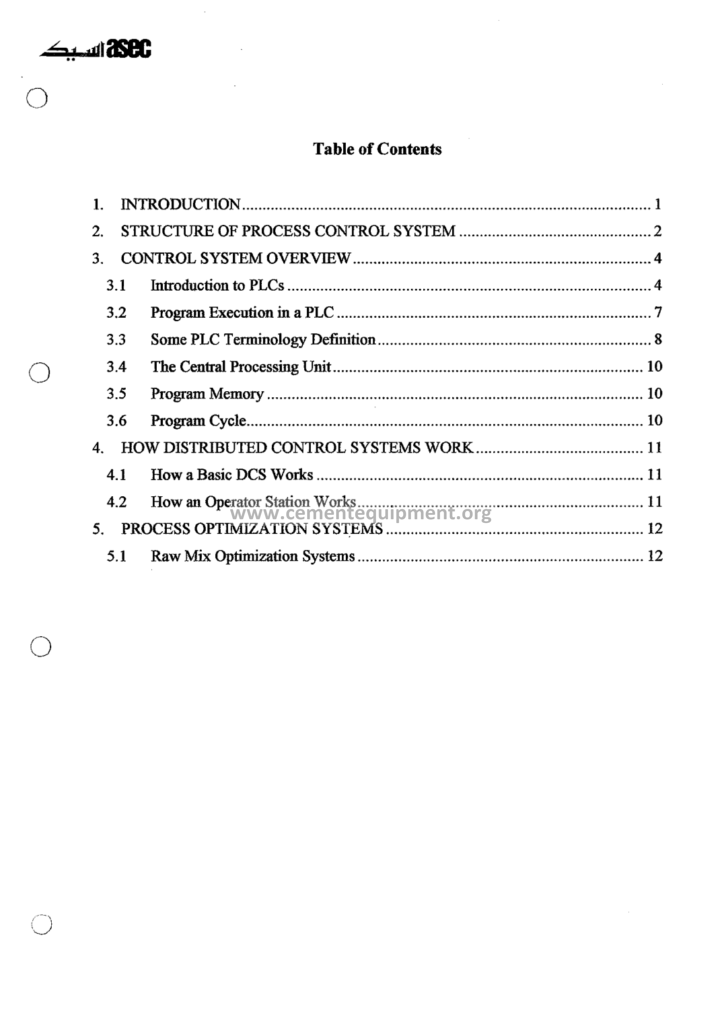
Process Control Systems: Complete Technical Guide
The process control systems of the cement plant are the brain of the operation: the distributed control systems (DCS) that read the thousands of measurements, the control loops that hold the temperatures and the flows, the interlocks that protect the machines, and the advanced control systems that run the kiln and the mills: the modern cement plant is operated from the control room screens, and the engineers who understand the control architecture understand the plant itself.
The Complete Cement Technical Package (931 files including the books, the courses, the Excel tools and the presentations: $249 one-time: instant download immediately after payment) includes this process control guide with its architecture diagrams, the loop tuning tables and the control strategies of the plant sections: this article walks the file: the control hierarchy, the DCS and the PLC systems, the classical loops, the kiln and the mill control and the advanced control: the reader arrives at the complete control map of the cement plant.
The cement process is a continuous, slow, coupled system: the kiln responds to the changes over hours, the mills over minutes, and the interactions between the loops are everywhere: the control engineering of the cement plant is the engineering of the stability: this guide covers the architecture from the field instruments to the control room screens, the tuning of the loops and the strategies that the operating plants use.
1. The Control Hierarchy: From the Field to the Boardroom
The process control of the plant is organized in the layers that separate the fast and the slow decisions:
- The field level: the sensors and the actuators: the temperature elements, the pressure transmitters, the flow meters, the weigh feeders and the control valves: the field devices measure and act at the loop speeds of the seconds:
- The control level: the controllers of the DCS: the single-loop control, the interlocks and the sequence logic execute automatically at the millisecond to the second speeds: the PID loops, the motor controls and the sequence steps live here:
- The supervision level: the operator stations, the alarm management and the process graphics: the operators supervise the hundreds of loops from the screens and intervene at the pace of the process:
- The management and the optimization level: the advanced process control, the production planning and the reporting: the optimization runs at the minutes to the hours, feeding the setpoints to the control level: the historians and the reports close the loop to the management:
The hierarchy of the file is the framework of the whole control understanding: each layer has its equipment, its speeds and its responsibilities, and the plant’s control problems are usually the problems of the wrong layer acting: the engineer who places the decision at the right level designs the stable, responsive plant.
2. The DCS Architecture: The Distributed Brain of the Plant
The distributed control system is the central nervous system of the modern cement plant:
| DCS component | Function | Typical numbers |
|---|---|---|
| Process stations / controllers | Executes control logic, I/O scan | 5-20 stations per plant |
| Operator stations | Process graphics, alarm handling | 3-8 stations |
| I/O count | Field signals connected | 3,000-15,000 points |
| Control loops | Regulatory and sequence loops | 500-2,000 loops |
| Redundancy | Controller, network, power | 1:1 redundant on critical |
- The controllers: the process stations execute the control logic with the scan cycles of 100 to 500 milliseconds: the controllers of the kiln and the mill sections run the critical loops with the redundant configurations:
- The networks: the control network connects the controllers and the operator stations: the redundant communication paths protect the plant from the network failures: the fieldbuses (the Profibus, the Foundation Fieldbus) distribute the intelligence to the field instruments:
- The operator stations: the graphic displays of the process sections with the trend curves, the alarms and the operator actions: the station layout follows the plant sections: the operator of the kiln sees the whole burning line on the one screen:
- The architecture decisions: the selection of the DCS against the PLC for the plant: the DCS serves the continuous process control of the plant, the PLCs the machine sequences: the modern plants often hybridize: the file compares the architectures with their strengths:
The DCS is the platform of the whole control philosophy: the file documents the architecture selection, the redundancy philosophy and the upgrade paths of the control systems: the age of the DCS is a hidden constraint of the plant: the old systems reach the end of the spare parts supply and the modernization projects replace them section by section.
3. The PLC and the Machine Control: The Sequences of the Equipment
The programmable logic controllers run the machine sequences that the DCS supervises:
- The scope of the PLC logic: the conveyor interlocking, the packer sequences, the crusher control and the bag filter control: the PLC executes the logic at the millisecond speeds with the ladder and the structured text programming:
- The interlocking: the start and the stop sequences of the equipment trains: the conveyor cannot start before its predecessors, and the trip of one machine stops the feeding chain: the interlocks protect the equipment and the personnel:
- The communication with the DCS: the PLC groups communicate with the DCS over the network: the DCS commands the sequences and the PLC reports the states: the interface engineering is the integration discipline of the control systems:
- The fieldbus intelligence: the smart field devices with the embedded diagnostics: the remote I/O cabinets near the equipment reduce the cable runs: the file covers the fieldbus design of the plant sections:
The PLC layer is the machine-level control that the operators rarely see and the plant cannot run without: the file documents the PLC program structure, the interlock philosophy and the sequence design of the classical equipment trains: the discipline of the machine control is the reliability of the plant’s physical flow.
4. The Control Loops: The PID and the Tuning of the Process
The regulatory control of the cement process is the hundreds of PID loops, and their tuning is the daily art of the control engineer:
- The loop structure: the measurement, the setpoint, the controller and the final element: the proportional, the integral and the derivative actions corrected against the deviation: the loop tuning constants (the gain, the integral time, the derivative time) define the response:
- The tuning goals: the stability, the fast response and the small overshoot: the process loops of the cement plant are tuned conservatively: the too-aggressive tuning cycles the plant and the too-slow tuning drifts it: the file teaches the tuning methods from the reaction curve to the lambda tuning:
- The cascade structures: the nested loops: the mill outlet temperature as the master of the water injection flow loop: the cascade splits the slow and the fast dynamics and improves the control quality:
- The feed-forward: the measured disturbances compensated before they reach the loop: the clinker temperature feed-forward to the mill cooling: the feed-forward loops of the file anticipate the process changes:
- The actuator and the process lags: the cement process carries the long dead times: the kiln and the mill responses lag the interventions by the minutes: the control design respects the dead times and the file’s tuning tables carry the typical values per loop type:
The loop tuning is the foundation of the control quality: the plant with the well-tuned loops runs steadily and the advanced control systems above it perform: the file provides the tuning templates of the classical cement loops (the temperatures, the pressures, the flows, the levels) with the typical controller constants of the industry.
5. The Kiln Control: The Mastery of the Burning Line
The kiln control is the most demanding control problem of the cement process: the long dead times, the coupled variables and the refractory consequences:
- The controlled variables: the burning zone temperature, the kiln inlet gas temperature, the preheater gas temperatures, the O2 and the CO at the kiln inlet and the stack, and the clinker quality: the operators and the control systems balance the variables against the fuel and the feed:
- The manipulated variables: the kiln fuel rate, the kiln feed rate, the kiln speed, the ID fan speed and the cooler control: the classical conflict: the feed rate and the fuel rate couples directly and the thermal balance of the kiln follows:
- The manual strategy: the operator observes the burning zone through the camera and the thermal images, watches the NOx and the O2 trends and adjusts the fuel and the air: the manual control quality depends on the operator’s experience:
- The automatic strategies: the fixed-ratio control, the constant-O2 control and the temperature-based control: the modern kilns run the automatic control with the operator supervision: the file documents the strategy ladder and the conditions of each mode:
- The kiln uptime management: the control system also manages the kiln rotation during the stops (the rotation schedules) and the startup and the shutdown sequences: the thermal protection of the refractory runs in the control logic:
The kiln control is the showcase of the plant’s control capability: the modern plants run the kiln on the automatic control for the days, with the operator intervening only at the transitions: the file’s kiln control section is the practical manual of the burning line: the loops, the strategies, the modes and the operator interface of the kiln.
6. The Mill Control: The Grinding Circuits in the Automatic Mode
The mill control keeps the grinding circuits at the maximum throughput within the quality limits:
- The variables: the mill feed rate, the separator speed, the mill outlet temperature, the mill differential pressure and the product fineness: the control target is the maximum feed rate that holds the fineness specification:
- The ball mill control: the mill sound (the power of the first compartment noise), the mill power draw and the feed rate form the load control: the sound-based control adjusts the feed to the mill level: the modern plants use the mill power and the differential pressure signals:
- The VRM control: the grinding pressure, the dam ring, the feed rate and the classifier speed interact: the vibration and the differential pressure protect the mill: the VRM control is the newer layer of the control knowledge:
- The fineness loop: the separator speed adjusts the Blaine and the residue against the laboratory and the online particle size measurements: the online analyzers close the fineness loop in the modern plants:
- The quality coupling: the mill control couples with the product quality: the temperature control of the gypsum, the fineness distribution and the strength feedback: the control system of the file holds the quality within the specification while maximizing the tonnage:
The mill control of the file covers the ball mill circuits and the vertical mills with the control modes, the interlock protections and the tuning: the automatic mill operation frees the operators for the supervision and raises the average throughput of the grinding department by the 3% to 8% that the steady operation delivers.
7. The Advanced Process Control: The Expert Systems on Top of the DCS
The advanced process control (APC) is the optimization layer that runs the kiln and the mills above the classical loops:
- The model predictive control (MPC): the dynamic models of the process predict the future response and optimize the manipulated variables over the horizon: the MPC handles the coupled multivariable problem of the kiln in the way the single loops cannot:
- The fuzzy logic and the rule-based systems: the expert systems convert the operator’s knowledge into the control rules: the fuzzy systems soften the rule switching and run the smooth transitions: the classic cement kiln expert systems of the industry are the rule-based controllers:
- The neural and the statistical models: the data-driven models of the burning zone temperature and the quality: the soft sensors predict the values that the hardware cannot measure continuously: the machine learning layer of the modern APC solutions:
- The results: the advanced control deployments report the fuel savings of 2% to 5%, the production gains of 2% to 8% and the improved stability of the process: the payback of the APC projects runs in the months: the file presents the evaluation methodology of the APC projects:
The APC is the growth area of the process control: the control systems of the modern plants run the MPC and the expert layers on top of the DCS, and the file documents the degrees of the automation and the project implementation: the APC is not the replacement of the operators but their assistant, and the operator supervision remains the safety layer.
8. The Interlocks and the Safety Systems: The Protection of the People and the Equipment
The interlocks and the safety controls form the protection layer between the process and the accidents:
- The equipment interlocks: the trip conditions of the machines: the bearing temperatures, the vibration, the motor overloads and the material blockages: the interlock logic stops the equipment and the feeding chains in the sequence that prevents the damage:
- The process trips: the kiln flame loss, the high CO in the precipitators, the high pressures and the low flows: the process protection trips the systems into the safe states: the trip philosophy and the reset procedures are the written discipline of the plant:
- The safety instrumented systems (SIS): the independent safety layer for the classified risks: the fuel handling and the gas systems carry the safety integrity levels (SIL) requirements: the SIS runs separated from the DCS with the certified logic solvers:
- The interlock management: the bypasses of the interlocks are logged, licensed and removed: the maintenance of the interlock functions with the proof tests: the file documents the interlock register and the management of the bypasses:
The protection layer is the non-negotiable part of the control system: the file’s interlock philosophy follows the international standards of the machinery and the process safety, and the proof testing schedules keep the protection alive: the control system that fails to protect is worse than no control system.
9. The Operator Interface and the Alarm Management: The Screens of the Control
The interface between the process and the operators decides how effectively the plant is run from the control room:
- The process graphics: the section displays with the live values, the statuses and the navigations: the graphic design follows the process flow: the operator of the kiln line reads the complete burning system on the screens without the paper lists:
- The alarm management: the alarm philosophy, the rationalization and the suppression: the alarm floods drown the operators: the modern plants target the alarm rates below about 5 alarms per operator per hour in the steady operation: the alarm rationalization is a standing improvement program:
- The trends and the historians: the process historian records the thousands of the values for the months: the trends serve the analysis of the events and the optimization studies: the historian data is the evidence base of the plant’s improvements:
- The operator training simulators: the control room simulators train the operators on the start-ups, the trips and the emergencies without touching the real kiln: the simulator training is the insurance of the control room competence:
The operator interface of the file follows the human factors engineering: the displays, the alarms and the procedures are designed for the decision quality of the tired night shift: the alarm management and the simulator training convert the control room into the reliable command center of the plant.
10. The Data and the Reporting: From the Sensors to the Decisions
The control system is also the data system of the plant, and its reporting feeds the management decisions:
| Report | Content | Frequency |
|---|---|---|
| Shift report | Production, downtime, quality, alarms | Per shift |
| Daily production report | Tonnage per line, specific consumptions | Daily |
| Energy report | KWh/t, kcal/kg, department consumption | Daily / weekly |
| Quality report | Fineness, strengths, chemical data | Daily |
| Availability report | Downtime causes, MTBF, MTTR | Monthly |
- The production data: the weigh feeders and the silo levels record the production of each line: the reconciled production numbers close the daily material balance of the plant:
- The specific consumptions: the kilowatt-hours per ton and the kilocalories per kilogram computed from the metering: the specific consumption trends are the process health dashboard of the plant:
- The downtime accounting: the event logs and the downtime reasons: the availability statistics drive the maintenance planning: the downtime data quality depends on the event logging discipline of the control room:
- The integrity of the data: the data validation, the meter calibration and the reconciliation: the reporting is only as good as the measurements: the file covers the metering management of the plant data:
The reporting layer closes the loop from the process to the management: the reports of the file are the instruments of the continuous improvement, and the plant that runs on the solid data improves measurably: the data discipline of the control room is the foundation of the plant’s management decisions.
11. The Maintenance of the Control Systems: The Care of the Digital Plant
The control systems need their own maintenance discipline, different from the mechanical worlds:
- The preventive maintenance: the cleaning and the tightening of the terminations, the battery replacements, the UPS testing and the cooling filter cleaning: the control cabinet hygiene is the reliability of the electronics:
- The backup management: the database backups of the DCS configurations, the program copies and the documentation: the disaster recovery plan of the control system: the backup discipline protects the plant from the configuration losses:
- The spare parts strategy: the electronic boards, the power supplies and the field transmitters in the stock: the aging control platforms face the spare parts obsolescence and the modernization planning:
- The cybersecurity: the control network separation, the access control, the patch management and the incident response: the digital plant is exposed to the digital threats: the file follows the IEC 62443 guidance for the plant’s industrial cybersecurity:
- The performance monitoring: the CPU loads, the network traffic, the alarm rates and the loop performance metrics: the continuous monitoring of the control system health catches the degradation early:
The maintenance of the control systems is the care of the plant’s brain: the file schedules the cabinet cleaning, the backups, the battery cycles and the security reviews, because the control outage is the plant outage: the disciplined digital maintenance keeps the brain of the plant young.
12. The Control of the Raw Material Preparation and the Blending
The raw material control is the first link of the process automation, and its loops prepare the quality that the kiln burns:
- The feed rate control: the weigh feeders of the limestone, the clay and the corrections hold the blend ratios: the feeder loops maintain the mass flows within the 0.5% to 1% accuracy: the blend ratio control is the composition control of the raw mix: the file documents the feeder loop configuration:
- The blend optimization: the online cross-belt analyzers measure the raw mix composition and the optimizer adjusts the feeder setpoints: the closed-loop raw mix control reduces the lime saturation variation: the plants with the online analysis run the quality control of the raw mix continuously: the file covers the optimization loop:
- The raw mill control: the mill load, the outlet temperature, the drying and the fineness loops of the raw grinding: the raw mill control balances the throughput and the fineness against the kiln demand: the hot gas control of the drying loop is the raw mill’s own process section:
- The storage and the homogenization control: the silo levels, the homogenization cycles and the kiln feed control from the silo discharge: the storage control connects the raw mill and the kiln: the file documents the complete raw material control chain from the feeder to the kiln feed:
The raw material control is the quality foundation of the whole line: the kiln receives the stable feed and runs the stable flame, and the control quality of the raw section is measured in the standard deviation of the clinker composition: the file’s raw control chapter is the first cycle of the process automation, and the engineers who master it stabilize the line before the kiln control even starts.
13. The Cooler and the Fuel Handling Controls: The Secondary Systems
The clinker cooler and the fuel preparation systems carry their own control loops, and their stability supports the kiln:
- The cooler control: the grate speed, the under-grate pressures, the cooling air amounts and the clinker temperature at the cooler discharge: the cooler control objectives: the clinker cooling quality, the secondary air temperature for the flame and the heat recovery: the cooler loops of the file balance the recovery and the cooling:
- The fuel mill control: the coal mill load, the outlet temperature, the fineness and the inertization loops: the fuel grinding safety (the mill outlet temperature limits, the CO monitoring and the inertization) is the protecting layer of the coal system: the file documents the fuel mill control with the safety interlocks:
- The fuel feeding control: the kiln fuel rate follows the burning zone temperature: the fuel feeder control of the pulverized coal with the weighing accuracy: the alternative fuel feeding loops of the modern plants meter the waste fuels into the kiln system:
- The integration with the kiln: the cooler and the fuel systems respond to the kiln state: the cooler air and the tertiary air interact with the flame: the integrated control of the burning line treats the kiln, the preheater and the cooler as the one system: the file presents the integrated control architecture:
The secondary systems complete the burning line control: the cooler, the fuel mill and the feeding loops are the supporting cast of the kiln, and their stability decides the kiln’s: the file’s coverage of the secondary systems is the complete control picture of the clinker line: from the coal mill to the cooler grate, the loops of the burning line are documented as the one integrated system.
14. The Control Project Implementation: From the Design to the Commissioning
The control systems are built and modernized through the projects, and the implementation methodology of the file is the track record of the industry:
- The requirements definition: the process sections, the loop list, the alarms, the interlocks and the reporting: the functional specification of the control system: the requirements document is the contract between the process and the automation engineers:
- The engineering phases: the architecture design, the hardware selection, the software development, the graphics and the testing: the factory acceptance test against the requirements before the shipment: the control engineering deliverables of the file follow the standard project phases:
- The installation and the commissioning: the field installation, the loop checks, the functional tests and the startup of the sections: the commissioning sequence follows the process startup: the performance verification against the design values: the file provides the commissioning checklists of the control systems:
- The operator training and the handover: the training of the operators on the new graphics and the strategies, the documentation handover and the warranty support: the control project is complete only when the operators run it confidently: the file closes the project methodology with the training and the change management:
The control project methodology is the bridge between the design and the operation: the disciplined projects deliver the control systems that operate from the day of the startup, and the sloppy projects deliver the systems that the operators switch to manual: the file’s implementation guidance is the practical project management of the automation, and it completes the process control guide with the delivery discipline: the control knowledge of the file spans the full cycle from the loop to the commissioned system.
15. The Cybersecurity and the Digitalization of the Control Systems
The digitalization of the cement plant brings the control systems into the connected world, and the cybersecurity becomes part of the control engineering:
- The threat landscape: the industrial control systems face the ransomware, the network intrusions and the insider errors: the cement plants are the critical infrastructure of the regions and the targets of the malware: the incidents in the industry have shut the production lines for the days: the file presents the realistic threat assessment of the plant control networks:
- The defense measures: the network segmentation of the control and the office networks, the firewalls and the access control, the patch management of the control systems and the backup strategies: the defense-in-depth architecture of the plant follows the IEC 62443 zones and the conduits: the file provides the cybersecurity architecture of the cement plant:
- The remote access discipline: the vendor remote access for the support and the diagnostics: the secure remote access gateways, the session logging and the approval procedures: the remote access is the most exploited door of the industrial systems, and its discipline is the first priority of the file:
- The digitalization benefits: the cloud historians, the analytics platforms and the mobile operator access: the digital services of the equipment vendors and the condition monitoring platforms: the digitalization extends the value of the control data while the cybersecurity protects the exposure: the file balances the benefits and the risks of the connected plant:
The cybersecurity and the digitalization chapter is the modern dimension of the process control: the plant that connects must protect, and the control engineer of today is also the security engineer of the network: the file’s security architecture and the procedures give the plant the safe path into the digital operation: the process control knowledge of the file spans the full arc from the PID loop to the cyber defense line.
16. The Frequently Asked Questions
What is the difference between the DCS and the PLC in the cement plant?
The DCS is designed for the continuous process control with the hundreds of the loops, the process graphics and the redundancy: the PLC is designed for the machine sequences and the interlocks: the cement plant typically runs both: the DCS for the process sections and the PLCs for the machine trains, integrated over the network.
Why is the kiln control so difficult?
The kiln is a slow system with the long dead times (the feed takes the hours to the burning zone), the coupled variables (the fuel, the air, the feed) and the refractory constraints: the single loop cannot handle the coupling, and the control requires the cascades, the feed-forwards and the advanced control layers.
How much does the advanced process control save?
The documented APC results show the fuel savings of 2% to 5%, the production gains of 2% to 8% and the improved process stability: the payback of the APC projects runs in the months: the savings depend on the baseline operation quality and the project execution.
Does the file include the loop tuning tables?
The Complete Cement Technical Package includes this process control guide with the loop tuning templates of the cement loops, the architecture diagrams and the control strategy documentation: the 931 files of the package include the control and the instrumentation knowledge across the plant, and the tools cover the calculations.
Can the cement plant run fully automatically?
The kiln and the mills run the automatic control for the extended periods, with the operator supervision and the interventions at the transitions: the full autonomy of the process is the research frontier: the safety and the decision layers remain human: the automation level of the plant is a gradual spectrum, and the file documents the degrees.
What happens when the DCS fails?
The redundant controllers and the networks keep the critical loops running: the fallback positions of the final elements (the fail-safe valve positions) protect the process: the operators take the manual control of the critical machines: the redundant architecture and the drills of the file minimize the DCS outage impacts.
17. Conclusion
The process control systems of the cement plant are the brain that the industry built over the decades: from the single-loop controllers to the DCS networks, the expert systems and the model predictive control: the control architecture, the loop tuning and the strategies of the kiln and the mills decide the stability, the efficiency and the quality of the plant: the engineer who masters the control layer operates the plant at its design potential: the knowledge of the control systems is the knowledge of the modern plant itself, and the file of the package delivers it completely: from the field transmitter to the operator screen.
The Complete Cement Technical Package includes this process control guide with the architecture diagrams, the tuning tables and the control strategies: $249 one-time: instant download immediately after payment: the library of the cement professional: the 931 files of the package cover the process, the equipment and the control knowledge of the industry, and the control file is one of its most valuable pages.
Get this process control file + the full 931-file package
$249 — one-time purchase, instant download immediately after payment
This file is part of the Complete Cement Technical Package (931 files) available from cementequipment.org. Respective rights holders; library copy for the licensed single user.