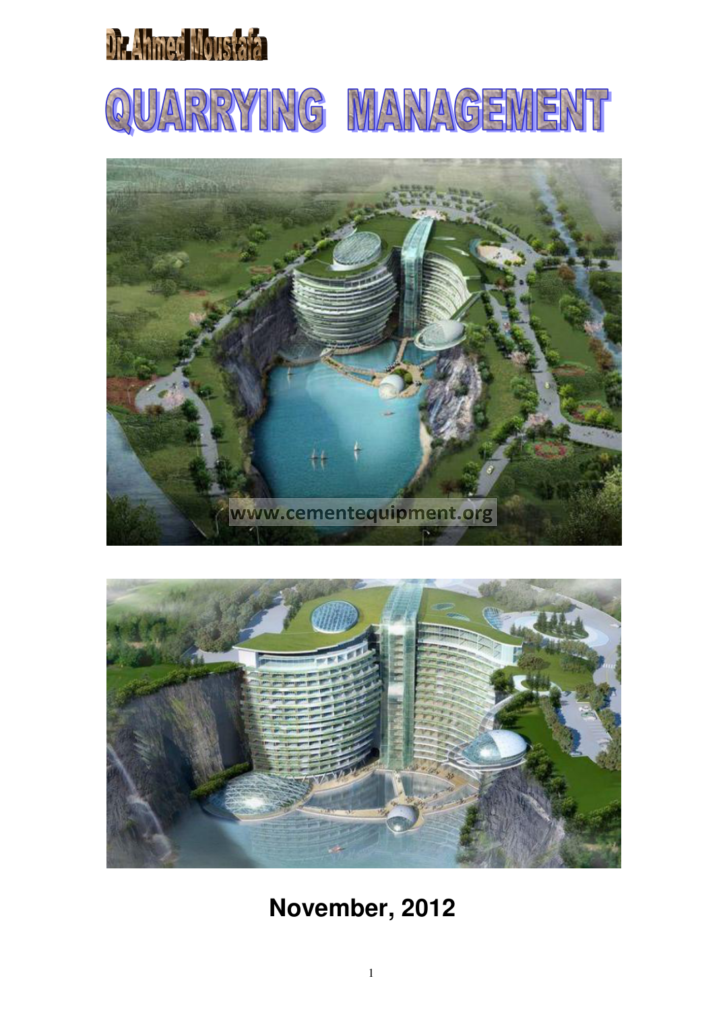
New Quarry Manegement Course: Full Course & Training Guide
The new quarry management course is the modern formation of the quarry professional: in the past the quarry was the stepchild of the cement plant, the dusty pit where the stone came from: today the quarry is the strategic resource: its chemistry, its yield, its equipment, its safety and its rehabilitation decide the cost sheet and the license to operate of the whole cement company: the course of the package is the complete curriculum of the modern quarry: from the geology to the pit plan, from the drilling to the blasting, from the crushers to the environmental closure.
The Complete Cement Technical Package (931 files including the books, the courses, the Excel tools and the presentations: $249.99 one-time: instant download via the PayPal payment) includes this quarry management course with its lectures, its case studies, its calculation sheets and its register templates: the formation covers the exploration, the planning, the extraction, the safety and the regulations: this article walks the entire course module by module: the reader acquires the vocabulary and the methodology of the modern quarry manager.
This page takes the same order as the course: the geological map first, the exploration and the reserves second, the mine plan third, the drilling and the blasting fourth, the loading and the transport fifth, the environment and the safety sixth, and the management and the economics last: the numbering of the sections matches the modules of the course: the reader can follow the file with the article beside it: the promise: after this page, the reader sees the quarry with the eyes of a manager, not only with the eyes of a visitor.
1. The Geological Basis of the Quarry: The Rocks that Feed the Cement
Every cement deposit has its story in the geology: the limestone formations of the Cretaceous and the Jurassic hold most of the world’s cement raw materials: the course begins with the geological reading of the deposit:
- The limestone families: the hard compact limestone, the chalk and the marl: the calcite content, the clay content and the hard streaks: the cement quality starts at the geology: the CaCO3 of the limestone above 75 percent for the normal plants:
- The Argillaceous component: the clay, the marl and the shales: the silica, the alumina and the iron of the raw mix: the quarry pairs the calcareous and the argillaceous: the balance of the two:
- The corrective materials: the sand, the iron ore and the bauxite: the small quarries and the purchased supplements: the correction of the chemistry of the main stone:
- The structures: the faults, the joints, the karst cavities and the clay pockets: the sudden changes of the deposit quality: the geological map of the plant: the drilling plan of the study:
- The overburden: the soil and the weathered rock above the economic layer: the stripping ratio: the cubic meters of the removed per tonne of the stone: the cost driver of the open pit:
The geological course of the file presents the base maps, the sections and the structural features with the photographs and the legends: the quarry geologist and the manager read the deposit like a book: the pages are the strata and the words are the chemistries: the file turns the science into the working knowledge of the plant: the first week of the course: the geology.
2. The Exploration and the Estimation of the Reserves
The quarry exists only after the exploration proves it: the estimation of the reserves is the bank statement of the quarry: the file takes the student through the complete exploration campaign:
- The mapping: the geological maps of the area, the satellite imagery and the previous borings: the office stage of the exploration: the plan of the drill holes:
- The drilling: the core drilling and the percussion: the grid of the holes of 100 x 100 m down to 50 x 50 for the details: each hole the sample of the strata:
- The sampling: the core logging: the density, the recovery, the chemistry of the meter-by-meter samples: the XRF of the laboratory: the moisture and the physical tests:
- The reserve classification: the measured, the indicated and the inferred: the confidence levels: the standards of the reporting: the bankable documents of the investors:
- The economic analysis: the mineable tonnes and the life of the quarry: the recoverable at the plant gate: the cost of the exploration per tonne of the reserve: the investment case:
The estimation of the reserves is the arithmetic of the future: a cement plant of 5,000 t/d consumes about 1.5 to 2 million tonnes of the raw material each year: the quarry life of 30-50 years asks for the reserves of 50-100 million tonnes of the extractable stone: the file calculates the complete case in its worked example: the reader finishes the module able to evaluate any deposit: the reserve certificate of the quarry: the profession of the exploration.
| Reserve class | Confidence | Drilling density | Use |
|---|---|---|---|
| Measured | high | 50 – 100 m grid | mine plan, design |
| Indicated | medium | 100 – 200 m grid | investment |
| Inferred | low | 200 – 400 m grid | long range plan |
The course of the file completes the module with the statistical treatment of the grades: the mean, the variance and the variogram of the deposit: the block model of the modern tools: the student of the course performs the reserves estimation on the case of the file with the Excel templates: the reality check of the module: the money of the reserves is the money of the mine.
3. The Quarry Planning: From the Block Model to the Pit Design
The mine plan is the blue book of the extraction: it says exactly where the stone comes from in the next year, the next five years and the next thirty: the course teaches the planning methodology of the modern quarry:
- The block model: the deposit divided into the blocks of known chemistry and tonnage: the three-dimensional model of the pit: the statistical engine of every plan:
- The pit design: the benches, the benches height of 10-20 m, the slope angles and the pit bottom: the safety berms and the access ramps: the geometry of the extraction:
- The sequences: the year plans by the bench: the chemistry smoothing from the alternating layers: the blending of the good and the poor stone in the sequence: the kiln feed quality in the plan:
- The relocation planning: the plant moves through the pit: the crusher relocates every years: the conveyor extensions and the road moves: the sequence is the living cost of the quarry:
- The software and the spreadsheets: the planning tools of the industry and the Excel planning templates of the package: the schedule of the benches and the grades: the optimization of the sequence:
The plan of the file: the 10-year production schedule with the monthly detail: the chemistry envelopes of every year and the blending strategies: the quality rejections of the plan: the contingencies for the weather and the equipment: the course gives the complete examples: the student builds the plan of his plant with the worksheet: the result: the quarry runs five years ahead of its own future instead of six months behind the kiln demand.
4. The Drill and the Blast: The First Fragmentation
The drilling and the blasting free the stone from the mass: the blasting design decides the fragment size, the slope stability and the safety of the surrounding: the module of the file is the complete blasting formation of the blasting certificate level:
- The drill rigs: the rotary and the percussion drills: the hole diameters 89-141 mm of the bench blasting: the drilling pattern of the grid: the meters drilled per tonne: the cost of the drilling:
- The explosives: the ANFO and the emulsions: the densities and the strengths: the initiation systems: the electric and the electronic detonators: the delays of the initiating pattern:
- The blast design: the burden, the spacing, the stemming and the sub-drill: the powder factor kg of the explosive per tonne: the fragmentation goal: the rules of the file: the tables of the burden per the hole:
- The environmental effects: the vibration at the distance, the air blast and the flying rock: the limits of the neighbors: the blast monitoring with the seismographs: the records of every blast:
- The safety of the blast: the exclusion zone, the initiation procedure, the misfire handling and the post-blast inspection: the strict operation of the file: the certification of the blasted area:
The blasting practice of the course: the complete design of the working blasts with the numbers: the burden 2 m for the 89 mm hole, the spacing 2.5-3 m, the stemming 3 m: the powder factor of the limestone 0.15-0.4 kg/t: the course gives the calculation tables and the records: the blasting is the hourly economics: the fragment too coarse robs the crusher capacity, the fines waste the energy: the discipline of the design and the monitoring: the champion module of the quarry course.
The blast design tables of the file deserve the attention: for the bench height of 15 m and the hole diameter of 115 mm the typical pattern of the file is the burden 3.0-3.5 m and the spacing 3.5-4.0 m, with the sub-drill of 1-1.5 m below the bench level and the stemming of 3-4 m: the initiation sequence with the row delays of 25-50 milliseconds produces the free face breakage: the fragmentation control is the audit: the sieve analysis of the muck pile and the loader cycle in the following hours: the good blast and the bad blast are measured by the crusher throughput: the file carries the fragmentation estimation curves and the cost comparison of the trial blasts: the student of the course performs his own pattern design against the case rock and defends the choice with the numbers: the second nature of the trained blaster.
The weather changes the blasting day: the wet holes of the rainy season need the waterproof emulsion instead of the ANFO: the cold seasons the sensitivity of the initiating systems: the static and the stray currents at the pit: the grounding of the initiation network of the electric detonators replaced by the electronic caps immune to the interference: the course explains the modern initiation: the electronic detonators with the individual programming: the millisecond precision of the pattern, the reduction of the vibration and the fly rock: the electronic initiation has become the standard of the modern quarry and the file covers the systems, the programming and the legal certification of the operators: the complete electrical initiation.
5. The Loading, the Haulage and the Crusher Feeding
Between the blasted pile and the primary crusher stands the loading and the hauling fleet: the cycle of the trucks and the shovels is the throughput machine of the quarry: the module studies the fleet economics:
- The loading equipment: the hydraulic shovels, the wheel loaders and the backhoes: the bucket size against the truck: the number of the passes: the 4-6 bucket loads per the truck standard:
- The haul trucks: the rigid dump trucks of the 40-100 t and the articulated: the cycle time, the speed curves and the grade resistances: the payload and the availability of the fleet:
- The match factor: the truck capacity against the loading rate: the idling of the trucks at the shovel: the queue of the plant: the fleet matching calculation of the file: the minimization of the waste:
- The in-pit crusher solution: the crushing inside the pit with the conveyor to the plant: the elimination of the truck cycle: the economics of the big pits: the case of the file:
- The fuel and the tires: the fuel consumption per tonne moved, the tire life and the operators: the truck payload weighing: the fleet dashboard of the plant:
The load is the loader-truck-crusher: the heartbeat of the quarry: the file shows the calculations of the fleet: the 4 trucks per the 250 t/h: the cycle of 12-15 minutes: the utilization of the 85 percent: the team learns to size and to balance the fleet with the spreadsheets: the pits of the world run the same discipline and the best plants run the same numbers: the module: the transport economics of the quarry.
The haul road is the forgotten civil asset of the pit: the road of the 25-30 m width, the 8-10 percent maximum grade, the crowned surface and the drainage beside it: the good haul road saves the 10-20 percent of the cycle time against the neglected one: the course includes the road design chapter: the curves of the road, the intersections and the pull-up areas of the crusher feed: the grader passes daily and the water truck keeps the dust down: the tires of the trucks last twice on the smooth bed: the file gives the road maintenance schedule: the grader hours per week and the base renewals: the road is the first investment of the pit that pays the second year: the attention of the manager.
The winter and the night operation close the module: the lighting of the quarry floor, the mirrors and the cameras, the visibility rules of the dark shift: the slippery ramps after the rain and the ice: the seasonal operation plan with the reduced shift hours of the fog: the high risk moments identified: the file includes the night operation checklist: the quarry security: the operating discipline of the 24-hour pits: the course: the complete operator knowledge.
6. The Quarry Safety: The Rules that the Course Drills
The quarry is the most dangerous department of the cement company: the falling rocks, the moving machines and the blasting hazards: the safety module of the course is mandatory and rigorous:
- The geotechnical stability: the bench faces, the slope angles and the signs of the movement: the inspection of the highwalls after every rain and every blast: the stability monitoring of the file: the risk of the collapse:
- The machine segregation: the exclusion zones around the shovels and the trucks: the visibility of the rear and the cameras: the traffic rules of the pit: the speed laws and the signage:
- The blasting safety: the blast area clearing, the flagging, the warning signals and the post-blast all-clear: the personal protection of the blast crew: the storage of the explosives in the licensed magazine:
- The personal protection: the helmets, the safety boots, the high-visibility vests, the hearing protection at the crusher: the respiratory protection in the dust: the PPE matrix of the file:
- The fatigue and the culture: the shift schedules of the operators, the safety observations and the reporting culture: the near miss program: the leadership of the safety: the weekly meetings of the pit:
The safety culture of the quarry is the license of the operation: the regulators inspect, the neighbors watch and the families wait: the course of the file makes the safety a weekly subject: the inspections, the checklists and the drills are documents of the course: every scale of the module: the zero harm of the quarry is the management’s first KPI: the file provides the complete system.
7. The Environment of the Quarry: The Dust, the Water and the Noise
The modern quarry earns its license from the environmental discipline: the dust, the water, the noise and the biodiversity are the regulated and the watched subjects: the module of the course covers the environmental engineering of the pit:
- The dust control: the haul road watering, the crusher dedusting, the stockpile covers and the wind fences: the dust measurement at the boundary: the limits of the local law: the ambient monitoring stations of the plant:
- The water management: the pit dewatering: the pumps and the sumps: the water treatment of the suspension: the discharge limits: the water balance of the quarry: the reuse of the pit water in the plant:
- The noise and the vibration: the blasting schedules within the allowable windows, the vibration limits at the neighbors: the noise barriers: the community relations of the file: the log of the complaints:
- The biodiversity: the topsoil stripping and the stockpiling: the protection of the species: the environmental impact assessment and the permits: the obligations of the company:
- The monitoring system: the boundary monitoring: the groundwater wells and the dust gauges: the annual environmental reports: the ISO 14001 system: the records of the course:
The environmental engineering of the modern quarry is a full discipline: the course of the file walks the pit with the checklists of the monitoring, the permits and the reports: the student evaluates the compliance of his own operation and closes the gaps: the quarry is the neighbor of the community and the environmental behavior of the plant is the local face of the cement industry: the module is the license of the future.
8. The Quarry Management and the Administration: The Office of the Pit
The quarry manager is the business manager of the extraction: the administration module of the course covers the documents, the costs and the people of the pit:
- The production reports: the daily tonnage, the drilling meters, the blast records, the truck cycles: the shift report and the daily reconciliation: the tables of the course: the KPI of the pit:
- The cost accounting: the cost per tonne of the blasted, the loaded and the driven: the explosive cost, the fuel, the tyres, the parts: the budget and the actual: the budget control of the file:
- The personnel: the drillers, the blasters, the operators and the maintenance: the manning plan of the shifts: the qualifications and the certifications: the training matrix:
- The regulations: the extraction permits, the lease obligations, the royalties and the taxes: the authorities of the industry: the compliance calendar of the plant:
- The contractor management: the drilling contractors, the blasting services and the transport: the contract documents: the KPIs and the penalties: the purchase of the explosives: the audit:
The quarry management course of the file closes its modules with the business simulation: the student acts as the quarry manager: the budget allocations, the production plan, the safety incidents and the corrective decisions: the Excel simulation of the course shows the outcomes of the decisions: the result: the practical management training without the classroom: the quarry manager thinks, and the pit responds: the complete formation of the office of the pit.
9. The New Technologies of the Quarry: The Digital Mine
The new quarry management is the digital management: the course presents the technologies that the modern pits run:
- The drone surveys: the monthly topographic flights above the pit: the point clouds and the volumes: the inventory of the piles and the faces: the audit cells: the survey without the crewers at the slope:
- The fleet management systems: the GPS on the trucks and the shovels: the live positions, the cycles and the delay codes: the productivity dashboards of the operators: the fuel control of the fleet:
- The blade of the mixed materials: the real-time chemistry of the martens in the plan: the blending model predicts the quality of every bench: the drill-core chips sampling and the XRF: the online prediction:
- The automation of the equipment: the semi-autonomous trucks and the remote shovels: the piloted pits of the first companies: the safety: the cost reduction: the optics of the file:
- The data integration: the geological, the planning, the production and the environmental in one system: the pit KPIs of the night: the decisions of the morning from the data of the day: the digital quarry management:
The digital mine of the course: the plan and the reality merge: the block model updates from the daily data: the chemistry of every exploded row known within the hour: the blending optimized instantly: the digital twin of the pit: the production, the cost and the safety visible in the office: the course of the file carries the readers through the technology, the vendors catalogue and the implementation: the quarry management of the future: the office operates the pit.
10. The Frequently Asked Questions About the Quarry Management
How many years of reserve should the cement plant have?
The industry targets the 30-50 years of the extractable reserve: the banks and the investors expect the life beyond the depreciation: the renewal of the permit and the expansion of the lease: the reserves of the file: the mining plan of the plant is drawn against the full life.
What is the powder factor of the blasting?
The powder factor is the kilograms of the explosive per tonne of the blasted rock: the 0.15-0.40 kg/t for the limestone of the cement industry, the exact value by the rock hardness and the desired fragmentation: the blasting module of the course teaches the design and the monitoring of the factor.
What is the difference between the measured and the indicated reserves?
The measured reserve has the high confidence of the dense drilling (the 50-100 m grid) and can support the detailed design: the indicated comes from the wider drilling and supports the investment decisions: the classification follows the standards of the reporting: the table of the course: the confidence of the numbers.
Can the quarry operate in the rainy season?
The pits of the rainy climates manage the water: the sumps, the dewatering pumps, the haul road covers: the plan of the extraction avoids the flooded benches: the moisture management of the feed and the clay behavior: the seasonal plan of the quarrying course
Does the package include the quarry forms and the Excel tools?
Yes: the Complete Cement Technical Package includes the quarry management tools: the reserve calculation sheets, the blast design tables, the fleet matching calculators, the cost per tonne templates and the safety checklists: the course and the tools: the 931 files: the quarry: professionally managed.
11. The Quarry of the Future: Sustainability and the Circular Operation
The quarry of the future is part of the territory, not its enemy: the course concludes with the vision:
- The zero-waste quarry: the every tonne of the stone used: the marginal materials in the subbase and the aggregates: the complete valorization of the deposit: the bookings of the course:
- The carbon neutral operation: the electrified fleets: the renewable power of the pit floor: the carbon accounting of the blasting agents: the CO2 per tonne of the raw material tracked:
- The integrated rehabilitation: the mining and the restoration in one continuous activity: the topsoil returned, the lakes formed, the sports fields and the nature reserves: the quarry becomes the legacy asset of the region:
- The community partnership: the water sharing, the jobs and the local supplies: the social license of the pit: the long-term agreement of the mine with its town:
The quarry of the future: the sustainable enterprise: the deposit that feeds the plant and returns the land richer: the new quarry management course: the formation of the manager who understands the geology, runs the pit, safeguards the people and leaves the territory better: the Complete Cement Technical Package: the complete quarry course and the 930 other files: the professional formation of the complete value chain: the quarry, the plant, the cement.
12. Final Words of the Course
The new quarry management course: the geology, the reserves, the planning, the blasting, the transport, the safety, the environment, the administration, the technology and the future: the complete curriculum of the modern quarry professional: the reader of the file leaves with the knowledge of the pit and the manager’s brain of the deposit: the quarry runs on the understanding of the marten: the plant runs on the quarry, and the cement company runs on both: the course of the package is the formation of the whole chain.
The Complete Cement Technical Package includes this quarry management course with the lectures, the examples, the checklists and the Excel tools: the one-time payment of 249.99 dollars through the PayPal: the instant download: the 931 files: the quarry course is part of the professional formation: the cement: the mine: the future: complete.
Get this quarry management course file + the full 931-file package
$249.99 — one-time purchase, instant download, lifetime access
This file is part of the Complete Cement Technical Package (931 files) available from cementequipment.org. Respective rights holders; library copy for the licensed single user.