Kc Nox Abatement: Complete Technical Guide
Module 3.6 teaches the oxygen-side and the nitrogen-side chemistries that bring the kiln’s NOx down: the abatement ladder climbs from the process-close levers that the formation module 3.5 prepared — the low-NOx burners with their shaped flames, the oxygen and the feed discipline, the staged combustion of the calciner and the mid-kiln firing that create the reducing zones where the NOx re-dissociates to the nitrogen — up to the two reagent technologies: the selective non-catalytic reduction, the SNCR, that injects the urea or the ammonia into the 850 to 1,050 degree gas and converts the NO through the radical chemistry into the nitrogen and the water, and the selective catalytic reduction, the SCR, that runs the same chemistry on the vanadium and the titanium catalyst at the 280 to 350 degrees with the 70 to 95 percent removal rates, each with its reaction mechanisms, its windows, its numbers, its slip economics and its plant practice, closing with the ammonia slip management that ties the NOx control to the blue plume questions of the module 3.8.
The Complete Cement Technical Package (931 files including the books, the courses, the Excel tools and the presentations: $249.99 one-time: instant download via the PayPal payment) includes this course module with the SNCR and the SCR design notes, the reagent dosing calculators and the emission trend tools: the same package that carries the combustion and the burner books, the gas analysis guides and the environmental engineering files: this article walks the module: the reader finishes it able to choose the abatement level that the permit demands, to size and to place the SNCR injection, to read the SCR catalyst condition from the process data, to manage the ammonia slip against its plume consequences, and to run the NOx management program that takes the plant from the formation range of the module 3.5 to the permit numbers.
The style of the module is the style of the course: the numbers first, the mechanisms second, the plant practice third: the NOx abatement story is the story of the radical chemistry and the temperature windows, and the module keeps the chemistry visible in every design and operating section, because the SNCR window and the SCR catalyst decide the success, and the engineer who knows the windows knows the plant.
1. The Abatement Hierarchy: The Process First and the Reagents Second
The module opens with the ordering principle of the NOx control, the sequence that saves the money and the reagents:
- The three-level ladder: the NOx abatement climbs the levels: the primary measures that prevent the formation, the combustion measures that restructure the flame, and the secondary measures that treat the formed NOx with the reagents, and the module teaches the discipline of using each level only after the deeper one is exhausted;
- The primary territory: the primary measures live in the process: the stable feed and the stable flame, the oxygen at the floor of the trade-off curve, the low-NOx fuel selection to the kiln, the false air elimination and the heat conservation, the measures that the formation module already taught as the NOx drivers and that here become the first abatement instruments;
- The combustion territory: the combustion measures restructure the flame and the calciner chemistry: the burner aerodynamics, the staged air and the staged fuel, the mid-kiln firing and the reducing calciner zones, the measures that create the nitrogen-dissociation chemistry inside the furnace itself;
- The secondary territory: the secondary measures treat the gas after the formation: the SNCR and the SCR reagent chemistries with their own equipment, costs and slip consequences, the measures that only the permits and the margins justify;
- The margin logic: the module fixes the economic logic of the hierarchy: the primary and the combustion measures cost the operating discipline and the moderate capital, while the reagents and the catalysts cost the running money, so the plant pursues the deepest free reduction first and sizes the reagent systems only for the remaining distance to the limit, the logic that every section of the module applies;
The hierarchy gives the module its structure: the abatement story of the kiln is a ladder rather than a single technology, and the reader learns to walk it from the bottom, pulling the process levers that the module 3.5 explained and reserving the reagent chemistry for the gap that the process cannot close, the discipline that keeps the NOx control affordable and the plant stable.
2. The Low-NOx Burners: The Flame-Shaping Chemistry
The first combustion measure attacks the flame at its source, and the module teaches the low-NOx burner design:
- The aerodynamic principle: the low-NOx burner divides the combustion air: the primary air through the burner nozzle carries the fuel in the fuel-rich core, the axial and the swirl components control the mixing, and the burner-internal staging delays part of the air, so the core temperature stays below the thermal spike of the fully mixed flame;
- The fuel-rich core: the staged burner keeps the inner flame fuel-rich: the fuel pyrolysis proceeds with the limited oxygen, the thermal NO formation is starved in the core, and the fuel and the prompt chemistry convert their nitrogen into the cyanide and the ammonia intermediates instead of the NO;
- The burnout zones: the remaining air enters downstream of the core through the staged ports and the secondary air: the intermediates oxidize and the burnout completes with the reduced peak temperature, the flame profile that the cement burners achieve with the retention of the clinker-required heat release;
- The cement-specific design: the cement kiln burners must keep the flame shape, the luminosity and the heat flux that the clinker sintering demands: the low-NOx cement burners combine the staged air with the multi-channel fuel distribution, yielding the reductions of the order of 20 to 40 percent against the conventional single-channel burners;
- The verification practice: the burner performance is verified with the flame observations, the NOx scans and the clinker quality checks, and the module teaches the plant practice: the burner settings documented, the NOx and the free lime trends correlated, and the burner worn parts replaced before the flame shape drifts, the maintenance that keeps the design NOx reduction real;
The burner section is the first design answer to the formation module: the flame that the module 3.5 showed as the thermal NO factory is reshaped, not extinguished, and the reader learns the aerodynamics of the fuel-rich core and the staged air as the burner-level chemistry that preserves the clinker-burning duty while cutting the NOx by the tens of percent.
3. The Process Optimization: The Oxygen, the Feed and the Fuel Levers
The second rung of the ladder is the operating discipline, and the module teaches its numbers:
- The oxygen floor: the kiln exit oxygen held at the floor of the trade-off curve, the 1.5 to 2.5 percent range of the well-tuned plants, cuts the thermal NO by the order of 10 to 30 percent against the loose 3 to 4 percent operation, with the CO of the module 3.3 watched on the other edge of the window;
- The feed stability: the stable feed and the stable fuel ratio hold the flame and the calciner steady: the automatic kiln control that smooths the feed variations removes the NOx spikes of the module 3.5, and the module teaches the operating statistics: the plants with the tight feed control run the lower average NOx with the smaller variance for the same quality;
- The fuel-to-the-calciner shift: the fuel split between the kiln and the calciner moves the NOx chemistry: the higher the share of the fuel burned in the cooler calciner zone, the less the hot kiln flame carries, and the module teaches the split optimization with the calciner heat duty as the constraint;
- The false air and the seal discipline: the false air of the kiln hood, the seals and the tower admissions raises the effective oxygen and cools the zones: the seal repairs and the pressure management cut the NOx as they cut the heat loss, the double benefit the plant measures in both ledgers;
- The temperature control: the burning zone temperature held at the minimum that the clinker quality accepts, the free lime and the belite checks as the quality gate, reduces the flame demand and the thermal NO with it, the process-close lever that ties the module 3.5 temperature law to the daily operation;
The process optimization is the cheapest rung of the ladder: the oxygen floor, the feed stability, the fuel split, the seals and the temperature control deliver the tens of percent with the operating discipline alone, and the reader learns to quantify the process-close reduction before any reagent is ordered, the habit that the module 3.6 teaches as the first rule of the NOx economy.
4. The Staged Combustion and the Mid-Kiln Firing: The Reducing Zones
The third combustion measure creates the reducing chemistry inside the gas path, and the module teaches the reburning concept:
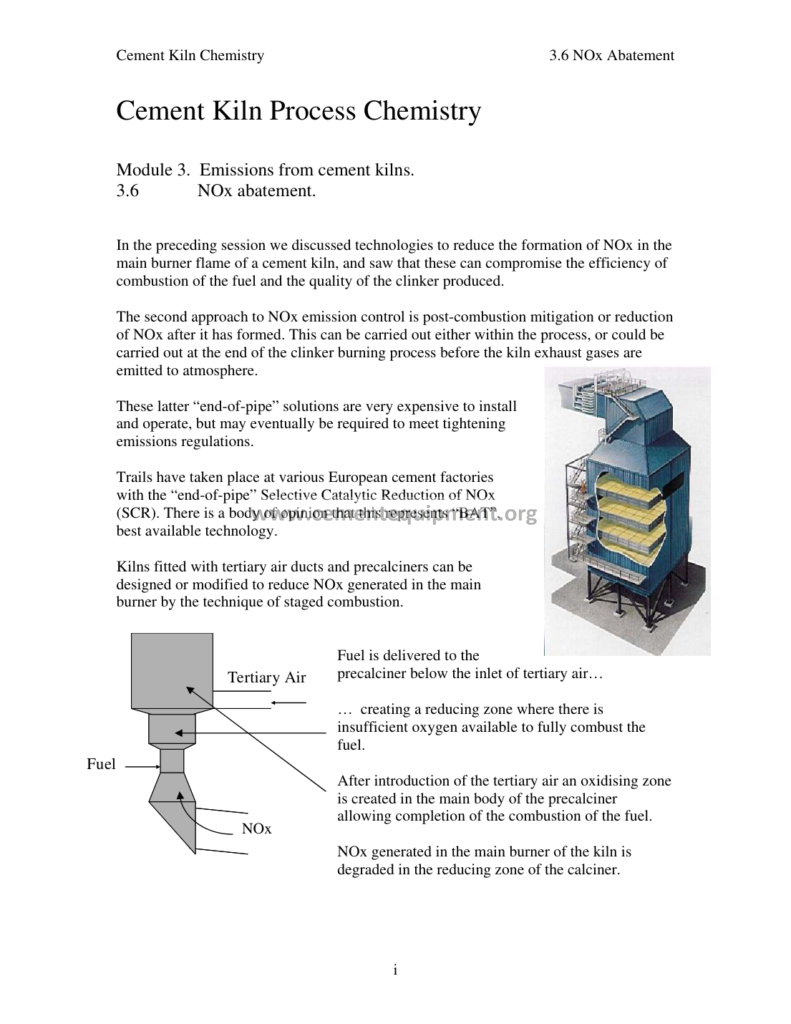
- The calciner air staging: the calciner receives its combustion air in the stages: the fuel and part of the tertiary air enter at the bottom, and the remaining air upstream, so the lower zone runs fuel-rich, creating the reducing atmosphere where the NOx arriving from the kiln dissociates back to the nitrogen;
- The mid-kiln firing: the mid-kiln fuel injection introduces the fuel at the kiln midpoint: the fuel volatiles burn in a local fuel-rich region that reduces the kiln NOx before it leaves the kiln, the reburning chemistry where the hydrocarbon radicals and the ammonia intermediates react with the NO from the flame zone;
- The reburning mechanisms: the reduction runs through the radical chemistry: the hydrocarbon fragments and the cyanide and the ammonia intermediates reduce the nitrogen monoxide to the nitrogen rather than oxidizing, the chemistry that the module teaches with the same intermediates as the fuel-NOx route of the module 3.5, now turned to the protective direction;
- The performance numbers: the staged and the reburning measures deliver the reductions of the order of 20 to 40 percent at the system level in the cement kilns that implement them, with the calciner staging the most cost-effective of the family;
- The quality constraints: the reducing zones carry their constraints: the oxygen shortage must not reach the clinker quality and the CO safety margins of the module 3.3, and the mid-kiln firing must not disturb the coating and the bed chemistry, the module’s honest boundary between the NOx gains and the process risks;
The staged combustion section teaches the in-process nitrogen dissociation: the kiln’s own reducing chemistry, fed by the staged air and the staged fuel, destroys the NO that the hot flame created, and the reader learns to see the calciner and the kiln as the reactor volumes where the reduction is baked in, the approach that delivers the tens of percent without any reagent cost.
5. The SNCR Chemistry: The Urea and the Ammonia Reactions
The first reagent technology converts the remaining NO by the thermal radical chemistry, and the module teaches the SNCR mechanisms:
- The ammonia route: the ammonia, injected as the ammonia water or the gaseous ammonia, decomposes into the amino radicals, and the radicals react with the NO through the chain: the NH2 radicals reduce the NO into the nitrogen and the water in the overall reaction of the four NO, four ammonia and one oxygen into four nitrogen and six water, the chemistry that the selective non-catalytic reduction runs at the temperature window;
- The urea route: the urea, the carbamide, decomposes thermally first into the ammonia and the isocyanic acid, and the isocyanic acid hydrolyzes into the additional ammonia and the CO2, so the urea solution delivers the same reduction chemistry with the safer handling at the price of the decomposition step;
- The temperature window: the reduction runs in the narrow temperature band of roughly 850 to 1,050 degrees Celsius: below about 800 the ammonia passes unreacted as the slip, and above about 1,100 the ammonia oxidizes into the NO again, the double-edged window that decides the injection placement of the plant;
- The normal stoichiometric ratio: the effective dosing runs the ammonia above the stoichiometric need: the normalized stoichiometric ratio of the order of 1.5 to 3, meaning the 1.5 to 3 moles of the ammonia per mole of the NO, with the excess covering the mixing imperfections and the window losses;
- The performance numbers: the well-designed SNCR achieves the NOx reductions of the order of 40 to 70 percent in the cement kiln application, taking a 600 to 800 milligram kiln toward the 200 to 400 range, with the reduction limited by the window residence and the mixing rather than by the chemistry;
The SNCR chemistry is the radical bridge between the gas and the nitrogen: the injected reagent decomposes into the radicals that carry the NO back to the nitrogen, and the reader learns the window, the ratio and the conversion numbers together, because the placement of the injection in the next section only makes sense with the window chemistry of this section in mind.
6. The SNCR Engineering: The Injection Placement and the Dosing
The chemistry finds its places in the tower, and the module teaches the SNCR engineering:
- The injection locations: the reagent is injected where the gas holds the window temperature: for the precalciner kilns, the riser duct between the kiln exit and the lowest cyclone stage and the lowest calciner zones carry the 850 to 1,050 degree gas, the classic SNCR injection zone with the residence of the order of one to three seconds;
- The lance design and the atomization: the reagent enters through the multi-nozzle lances as the finely atomized droplets: the droplet size of the order of 50 to 200 microns, the air-assisted atomization, and the lance geometry that distributes the reagent across the duct cross-section, the mixing quality that decides the ratio demand and the slip;
- The staging across the load: the gas temperature at the injection point moves with the load: the plants stage the injection into the multiple elevation lances, activating the higher or the lower banks as the load and the temperature shift, keeping the reagent inside the window across the operating range;
- The dosing control: the reagent flow follows the NOx measurement: the closed-loop control reads the stack or the kiln exit NOx and modulates the pump, with the feedforward from the load and the fuel, the control structure that keeps the average reduction while the peaks are clipped, and the module teaches the control tuning that balances the reduction against the slip;
- The reagent storage and the safety: the urea solution stores as the harmless aqueous liquid, the ammonia water with its vapor pressure and the gaseous ammonia with its hazards follow the handling codes, and the module teaches the storage, the dosing and the safety systems that the reagent choice settles, with the urea favored where the transport and the safety dominate;
The engineering section converts the SNCR chemistry into the installed system: the riser duct lance banks, the atomization, the load staging and the closed-loop dosing are the hardware of the window chemistry, and the reader leaves the section able to specify and to operate an SNCR train, reading the NOx, the slip and the temperature to keep the reagent inside the 850 to 1,050 degree bank.
7. The SCR: The Catalyst Chemistry and Its Windows
The second reagent technology runs the same reduction on the catalyst, and the module teaches the SCR chemistry:
- The catalytic reaction: the SCR reduces the NO with the ammonia on the catalyst surface: the four NO, four ammonia and one oxygen react into the four nitrogen and the six water over the catalyst, the same overall chemistry as the SNCR but run at the 280 to 350 degree temperatures where the catalyst activates the reaction;
- The catalyst material: the industrial catalyst stacks the vanadium pentoxide as the active phase, the tungsten trioxide as the promoter and the titanium dioxide as the support, formed into the honeycomb and the plate geometries that maximize the surface per volume, with the cerium and the other dopants in the newer formulations;
- The temperature window: the SCR works the 280 to 350 degree band: above about 400 the ammonia oxidizes and the catalyst sinters, and below about 250 the sulfur chemistry forms the ammonium sulfates that blind the pores, the window that places the cement SCR modules in the specific gas path positions;
- The selectivity and the performance: the catalyst selectively carries the NO reduction over the oxygen oxidation, achieving the 70 to 95 percent removal at the design velocity: the NOx concentrations of 700 milligrams entering a well-designed SCR exit at the 50 to 100 milligram levels, the performance that the module 3.6 presents as the deep-reduction end of its ladder;
- The catalyst life and its decay: the catalyst activity decays with the operating years: the poisoning by the alkalis, the arsenic and the phosphorus of the cement dust, the blinding by the dust and the ammonium salts, and the thermal sintering, with the industrial lifetimes of the order of the years and the layer-by-layer management;
The SCR chemistry is the deep-reduction instrument: the catalyst surface removes the radical-temperature constraint of the SNCR, running the same nitrogen chemistry at the moderate temperatures with the 70 to 95 percent rates, and the reader learns the catalyst materials, the window and the decay modes together, because the cement-specific placement of the next section exists precisely where those constraints meet.
8. The SCR in the Cement Plant: The Placement and the Dust Management
The cement gas path offers the catalyst few homes, and the module teaches the cement-specific SCR engineering:
- The placement dilemma: the gas leaves the preheater at the 280 to 350 degrees, the SCR window, but loaded with the dust of the order of 30 to 100 grams per normal cubic meter: the catalyst placed there, the “high-dust” configuration, avoids the reheating but faces the erosion, the blinding and the poisoning of the alkaline dust;
- The configuration options: the plants weigh the configurations: the high-dust SCR after the preheater with the dust load on the catalyst, the tail-end SCR after the desulfurization and the dedusting with the cleaned gas but the reheating to the window, and the bypass-split configurations that combine the cleaning and the economy;
- The dust management on the catalyst: the high-dust modules run the soot-blowing and the rapping systems, the vertical flow designs that shed the dust, and the catalyst pitches and the plate spacings selected for the plugging resistance, with the pressure-drop and the activity monitoring telling the fouling story;
- The poisoning management: the alkaline dust and the volatile species of the modules 1 and 2 poison the vanadium: the plants with the high alkali and the chloride loads protect the catalyst with the dust bypass decisions and the periodic activity tests, and the module teaches the catalyst management cycle of the testing, the washing and the layer replacement;
- The ammonia injection for the SCR: the SCR requires the tight ammonia dosing from its own injection grid: the static mixers upstream of the catalyst distribute the reagent, and the ammonia slip target of the order of 5 milligrams per normal cubic meter at the stack sets the margin that the injection control maintains, the interface to the slip management of the section 10;
The cement SCR section teaches the reader the hard reality of the deep abatement: the catalyst lives where the temperature is right and the dust is heavy, and the engineering of the placement, the dust management and the ammonia grid decides whether the 70 to 95 percent chemistry works in the years or decays in the months, the practice that the module trains in detail.
9. The Ammonia Slip: The Chemistry of the Excess Reagent
The reagent that misses the reaction leaves the stack, and the module teaches the slip chemistry:
- The slip sources: the ammonia leaves the system wherever the chemistry fails to consume it: the SNCR reagent below the window temperature, the over-dosed reagent in the cold pockets, the SCR reagent beyond the catalyst capacity, and the decomposition products of the urea that never reach the NO, the sum that the plants measure as the slip;
- The slip numbers: the ammonia slip of the well-tuned SNCR runs in the range of 5 to 30 milligrams per normal cubic meter, the SCR systems target the 5 and below, and the permits quote the ammonia limit values of the order of 10 to 30 depending on the jurisdiction, so the slip is a regulated species in its own right;
- The plume interface: the slipped ammonia meets the sulfur trioxide in the cooling gas: the two species condense into the ammonium sulfate and the ammonium bisulfate aerosols, the sub-micron mist that the filter passes and the plume shows as the blue haze, the interface to the module 3.8 that the module 3.6 flags for the reader;
- The deposition consequences: the ammonium bisulfate deposits onto the dust, the ducts and the heat exchanger surfaces: the sticky salt builds the deposits that plug the filter bags and corrode the duct metal, so the slip control is also the maintenance protection of the downstream equipment;
- The dosing balance: the operating art of the reagent systems is the slip-reduction balance: the more the reagent, the deeper the NOx cut and the higher the slip, and the module teaches the operating point selection that keeps both the NOx and the ammonia inside their limits, the dual-target control that the modern systems run automatically;
The slip section gives the module its second regulated species: the ammonia that rides the nitrogen chemistry is itself a pollutant, a plume maker and a deposit builder, and the reader learns to manage the NOx and the ammonia as the coupled pair, the balance that the dosing control and the window discipline hold together.
10. The Combined Strategies and Their Numbers
The ladder delivers its full depth only in the combination, and the module teaches the strategy synthesis:
- The process-only plant: the well-run kiln with the low-NOx burner, the oxygen floor and the calciner staging reduces its formation from the 800 to 1,200 to the 400 to 600 milligram range, the level that the older and the moderate permits accept without the reagents;
- The process plus the SNCR plant: the addition of the SNCR at the 40 to 70 percent reduction takes the same kiln to the 200 to 300 milligram levels, the configuration that serves the European 200 to 500 permit values with the moderate capital and the reagent cost;
- The process, the SNCR and the SCR plant: the SCR at the 70 to 95 percent reduction closes the account at the 50 to 100 milligram levels, the configuration of the newly built plants under the tightest permits, with the catalyst capital and the ammonia discipline as the price;
- The selection logic: the module teaches the selection matrix: the permit level decides the target, the formation level of the module 3.5 decides the required reduction, the process-close potential decides the free share, and the reagent systems cover the remaining gap, with the fuel, the dust and the site layouts weighing the SNCR against the SCR;
- The measured outcomes: the industry outcomes that the module quotes: the modern European best-practice kilns report the annual average NOx concentrations in the range of 150 to 300 milligrams per normal cubic meter with the SNCR combinations and below 100 with the SCR, the level of the module’s combined-strategy evidence;
The synthesis section converts the individual technologies into the plant strategy: the NOx target of the permit selects the rung of the ladder, and the reader learns to compose the process measures, the SNCR and the SCR into the designed combination with the expected numbers on every rung, the composition skill that the engineering of the NOx control actually is.
11. The Costs and the Trade-offs of the Abatement Systems
The module refuses the technology without the price, and it teaches the economics of the ladder:
- The process measures’ economics: the oxygen, the feed and the seal measures cost the operating time and the minor capital: their cost per tonne of the NOx avoided is the lowest of the ladder, often negative once the heat savings of the seal repairs are counted;
- The SNCR economics: the SNCR carries the reagent bill: the urea and the ammonia of the order of 50 to 200 euros per tonne of the NOx removed depending on the reagent, the dosing efficiency and the local prices, with the capital of the lances, the storage and the controls amortized over the years;
- The SCR economics: the SCR carries the catalyst capital of the millions and the layer replacements: its cost per tonne of the NOx removed runs above the SNCR at the moderate reductions but falls into the competitive range where the deep reduction to the 50 to 100 milligram levels is the only route, the economics that the module presents with the honest ranges;
- The energy and the operation trade-offs: the reagent systems add the small energy demands of the pumps, the atomizing air and the fan pressure for the catalyst, while the process measures save the energy, and the module teaches the reader to carry both directions in the cost comparison;
- The decision horizon: the module closes the economics with the horizon: the permit trajectory, the fuel portfolio and the plant lifetime decide the investment: the plants with the long remaining life and the tightening permits justify the SCR, and the others hold the SNCR and the process rungs, the decision logic that the module gives the reader as the capital-planning instrument;
The economics section completes the abatement picture: every rung of the NOx ladder now carries its cost, and the reader learns to compose the plant’s NOx strategy with the tonne-economics in hand, the composition that balances the permit, the reagents and the capital the way the module 3.6 has taught the chemistry and the numbers of each technology.
12. The Plant Practice: The NOx Management Program
The module closes its teaching with the operating program that holds the abatement systems at their design performance:
- The daily control routine: the shift routine watches the NOx and the oxygen at the kiln exit, the calciner temperatures, the reagent pump rates and the slip trend, with the correlation charts of the module 3.5 updated and the combustion events logged against the NOx peaks;
- The reagent and the catalyst care: the SNCR systems follow the nozzle cleaning, the dose calibration and the lance inspections, and the SCR modules follow the pressure-drop, the activity and the ammonia-grid checks, the maintenance that keeps the chemistries of the sections 5 to 8 at their design numbers;
- The limit response: the rising NOx toward the permit margin triggers the response ladder: first the process-close tightening of the oxygen and the feed, then the reagent dosing raise, and then the investigation of the flame, the fuel and the calciner events, the response order that the module teaches as the operating protocol;
- The seasonal and the fuel adjustments: the summer and the winter ambient conditions and the fuel blend changes move the windows: the injection elevation switches and the catalyst load expectations follow, and the module teaches the seasonal plans that the plants run to hold the annual averages stable;
- The reporting and the improvement cycle: the monthly NOx summary against the permit averages, the annual abatement review with the costs and the removals, and the improvement projects prioritized on the ladder of the section 1, the cycle that turns the module’s teaching into the plant’s continuous NOx program;
The plant practice section turns the module into the running program: the NOx management of the cement kiln is the daily correlation, the reagent and the catalyst care, the limit response and the seasonal adjustments, and the reader who runs the program holds the NOx story of the plant in the control room rather than discovering it in the monthly report.
13. The Abatement and the Wider Process Chemistry
The module closes by placing the NOx abatement inside the process chemistry that the course has taught:
- The chemistry interactions: the NOx measure move the neighbor pollutants: the reduced oxygen raises the CO of the module 3.3, the ammonia feeds the plume chemistry of the module 3.8, and the staged fuel changes the calciner temperature and the alkali cycles of the module 1, so the abatement decisions are the system decisions, the module’s honest reminder;
- The sulfur interface: the sulfur chemistry and the NOx control meet at the ammonium salts: the SO3 of the fuel and the raw meal pairs with the slipped ammonia at the low temperatures, the blue plume chemistry of the module 3.8 and the deposition that the sections 9 has taught, the coupling that the plants with the SNCR and the high-sulfur materials feel the most;
- The carbon and the energy interfaces: the deep NOx abatement consumes the energy and the reagents that carry their own carbon footprints: the urea and the ammonia manufacture and the catalyst supply add the embodied emissions, and the module teaches the reader to carry the footprints in the carbon accounting of the module 3.2, the trade that the low-carbon plants now quantify;
- The control synergy: the modern plant control integrates the goals: the oxygen trades the NOx against the CO, the dosing trades the reduction against the slip, and the process optimization holds the clinker quality, the heat and the emissions on the same control surfaces, the integration that the module presents as the final operating skill of the NOx engineer;
- The trajectory: the module closes with the forward view: the SNCR and the SCR installations multiply across the industry as the permits tighten, the catalyst formulations improve against the poisoning, and the NOx abatement joins the carbon capture equipment in the emission hall of the future plants, the direction that the reader of the module 3.6 now reads with the mechanism-level understanding;
The integration section completes the module: the NOx abatement is not an island but the member of the pollutant system that the course part 3 teaches, and the reader leaves the module 3.6 with the full ladder, from the flame aerodynamics through the reducing zones and the reagent windows to the catalyst chemistry, and with the understanding that the NOx control of the cement kiln is the chemistry of the nitrogen, applied cleverly, and the discipline that runs it.
The Frequently Asked Questions
Which NOx abatement should the plant choose, the SNCR or the SCR?
The choice follows the target: the SNCR with its 40 to 70 percent reductions and the modest capital serves the 200 to 400 milligram permit levels at the 50 to 200 euro per tonne reagent cost, while the SCR with its 70 to 95 percent rates and the catalyst capital serves the 50 to 100 milligram targets of the new and the tightest plants, with the process-close measures and the low-NOx burners cutting the base of every strategy first.
Why is the SNCR temperature window so narrow?
Because the ammonia chemistry is double-edged: below about 850 degrees the reagent passes as the slip without the reaction, and above about 1,050 degrees the ammonia oxidizes into the NO again, so the injection must ride the 850 to 1,050 degree band, the reason the SNCR lances sit in the riser duct of the precalciner kiln and stage across the load.
What does the normalized stoichiometric ratio of the SNCR mean?
It is the ratio of the injected ammonia to the ammonia that the NO would stoichiometrically need: the industrial ratios of 1.5 to 3 deliver the 40 to 70 percent reductions, the excess covering the imperfect mixing and the window losses, with the slip rising as the ratio climbs, the balance that the dosing control holds.
How does the cement dust affect the SCR catalyst?
The dust of the preheater gas poisons and blocks: the alkalis, the arsenic and the phosphorus poison the vanadium activity, the dust erodes and blinds the channels, and the ammonium salts blind the pores at the low temperatures, so the cement SCR runs the dust-management systems and the activity testing, with the lifetimes of the order of the years and the layer replacement practice.
Why does the ammonia slip matter beyond its own limit value?
Because the slipped ammonia reacts with the sulfur trioxide in the cooling gas into the ammonium sulfate and the bisulfate aerosols, the sub-micron mist that shows as the blue plume of the module 3.8, and the sticky salts that deposit on the ducts and the filter bags, so the slip is the coupling point between the NOx control and the neighborhood and the maintenance questions.
Can the cement kiln meet the tight NOx limits without the reagents?
Only the moderate ones: the process-close ladder of the low-NOx burner, the oxygen floor, the stable feed and the calciner staging takes the kiln from the 800 to 1,200 milligram formation toward the 400 to 600 range, so the plants with the 400 to 500 permits run without the reagents, while the 200 and the 100 milligram targets demand the SNCR and the SCR respectively.
The module 3.6 has taught the complete NOx abatement ladder of the cement kiln: the process-close measures of the flame, the oxygen, the feed and the seals, the combustion measures of the staged air and the mid-kiln firing, the SNCR radical chemistry with its 850 to 1,050 degree window and its 40 to 70 percent reductions, the SCR catalysis with its 280 to 350 degree modules and its 70 to 95 percent rates, the slip management and the costs, the reader leaves able to compose the plant’s strategy from the formation profile of the module 3.5 to the permit number, with the chemistry and the numbers of every rung in hand.
The Complete Cement Technical Package includes this course with the SNCR and the SCR design notes, the reagent dosing calculators and the emission trend tools: the one-time 249.99: the instant download: the abatement module is the practical half of the NOx story, and the reader now owns the full instrument set, the low-NOx flame, the staged calciner, the reagent windows and the catalyst care, that keeps the kiln inside the permitting numbers of today and the tightening numbers of tomorrow.
The module closes with the operating summary of the NOx abatement: the process rungs come first and free, the reagent rungs follow at their price, the windows decide the success and the slip pays the excess, so the plant that walks the ladder in the order that this module teaches holds the nitrogen chemistry of its kiln in its own hand, from the flame core to the stack.
The reading plan for the engineer: quantify the process-close reduction potential with the correlation charts of the module 3.5, place the SNCR injection against the load-resolved temperature profile, and reserve the SCR decision for the permit trajectory, because the NOx abatement of the module 3.6 is the chemistry of the nitrogen applied in the right order, and the reader now knows the order.
Get this kiln chemistry file + the full 931-file package
$249.99 — one-time purchase, instant download, lifetime access
This file is part of the Complete Cement Technical Package (931 files) available from cementequipment.org. Respective rights holders; library copy for the licensed single user.