Kc Polymorphs: Complete Technical Guide
The polymorphs are the multiple faces of the same chemistry: the alite that forms at 1,450 degrees changes its crystal structure as it cools, the belite flips between five forms, and the aluminate switches its symmetry with the sodium it absorbs: the same chemical formula, the same atoms, arranged in the different crystal patterns that the temperature and the impurities freeze into the clinker: the polymorph module 2.7 teaches the identities of these forms, the temperatures of the transitions, and the plant practice that decides which forms the cooler delivers to the mill: the polymorphism is the memory of the thermal history written in the crystal lattice.
The Complete Cement Technical Package (931 files including the books, the courses, the Excel tools and the presentations: $249.99 one-time: instant download via the PayPal payment) includes this course module with the polymorph identification charts, the XRD reference patterns and the cooling practice tables: the same package that carries the cement chemistry of Taylor, the clinker microscopy files and the kiln process documents: this article walks the module: the reader finishes it able to name the polymorphs of his own clinker, to explain why the clinker dusts or hardens as it cools, and to steer the cooling and the stabilizer chemistry that freeze the reactive forms.
The style of the module is the style of the course: the numbers first, the mechanisms second, the plant practice third: the polymorphism is the crystalline backbone of the clinker science, and the module selects exactly the parts that the kiln and the quality laboratory use: the alite family, the belite family and its dusting trap, the aluminate symmetry, the ferrite series, and the microscopy and the XRD fingerprints that identify the forms in the plant, closing with the cooling discipline that every plant can apply.
1. What Polymorphism Is and Why the Clinker Cares
The module opens with the definition that carries the whole story:
- The definition: the polymorphism is the property of a chemical compound to crystallize in more than one crystal structure, with the same atoms and the same formula arranged in the different lattices, and the different structures are the polymorphs of the compound;
- The driver: the temperature decides the structure: each polymorph is stable in its own temperature window, the crystal flips between the forms at the fixed transition temperatures as it heats and cools, and the flips are fast reconstructive or displacive rearrangements of the lattice;
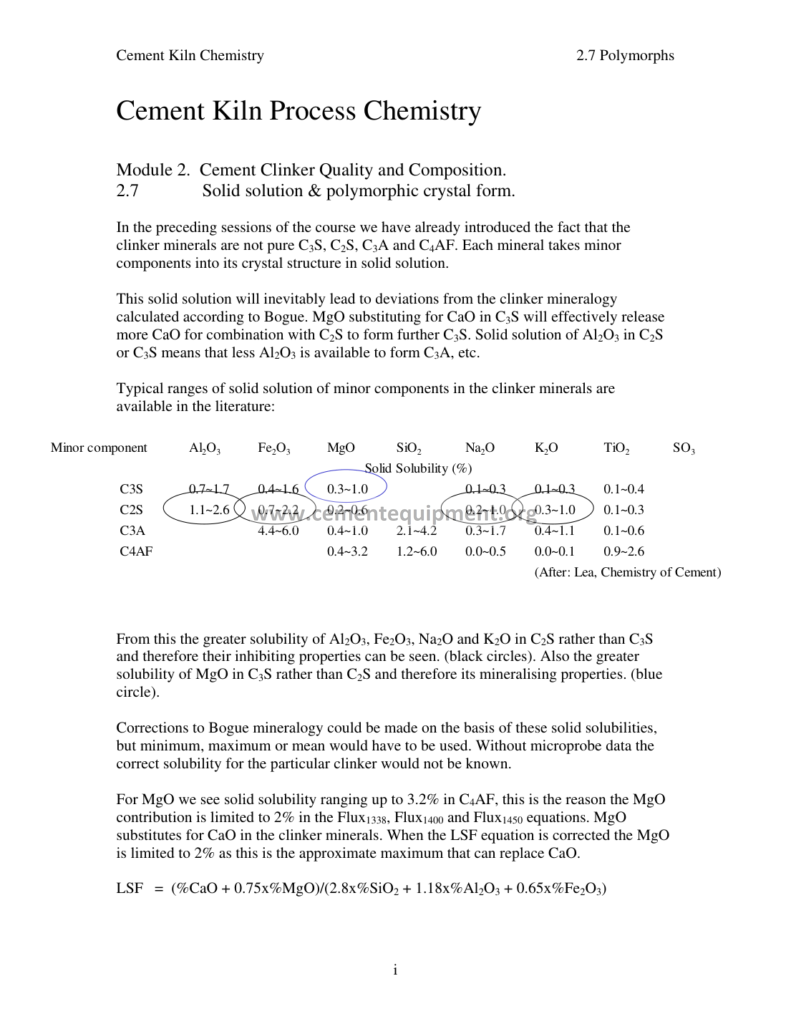
- The impurity stabilizer: the foreign oxides dissolved in the crystal shift the stability windows: the magnesium, the aluminium and the alkali in the alite lattice stabilize the high-temperature forms down to the room temperature, which is why the industrial clinker never shows the pure forms of the laboratory;
- The property consequence: the different polymorphs of the same phase react differently with the water: the reactive belite of the plant is the beta form, the inert one is the gamma form, and the strength, the heat and the setting of the cement hang on which forms the cooler froze;
- The plant relevance: the cooling path, the raw material minors and the fuel ash all decide the polymorph inventory of the clinker, and the module 2.7 teaches the engineer to recognize the inventory and to steer it, because the polymorphs are the cheapest quality instrument that the plant never installed;
The polymorphism is the hidden geometry of the clinker quality: the oxide analysis of the laboratory says how much of each phase should exist, the polymorph module says in which crystal form it exists, and the form carries the reactivity that the percentages alone cannot tell.
2. The Alite Family: The Seven Polymorphs and Their Transitions
The alite is the aristocrat of the clinker phases and the most polymorphic, and the module presents the complete family with the transition temperatures that the literature established:
| Polymorph | Crystal system | Stable above | Transition |
|---|---|---|---|
| Alite T1 | Triclinic | Room temperature | Pure alite form at 20 °C |
| Alite T2 | Triclinic | 620 °C | T1 → T2 at about 620 °C |
| Alite T3 | Triclinic | 920 °C | T2 → T3 at about 920 °C |
| Alite M1 | Monoclinic | 980 °C | T3 → M1 at about 980 °C |
| Alite M2 | Monoclinic | 990 °C | M1 → M2 at about 990 °C |
| Alite M3 | Monoclinic | 1,060 °C | M2 → M3 at about 1,060 °C |
| Alite R | Rhombohedral | 1,070 °C | M3 → R at about 1,070 °C |
- The temperature ladder: the seven forms climb the ladder from the triclinic at the room temperature through the monoclinic triplets to the rhombohedral at the top, and the transitions between 620 and 1,070 degrees mark the steps of the ladder;
- The pure alite at home: the pure tricalcium silicate, free of the impurities, cools all the way to the triclinic T1, and the laboratory crystals of the pure synthesis show exactly this low-symmetry form at the room temperature;
- The industrial forms: the alite of the plant clinker is stabilized in the monoclinic M3 and the M1 forms, with the traces of the rhombohedral, because the industrial crystal lattice carries the magnesium, the aluminium and the iron that the pure system does not have;
- The transition speed: the displacive transitions between the alite forms are fast and reversible, so the crystal follows the temperature almost instantly, and the form found in the clinker is the form stable at the temperature where the crystal stopped the rearrangement;
- The identity habit: the module notes that the names alite and C3S are used interchangeably in the plant language, but the strict literature reserves the name alite for the C3S solid solutions of the industrial clinker, and the module follows the plant habit with the technical precision;
The alite family is the fingerprint of the burning and the cooling: the monoclinic forms dominate the well-burned industrial clinker, the triclinic forms appear in the low-impurity syntheses, and the XRD pattern of the plant alite identifies the form in the same way that the microscope identifies the crystal habit.
3. The Stabilization of the Alite: The Impurities That Hold the Forms
The seven forms would be a laboratory curiosity if the impurities did not hold the high-temperature structures at the room temperature, and the module teaches the stabilizer chemistry that the plant actually steers:
- The magnesium stabilizer: the MgO is the most effective stabilizer of the monoclinic M3 form: the clinkers with the MgO above about 1 to 2 percent show the strong M3 patterns, and the magnesium replaces the calcium in the alite lattice and locks the high-temperature symmetry in place;
- The aluminium and the iron: the Al2O3 and the Fe2O3 of the clinker substitute into the alite and shift the balance toward the M1 form, and the module notes that the two monoclinic forms of the industrial alite reflect the relative levels of the fluxing oxides;
- The alkali effect: the potassium and the sodium in the alite lattice push toward the rhombohedral and the high-symmetry forms, and the alkali-bearing clinkers of module 2.6 show the alite forms that the low-alkali clinkers never display;
- The sulfur and the phosphorus: the SO3 and the P2O5 of the fuels and the meal enter the alite in the small amounts and participate in the stabilization, and the alternative-fuel plants find their alite forms shifted by the fuel chemistry;
- The balance discipline: the stabilizer levels are the minor oxides of the raw mix, so the quarry, the blending and the fuel choices of the plant set the alite forms months before the kiln burns the meal, and the module teaches the quality department to read its own alite patterns as the mirror of its raw material policy;
The stabilization story connects the polymorph module with the raw materials and the fuels: the crystal forms of the alite are the fingerprint of the minor oxide policy, and the plant that knows its forms knows whether its raw material mix is delivering the reactive alite or only the appearance of it.
4. The Belite Family: The Five Forms and the Dusting Trap
The belite carries the richest polymorphism of the clinker and the most dangerous trap, and the module presents the family with the temperatures:
| Polymorph | Crystal system | Stable range | Reactivity note |
|---|---|---|---|
| Alpha belite | Orthorhombic / hexagonal | Above about 1,425 °C | The highest-temperature form |
| Alpha prime H | Orthorhombic | About 1,160 – 1,425 °C | High variant of the alpha prime |
| Alpha prime L | Orthorhombic | About 690 – 1,160 °C | Low variant of the alpha prime |
| Beta belite | Monoclinic | Stable below about 690 °C | The reactive form of the industrial clinker |
| Gamma belite | Orthorhombic | Below about 500 °C on cooling | The inert form, the cause of the dusting |
- The cooling cascade: the belite that forms near 1,400 degrees races through the alpha prime and the beta windows as it cools, and the final form depends on how fast it crosses the last steps of the cascade;
- The beta form at home: the industrial clinker holds its belite in the reactive monoclinic beta form, stabilized by the potassium, the sodium, the aluminium and the phosphorus dissolved in the lattice, and the beta belite is the form that the strength of the cement counts;
- The gamma threat: on the slow cooling through the band near 500 to 700 degrees, the beta form transforms into the gamma form, and the gamma belite is the inert, useless phase that no longer reacts with the water;
- The volume explosion: the beta to gamma transformation expands the crystal volume by roughly 10 to 12 percent, and the internal stress of the expansion shatters the clinker grains, the phenomenon that the industry calls the dusting of the clinker;
- The dusting result: the fully dusted clinker crumbles into the fine powder in the cooler and the silo, the alite itself survives but the material handling, the cooling and the grinding are damaged, and the plant that loses the clinker to the dusting loses the production it already paid the fuel for;
The belite family is the warning system of the module: the beta form is the quality, the gamma form is the loss, and the transition between the two is the temperature trap that the cooling control of section 6 must avoid with the discipline of the fired processes.
5. The Gamma Belite and the Dusting: The Clinker That Turns to Powder
The dusting deserves its own section because it is the most dramatic and the most avoidable polymorph event of the cement plant, and the module documents the phenomenon completely:
- The history of the recognition: the early cement plants lost the clinker batches to the mysterious disintegration, and the identification of the gamma belite and its volume expansion closed the case: the dusting is a polymorph event, not a chemical failure;
- The conditions of the dusting: the dusting requires the belite-rich clinker and the slow cooling through the transition band: the belite-rich mixes with the low flux and the slow coolers are the classical dusting recipes, and the high-lime, well-burned mixes with the fast cooling rarely suffer it;
- The stabilizer shields: the alkali, the aluminium, the iron and the phosphorus in the belite lattice hold the beta form and block the gamma transformation, so the same impurities that stabilize the alite protect the belite, and the alkali-poor, pure-mix clinkers are the most exposed to the dusting;
- The quantitative face: the expansion of the lattice in the order of 10 to 12 percent by volume produces the complete disintegration of the affected grains, and the plant observes the dusting as the falling of the silo densities, the dust storms in the cooler and the loss of the lumps in the conveyor;
- The rescue measures: the plants rescue the dusting-prone clinker with the faster cooling, the higher flux in the mix, or the intentional alkali and sulfate balance that stabilizes the beta form, and the module documents the corrective recipes that the package carries;
The dusting section is the practical heart of the belite story: the polymorph that the engineer never named in the university classroom becomes the silo full of the powder that the plant cannot sell, and the module makes sure that the reader will recognize the event, name its cause and apply its fix before the next batch disintegrates.
6. The Cooling Control: Freezing the Reactive Forms
The polymorph inventory of the clinker is decided in the cooler, and the module translates the crystal science into the cooling discipline of the plant:
- The fast cooling band: the critical window of the belite lies between about 700 and 500 degrees on the cooling path, and the clinker that races through this band in the minutes of the fast cooler holds its beta belite, while the clinker that lingers for the hours in the slow handling converts to the gamma;
- The alite protection: the fast cooling through the range of 1,450 to 1,250 degrees protects the alite from the decomposition into the belite and the lime, and the well-cooled clinker carries the alite of the burning zone intact to the mill;
- The interstitial freeze: the fast cooling freezes the interstitial melt into the fine-grained aluminate and ferrite and the glass, while the slow cooling coarsens the crystals, and the finely divided interstitial phases react faster with the sulfates and the water;
- The cooler practice: the grate and the crossbar coolers with the even clinker bed, the full grate coverage and the quick quenching achieve the cooling rates that the polymorph discipline demands, and the module maps the cooling curves of the cooler types onto the transition temperatures;
- The measurable result: the plant verifies the cooling discipline with the belite microscopy, the alite shape and the XRD polymorph fits, and the module closes the section with the audit: the clinker with the sharp alite, the clean beta belite and the fine interstitial matrix is the certificate that the cooling control is doing its job;
The cooling control is the plant half of the polymorph story: the chemistry of the raw mix decides which forms are possible, and the cooler decides which forms are delivered, so the polymorph module hands the operator the temperature map of the cooling path and the inspection habits that verify the map in the polished section.
7. The Aluminate Polymorphism: From the Cubic to the Orthorhombic
The aluminate is the third polymorphic citizen of the clinker, and its story is written by the sodium, and the module teaches the symmetry change that the alkali brings:
- The pure form: the pure tricalcium aluminate crystallizes in the cubic system, and the cubic C3A of the pure synthesis is the reference form of the textbooks;
- The alkali shift: the sodium and the potassium enter the aluminate lattice during the crystallization, and as the alkali content of the phase rises the symmetry drops from the cubic to the orthorhombic form, with the crossover occurring at the incorporated alkali levels in the range of about 1.5 to 2.5 percent Na2O equivalent in the aluminate solid solution;
- The lattice consequences: the orthorhombic aluminate has the distorted lattice that reacts with the water and the sulfate differently from the cubic form, and the setting and the early heat of the cement move with the aluminate form;
- The sulfate interaction: the aluminate form decides the speed of the reaction with the gypsum: the different aluminate forms consume the sulfate at the different rates, and the gypsum dosage of the finish mill is tuned against the aluminate form of the plant clinker;
- The plant reading: the XRD of the plant clinker shows the cubic and the orthorhombic aluminate peaks, the quality department fits the two forms, and the module teaches the correlation: the alkali-rich clinkers of module 2.6 carry the orthorhombic aluminate, and the aluminate form is the mineralogical fingerprint of the alkali balance;
The aluminate polymorphism ties the mineralogy back to the alkali chemistry of the previous module: the sodium that the barrier lets through the clinker lands in the aluminate and changes its crystal face, and the plant that tracks the aluminate form tracks the alkali fate of its system in the crystal lattice.
8. The Ferrite Solid Solution: One Family, Endless Compositions
The ferrite is not a polymorphic family in the classical sense but a continuous solid solution, and the module teaches the series that the Bogue deviation module 2.5 already met:
- The series formula: the ferrite family follows the general formula Ca2AlxFexO5, where the ratio of the aluminium to the iron sweeps the compositions from the aluminium-rich end toward the iron-rich C2F, and the ordinary clinker ferrite sits in the middle of the series;
- The Al over Al plus Fe parameter: the composition of the ferrite is fixed by the ratio of the alumina to the iron available in the melt, and the values near 0.5 give the classical C4AF, the values below 0.3 the iron-rich ferrites of the sulfate-resisting clinkers;
- The lattice flexibility: the ferrite lattice accepts the magnesium, the titanium, the manganese and the zinc in the substitution, and the ferrite is the hospitality suite of the clinker minors, absorbing the trace metals that the other phases reject;
- The reactivity range: the aluminium-rich ferrites hydrate and react faster than the iron-rich ends, and the low-C3A clinkers of the sulfate-resisting types still deliver the moderate heat and the hardening through their ferrite series members;
- The microscope and the XRD habits: the ferrite appears as the interstitial matrix and the prismatic crystals between the silicates, its color deepens with the iron content, and its XRD pattern shifts with the series composition, giving the analyst the composition clues in both instruments;
The ferrite series completes the polymorphic cast: the four major phases of the clinker carry their crystal families, and the ferrite, the most flexible of them, shows the plant that the clinker chemistry has the room to absorb the variations of the raw materials and the fuels without losing its identity.
9. The Polymorphs and the Reactivity: Which Form Delivers the Strength
The polymorph module exists because the forms differ in the reactivity, and the module quantifies the differences that the concrete finally feels:
- The belite pair: the beta belite hydrates to the strength in the weeks and the months, while the gamma belite hardly reacts at all, so the clinker with the gamma-converted belite loses a share of its late strength to the powder that carries no reactivity;
- The alite forms: the monoclinic and the rhombohedral alites of the industrial clinker hydrate well, and the differences between the industrial forms are second order compared with the belite divide, though the crystal perfection and the foreign oxide content of the alite modify its early heat;
- The aluminate forms: the orthorhombic aluminate reacts with the sulfate faster than the cubic form, and the gypsum demand, the set regulation and the early heat shift with the aluminate symmetry of the clinker;
- The interstitial distribution: the finely frozen interstitial phases react fast and completely, while the coarsely crystallized interstitial material of the slow cooling lingers, so the cooling speed writes the reactivity into the clinker beyond the form identity alone;
- The heat and the strength bookkeeping: the plant that maps its polymorph inventory onto the hydration heat and the strength curves learns the signature of its own clinker, and the module provides the comparison table of the forms against the early heat, the setting and the strength contributions;
The reactivity map is the commercial meaning of the polymorphism: the forms are not the academic decoration of the crystal tables, they are the machinery of the hardening, and the module makes the link that the quality engineer needs: the same Bogue composition can deliver two different cements if the polymorph inventory and the cooling differ.
10. The Microscopy of the Polymorphs: What the Polished Section Shows
The plant identifies the polymorphs with the microscope long before the XRD, and the module trains the eye on the polished section:
- The alite habit: the alite appears as the polygonal crystals of the 10 to 50 micrometer size, and the etching with the standard reagents reveals the zoning, the inclusions and the twinning that mark the different alite forms and the cooling histories;
- The belite shapes: the beta belite shows the characteristic twinning and the rounded or the corroded outlines, while the gamma belite appears as the untwinned, rounded grains that the experienced analyst flags immediately as the dusting risk;
- The aluminate and the ferrite matrix: the interstitial material shows the cubic and the orthorhombic aluminate crystals and the ferrite prisms, and the etching contrast separates the alkali-aluminate from the ferrite in the reflected light;
- The free lime and the periclase: the module reminds the reader that the polished section also carries the free lime, the periclase and the alkali sulfates, the phases that complete the story of the previous modules;
- The sampling and the counting: the microscopy section closes with the practical discipline: the representative sample, the plane of the cut, the etchants of the package and the point counting routine that turns the visual inspection into the quantitative polymorph audit;
The microscopy is the oldest polymorph instrument and still the fastest: the polished section tells the analyst the alite form, the belite fate and the interstitial distribution within the hour of the sampling, and the module gives the reader the observation checklist that the cement petrographers of the package use daily.
11. The XRD of the Polymorphs: The Diffraction Fingerprints
The X-ray diffraction identifies the polymorphs by their fingerprints, and the module teaches the pattern reading that the quality laboratory needs:
- The alite pattern: the monoclinic M3 alite shows the characteristic splitting of the reflections in the region near the 32 to 34 degrees two-theta, the region that the analysts call the alite fingerprint, and the M1 and the triclinic forms show their own splitting patterns;
- The belite pattern: the beta belite shows the strong reflections near the 32 to 33 degrees and the 41 degrees with the characteristic doublets, while the gamma belite shows its own sharp singlets, and the presence of the gamma peaks in the pattern is the quantitative alarm of the dusting;
- The aluminate patterns: the cubic and the orthorhombic aluminate show the distinct peak sets, and the Rietveld refinement fits the two forms with their structure models, reporting the share of each form in the clinker;
- The ferrite series: the ferrite pattern shifts continuously with the composition of the series, and the refined lattice parameters of the ferrite give the analyst the Al over the Al plus Fe ratio of the phase;
- The Rietveld practice: the module walks the Rietveld workflow of the package: the structure models loaded, the background and the peak shapes fitted, the polymorph shares refined, and the results compared with the Bogue estimates in the deviation tables of module 2.5;
The XRD fingerprints convert the polymorph story into the numbers: the diffraction pattern of the plant clinker is the census of the crystal forms, and the Rietveld refinement counts them, so the polymorph module gives the quality department the instrument-based method that complements the eye of the microscope.
12. The Phase Diagram Reading: The Temperature Memory of the Clinker
The polymorphs are the memory of the temperatures the clinker has seen, and the module teaches the reverse reading of the phase diagrams:
- The diagram as the map: the phase diagrams of module 2.2 show the stable forms at each temperature, and the polymorph transitions add the vertical dimension: the cooling path of any clinker grain is a line on the map, crossing the transition temperatures in the fixed order;
- The frozen history: the form found in the clinker at the room temperature identifies the last temperature window where the crystal was free to rearrange: the beta belite says the crystal left the high-temperature path fast enough, and the gamma belite says it crossed the 500 to 700 degree band slowly;
- The alite reading: the monoclinic M3 alite of the plant says the crystal carried the stabilizers and cooled without the decomposition, and the alite decomposition products, the belite rims and the lime nests, say the cooling lingered in the danger band below 1,250 degrees;
- The melt memory: the interstitial crystallization pattern remembers the melt fraction of the burning zone: the abundant fine aluminate and ferrite say the melt was rich and well distributed, and the coarsely crystallized matrix says the melt drained and crystallized slowly;
- The reconstruction exercise: the module closes the reading with the reconstruction exercise: from the polished section, the XRD forms and the free lime, the engineer writes the thermal history of the clinker sample, the temperature path it traveled from the burning zone to the mill, and the plant uses the reconstruction to tune the cooler and the kiln profile;
The reverse reading is the analytical power of the polymorph module: the clinker is the archive of its own history, the crystals are the pages, and the engineer who reads the forms reconstructs the process events that produced them, turning the daily sample into the full audit of the kiln and the cooler.
13. The Plant Practice: The Stabilizers, the Cooling Rate and the Quality Recipe
The module closes the technical teaching with the recipe that the plant applies, combining the polymorph science with the daily practice:
- The raw mix stabilizers: the mix design keeps the minor oxides in the stabilizing ranges: the MgO, the alkali and the sulfate levels that hold the beta belite and the monoclinic alite, and the module maps the stabilizer windows against the dusting risk;
- The flux balance: the iron and the alumina levels of the mix set the melt quantity and the cooling response, and the sulfate-resisting and the white cement recipes adjust the flux to protect the polymorph inventory in their own ways;
- The cooler tuning: the cooling rate is set by the grate speed, the air flow, the clinker bed depth and the distribution, and the module documents the tuning procedure that the control rooms follow when the polymorph audit shows the drift;
- The quality checks: the daily polished section and the weekly XRD polymorph fit keep the forms under the observation, and the module proposes the quality KPIs: the beta over gamma belite share, the alite form mix and the interstitial fineness;
- The failure responses: the module ends the recipe with the response table: the dusting onset answers with the faster cooling and the stabilizer boost, the alite decomposition with the cooler and the burning correction, and the aluminate form shift with the alkali and the gypsum review;
The practice recipe is the deliverable of the module: the polymorph science condensed into the actions of the plant, the raw mix, the cooler and the laboratory, so the reader leaves the module not with the crystal tables alone but with the working procedure that keeps the reactive forms in the clinker and the gamma dust in the history books.
The Frequently Asked Questions
What is the difference between the alite and the tricalcium silicate?
The strict literature reserves the name alite for the solid solutions of the tricalcium silicate in the industrial clinker, which carry the magnesium, the aluminium, the iron and the alkalis in the lattice and crystallize in the monoclinic or the rhombohedral forms, while the pure tricalcium silicate is the laboratory compound in its triclinic form: the plant language uses the two names interchangeably, and the module keeps the precision where the analysis demands it.
Why does the clinker sometimes turn into a powder on the cooler?
Because the belite transforms from the reactive beta form into the inert gamma form during the slow cooling through the band near 500 to 700 degrees, and the transformation expands the crystals by about 10 to 12 percent by volume, shattering the clinker into the fine powder: the dusting is prevented by the fast cooling and by the alkali, the aluminium and the phosphorus stabilizers in the belite lattice.
Which polymorphs of the alite are found in the ordinary industrial clinker?
The ordinary well-burned industrial clinker carries the monoclinic M3 and M1 alites, stabilized by the magnesium, the aluminium and the iron of the raw mix, with the traces of the rhombohedral form in the alkali-rich clinkers, while the pure triclinic forms appear only in the low-impurity laboratory syntheses: the M3 to M1 balance is the fingerprint of the plant minor oxide policy.
How does the polymorph inventory affect the cement quality?
Through the reactivity: the beta belite delivers the late strength and the gamma belite nearly nothing, the aluminate form changes the sulfate response and the early heat, and the finely frozen interstitial phases react completely, so the same Bogue composition can produce two different cements if the polymorph inventory and the cooling differ: the forms are the hidden half of the quality.
How can the plant verify that its cooling is protecting the reactive forms?
With the two instruments of the module: the daily polished section shows the beta belite twinning, the sharp alite and the fine interstitial matrix, and the weekly XRD Rietveld fit quantifies the alite forms, the belite beta over gamma ratio and the aluminate symmetries, with the reconstruction exercise of section 12 turning the observations into the cooling audit.
The polymorphism has given the course its crystal dimension: the same phases of the Bogue arithmetic, the same atoms, arranged in the forms that the temperature and the impurities decide, from the seven alite faces through the five belite faces to the aluminate symmetries and the ferrite series: the temperature ladders of the module, from the 620 degree triclinic step to the gamma belite trap near 500, are the maps of the clinker memory, and the reader carries them into the modules that follow: the combustion module 2.8 feeds the temperatures that write the forms, and the alkali modules 2.6 and 2.9 provide the stabilizers and the sulfates that the crystals absorb.
The Complete Cement Technical Package includes this course with the polymorph identification charts, the XRD reference patterns and the cooling practice tables: the one-time 249.99: the instant download: the crystal forms of the clinker are the cheapest quality archive of the plant, and the reader of module 2.7 now owns the reading: the polished section, the diffraction pattern and the reconstructed history of every sample.
The module closes with the summary that the plant should remember in one breath: the alite prefers the monoclinic, the belite must stay beta, the aluminate follows the sodium, the ferrite absorbs the world, and the cooling decides which of them the concrete receives: the polymorph discipline of module 2.7 is the cooling discipline of the plant, written in the crystal lattice.
The reading plan for the engineer: examine the polished section of the daily clinker with the checklist of section 10, run the weekly polymorph fit of section 11, and return to the dusting section whenever the silo densities fall, because the gamma transformation announces itself in the crystal pattern before the powder covers the conveyor.
Get this kiln chemistry file + the full 931-file package
$249.99 — one-time purchase, instant download, lifetime access
This file is part of the Complete Cement Technical Package (931 files) available from cementequipment.org. Respective rights holders; library copy for the licensed single user.