Kc Sulphates: Complete Technical Guide
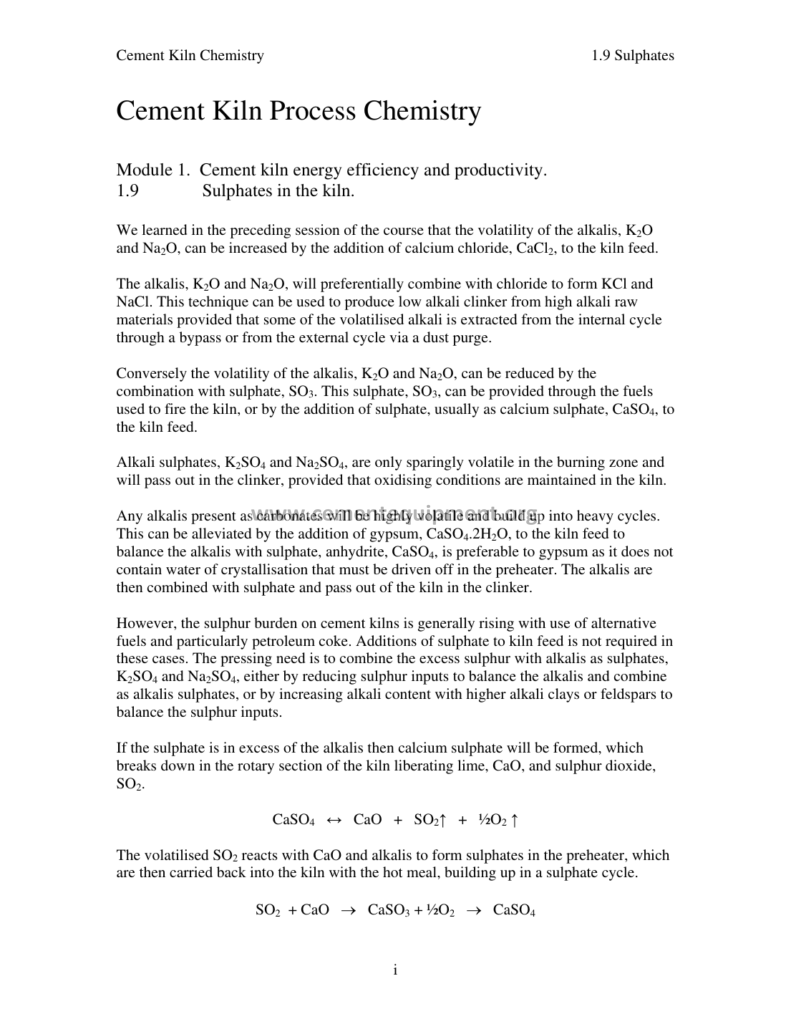
The sulphur of the cement kiln is the hardest element to please: the same atom that the burning zone needs for the fluxing of the melt, the same sulphate that the finish mill adds deliberately as the gypsum for the setting control, is the element that evaporates in the flame, condenses in the preheater, builds the sulphate spurrite rings at the kiln inlet and, in the reducing atmosphere, slips away into the stack as the SO2: the sulphur is the element of the many faces, and its management across the kiln system, the fuel, the raw materials and the clinker is one of the most demanding balances of the cement chemistry: this lesson of the kiln chemistry course gives the full sulphate story, from the pyrite of the quarry to the gypsum of the cement mill.
The Complete Cement Technical Package (931 files including the books, the courses, the Excel tools and the presentations: $249.99 one-time: instant download via the PayPal payment) includes the sulphate chapter of the kiln chemistry course, the sulphur balance calculation tools and the reference tables of the volatile behaviour: this article is the lesson: the inputs, the reactions, the volatility, the cycle, the deposits, the oxygen control and the clinker sulphate, explained for the engineer who must keep both the kiln and the cement stable.
The sulphate lesson is the third of the cycle family, and the reader of the course now holds the full picture: the alkalis cycle with the partial volatility, the chlorides with the near-total volatility, and the sulphur sits in the middle with its own decisive feature: the atmosphere: no other element of the kiln responds so strongly to the oxygen balance: the sulphate chemistry is, at its core, the chemistry of the oxidising discipline.
1. The Sulphur Inputs: The Fuel and the Raw Materials
The sulphur balance of the plant begins with the two great doors of the input: the fuel and the quarry:
- The fuel sulphur: the coal and the petcoke carry the sulphur as the pyrite and the organic sulphur compounds: the petcoke is the sulphur champion, with the sulphur content of 3 to 7%, while the coals run 0.5 to 3%: the fuel is the dominant sulphur input of most plants, and the fuel contracts are written with the sulphur clause for the kiln chemistry reasons as much as for the emission reasons;
- The raw material sulphur: the pyrite (FeS2) and the marcasite in the limestones and the shales, the gypsum and the anhydrite in the sedimentary deposits, and the sulphate salts of some basins: the raw material sulphur varies with the quarry benches, and the sulphur map of the deposit is part of the quarry planning of the difficult plants;
- The alternative fuels and the wastes: the tyres carry the sulphur of the rubber, the sludges and the refuse-derived fuels bring the variable loads: the alternative fuel reception analysis includes the sulphur, and the blending of the fuel mix is the management of the input;
- The scale of the numbers: the total sulphur input of a typical plant runs 0.3 to 1.0% of the clinker mass as the SO3 equivalent, and of this the fuel contributes typically half to two thirds: the sulphur entering the system is a stream of the same order as the alkali stream, and the two elements are managed together, because the alkalis and the sulphate meet in every reaction of the cycle;
The input section is the beginning of the balance: the monthly sulphur account of the plant, the sum of the fuels, the raw materials and the additives, is the frame of everything that follows: the plants that do not close their sulphur balance fly blind in the sulphate chemistry, and the balance is the first document of every sulphate investigation.
2. The Reactions in the Preheater: The Oxidation of the Pyrite and the First Sulphate
Long before the burning zone, the sulphur of the raw materials is active in the preheater, and its first reactions set the state in which it will arrive at the kiln:
- The pyrite oxidation: the iron pyrite (FeS2) of the meal decomposes and oxidises in the middle stages of the preheater, roughly between 500 and 700 degrees Celsius: the pyrite gives up the sulphur as the SO2, the iron oxidises into the hematite: the reaction is exothermic and fast, and the SO2 so produced joins the gas of the preheater;
- The first capture: the freshly calcined lime of the lower stages captures the SO2 of the gas as the calcium sulphate: CaO + SO2 + 1/2 O2 → CaSO4: this capture is the natural desulphurisation of the preheater: part of the pyrite sulphur is caught again by the meal before it ever reaches the flame, and the capture efficiency depends on the lime availability and the temperature of the stages;
- The organic and the sulphate sulphur: the organic sulphur compounds oxidise at the similar temperatures, and the sulphate minerals (gypsum, anhydrite) of the raw meal survive the preheater intact, carrying their sulphur straight to the kiln: the three forms of the sulphur travel three different paths, and the plant distinguishes them because the pyrite and the organic sulphur release the SO2 in the preheater while the sulphate sulphur releases it only at the flame;
- The state at the kiln inlet: the meal arrives at the kiln with its sulphur partly as the calcium sulphate (the captured and the original sulphate) and partly still as the sulphides if the preheater was too cold: the oxidation completeness of the sulphides in the preheater is one of the quality items of the burning, because the unoxidised sulphide reaching the flame zone evaporates violently and disturbs the cycle;
The preheater chemistry of the sulphur is the least visible part of the cycle and the one that the operators influence through the stage temperatures: the plants with the cold third and fourth stages (low calcination, the sulphide survivals) see the sulphur problems of the kiln that the plants with the hot, well-calcining preheaters never meet: the calcination lesson and the sulphate lesson meet in this paragraph.
3. The Volatility in the Burning Zone: The SO3 Leaves the Clinker
In the burning zone, the sulphate of the clinker melt is thermodynamically unstable at the temperatures of the flame, and the sulphur takes its great decision:
- The evaporation: the calcium sulphate of the melt decomposes partially in the hot zone: CaSO4 → CaO + SO2 + 1/2 O2: the decomposition is driven by the temperature and accelerated by the reducing conditions: the industrial volatility of the sulphur in the burning zone is of the order of 50 to 60% in a normal oxidising operation, and it climbs steeply in the reducing operation towards 90% and beyond;
- The temperature effect: the sulphate decomposition accelerates with the temperature: the hotter the burning zone, the more sulphur evaporates, the higher the circulating load: the plants running the very hot zones for the hard meals carry the heavier sulphate cycles: the temperature of the zone and the sulphur cycle are linked through this decomposition;
- The atmosphere effect: the reducing conditions destroy the sulphate aggressively: in the presence of the CO, the sulphate decomposes at far lower temperatures, the SO2 floods the system, and the gas phase carries the sulphur back to the preheater in quantity: the reducing burning zone is the sulphur accelerator, exactly as it is the alkali accelerator: the two elements speak the same language of the atmosphere;
- The retained share: the sulphate that survives the evaporation stays in the clinker, combined with the alkalis as the alkali sulphate and with the lime as the residual anhydrite: the retained sulphate is the beneficial share: it fluxes the melt (the mineralisation lesson), controls the setting through the later gypsum optimisation, and its quantity is the clinker SO3 that the cement mill measures and the quality department manages;
Table of the sulphate volatility behaviour (illustrative values of the industry practice):
| Operation condition | Volatility of the sulphur in the zone, % | Consequence |
|---|---|---|
| Oxidising, moderate zone (typical) | 40 – 60 | Normal cycle, manageable circulation |
| Oxidising, hot zone | 60 – 80 | Heavy cycle, deposit and ring risk rises |
| Reducing conditions (CO present) | 80 – 95 | SO2 breakout, cycle spike, emission problems |
The volatility table is the law of the sulphate balance: the retained sulphur is set by the temperature and the atmosphere of the zone, and the circulating sulphur is the difference: the operator who understands the table understands why the oxygen at the kiln inlet is the first control variable of the whole sulphur chemistry.
4. The Sulphate Cycle: The Loop of the SO3 and its Enrichment
The evaporated sulphur rides the gas into the preheater, condenses on the meal, and returns to the kiln with it: the sulphate cycle is the middle member of the cycle family:
THE SULPHATE CYCLE (steady state, illustrative)
-----------------------------------------------
SULPHUR INPUT (fuel + raw materials: 100 units as SO3)
      |
      v
PREHEATER: the reactions begin: the pyrite SO2 is captured by
      the lime; the gas of the kiln carries the evaporated SO3
      |        the SO3 condenses on the meal as the calcium and
      |        the alkali sulphates: the kiln feed carries the load
      v
KILN INLET / TRANSITION (1000-1200 C): the sulphate spurrite
      (2C2S . CaSO4) and the alkali sulphates form the deposits
      and the rings here: the creeping enemy of the plant
      |
      v
BURNING ZONE (1350-1450 C): ~50% of the arriving sulphate
      evaporates again (oxidising), the rest is retained:
      the retained sulphate fluxes the melt and stays in the clinker
      |
      +---> the evaporated share climbs the gas to the preheater
      |        again: the loop closes
      v
OUTTAKES: clinker SO3 (the retained share) + the dust rejects
      + the SO2 of the stack = the input: the steady state sets
      the enrichment factor of the sulphate: typical 2-5
Three facts of the sulphate loop distinguish it from the chloride and the alkali loops:
- The moderate enrichment: the typical sulphate enrichment factor of the kiln feed over the raw meal is 2 to 5, far below the chloride enrichment, because the volatility is partial and the clinker retention is real: the sulphate cycle is the manageable member of the family;
- The deposit chemistry: the sulphate deposits are dominated by the sulphate spurrite (2C2S·CaSO4), the syngenite (K2SO4·CaSO4·H2O) and the aphthitalite: the sulphate-bearing deposits form in the transition zone and at the kiln inlet, where the temperature sits in the condensation and the sulphation band: the sulphate ring is the slow, creeping brother of the chloride blockage;
- The coupling: the sulphate cycle cannot be drawn without the alkalis: the sulphur condenses preferentially as the alkali sulphates, and the alkali-sulphur ratio of the feed decides how much of the sulphur travels as the benign alkali sulphate and how much as the deposit-forming calcium sulphate: the two cycles are one management problem, and the ratio is the management handle;
The loop picture, with the enrichment factor and the deposit chemistry, is the third member of the family portrait: the engineer who can draw the three loops (the alkali, the chloride, the sulphate) side by side owns the volatile chemistry of the whole kiln system.
5. The Sulphate Rings and the Deposits: The Creeping Enemy
The sulphate build-ups are the chronic disease of the kiln system, and their chemistry and their growth are worth the full paragraph:
- The kiln inlet ring: the sulphate ring grows at the kiln inlet and the lower transition zone, where the meal is hot enough for the sulphate spurrite formation but not hot enough to melt it away: the ring creeps inward over weeks, the kiln diameter shrinks, the material flow becomes irregular, and the kiln loses its throughput: the sulphate ring is the classic cause of the gradual production decay that the operators detect as the rising kiln inlet pressure and the falling production;
- The riser duct deposits: the sulphate and the alkali deposits narrow the riser duct and the lower stages: the deposits are fed by the condensation and the sulphation of the same circulating species, and their growth accelerates with the enrichment of the feed:
- The hot meal build-ups: the sticky, sulphate-bearing meal accumulations in the cyclone cones and the air slides, the material that refuses to flow: the build-ups are the cousins of the chloride crusts, harder and slower than the chloride, but the same family of the condensate chemistry;
- The remedies: the ring is removed by the kiln stoppage and the blasting, by the targeted thermal cycling, or by the “sail” procedures with the reduced feed and the adjusted flame: the deposit is contained by the air cannons, the insulation changes and the scheduled cleaning: and the whole family is prevented by the chemistry: the sulphate cycle control of the preceding sections is the real cure, and the mechanical remedies are only the consequences of the failed chemistry;
The ring paragraph is the practical motivation of the entire lesson: the sulphate deposits are the most frequent chronic deposits of the cement kiln, the costliest in the accumulated production losses, and the most responsive to the chemical management: the plants that control their sulphate cycle run the cleaning intervals of the months, and the plants that ignore it run the stoppages.
6. The Oxygen as the Master Lever: The Reducing Atmosphere and its Cost
The sulphate chemistry gives the oxygen its role as the most important single control variable of the kiln process:
- The mechanism: the decomposition of the calcium sulphate is suppressed by the oxygen according to the equilibrium: the more O2 in the burning zone atmosphere, the more the sulphate is retained in the clinker and the smaller the evaporation: the less O2, the larger the evaporation, and in the presence of the CO the decomposition accelerates catastrophically;
- The reducing operation: when the flame lapping the charge or the fuel excess produces the CO at the burning zone, the local atmosphere strips the sulphate from the clinker melt: the SO2 floods the gas, the cycle spikes, the deposits accelerate, the clinker SO3 collapses, and the emitted SO2 climbs: the reducing burning zone is the single most expensive mistake of the kiln operation, and the sulphate chemistry explains exactly why;
- The third effect of the reducing zone: beyond the sulphur, the reducing conditions destabilise the iron of the ferrite (the melt loses the iron, the coating suffers), raise the alkali volatility, and waste the fuel: the three damages share one cause, and the three lessons of the course attribute them to one lever: the oxidising discipline of the burning zone;
- The practice: the plant watches the oxygen at the kiln inlet (typically 0.5 to 3.5% in the normal operation, 1 to 3% in the modern practice with the precalciner) and the CO (below about 0.1%): the oxygen target is set high enough to secure the sulphate retention and the iron stability, and low enough to save the fuel and the NOx: the oxygen window is the razor edge of the kiln operation, and the sulphate chemistry is its sharpest blade;
The oxygen paragraph is the heart of the lesson: the sulphate balance, the clinker SO3, the ring growth and the stack emissions all hinge on the oxidising discipline, and the operators who internalise this lesson watch their kiln inlet oxygen with the eyes of the sulphate chemists: the number that the screen shows is not a percentage, it is the state of the whole volatile system.
7. The Sulphate in the Clinker: The SO3 of the Product and the Gypsum Balance
The retained sulphate is the share of the sulphur that the process chooses to keep, and it is doubly important: for the clinker chemistry and for the cement setting:
- The clinker SO3: the retained sulphate of the ordinary clinkers runs about 0.3 to 1.0% as the SO3: part is combined as the alkali sulphate, part as the residual anhydrite, and the balance is managed through the temperature and the oxygen of the zone and the alkali content of the meal: the clinker SO3 is measured on every sample, and its trend is one of the quality lines of the control chart;
- The fluxing role: the retained sulphate fluxes the burning zone melt (the mineralisation and the sintering lessons): the clinker with the higher SO3 burns softer at the same temperature: the sulphate is a quality-relevant flux, and the plants with the sulphur-rich fuels harvest this benefit within the limits of the clinker SO3 target;
- The setting control: the sulphate of the finish mill is the gypsum that the plant adds to control the setting: the total sulphate of the cement is the sum of the clinker SO3 and the added gypsum SO3, and the gypsum optimisation of the mill is computed against the clinker sulphate: the clinker with the high SO3 needs the less added gypsum, and the cement plant couples the kiln sulphate balance to the mill gypsum dosage daily;
- The alkali sulphate of the cement: the alkali sulphate fraction of the clinker dissolves quickly in the mixing water and accelerates the early hydration: the alkali-sulphate balance of the clinker is read by the cement quality laboratory as part of the setting behaviour picture, and the flash set events of the cement are sometimes the misread of this balance;
The clinker paragraph closes the loop of the sulphur through the product: the element that the burning zone evaporates, the preheater cycles and the rings harvest is also the element that the cement mill buys and the concrete relies on: the sulphate is managed at the front door (the inputs), at the middle door (the oxygen and the cycle) and at the back door (the clinker SO3 and the gypsum), and the three doors are one balance.
8. The SO2 Emissions: The Environmental Accounting of the Sulphur
The sulphur that neither the clinker retains nor the preheater captures leaves the stack, and the emission is the regulated face of the same balance:
- The emission paths: the SO2 leaves with the preheater top gas (the pyrite and the organic sulphur released below the capture zones) and with the kiln gas events (the reducing operations, the fuel sulphur surges): the two paths have different chemistries, and the emission diagnostics distinguish them;
- The capture chain: the natural desulphurisation of the preheater captures a large share of the released SO2 (the calcined lime is the cheap sorbent), and the dry desulphurisation systems (the hydrated lime injection) extend the capture when the limits demand: the capture efficiency depends on the temperature, the dust load and the contact time, and the modern plants tune their preheater conditions partly for the emission compliance;
- The monitoring: the continuous SO2 analysers at the stack and the periodic gas analyses at the preheater stages give the emission map of the sulphur: the SO2 peaks correlate with the pyrite benches, the fuel lots and the reducing events, and the correlation is the diagnostic of the emission control;
- The management: the emission limits decide the sulphur ceiling of the fuels and the raw materials: the plants with the high-sulphur fuels and the strict limits invest in the desulphurisation, while the plants with the margins manage by the fuel blending and the preheater operation: the environmental account closes the sulphur story of the plant: the same balance, the three doors, and the fourth door of the stack;
The emission section is the environmental completion of the lesson: the sulphur that the plant cannot retain, cannot cycle silently and cannot dump is the sulphur that the regulations see: the sulphate chemistry of this lesson is therefore not only the chemistry of the rings and the clinker, it is the chemistry of the permit, and the balance tools of the package serve the compliance files as well as the production files.
9. The Measurement and the Monitoring of the Sulphate Chemistry
The sulphate system is measured at every node, and the monitoring discipline is the same as the alkali and the chloride lessons:
- The analyses: the SO3 of the raw meal, the kiln feed, the clinker and the cement by the XRF, the total and the pyritic sulphur of the raw materials by the combustion methods, and the SO2 of the gas by the analysers: the sulphate enrichment of the kiln feed over the raw meal is computed like the alkali enrichment, and the two enrichments are charted together;
- The enrichment trend: the rising sulphate enrichment with the stable deposit state is the normal loading; the rising enrichment with the rising kiln inlet pressure is the ring in the making; the collapsing clinker SO3 with the rising SO2 is the reducing zone event: the three signatures are the language of the sulphate control charts;
- The deposit forensics: the X-ray diffraction of the removed rings and the deposits identifies the sulphate spurrite, the syngenite and the aphthitalite: the forensics separate the sulphate deposits from the chloride and the alkali ones, and the cure follows the identification: the sulphate diagnoses answer the oxygen, the temperature and the input levers;
- The monthly balance: the sulphur balance of the month (the inputs, the clinker, the dust, the emissions) closes the account: the balance that does not close is the sampling problem, and the balance that closes with the high enrichment and the high deposits is the argument for the input or the bypass measures: the monthly balance is the summary of the whole sulphate management;
The monitoring section is the daily face of the lesson, and its discipline is the same across the cycle family: the enrichment, the pressure drops, the forensics and the balance: the plants that run the three cycles with the same monitoring discipline run the most predictable kilns of the industry, and the predictability is the availability.
10. The Frequently Asked Questions
What is the difference between the sulphur of the raw materials and the fuel in the kiln?
The raw material sulphur arrives partly as the pyrite and the organic compounds that release the SO2 already in the preheater, and partly as the sulphates that survive to the kiln; the fuel sulphur burns in the flame and feeds the gas of the zone: the two paths meet in the same balance, but their release points differ, and the emission and the deposit diagnostics must separate them: the pyrite events show at the preheater, the fuel events show at the flame.
Why is the reducing atmosphere so expensive in the sulphate chemistry?
Because the CO destroys the sulphate that the oxidising operation would retain: in the reducing flame the calcium sulphate decomposes violently, the sulphur evaporates almost completely, the cycle spikes, the rings accelerate, the clinker SO3 collapses and the SO2 emissions climb: the single flame event damages the process and the environment at once, which is why the oxidising discipline is the first commandment of the kiln operation.
What is the ideal SO3 content of the clinker?
The ordinary Portland clinkers carry about 0.3 to 1.0% of the SO3, and the target is set by the plant from the alkali content and the cement quality: the sulphate above the alkali-combining capacity appears as the calcium sulphate in the clinker and the ring deposits, and the sulphate far below the capacity leaves the setting control entirely to the added gypsum: the balance is the partnership of the kiln and the mill.
Can the sulphate ring be removed without stopping the kiln?
Sometimes, by the “sail” procedure: the plant reduces the feed, adjusts the flame and the oxygen, and lets the hot gas and the mobile charge erode the ring over hours; when the ring is hard or the sail fails, the kiln stops for the blasting or the thermal shock: the true prevention is the cycle control of this lesson: the enrichments, the oxygen and the inputs, because the removed ring always grows back under the same chemistry.
How does the SO3 end up in the cement as the “gypsum” of the mill?
The finish mill adds the natural or the synthetic gypsum (calcium sulphate dihydrate, CaSO4·2H2O) to the ground clinker, and the total sulphate of the cement is the sum of the clinker SO3 and the added gypsum: the gypsum dosage is optimised against the clinker sulphate and the cement fineness to give the correct setting time and the strength development: the sulphur of the kiln and the gypsum of the mill are the two halves of one SO3 story in the cement.
Why do the sulphate deposits form mainly at the kiln inlet?
Because the kiln inlet temperature (1000 to 1200 degrees Celsius) sits in the band where the sulphate spurrite and the alkali sulphates are stable and sticky, while the gas there still carries the circulating sulphate from the zone: the meal at the inlet is hot enough to host the sulphate-bearing phases and too cold to melt them away: the ring grows exactly in this thermal window, and the plants manage it by the depth of the cycle and the position of the sintering zone.
11. Conclusion
The sulphate chemistry closes the cycle family of this course with its own signature: the partial volatility, the moderate enrichment, the creeping rings and the oxygen as the master lever: the sulphur is the element of the balance: the flux of the melt against the ring at the inlet, the clinker SO3 against the stack SO2, and the gypsum of the mill against the sulphur of the fuel: the engineer who has worked through the three cycle lessons now holds the complete volatile picture of the kiln: the alkalis, the chlorides and the sulphates, one law, three elements, one discipline: the last lesson of the course turns to the fire that drives the whole machine: the combustion chemistry of the flame.
The Complete Cement Technical Package includes the sulphate chapter of the kiln chemistry course, the sulphur balance tools and the volatile element references: the one-time $249.99: the instant download: the kiln chemistry course from the burnability to the combustion: the professional library of the cement process: the sulphur, balanced: the rings, prevented: the kiln, stable.
Get this Sulphates file + the full 931-file package
$249.99 — one-time purchase, instant download, lifetime access
This file is part of the Complete Cement Technical Package (931 files) available from cementequipment.org. Respective rights holders; library copy for the licensed single user.