Kc Burnability: Complete Technical Guide
Burnability is the chemical character of the raw meal: the measure of how easily the meal burns into a well-clinkered nodule at a given temperature, time and fineness: two raw meals with identical oxide analysis can burn very differently, because burnability is decided by more than the modules: it is decided by the way the silica and the lime are packed inside the particles, the size of the quartz grains, the fineness of the calcite and the fluxing character of the minor oxides: the burnability is the first question of the kiln engineer, because it sets the temperature demand of the burning zone, the fuel bill, the coating regime and, finally, the free lime of the clinker.
The Complete Cement Technical Package (931 files including the books, the courses, the Excel tools and the presentations: $249.99 one-time: instant download via the PayPal payment) includes the burnability chapter of the kiln chemistry course, the tabulated free-lime tests of typical raw meals and the calculator of the burnability indices: this article is the lesson of the course: the definition, the chemical and the physical factors, the laboratory test, the indices and the levers that the plant pulls to make a hard meal easy to burn.
The engineer treats the burnability as a measurable, changeable property: the plant does not accept the burnability of its quarry as destiny: it manages it through the fineness of the raw mill, the mixing of the stockpiles, the corrective additions and, within limits, the mineralising elements: this lesson gives the mechanism of each lever: the reader leaves with the ability to read a burnability problem and to name the chemical reason behind it.
1. The Definition of Burnability: What “Easy to Burn” Means Chemically
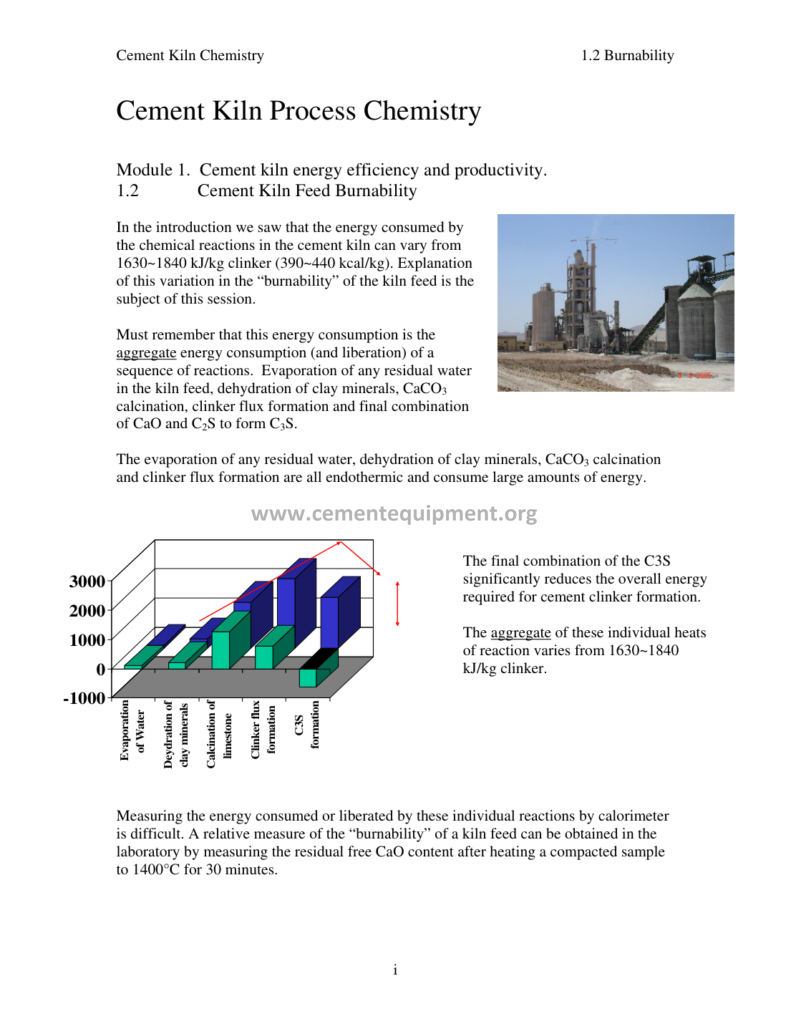
The burnability of a raw meal is expressed by the free lime that remains after a standardised burning test: the more the free lime, the harder the meal burned:
- The standard test: a pellet of the raw meal is burned in the laboratory furnace at a fixed temperature, classically 1350, 1400 and 1450 degrees Celsius, for a fixed time, classically 30 minutes, and the residue free lime is titrated: three numbers, one per temperature;
- The reading: a meal that leaves free lime below about 2% at 1350 degrees Celsius is an easy meal; a meal that still shows 4 to 6% free lime at 1450 degrees Celsius is a hard meal that demands the maximum kiln temperature, the longest retention and the finest grind;
- The physical meaning: the free lime is the unreacted CaO: the meal burned easily means the calcium oxide found its partners quickly through the melt; the meal burned hard means the lime and the silica were physically separated, chemically sluggish or insufficiently mobilised by the liquid phase;
- The industrial meaning: an easy meal allows the kiln to run at lower burning zone temperature, saving fuel and extending the refractory campaign; a hard meal forces the high temperature, the risk of the coating loss, the ring formation and the production penalty: the burnability is therefore an economic property, not only a laboratory one;
The definition already carries the whole course: the burnability is the summary of everything that happens between the raw mill and the burning zone, condensed into one free-lime number: the rest of this lesson unpacks the factors behind that number, one by one.
2. The Chemical Factors: LSF, SR and AR in the Burnability Equation
The three modules of the mix design dominate the chemical side of the burnability, and their action follows the mechanics of the melt chemistry:
| Module | Effect of a high value | Mechanism in the burning zone |
|---|---|---|
| LSF (lime saturation) | Burnability gets harder, one of the strongest effects | More lime must dissolve into the melt per unit of silicate: the reaction C2S + CaO → C3S demands more lime transport |
| SR (silica ratio) | Burnability gets harder | Less Al2O3 + Fe2O3 means less liquid phase at the burning zone: the melt is the transporter of the lime |
| AR (alumina ratio) | Indirect: iron-rich meals melt earlier | The ferrite melts at lower temperature than the pure aluminate: a low AR starts the liquid sooner and lowers the viscosity at the same temperature |
The practical order of magnitude: for a typical Portland raw meal, raising the LSF by one point (98 to 99%, say) raises the free lime of the standard 1400 degrees Celsius test by on the order of half a percent to one percent, while raising the SR by one tenth pushes the same temperature demand upward by several tens of degrees: the exact constants depend on the meal, and the package calculator fits the correlation of the plant’s own data: the qualitative law, however, never changes: the lime-heavy meal is the hard meal, and the melt-rich meal is the easy meal: the two statements are the same statement spoken in the language of the modules.
The interaction between the modules matters as much as their individual values, because the burnability is a two-dimensional surface and not a line: the hard effect of a high LSF can be partially repaid by the fluxing of a lower SR, and the high-SR meal can be rescued by the lower LSF: the plants therefore plan their recipes on the LSF-SR map, drawing the constant burnability contours from their laboratory series: the contour map is the practical instrument of the mix design: the recipe changes that move the mix along a contour preserve the burning, while the changes that cross the contours change the temperature demand: the engineers of the package use the calculator to draw the contour of their own plant from the accumulated burnability tests, and the resulting map becomes the reference of every raw mix meeting: the modules are not three separate dials, they are the two coordinates of the burning difficulty, and the third coordinate, the fineness, is the subject of the next section.
3. The Physical Factors: The Particle Size of the Lime and the Quartz
The best modules in the world do not help if the reactants are locked inside oversized grains, because the reactions of the burning zone proceed from the surface of the particles:
- The calcite (CaCO3) particle size: the calcination produces a skeleton of the lime inside the original limestone grain: a coarse calcite grain becomes a coarse lime clump that dissolves slowly into the melt: the raw meal fineness (the residue on the 90 micrometer sieve, classically 10 to 15%, and on the 200 micrometer sieve, classically 0.5 to 2.5%) is the first tool of the burnability management;
- The quartz particle size: the most dangerous component: the quartz grains of 44 micrometers and larger are slow to react, because the silica must be dissolved from the surface of the quartz crystal into the melt, a sluggish process compared with the fine clay silica: the classical specification: virtually no quartz above 45 micrometers, and the median quartz well below 20 micrometers;
- The irrigation rule of the textbooks: each 1% of the calcite above 125 micrometers and each 1% of the quartz above 45 micrometers hardens the burning measurably: the plant sets the raw mill residue exactly to tame these two tails;
- The clinkerisation of the coarse lime: the coarse lime clumps that survive to the clinker appear in the microscope as the belite clusters and the free-lime nests, the visible signature of the poor burnability: the same meal burned with the same temperature but a finer grind shows the uniform alite structure: the grain size writes itself into the microstructure of the product.
Table of the classical grind targets of the raw meal for a good burnability:
| Screen | Typical target | Chemical significance |
|---|---|---|
| 90 µm residue of the raw meal | 10 – 15% | Overall fineness of the lime and the clay |
| 200 µm residue | 0.5 – 2.5% | The coarse tail that costs fuel in the burning zone |
| Quartz > 45 µm | 0 – 2% of the meal | The slow silica: hardens the burn almost linearly |
| Calcite > 125 µm | minimised | The coarse lime: delays the dissolution into the melt |
The rule of the plant: the raw mill is not only a size device, it is a chemical device: the fineness profile it produces is a burnability profile, and the laboratory therefore measures the sieve residues and the quartz content of the raw meal with the same regularity as the oxides.
4. The Fluxing Chemistry: The Minor Oxides at the Service of the Melt
Beyond the modules, the minor oxides act as fluxes that soften the melt and accelerate the burning zone reactions:
- The iron oxide: the classic flux: the ferrite phase is the first liquid former, and iron-rich meals (low AR) start melting at temperatures 50 to 100 degrees Celsius below the alumina-rich meals: the iron is the cheapest burnability medicine of the industry;
- The magnesia: within the natural range up to about 2 to 3% of the clinker, the MgO distributes into the melt and lowers its viscosity, improving the burnability: beyond the soundness limit of the cement, the same element becomes a liability;
- The alkalis: small amounts (0.2 to 0.6% as the equivalent oxide) are incorporated into the alite and the melt, mildly improving the burn: the same alkalis above the cement limits are a quality problem, so the benefit is an ambivalent one, handled in the alkali lesson (KC 1.7);
- The fluorine and the mineralisers: the deliberate fluxes such as the CaF2 additions, which lower the temperature of the first liquid by roughly 100 degrees Celsius or more at the addition rates of 0.2 to 0.5%: the full mechanism is the subject of the mineralisation lesson (KC 1.6);
- The sulphate (SO3): the fuel sulphur that is retained in the clinker melts early as the alkali sulphate and the anhydrite, contributing its share of the liquid at the burning zone: an excess, however, drives the sulphate cycles and the rings of KC 1.9;
The fluxing picture is the balance of the whole minor-element chemistry: every element that enters the liquid phase lowers the burnability demand, and every element that volatilizes re-enters the cycles: the burnability lesson introduces the fluxes, the cycle lessons address their dark side: the engineer reads the minor oxide analysis of the raw meal with both pages open.
5. The Kinetics of the Burning Zone: Temperature, Time and the Melt
The burnability is finally decided by the three kinetic handles of the burning zone: the temperature, the retention time and the liquid phase quantity:
- The temperature: the classical rule of thumb of the cement industry: a 100 degree Celsius increase of the burning zone temperature roughly doubles the rate of the alite formation: the temperature is the most powerful single handle, which is why the control room lives on the burning zone temperature signal;
- The retention time: the charge residence in the burning zone of a typical kiln is of the order of 10 to 20 minutes, and the nodule spends only a fraction of that revolution time in the hottest part: the retention is fixed by the kiln geometry and the speed, and is the least flexible of the three handles;
- The liquid phase: in the 1300 to 1450 degrees Celsius window the melt represents typically 20 to 30% of the charge: the lime dissolves into this melt, the alite crystals grow from it: the more melt, the more transport, the faster the burn: this is why the SR is so influential: it controls the amount of the liquid;
- The combination in practice: a hard meal with a high LSF and a high SR must be compensated by the temperature: but the temperature is capped by the brick (typically 1350 to 1450 degrees Celsius of the material temperature, higher at the flame side) and by the coating stability: when the compensation is exhausted, the plant changes the meal: the burnability is the negotiation between the meal, the kiln and the refractory;
The kinetics lesson of the sintering (KC 1.5) expands this picture to the full mechanism of the alite growth: here the student retains the triangle: temperature, time, liquid: the three coordinates of every burnability discussion on the plant floor.
6. The Laboratory Burnability Test: The Standard Free Lime Series
The plant laboratory measures the burnability with the standard burning series, and the discipline of the test matters as much as the chemistry:
THE STANDARD BURNABILITY TEST (30-minute series)
------------------------------------------------
1. SAMPLE    the raw meal is sampled at the kiln feed, dried, ground
             to the clinker fineness concept: residue controlled
2. PELLETS   5-10 g pressed into discs of fixed diameter: the same
             density every time: reproducibility starts here
3. BURNING   three pellets, three furnaces (or three runs):
             1350 C, 1400 C, 1450 C, 30 minutes each, air atmosphere
4. COOLING   rapid quench in air: the phases are frozen at the
             burning state: slow cooling would quietly burn further
5. TITRATION each pellet is ground, the free lime extracted with the
             glycol reagent and titrated with acid: free lime %
6. REPORT    the three free lime values, e.g. 2.8 / 1.4 / 0.9 %:
             the curve of the burnability of the meal
The three temperatures trace the full answer: an easy meal shows a steep drop of the free lime between 1350 and 1450 degrees Celsius and reaches low values already at 1400; a hard meal shows a flat, high curve: the shape of the curve tells the engineer whether the problem is the temperature demand (chemical) or the melt quantity (physical): the plant repeats the test at each change of the quarry, the mill or the mix, and keeps the series in the laboratory logbook as the burnability history of the deposit.
7. The Burnability Indices: Turning the Curve into One Number
The industry has condensed the three-temperature curve into single-number indices so that the plants can compare meals and follow trends:
- The free lime at 1400 degrees Celsius: the simplest and the most quoted: the meal with a free lime at 1400 of 1.5% burns easily, at 3.5% it burns with difficulty: many plants run their whole monitoring on this one number;
- The burnability factor style indices: the weighted combinations of the free limes at several temperatures, designed so that a number near the low end means an easy burn: the exact coefficients are published in the reference literature and implemented in the package calculator;
- The calculated indices from the chemistry: the formulas that estimate the burnability from the LSF, the SR, the quartz and the fineness, giving the engineer a prediction before the laboratory test runs: the prediction is a guide, the test is the truth;
- The normalisation by the C3A and the C4AF: the melt-dependent terms of the burnability are expressed through the calculated interstitial phases, connecting the index back to the Bogue chemistry of the mix;
The indices are not academic toys: the plants quote them in the monthly reports, the technical services use them to justify the raw mill fineness changes, and the alternative raw material studies use them to decide whether a new quarry layer is acceptable: the single number is the currency of the burnability discussions across the plant and the headquarters: the lesson of the course and the calculator of the package make the index computation a ten-second job.
8. The Influence of the Homogenisation and the Variability on the Burnability
Every burnability statement presupposes a stable meal: in reality the meal arrives at the kiln with a statistical spread, and the variability degrades the effective burnability:
- The arithmetic illusion: a meal whose LSF averages 96% but oscillates between 92 and 100% is much harder to burn than a meal pinned at 96%, because the burning zone must be tuned to the hardest excursions, not to the average: the free lime of the clinker follows the peaks of the LSF, not its mean;
- The measured effect: the classical plant studies show that the fluctuation of the free lime in the clinker is driven by the fluctuation of the LSF with a proportionality that the Davenport-type relationships express: the variability lesson (KC 1.3) quantifies this coupling in detail;
- The homogenisation as a burnability tool: the blending silo, the stockpile blending and the raw mill proportioning are, from this angle, burnability equipment: their job is to keep the effective burnability of the kiln feed at its best by removing the excursions: a plant that improves its homogenisation from a standard deviation of the LSF of 2.0% to 1.0% effectively softens its meal without any change of the recipe;
- The sampling question: the burnability measured on the one laboratory sample is only as good as the sampling point: the plant draws the burnability samples at the kiln feed, downstream of the full homogenisation chain, so that the number describes what the kiln truly receives;
The coupling between the variability and the burnability is one of the most valuable insights of this course: the two lessons, KC 1.2 and KC 1.3, are the two halves of one plant problem: the meal quality, and the quality of the meal statistics.
9. The Levers of the Plant: The Practical Menu of the Burnability Improvement
When the burnability of the kiln feed is judged too hard, the plant works down the menu of the levers, in order of the cost:
- 1. The raw mill fineness: the cheapest and the most common move: reduce the 90 micrometer residue by 2 to 3 percentage points or tame the 200 micrometer tail: the mill capacity cost versus the kiln fuel saving is evaluated in the weekly review;
- 2. The quartz management: the screening of the coarse silica out of the blend, the substitution of the sand by a clay with fine silica, or the additional grinding of the sand fraction: the quartz above 45 micrometers is the most expensive particle in the meal;
- 3. The iron adjustment: a tenth of a point of the AR towards the iron (a small iron ore addition) softens the meal through the earlier melt: the dosage must respect the target phase composition and the colour of the cement;
- 4. The LSF trimming: the reduction of the target LSF by 0.5 to 1.0 point when the clinker quality margins allow it: the alite target loses a little, the burn gains a lot;
- 5. The homogenisation first: the stabilisation of the feed statistics before any recipe change, because the excursions are often the hidden cause of the apparent hardness;
- 6. The mineralisers as the last resort: the deliberate flux additions (fluorine based in white and special cements, the sulphate balance where the fuel allows) once the conventional levers are exhausted: the mineralisation lesson (KC 1.6) details the risks and the rewards;
The order is deliberate: the plant spends the cheap chemistry first and reserves the intrusive chemistry for the last: the burnability improvement is an economic decision under the quality constraints, and the laboratory provides the measurement at every step: the free lime series before the change and after the change is the evidence of the improvement, and the plant keeps that evidence in the monthly report.
The economics of the burnability deserve a closing quantification, because the laboratory number is finally a currency: a plant burning a raw meal whose free lime at 1400 degrees Celsius runs 3.0% instead of 2.0% typically pays the difference in the fuel (the hotter zone, the higher excess air), in the refractory (the shorter campaign at the higher temperatures) and in the production (the slower feed to hold the quality): the combined penalty of one free-lime point of hardness is commonly quoted in the industry at the order of one to two percent of the thermal energy and a measurable share of the campaign cost: the burnability management of the plant is therefore not a laboratory exercise but a production optimisation, and the budgets of the raw mill fineness, the homogenisation and the mix corrections are argued in exactly these units: the free lime series is the meter of the argument, and the monthly report is the settlement of the account.
10. The Burnability in the White and the Special Cement Plants
The white cement plants live by a special burnability story, because their recipe forbids the classic fluxes:
- The iron restriction: the white clinker must hold the Fe2O3 below roughly 0.3 to 0.4% for the whiteness, which removes the ferrite flux almost entirely: the meal is left with the high-melting alumina-rich system and a stubborn burnability;
- The compensation: the white plants burn at the highest temperatures of the industry, add the fluorine mineralisers (for example as the fluorspar or the fluorspar-bearing additives), use the very fine grinding and accept the highest fuel and refractory costs of the trade;
- The lesson of the general plant: the white cement is the laboratory-scale demonstration of everything this lesson teaches: remove the iron flux and the burnability collapses; add the fluorine flux and it returns: the same two mechanisms, iron and fluorine, that the grey plants tune mildly are tuned dramatically in the white plants;
Special cements repeat the pattern: the high-alumina cements with their melting chemistry, the sulphate-resisting cements with their low C3A targets, the belite-rich cements with their gentle burn: each speciality moves one module of the burnability equation, and the general engineer who understands the grey plant understands all the special cases: this is why the course places the burnability so early: it is the foundation chapter of the whole process chemistry.
11. The Frequently Asked Questions
What free lime value at 1400 degrees Celsius is considered good?
For a normal Portland raw meal, a free lime of about 1.5 to 2.0% after 30 minutes at 1400 degrees Celsius indicates a good burnability; values above 3.0% indicate a hard meal that will strain the kiln temperature: the same number below about 1.0% suggests an unnecessarily soft meal, where the plant could be saving fuel with a leaner target LSF.
Can the burnability be predicted without the laboratory firing?
The calculated indices approximate the burnability from the LSF, the SR, the quartz content and the fineness, and the package calculator runs them in seconds: the prediction is the planning tool, the firing test is the decision tool: the plants use the prediction for the daily screening and confirm with the 30-minute test at every significant change of the feed.
Why is the quartz more dangerous than the coarse calcite?
Because the quartz is nearly inert in the preheater and the calciner: it survives to the burning zone as a crystal and must be dissolved from its surface by the melt at 1400 degrees Celsius, on the hours scale that only the long retention can partially provide: the coarse calcite, by contrast, is at least delivered to the system as the ready calcined lime, and its dissolution through the porous skeleton is faster: the quartz above 45 micrometers is the slowest particle of the entire meal.
Does the fuel type change the burnability?
Indirectly, yes: the ash of the fuel enters the clinker: the coal ash (silica, alumina, iron) changes the modules of the actual material in the kiln, and the sulphur of the fuel feeds the sulphate cycle: a fuel change can therefore shift the effective burnability by a fraction of a point of the modules: the plants watch the ash analysis of each fuel lot and correct the raw meal accordingly.
How often should the plant run the burnability series?
The routine is monthly to quarterly for the standard monitoring, plus an immediate test at every change of the quarry, the raw mix recipe, the raw mill fineness or the fuel: the plants with variable qualities run the series weekly: the burnability history of the deposit is one of the most predictive files of the quality department.
Is the burnability of the alternative raw materials tested the same way?
Exactly the same way: the alternative clays, the corrected slags, the mine tailings and the inert industrial residues are all burned in the standard series before acceptance: the plant refuses or accepts a new material based on its burnability curve as much as on its oxide analysis: the test is the universal gate of the raw material department.
12. Conclusion
The burnability is the personality of the raw meal: the sum of the chemistry (LSF, SR, AR), the physics (fineness, quartz, calcite tails) and the statistics (variability) of the feed, expressed in the one honest number: the free lime after the standard burn: the engineer who masters the burnability masters the first half of the kiln control problem, because he knows what the kiln is being asked to burn and what the meal should cost in fuel and refractory: the levers are named, the measurement is standard, and the improvement is always measurable.
The Complete Cement Technical Package includes the burnability chapter of the kiln chemistry course, the free lime calculation tools and the reference tables of the typical raw meals: the one-time $249.99: the instant download: the kiln chemistry course, the burnability first, the control of the process from the laboratory to the flame: the cement engineering, by the numbers and by the mechanisms: the professional library of the kiln.
Get this Burnability file + the full 931-file package
$249.99 — one-time purchase, instant download, lifetime access
This file is part of the Complete Cement Technical Package (931 files) available from cementequipment.org. Respective rights holders; library copy for the licensed single user.