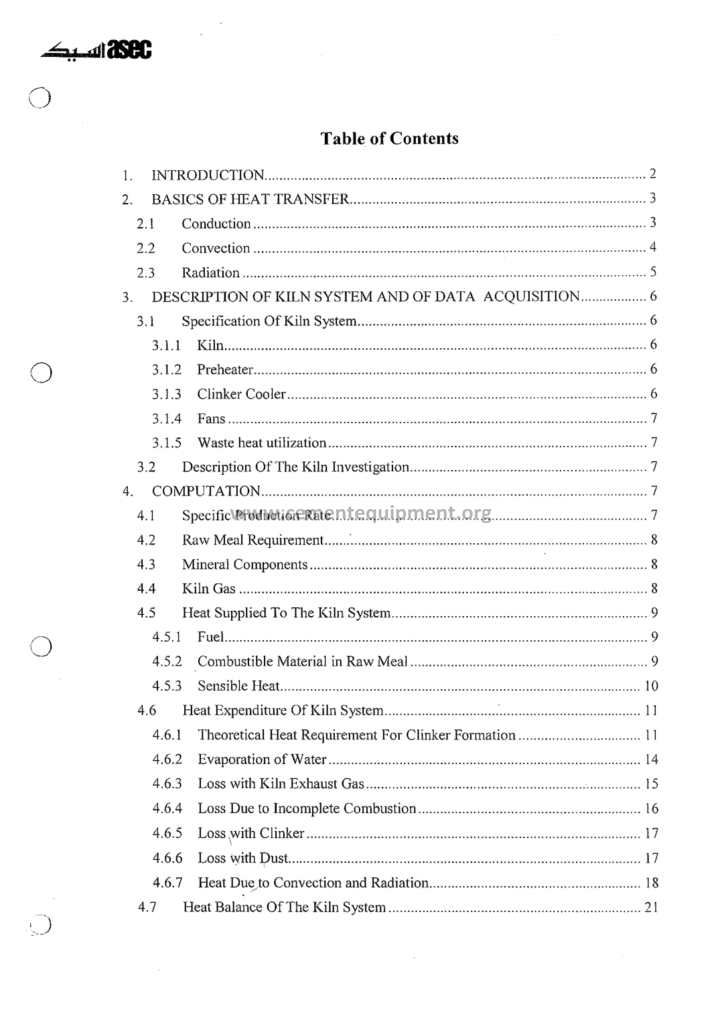
Heat Balance And Heat Transfer: Complete Technical Guide
The heat balance and heat transfer guide is the energy science of the cement process: the file that explains how the heat moves through the kiln line, how it is accounted in the balance sheets of the engineer, and how the specific heat consumption of 700-800 kcal/kg is built from the streams that enter and leave the system: the heat balance is the audit instrument of the plant, and the heat transfer is its physics: the two subjects are taught together in this file because the engineer cannot improve what he cannot account, and he cannot account without understanding the mechanisms: this guide is the complete course of both.
The Complete Cement Technical Package (931 files including the books, the courses, the Excel tools and the presentations: $249.99 one-time: instant download via the PayPal payment) includes the heat balance and heat transfer guide with its calculation workbooks, the balance examples, the heat transfer correlations and the audit protocols: this article walks the file: the balance methodology, the input and the output streams, the heat transfer mechanisms of the preheater, the kiln and the cooler, the losses and the efficiency levers: the reader finishes with the complete accounting framework of the thermal performance and the physical understanding of every term: the energy of the plant, measured and mastered.
The cement kiln is the largest single thermal machine of the industrial landscape after the power generators: it converts the 3 million to 5 million kilojoules of fuel energy per ton of clinker into the chemical work of the clinker formation, the drying of the feed, the heating of the gases and the unavoidable losses to the environment: every one of those kilojoules is tracked by the heat balance, and every mechanism of their movement is described by the heat transfer: the two disciplines are the foundation of the plant’s energy management: this article presents them in the order the guide teaches: the balances first, the mechanisms second, the improvements third.
1. The Heat Balance of the Kiln Line: The Accounting Framework
The guide opens with the balance methodology, the framework within which all the energy numbers of the plant live:
- The balance envelope: the system boundaries of the balance: the kiln line envelope includes the preheater, the calciner, the kiln and the cooler, with the defined input and output streams crossing the boundary: the envelope definitions of the guide allow the balances of the whole line, the kiln alone or the preheater alone: every question of the plant can be asked of its own envelope;
- The balance principle: the first law of the thermodynamics: the energy entering the envelope equals the energy leaving plus the accumulation: in the steady operation the accumulation is zero and the balance closes: the closure check of the guide (the input equals the output within the measurement tolerance) is the quality gate of every balance: the balance that does not close is the balance that teaches the questions, not the answers;
- The balance basis: the balances are computed per kilogram of clinker, the universal basis of the cement industry: the specific heat consumption of the line in kJ/kg or kcal/kg, the sensible heats and the losses all normalized to the clinker mass: the basis conversions of the guide (the clinker, the cement, the raw meal bases and their inter-conversions) are the arithmetic discipline of every balance engineer;
- The balance period: the balances are run over the stable operating periods (12-72 hours typical), with the averaged measurements and the stable production: the balance of the transient operation is meaningful only for the special studies: the guide’s balance protocol selects the period, collects the data and documents the operating conditions: the balance is the photograph of the steady plant;
- The measurement basis: the flows, the temperatures, the compositions and the calorific values measured or estimated for every stream: the guide’s measurement tables list the required data and the accuracy classes: the honest balance states its measurement quality, and the guide’s uncertainty section teaches the propagation of the errors: the balance is only as good as its measurements, and the file teaches the honesty of the numbers;
The framework chapter is the discipline of the whole file: the balance is the language in which the plant and the consultants discuss the performance, and the guide installs the grammar: the envelopes, the closures and the bases are the standard procedures of every chapter that follows: the reader who masters the framework can read any balance document of the industry and judge its quality: the framework is the professional passport of the energy engineer.
2. The Input Side: The Fuel Heat and the Sensible Heats
The input side of the kiln line balance is dominated by the fuel, and the guide itemizes every entering stream:
- The combustion heat of the fuel: the dominant input: the lower heating value of the fuel (the coal at 22,000-30,000 kJ/kg, the petcoke at 31,000-35,000 kJ/kg, the alternative fuels at their values) multiplied by the fuel rate: the LHV basis convention of the guide follows the international cement practice: the fuel heat of the modern precalciner lines supplies the total input of about 3,000-3,350 kJ per kilogram of clinker;
- The sensible heat of the fuel: the preheated fuels (the hot coal from the mill systems) carry the small entering enthalpy: the fuel temperature and the specific heat of the coal: the term is small (1-3% of the input) but accounted: the guide’s full accounting is the professional habit: no stream is too small to measure;
- The sensible heat of the raw meal: the meal enters the preheater at the ambient temperature in the standard balance: the balances with the meal preheating systems add the recovered preheat: the guide covers the meal preheater cases (the external preheating of the dry process feeds) with their balance adjustments;
- The sensible heat of the combustion air: the secondary air and the tertiary air from the cooler enter the process with the recovered heat: the balance convention counts the air heat as the recovered term of the output side (the cooler recovery) or as the input depending on the envelope: the guide’s convention chapter keeps the double counting out: the received air heats are the language of the cooler efficiency discussion;
- The input summary table: the guide’s input table of a modern five-stage line: the fuel heat, the fuel sensible, the meal sensible and the air streams, totaled to the line input: the reader recognizes the input structure that every heat consumption number of the industry references: the input side, accounted;
The input chapter closes with the fuel dispatch example: the 55-65% to the calciner and the remainder to the kiln, each stream with its fuel rate and its heat: the reader sees the input side of the balance as the living fuel map of the line, and the subsequent chapters answer where all the heat goes: the accounting of the input is the start of every energy conversation, and the guide starts it correctly.
3. The Output Side: The Formation Heat and the Process Uses
The output side of the balance is the destination of the fuel heat, and the guide itemizes the useful and the loss streams:
- The theoretical heat of the clinker formation: the minimum heat required to transform the raw meal into the clinker: about 1,750 kJ per kilogram of clinker (the formation heat including the calcination and the phase changes, about 415-420 kcal/kg): this is the thermodynamic floor of the process: the guide explains the derivation from the reaction heats and the phase enthalpies: the formation heat is the number every efficiency discussion circles;
- The evaporation heat: the heat consumed to evaporate the moisture of the raw materials and the fuel: the raw material moisture of 0.5-5% in the dry process (the moisture content of the raw meal at 0.5-1.5% typical for the feed entering the tower) costs its latent heat of about 2,400 kJ per kilogram of water: each percent of the raw meal moisture costs roughly 25-40 kJ/kg of clinker: the evaporation stream is the first variable the balance highlights for the raw material improvements;
- The sensible heat of the clinker and the cooler losses: the clinker leaves the cooler at 80-150°C with its sensible heat, and the cooler’s un-recovered heat leaves with the vent air and the shell: the cooler loss of the modern machines at 350-550 kJ/kg is the largest controllable loss after the exhaust: the guide’s cooler balance splits the stream into the recovered (the secondary and the tertiary air) and the lost shares;
- The exhaust gas heat: the tower exit gas leaves at 290-330°C with its sensible heat: the exhaust loss of the five-stage lines at 600-900 kJ/kg (about 19-23% of the input): the exhaust heat is the recovery target of the sixth stage and the waste heat systems: the guide’s exhaust enthalpy calculations use the gas volumes and the heat capacities of the guide’s tables: the exhaust stream is the biggest single number the modernization projects attack;
- The shell losses: the radiation and the convection from the hot surfaces: the kiln shell, the preheater, the cooler and the ducts: the total shell losses of 3-6% of the input, the kiln the largest share: the guide’s shell loss calculations use the surface temperatures, the areas, the wind factors and the emissivities: the shell loss chapter quantifies the insulation value of every square meter;
- The dust and the combustion losses: the sensible heat of the dust leaving with the gas, the heat of the incomplete combustion (the CO and the unburnt carbon) and the miscellanies: the dust losses of 1-3% and the CO losses normally below 1%: the small streams of the balance that the complete engineer never forgets:
The output chapter builds the complete table of the destination: the formation, the evaporation, the clinker and the cooler, the exhaust, the shell, the dust and the combustion: the reader sees the sum equal to the input within the closure: the useful share (the formation heat) of the modern line at about 52-58% of the input, and the loss streams the remainder: the structure of the output side is the battle map of the energy efficiency, and the guide draws it completely.
4. The Complete Balance Example: The Five-Stage Line Worked
The guide’s worked example is the heart of the balance chapters: the complete balance of a modern five-stage precalciner line, computed term by term:
| Balance term | Stream | Typical value kJ/kg clinker | Share of input |
|---|---|---|---|
| Input | Fuel combustion heat | 3,000-3,350 | 100% |
| Output | Theoretical clinker formation heat | 1,750 | 52-58% |
| Output | Evaporation and raw meal moisture | 100-300 | 3-9% |
| Output | Exhaust gas sensible heat | 600-900 | 19-23% |
| Output | Cooler losses (vent air, clinker, shell) | 350-550 | 10-15% |
| Output | Preheater and kiln shell losses | 100-200 | 3-6% |
| Output | Dust, CO and miscellanies | 30-100 | 1-3% |
- The data collection: the worked example starts with the plant data: the production at 4,500 tons per day, the fuel at 3,150 kJ/kg consumed, the exit gas at 310°C with the volume of 1.55 Nm3/kg, the clinker at 120°C, the shell temperatures and the compositions: every stream of the tables is sourced to its measurement point, and the guide’s example shows the honest sourcing;
- The enthalpy computations: the gas enthalpies from the heat capacities, the clinker enthalpy from the specific heat of 0.8 kJ/(kg·K) and the temperature above the reference, the shell losses from the surface areas and the temperatures: the computational steps of the guide are the replicable arithmetic: the reader recomputes every term from the tables: the example is the training ground of the method;
- The closure check: the sum of the outputs against the input: the closure of the worked example within 2-3%: the guide explains the closure gap from the measurement uncertainties and the unmeasured streams: the closure analysis of the guide identifies the weakest measurements: the closing balance is the honest balance, and the guide’s acceptance criteria (closure within 5% acceptable, below 3% good) are the professional references;
- The comparison against the targets: the worked example compares each term against the reference values of the industry: the exhaust loss against the well-operated five-stage lines, the cooler losses against the modern coolers: the comparison table of the guide positions the example plant among its peers: the balance is not only the accounting but the benchmarking instrument;
The worked example chapter makes the balance method operational: the reader follows the complete computation, recomputes it and then runs his own plant’s balance with the same worksheets: the guide’s Excel tool performs the identical arithmetic from the plant data: the example is the bridge between the framework chapters and the field practice, and the reader crosses it with the numbers of a real line in his hands.
5. The Heat Transfer Mechanisms: The Radiation, the Convection and the Conduction
The heat transfer chapters of the guide teach the physics of every stream: how the heat moves from the flame to the clinker, from the gas to the meal and from the shell to the air:
- The radiation: the electromagnetic heat transfer that dominates the high-temperature zones: the flame at 1800-2000°C radiates to the bed and the refractory with the fourth-power law: the radiant heat of the kiln burning zone is the majority of the heat delivered to the clinker: the guide’s radiation chapter covers the blackbody and the gray-body behavior, the emissivities of the flame, the bed and the brick, and the view factors of the kiln geometry: the radiation arithmetic of the chapter uses the Stefan-Boltzmann constant and the actual temperatures: the burning zone radiation of 200-400 kW per square meter of the bed area emerges from the calculations;
- The convection: the heat transfer by the gas movement: the dominant mechanism in the preheater ducts where the meal particles are suspended in the moving gas, and in the cooler where the air crosses the clinker bed: the convective heat transfer coefficients of the guide’s correlations (the duct flows at 12-18 m/s, the cross-flows over the bed) convert the gas temperatures into the heat fluxes: the convection chapter is the physics of the preheater and the cooler, the zones where the modern efficiency is won;
- The conduction: the heat transfer through the solid layers: the clinker bed to the shell, the refractory to the shell steel, the shell to the atmosphere: the conduction arithmetic of the guide uses the thermal conductivities and the layer thicknesses: the composite wall calculations of the kiln (the coating, the brick, the shell) compute the shell temperature from the internal temperature: the conduction chapter is the instrument of the shell loss analysis and the refractory evaluation;
- The combined mechanisms: the kiln zones operate on the combinations: the radiation and the convection together in the transition zones, the conduction through the walls everywhere: the guide’s combined heat transfer examples teach the mechanism accounting per zone: the reader learns to estimate which mechanism dominates each temperature region: the engineering judgment of the heat transfer, installed by the exercises;
The mechanism chapter closes with the temperature-zone map of the kiln line: the radiation-dominated burning zone above 1200°C, the mixed zones between 800-1200°C, the convection-dominated preheater and the cooler below: the map is the reader’s mental instrument: every temperature measured on the line can be placed in its mechanism context, and every improvement action can be reasoned about in the physics: the heat transfer is the why behind every balance number.
6. The Heat Transfer in the Preheater: The Suspension Exchange
The preheater chapter of the heat transfer teaching is the physics of the countercurrent suspension exchange:
- The duct heat exchange: the meal particles dispersed in the rising gas exchange the heat at the enormous surface area of the fine particles: the particles of 20-100 micrometers in the concentration of 300-900 grams per cubic meter of gas: the interfacial area of the suspension is the reason the preheater reaches the gas-meal equilibrium in the 1-2 seconds of the duct residence: the guide’s heat balance per stage shows the convergence of the gas and the meal temperatures toward the equilibrium;
- The cyclone exchange limit: the gas and the meal cannot fully equilibrate because the cyclone separates them before the complete exchange: the stage efficiency (the actual temperature approach over the ideal) of 70-90%: the guide’s stage efficiency concept and its measurement are the quantitative language of the preheater performance: the plants measure their stage temperatures and compute the efficiencies stage by stage;
- The stage temperature ladder: the heat transfer of the stages builds the temperature ladder: the gas from 1050°C at the kiln inlet to 290-330°C at the tower exit, the meal from the ambient to 820-870°C at the kiln inlet: the guide’s ladder example assigns each temperature to its stage and its mechanism: the ladder is the preheater’s thermal fingerprint, and the balance chapters read the fingerprint for the blockages and the bypassing;
- The inversion and the zero-point considerations: the temperature profiles and the points where the gas and the meal cross: the guide’s profile calculations mark the maximum approach points and the limitations: the preheater cannot cool the gas below the meal temperature at the theoretical equilibrium: the understanding of the approach limits the expectations of the stage count: the fifth and the sixth stages extract the heat in the diminishing returns the physics sets;
The preheater heat transfer chapter equips the reader to interpret the tower temperatures physically: why the top stage leaves the gas at 290-330°C and not the 200°C, why the six-stage towers reach 260-290°C, and what the moisture does to the dew point limits: the physics of the suspension exchange is also the physics of the blockages (the condensation points at the cold stages) and the bypasses (the short-circuited meal streams): the guide teaches the heat transfer and the operation together, the way the plant experiences them.
7. The Heat Transfer in the Kiln: The Flame, the Bed and the Shell
The kiln chapter of the heat transfer is the core physics of the clinker formation:
- The flame radiation: the luminous flame at 1800-2000°C with the soot and the particle radiation: the emissivity of the cement kiln flames of 0.3-0.6 with the effective radiating gas volume: the radiant flux toward the bed and the refractory: the guide’s flame radiation calculations use the flame dimensions, the emissivity and the fourth-power difference against the bed at 1350-1450°C: the burning zone heat fluxes of 200-400 kW per square meter are the numbers the flame shaping manages;
- The refractory and the coating role: the refractory radiates the absorbed heat back to the bed, evening the heat delivery: the coating of 50-200 millimeters adds its conduction resistance and its insulation: the guide’s coating heat transfer model computes the bed heat from the flame and the refractory temperatures: the coating is found to be both the protector and the moderator of the heat transfer: the stable coating delivers the stable heat to the clinker;
- The bed heat absorption: the rolling bed receives the radiant heat at its exposed surface and distributes it through the bed by the mixing: the bed surface temperature and the interior gradient: the guide’s bed heat transfer estimates the clinker temperature profile across the bed depth: the heat delivery rate decides the clinker formation rate and the production capacity of the vessel: the bed physics is the capacity physics of the kiln;
- The shell heat path: the heat lost through the coating, the brick and the shell to the atmosphere: the shell loss of the kiln at 2-4% of the input, the largest shell loss of the line: the guide’s shell calculations from the measured temperatures and the weather conditions: the shell scanning data of the plant combined with the heat transfer model give the local loss map: the insulation opportunities and the coating management both live in the shell path;
The kiln heat transfer chapter gives the reader the physical view of the vessel: the flame radiates, the refractory moderates, the bed absorbs and the shell bleeds: the balance terms of the output side are the accounting of these physical mechanisms, and the operating practice (the flame shaping, the coating management, the kiln speed) is the manipulation of the same mechanisms: the guide’s message: the kiln operator is a heat transfer engineer whether he knows the word or not, and this chapter gives him the mathematics of his trade.
8. The Heat Transfer in the Cooler: The Recovery of the Clinker Heat
The cooler chapter completes the heat transfer trio with the recovery physics:
- The cross-flow exchange: the cooling air at 20-25°C enters through the grate, crosses the clinker bed of 0.5-1.2 meters and leaves the bed at the secondary and the tertiary temperatures: the cross-flow heat exchange of the bed with the gas is the mechanism of the recovery: the guide’s bed heat transfer correlations (the packed bed correlations of the clinker size distributions) compute the air temperatures from the bed and the air flows: the secondary air at 900-1100°C emerges from the arithmetic of the hot end;
- The fineness of the bed: the clinker size distribution decides the surface area and the air distribution: the fine clinker exposes the large area and the high pressure drop, the coarse clinker the opposite: the guide’s bed model includes the size distribution of the clinker from the kiln: the bedding and the aeration practice of the cooler is the manipulation of the exchange surface;
- The air flow distribution: the compartment air flows matched to the local clinker temperature: the heat recovery is maximized when the air picks up the heat progressively along the grate: the guide’s recovery optimization uses the compartment flows as the variables and the recovered heat as the objective: the cooler control chapter of the file becomes the applied optimization of the heat transfer;
- The vent and the losses: the excess air leaves the bed at 200-400°C with the recoverable heat, the clinker leaves at 80-150°C, and the shell loses the surface heat: the guide’s cooler output calculations complete the recovery view: the modern coolers recover 70-75% of the entering clinker heat, and the guide’s efficiency arithmetic places every machine on the scale;
The cooler heat transfer chapter is the physics of the recovery that the cooler systems file practices mechanically: the reader who studies both files holds the complete picture: the mechanical machine that moves the bed and the physical exchange that recovers the heat, one discipline in two documents: the guide’s message: the cooler is an energy machine before it is a transport machine, and the heat transfer chapter is the proof of that order.
9. The Specific Heat Consumption: The Definition and the Benchmark
The specific heat consumption is the master number of the thermal performance, and the guide defines and benchmarks it rigorously:
| Process type | Specific heat consumption kcal/kg clinker | Specific heat consumption kJ/kg clinker |
|---|---|---|
| Wet process | 1,200-1,500 | 5,000-6,300 |
| Long dry kiln | 900-1,100 | 3,800-4,600 |
| Semi-wet / semi-dry | 800-1,000 | 3,350-4,200 |
| 4-stage precalciner | 800-900 | 3,350-3,750 |
| 5-stage precalciner | 700-800 | 2,950-3,350 |
| 6-stage precalciner | 660-760 | 2,750-3,150 |
- The definition: the fuel heat per unit of the clinker produced, in the established units of the industry: the reference temperature conventions and the LHV basis: the guide’s definition chapter settles the unit and the base questions so the reader’s numbers are comparable across the reports of the industry: the kcal and the kJ converters of the file are the daily instruments;
- The consumption components: the specific consumption decomposed into the formation heat (the thermodynamic floor), the process uses (the evaporation and the clinker sensible) and the losses (the exhaust, the shell, the cooler): the decomposition of the guide is the diagnosis of the plant: the consumption is not one number but the sum of the streams the balance chapters taught: the improvement plan of the plant is the reduction plan of the streams;
- The benchmark positions: the table of the guide positions the process types against each other: the step from the wet 1,300 kcal/kg to the five-stage 750 kcal/kg is the 40% saving that the industry achieved over the century: the step from the four-stage to the five-stage of 80-110 kcal/kg and the five to the six of 40-60 kcal/kg: the benchmark table is the strategic map of the fuel economy, and the reader locates his plant on the map;
- The plant variations: the actual consumptions vary with the raw material moisture, the fuel moisture, the altitude (the gas volume effects), the clinker modulus and the operating quality: the guide’s variation chapter quantifies the main sensitivities: each percent of the raw meal moisture, each 10°C of the exit gas and each percent of the excess air are converted into the kcal/kg by the sensitivity tables: the plant explains its own consumption against the benchmark through the sensitivities;
The specific consumption chapter closes with the diagnostic practice: the measured consumption of the plant analyzed against the benchmark through the balance decomposition: the guide’s worksheets lead the reader to the answers: is the plant paying for its moisture, its excess air, its cooler inefficiency or its stage count? The consumption number is the question, the balance is the answer, and the guide teaches the full interrogation.
10. The Efficiency Levers: The Reduction of the Loss Streams
The efficiency chapter of the guide translates the balance into the action list, the levers the plants pull in the modernization projects:
- The exhaust loss reduction: the addition of the preheater stages (each stage saves 80-110 kcal/kg in the transition), the reduction of the excess air (each 1% O2 at the kiln exit costs about 1-1.5% of the fuel), the exit gas tightness (the false air reduction): the largest single lever family of the energy plan: the guide’s calculations quantify each measure for the reader’s own line;
- The cooler recovery improvement: the modern coolers at 70-75% recovery versus the older 60-65%: the cooler upgrade saves 50-100 kcal/kg through the improved secondary and tertiary air temperatures: the recovery arithmetic of the guide shows the leverage of each recovery point: the cooler is the most concentrated modernization opportunity of the line:
- The shell loss reduction: the insulation of the preheater and the cooler surfaces, the kiln insulation where the coating allows: the shell savings of 20-60 kcal/kg in the total: the guide’s insulation ROI tables compare the insulation costs against the saved fuel: the shell losses are the visible losses, and the guide makes them the computable savings;
- The moisture reduction: the raw material drying and the fuel moisture management: each percent of the meal moisture saved is worth 25-40 kcal/kg: the guide’s moisture economics cover the pre-drying options and the fuel moisture dispatch: the moisture lever is the raw material side of the energy plan, and the balance quantifies it precisely;
- The process discipline: the stable operation at the minimum excess air, the coating stability, the consistent feed: the operating quality levers are not capital projects but the daily practice: the guide’s operating efficiency chapter quantifies the stable operation’s savings and assigns the measurement routines: the operators are the first energy instruments, and the guide makes their readings the management data;
The efficiency chapter closes with the integrated plan: the lever list, the quantified savings, the costs and the priority order: the modernization plan of the plant is the energy plan, and the guide’s tables provide the engineering backbone: the reader leaves the chapter with the complete action map of his own fuel economy, prioritized by the numbers his own balance produced: the levers, pulled in the rational order.
11. The Heat Balance in the Practice: The Audits and the Troubleshooting
The final technical chapters of the guide put the balance to work in the field practice, the audits and the diagnoses:
- The annual energy audit: the balance campaign of the plant run annually: the measurements, the balance closure, the comparison against the previous years and the benchmark: the audit report format of the guide presents the streams, the trends and the recommendations: the annual audit is the plant’s energy report card, and the guide makes the card honest and comparable;
- The diagnosis of the anomalies: the balance as the diagnostic instrument: the rising exhaust temperature with the constant production indicates the preheater blockage or the bypassing; the rising cooler vent temperature indicates the recovery decay; the impossible closure indicates the measurement failures: the guide’s diagnosis tables map the balance anomalies to the equipment causes: the balance is the X-ray of the thermal plant, and the anomalies are the shadows on the film;
- The project verification: the before-and-after balances of the modernization projects: the measured savings against the predicted: the guide’s verification protocol documents the baseline and the acceptance balances: the project economics of the plant are confirmed by the balances, and the guide makes the confirmation standard practice: the modernization decisions of the plant are the decisions of its balance data;
- The training use: the balance as the training ground: the operating staff trained through the balance exercises of the guide: the operators who understand the balance operate the line with the energy awareness, and the guide’s training materials are the instrument: the balance is the common mathematics of the plant’s energy community: the guide closes the practice chapters with the training structures the plants adopt;
The practice chapter makes the balance a living instrument rather than a report: the audits, the diagnoses and the verifications run on the same framework the file taught, and the reader’s own plant becomes the case study: the guide’s protocols, formats and checklists are the reusable instruments: the heat balance, practiced annually and continuously: the energy of the plant, governed by the numbers its own engineers generate.
12. The Frequently Asked Questions
What is the theoretical heat of the clinker formation and why does it matter?
The theoretical formation heat is the minimum energy required to convert the raw meal into the clinker, about 1,750 kJ per kilogram of clinker (roughly 415-420 kcal/kg): it is the thermodynamic floor of the process, the number that the efficiency of any plant is measured against: the useful share of the modern lines is 52-58% of the input because the remaining energy is paid to the evaporation, the exhaust, the shell and the cooler: the formation heat is the reference point of all the efficiency discussions.
Why does the exhaust gas leave the five-stage tower at 290-330°C and not colder?
The exhaust temperature is set by the heat exchange physics and the practical limits: the gas must stay above the acid dew point (about 200°C depending on the sulfur and the moisture) to protect the filter and the ducts, and each additional stage extracts the heat with the diminishing returns: the six-stage towers reach 260-290°C and the four-stage 380-420°C: the exit temperature is the compromise between the recovery and the condensation risk.
How much is each percent of excess oxygen worth in the fuel cost?
Each additional percent of oxygen at the kiln exit corresponds to roughly 4-7% more excess air, and the excess air costs its heated nitrogen: the rule of thumb of the industry is about 1-1.5% of the fuel per percent of excess oxygen at the kiln exit: on a 750 kcal/kg line this is 7-11 kcal/kg: the excess air is the continuous leak in the fuel account, and the O2 setpoint management is the cheapest energy project of the plant.
What is the difference between the heat balance and the heat transfer in the guide?
The heat balance is the accounting: the streams of heat entering and leaving the system, summed per kilogram of clinker: the heat transfer is the physics: how the heat moves between the flame, the gas, the bed, the refractory and the shell through the radiation, the convection and the conduction: the balance says how much heat goes where, the transfer says why and how: the guide teaches both because the improvements need both the numbers and the mechanisms.
How often should the plant run its heat balance?
The complete balance with the full measurements is run annually in the best practice, with the monthly and the quarterly lighter checks on the key streams (the fuel rate, the exit temperatures, the cooler performances): the annual balance is the audit, and the lighter checks are the monitoring: the plants with the live energy monitoring systems compute the key terms daily from the process data: the balance frequency of each plant depends on its data systems, and the guide’s recommendations span the full range of the practice.
13. Conclusion
The heat balance and heat transfer guide is the complete energy science of the cement kiln line: the balance framework, the input and the output streams, the worked example of the five-stage line, the radiation, the convection and the conduction mechanisms, the preheater, the kiln and the cooler physics, the specific consumption benchmarks and the efficiency levers: the engineer who studies the file can run the balance of his own plant, interpret every term physically, benchmark the performance and prioritize the improvements: the energy of the line, accounted and understood.
The energy performance of the cement plant is the largest controllable cost of its operation, and the balance is the instrument of the control: the plant that knows its streams knows its savings: the Complete Cement Technical Package includes this file with the calculation workbooks, the balance examples and the audit protocols among its 931 files, at the one-time price of $249.99 with the instant download via the PayPal payment: the heat balance and the heat transfer of the kiln, mastered: the kilojoules of the plant, accounted to the last stream.
Get this Heat Balance and Heat Transfer guide + the full 931-file package
$249.99 — one-time purchase, instant download, lifetime access
This file is part of the Complete Cement Technical Package (931 files) available from cementequipment.org. Respective rights holders; library copy for the licensed single user.