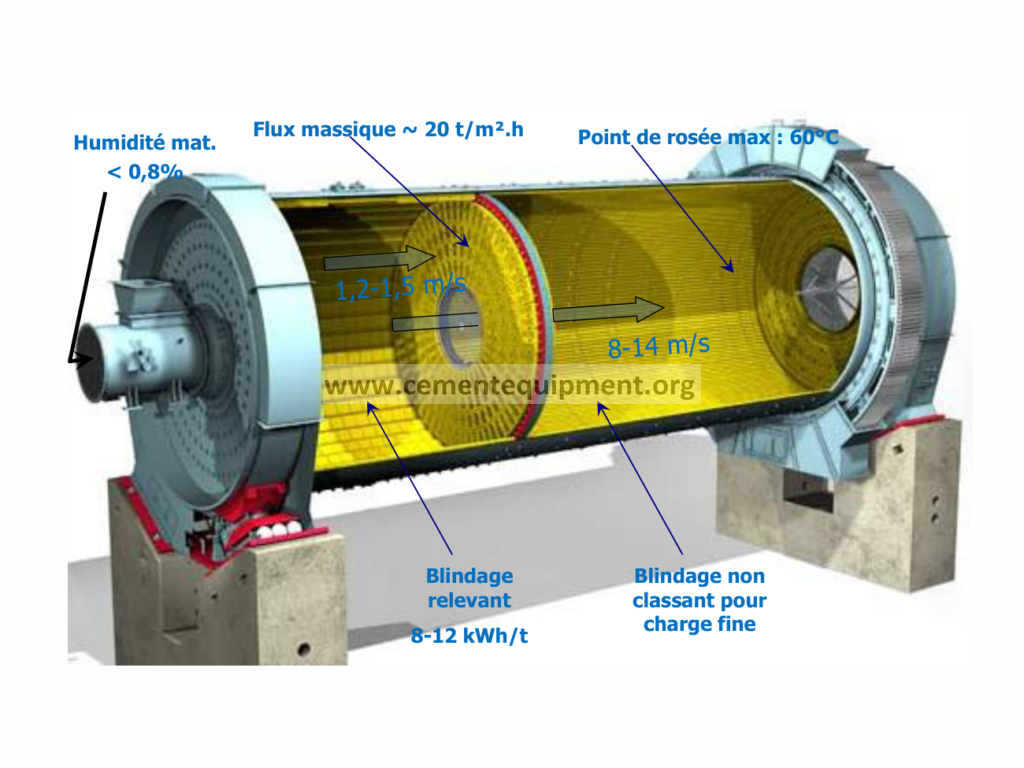
Mill Boulets: Complete Technical Guide
The ball mill (broyeur à boulets) is the workhorse of the cement plant: the rotating horizontal cylinder that tumbles the steel balls over the clinker and grinds it into the cement powder: the machine that appears in every flowsheet, from the raw grinding to the finish grinding, and in some plants still in the coal and the slag lines: the ball mill is simple to understand and difficult to master: the charge, the ventilation, the diaphragm, the separator, the speed and the liner all interact: this guide covers the machine of the 30 to 200 tons per hour modern cement lines with the numbers and the practice of the mill floor.
The Complete Cement Technical Package (931 files including this ball mill file, the grinding handbooks, the Excel calculators and the training courses: $249.99 one-time: instant download via the PayPal payment) hosts this guide with its dimensional tables, its charge charts and its calculation sheets: this article walks the file: the construction of the mill, the charge, the ventilation, the power, the circuits and the diagnosis: the reader closes the page with a complete mental model of the machine that grinds most of the cement of the world.
The ball mill is a machine of apparent simplicity: a cylinder, some balls, a motor. The reality is a system of coupled physics: the cascade of the balls crushing by the impact, the abrasion of the tumbling, the gas flow of the ventilation dragging the fines, the classification at the diaphragm, the temperature of the clinker reacting with the gypsum: the file teaches the system, and this article mirrors the file: the structure first, the physics second, the operation last, and the numbers throughout.
1. The Place of the Ball Mill in the Cement Process
The ball mill appears in four lines of the cement plant, and the duty decides the design:
- The raw grinding: the raw mix (limestone, clay, additives) ground dry or wet, typically to 12 to 15% residue on 90 micrometers, or finer to 10% for the burning:
- The finish grinding: the clinker with the gypsum and the additives ground to the 3,000 to 4,500 Blaine (cm²/g) or the 1 to 4% residue on 45 micrometers, the quality gate of the plant;
- The coal grinding: the coal dried and ground to 3 to 5% residue on 90 micrometers for the kiln burner, with the inert atmosphere care against the explosion;
- The slag and the white cement grinding: the specialist lines, the slag hard to grind at 15 to 20 kWh/t with the elevated mill temperature management;
The finish mill is the largest electricity consumer of the plant: 60 to 70% of the electrical energy of the cement production goes to the grinding, and the finish mill alone takes 30 to 40%: the ball mill at 25 to 35 kWh/t of cement is the standard against which the vertical roller mills compare: the numbers explain why the grinding department runs the energy audits and why the ball mill remains the reference of the quality despite the rising of the VRM.
2. The Construction of the Ball Mill: The Shell, the Flanges and the Bearings
The ball mill is the heavy machinery of the plant: a mill of 4.4 m diameter and 15 m length weighs 200 to 350 tons empty and carries 150 to 300 tons of the balls when loaded:
- The shell: the welded steel cylinder of 20 to 60 mm plate, with the cast steel flanges welded at both ends: the shell flexes under the load, so the design respects the critical deflection and the rotation tolerances;
- The trunnion bearings: the sliding or the hydrostatic bearings at both ends: the white metal babbit or the high pressure oil lifting: the trunnion diameter 800 to 1,500 mm, the oil temperature watched at 50 to 60 °C;
- The drive: the gear ring on the shell driven by the pinion, or the central drive through the reduction gearbox: the modern big mills (5,000 kW and above) use the ring motor or the dual pinion drives to halve the gear loading;
- The girth gear: the split cast gear of 5 to 10 m diameter, the lubrication by the spray: the gear flanks are checked for the pitch errors every shutdown: the gearbox and the pinion alignment within 0.05 mm per meter;
- The inlet and the outlet: the feed chute through the inlet trunnion with the screw conveyor, the outlet through the discharge trunnion into the separator or the bucket elevator;
The mechanical discipline of the file: the shell alignment is checked with the laser twice a year, the trunnion bearing temperature trended daily, and the torsional vibration of the pinion measured monthly: the ball mill failures are almost always the bearing or the gear failures, and both announce themselves in the vibration spectrum weeks before the breakdown: the predictive maintenance schedule of the file saves the plants the unscheduled stops.
3. The Compartments of the Mill: The Two-Stage Grinding Inside One Shell
The cement ball mill is normally a two-compartment machine, and the division of the labor is the first lesson of the file:
Compartment 1 (the coarse compartment): 25 to 35% of the mill length, charged with the 60 to 90 mm balls, equipped with the lifting liners (the wave or the step liners) that lift the charge high for the cascading impact: the job is the impact crushing of the 5 to 25 mm clinker down to about 1 to 2 mm: the energy here is the impact energy, and the liner profile is designed to maximize the lift and the drop.
The intermediate diaphragm: the slotted wall between the compartments, with the lifting plates and the grate: it holds back the coarse balls of compartment 1, passes the fine material and the ventilating air, and lifts the material over to the second compartment: the slot width 6 to 8 mm with the wear of the plates monitored: the blocked diaphragm is the first suspect when the mill fills up.
Compartment 2 (the fine compartment): 65 to 75% of the length, charged with the 15 to 40 mm balls and the classifying liners that sort the balls by size along the length: the coarse balls remain at the inlet end, the fine balls migrate to the outlet: the job is the abrasion grinding of the 1 mm material down to the 30 to 60 micrometers: the power split between the compartments is designed so that each compartment works at its own optimum: the file gives the length ratio table for the cement types and the feed sizes.
The classic design error the course highlights: the plant that charges the mill for the throughput without checking the compartment split finds the first compartment overloaded, the second underloaded, and the product coarse: the lengthwise sampling (the topic of the diagnosis file) reveals the imbalance within two hours of the shutdown.
4. The Grinding Media: The Charge, the Sizes and the Steel Quality
The balls are the tool of the mill, and the charge specification is the page every grinding engineer knows by heart:
- The filling degree: 28 to 34% of the internal mill volume occupied by the media (the void volume between the balls included): the formula: the filling degree J = the media volume divided by the mill volume times 100: the typical 4.0 m mill of 13 m length carries 180 to 220 tons of the balls;
- The top ball size: the classic Bond-derived formula d = 25.4 × (Wi / (K × √D)) × √(F / 100), where Wi is the work index, D the mill diameter in meters, F the feed size: the practice: for the clinker feed at 20 mm and Wi 14, the top size lands at 80 to 90 mm: the first compartment runs the 60 to 90 mm, the second the 15 to 40 mm;
- The gradation: the distribution of the ball sizes inside the compartment follows the Schuhmann or the Bond distributions: the first compartment aims at the 25 to 35% of the 80-90 mm balls in the charge, the fine compartment at the continuous gradation from 40 down to 15 mm;
- The steel grades: the forged high-chromium balls at 10 to 12% chrome with the hardness 60 to 65 HRC for the fine compartment, the cast balls or the forged low-alloy for the first: the ball consumption runs 400 to 800 grams per ton of cement for the forged, 150 to 400 for the high-chrome: the annual ball bill of the 1 Mt/y plant reaches 400 to 800 tons;
The charge management is the recurring theme: the charge wears down, the balls lose their size and their roundness, the mill performance drifts, and the monthly recharge plus the quarterly sorting are the discipline: the chapter on the charge (the charge broyante file of the same course) goes deeper into the gradation and the recharge calculation.
5. The Critical Speed and the Mill Speed Selection
The rotation speed decides the motion of the charge: too slow, the balls roll without lifting; too fast, they centrifuge against the shell without grinding:
The critical speed is the speed at which the ball at the shell surface just starts to centrifuge: Nc = 42.3 / √D revolutions per minute, D in meters: for the 4.2 m mill, Nc = 42.3 / 2.05 = 20.6 rpm: the mills run at 68 to 76% of the critical speed: the typical operating speed of the 4.2 m mill is 14.5 to 15.5 rpm.
- Below 65% Nc: the rolling and the abrasion regime: gentle, good for the fine compartment, inefficient for the coarse:
- 68 – 75% Nc: the cascading regime: the balls tumble and grind by the compression and the abrasion: the standard of the cement industry;
- 75 – 85% Nc: the cataracting regime: the balls fly and impact: efficient for the crushing of the coarse feed, hard on the liners and the balls: used in the first compartment of the short mills;
- Above 85% Nc: the centrifuge, the grinding stops, the liner wear accelerates: the danger zone of the overloaded or the underloaded mills;
The speed is fixed by the motor and the gear, so the plant cannot tune it daily: the lesson of the file is the pairing: the speed and the liner profile must agree: the wave liners with the high speed for the impact, the classifying liners with the standard speed for the fine abrasion: the mismatch explains many “mysterious” energy consumptions of the old mills.
6. The Power Draw of the Mill: The kWh of the Grinding
The motor power of the ball mill follows the classic relationships, and the file teaches both the quick estimate and the precise method:
The quick estimate: P = C × D²˜³ × L × J × n, where C is a constant near 4.5, D and L the internal diameter and length in meters, J the filling degree in %, n the speed factor: the modern precision is the GMS or the Nordberg methodology that the calculators of the package implement:
- The example: the mill 4.2 m by 13.5 m at 30% filling and 74% of critical speed draws about 4,000 to 4,400 kW at the mill shaft: with the drive efficiency 0.95 and the motor margin, the installed power of the line is 4,700 to 5,000 kW;
- The specific energy: the finish mill at 100 t/h of the OPC 42.5 at 3,500 Blaine consumes 30 to 34 kWh/t: the new generation circuits with the pre-grinding (the roller press) drop to 20 to 26 kWh/t total for the circuit;
- The no-load power: 15 to 20% of the rated power goes to the shell weight and the friction: the plant reads the no-load amperage after the charge removal as the mechanical health check;
The power audit of the plant: the kWh/t of the finish grinding is the KPI reported monthly, and the deviation of 3 kWh/t against the target costs the 1 Mt/y plant about 300,000 USD per year at the 0.10 USD/kWh: the energy chapter of the file converts every percent of the improvement into the money of the annual report.
7. The Ventilation of the Mill: The Air, the Temperature and the Dust
The ball mill breathes: the air flows from the inlet to the outlet, carrying the fines to the separator, cooling the mill, and removing the water vapor:
- The airflow: 0.8 to 1.5 m/s of the gas velocity in the free space above the charge: the typical flow is 1.0 to 1.5 Nm³/kg of the mill feed per hour at the mill outlet, or in the practice of the plants: the mill ventilation volume = 3.5 to 5 times the mill shell volume per minute;
- The function one: the transport: the fine particles at 60% of the critical velocity of the air stream lift and flow to the outlet: the insufficient air leaves the fines in the mill, the charge “cushions”, the grinding rate collapses;
- The function two: the cooling: the air at 25 to 30 °C ambient removes the heat of the grinding: the mill outlet gas temperature runs 90 to 110 °C for the finish grinding, and the material temperature at the outlet must stay under 110 to 115 °C to protect the gypsum from the dehydration (the false set risk);
- The function three: the drying: in the raw mills the hot kiln gases (200 to 350 °C) or the separate dryer gases dry the 3 to 8% moisture of the raw mix inside the mill;
The ventilation faults of the plant: the bag filter with the restricted bags drops the airflow and the mill outlet temperature climbs: the operator reads the delta P of the mill (the pressure drop across the mill body, normally 300 to 600 Pa) and the outlet gas temperature as the two ventilation gauges: the trend up of the temperature with the constant feed means the air is starving.
8. The Mill Circuits: Open, Closed, and the Circulating Load
No ball mill works alone: it works inside the circuit, and the circuit design decides the efficiency:
- The open circuit: the material passes the mill once: simple, low investment, and the product size control weak: used for the raw grinding and the small finish lines: the PSD of the open-circuit cement is narrower and the 32-micrometer fraction higher;
- The closed circuit with the separator: the mill discharge goes to the bucket elevator and the separator: the fines leave as the product, the coarse returns to the mill inlet: the circulating load of 150 to 400% of the feed is the standard: the closed circuit produces the wider PSD, the higher Blaine at the same energy, and the 10 to 20% better mill output;
- The circulating load: the ratio of the separator feed to the new feed: the 250% circulating load means the separator handles 2.5 tons per ton of the fresh feed: the higher the circulation, the finer the mill discharge and the more efficient the grinding, until the bucket elevator and the separator saturate;
- The modern additions: the roller press pre-grinder before the mill (the 25 to 50% of the energy saved), the high-efficiency separators replacing the old turbulent ones, the second generation of the internals: the package covers each one in its own file;
The circuit balance: the mill output in the closed circuit is set by the separator, not by the mill alone: the mill produces the coarse discharge at the high rate, the separator classifies: the operator who tunes the separator speed finds the mill output, the fineness and the cement quality all moving together: the separator files of this course (the Tromp curve I and II) teach the exact tuning.
9. The Liners: The Protection and the Profile of the Mill
The liner is the armor of the shell and the geometry of the grinding: the two roles in one component:
| Liner type | Location | Profile role | Typical life |
|---|---|---|---|
| Wave / step liners | Compartment 1 | Lift the charge, cascade impact | 2 – 4 years |
| Classifying liners | Compartment 2 | Sort the balls coarse-to-fine along the length | 3 – 5 years |
| Lifter bars with the rubber | Both | Noise reduction, weight reduction | 4 – 6 years (rubber) |
| Magnetic liners | Fine compartment | Hold the ball coating as the armor | 5 – 8 years |
The liner wear profile tells the story of the mill: the wear of the first rows of the coarse compartment faster than the rest means the feed is too coarse or the moisture carries the lumps; the stepped wear in the fine compartment means the classifying function failed; the liner survey at each shutdown (the thickness measurement at the 10 positions per row) feeds the remaining-life forecast: the file gives the survey form and the replacement rules, because the liner change is the 500,000 USD capital event of the shutdown window.
10. The Mill Temperature and the Water Injection
The finish mill runs hot, and the temperature is the quality variable of the cement:
- The heat sources: the grinding itself converts 90% of the motor energy into the heat: the 4,000 kW mill rejects about 3,600 kW of heat into the material and the gas: the clinker enters at 60 to 100 °C and the grinding adds the rest;
- The upper limit: the material temperature at the mill outlet must stay below 115 °C, otherwise the gypsum (the dihydrate CaSO4·2H2O) dehydrates to the hemihydrate and the anhydrite, the cement sets fast (the false set), the pack set in the silo worsens, and the separator efficiency falls;
- The water injection: 0.5 to 2% of the mill feed as the water sprayed at the second compartment inlet, evaporating inside the mill and taking the heat: the water injection cools the mill by the latent heat of the evaporation (2,260 kJ/kg): the system with the air-atomized nozzles and the spray lance through the outlet trunnion;
- The control: the water rate is trimmed by the mill outlet material temperature with the 10-minute lag: the maximum rate is limited by the cement moisture at the outlet (below 1% in the separator feed) and by the bag filter dew point;
The winter vs summer operation: the plant in the 40 °C climate grinds with the water injection 8 months of the year, and the same mill in the cold season reaches the 90 °C outlet without any water: the ventilation and the water injection are the two cooling handles, and the file teaches the combined control logic with the worked example of the 5,000 kW mill.
11. The Grinding Aids in the Ball Mill
The modern finish mills run with the chemical helpers, and the ball mill course covers their role in the context of the machine:
- The function: the grinding aids (the amine, the glycol or the siloxane formulations at 0.01 to 0.05% of the feed) reduce the agglomeration and the coating on the balls and the liners: the fine particles stop cushioning the charge;
- The effects: the mill output up 8 to 20% at the same fineness, or the Blaine up 30 to 100 cm²/g at the same output, the separator efficiency improved, the pack set of the silo reduced;
- The dosing: the liquid aid injected at the mill inlet or the separator feed at 200 to 800 g/t: the flow controlled by the magnetostrictive or the mass flow meter: the overdosing beyond 800 g/t wastes the money without the further gain;
- The economics: the aid at 1.5 to 4 USD/t of cement pays for itself when the electricity saved (0.5 to 3 kWh/t) exceeds the cost: the plant runs the qualification trials with the full factorial design before the permanent adoption;
The dedicated file of this course (the effect of the grinding aids) develops the mechanism and the trials: in the ball mill chapter, the message is the interaction: the aids work best when the ventilation, the charge and the separator are already healthy: the aid is the fertilizer, not the soil.
12. The Operation of the Mill: The Start, the Stop and the Daily Regime
The mill is a 4,000 kW rotating mass that takes 2 to 4 minutes to accelerate, and the operation rules protect both the machine and the product:
- The start: the mill starts with the charge in place (the ball mill starts loaded, unlike the sag mills of the mining): the sequence: the lubrication pumps, the cooling water, the separator and the fan, then the mill motor at the low speed if the inching drive exists, then the feed: the feed ramp over 15 to 30 minutes to the target rate;
- The running: the daily rounds: the bearing temperatures, the amperage trend, the mill outlet temperature, the separator speed and the residue samples every 2 hours: the power consumption per ton logged per shift;
- The stop: the feed cut first, the mill grinds the residual charge for 10 to 20 minutes, the separator and the fan continue until the mill body empties: the prolonged stop requires the mill rotation (the inching) every 8 to 12 hours to prevent the ball packing and the trunnion sag;
- The emergency: the power failure: the mill stops with the charge in place: the restart is allowed after the inspection of the diaphragm pressure: the mill jammed by the packed charge needs the manual clearing, the worst case of the finish mill operations;
The operator’s log of the file: the amperage and the temperature columns with the standard ranges, the shift comment line, and the “what the operator must check before the start” box: the discipline of the log is what separates the plants with the 90% availability from the plants with the 80%.
13. The Diagnosis of the Ball Mill: The Sampling and the Audit Methods
When the mill performance drifts, the plant opens the mill: the internal diagnosis (the subject of its own file of the course) runs in the scheduled shutdown:
- The lengthwise sampling: the mill stops, the 6 to 10 stations marked from the inlet to the outlet, and the material samples taken at each station: the residue curve of the material along the mill tells the grinding rate of each compartment;
- The charge survey: the balls measured at the stations: the average ball diameter per station, the percentage of the deformed and the broken balls, the coating on the balls: the charge condition read like the medical chart;
- The diaphragm and the grate: the slot wear, the blockages, the lifting plate condition: the free area of the intermediate diaphragm should remain 2.5 to 4% of the cross section;
- The liner measurements: the thickness and the profile at the stations, the lifting height of the wave liners, the classifying slope of the fine compartment;
- The report: the audit report with the four curves (the material fineness, the ball size, the filling, the temperature along the length) and the recommended actions: the file provides the report template the plants use unchanged;
The diagnosis converts the shutdown hours into the months of the improved operation: the typical audit finds the first compartment overfilled (the feed too coarse or the balls too small), the diaphragm slots blocked (the moisture or the aids imbalance), and the fine compartment under-ventilated: the corrections are the cheap changes with the 5 to 15% output gains.
14. The Maintenance and the Reliability of the Mill
The ball mill runs 7,500 to 8,300 hours per year in the continuous plants, and the maintenance program decides between the 90% and the 78% availability figures that separate the profitable plants from the marginal ones: the reliability chapter of the file is built from the maintenance calendars of the operating plants:
- The daily checks: the bearing oil levels and the temperatures, the gear spray lubrication, the coupling condition, the unusual noises and the vibrations: the operator’s round covers 25 checkpoints in 20 minutes;
- The weekly checks: the oil analysis samples of the gearbox and the bearings (the wear metals trending), the bag filter delta P, the separator bearing temperatures, the fan blade deposits;
- The monthly checks: the vibration spectrum of the pinion and the main bearings, the infrared scan of the motor and the gearbox, the lubrication schedule of the trunnion grease, the belt and the coupling alignments;
- The annual shutdown: the liner survey, the charge sorting, the diaphragm inspection, the trunnion clearance measurement, the girth gear inspection: the shutdown list of the file runs 60 items over the 7 to 14 days of the mill stop;
- The wear parts inventory: the liners, the diaphragm plates, the balls, the buckets of the elevator, the separator louvres: the stock strategy of the file: the capital part (the girth gear spare) decided by the risk, the wear parts by the consumption rate:
The failure statistics of the cement grinding: the gearbox and the bearing failures represent roughly half of the mill forced stops, the diaphragm issues a fifth, and the rest is the auxiliary equipment (the elevators, the fans, the separators): the file teaches the sparing strategy: the critical spares value calculated as the cost of the downtime hours (the 100 t/h mill at 200 USD per ton of the lost production costs 20,000 USD per hour of the stop) multiplied by the lead time: the arithmetic changes the attitude of the maintenance managers towards the inventory.
15. The Troubleshooting Table of the Mill Floor
The last operational chapter of the file is the quick reference table that the operators tape to the control room wall:
| Symptom | Probable causes | First action |
|---|---|---|
| Mill power drop with the constant feed | Charge packing, liner wear, empty compartments | Check the feed moisture, the amperage history, schedule the audit |
| Outlet temperature over 115 °C | Low ventilation, high clinker temperature, separator recycling the heat | Open the mill damper, increase the air, start the water injection |
| Coarse product at the constant Blaine | Separator mis-tuning, high circulating load | Check the separator speed and the Tromp curve |
| High ball consumption | Soft balls, wrong steel, cataracting at the high speed | Steel grade check, speed review, reduce the top ball size |
| Vibration and the knocking | Loose liners, broken diaphragm bolts, ball charge flat | Stop, inspect the internals, re-tighten the liner bolts |
| Mill breathing dust at the inlet | Blocked bag filter, high mill delta P, worn inlet seal | Clean the bags, check the fan, seal the inlet |
| Mill jams at the start | Packed charge from the previous stop, moisture | Manual clearing or the prolonged inching: prevent with the daily rotation |
The table is the condensed experience of the mill floors: every symptom maps to the physical cause and the first safe action: the file pages the full version with the deeper analyses, and the diagnosis file of the course carries the shutdown procedures that the table points to.
16. Frequently Asked Questions
What is the ideal filling degree of the cement ball mill?
28 to 34% of the internal volume for the cement mills: the first compartment at the upper part of the band (30 to 34%) for the impact duty, the second compartment slightly lower: the filling is measured by the static method at the shutdown (the distance from the surface of the charge to the mill center) and corrected by the power draw trend in the operation.
Why does the mill need the water injection?
The grinding converts the motor energy into the heat, and the material temperature above 115 °C dehydrates the gypsum, causing the false set of the cement and the separator problems: the water injected into the second compartment evaporates and carries the heat out: 0.5 to 2% of the feed as water, controlled by the outlet temperature.
How many tons of balls does the 4.2 by 13.5 m mill carry?
At the 30% filling degree, about 190 to 220 tons: the exact weight comes from the measured filling: the charge weight = the mill volume times the filling fraction times the bulk density of the balls (4.5 to 4.7 t/m³ including the voids): the monthly recharge typically adds 2 to 4 tons to compensate the wear.
What is the difference between the open and the closed circuit grinding?
The open circuit grinds the material once and the product leaves directly: simple but with the limited fineness control: the closed circuit sends the mill discharge to the separator, the fines become the product and the coarse returns: the closed circuit gives the higher efficiency, the wider PSD and the 10 to 20% higher output, at the price of the separator and the elevator.
How long does the ball mill liner last?
The wave liners of the first compartment 2 to 4 years, the classifying liners of the second 3 to 5 years, the rubber and the magnetic options longer: the actual life depends on the charge, the speed and the material abrasivity: the plant surveys the thickness at the shutdowns and plans the replacement before the shell is exposed.
Is the ball mill obsolete with the vertical roller mills?
No: the ball mill still grinds most of the world’s cement and remains the quality reference for the PSD and the strength development: the modern plants pair the ball mills with the roller presses and the high-efficiency separators, reaching the 20 to 26 kWh/t: the ball mill keeps its place in the blended cements, the white cement and the high-early-strength grades.
17. Conclusion
The ball mill is the 4,000 kW rotating giant that pays for the plant or eats it, and the knowledge of its internals is the difference: the charge, the speed, the ventilation, the liners, the circuit and the temperature: the machine rewards the engineers who understand the coupling of its physics: this guide walks the whole machine with the numbers of the practice, and the companion files of the course (the charge, the Tromp curves, the diagnosis, the aids) deepen each chapter.
The Complete Cement Technical Package includes this ball mill guide with the dimensional tables, the charge charts and the calculators: the one-time $249.99: the instant download: the 931 files of the cement library: the grinding knowledge of the plants, organized for the engineers: the ball mill of the plant, mastered: the career of the grinder, advanced.
Get this ball mill file + the full 931-file package
$249.99 — one-time purchase, instant download, lifetime access
This file is part of the Complete Cement Technical Package (931 files) available from cementequipment.org. Respective rights holders; library copy for the licensed single user.