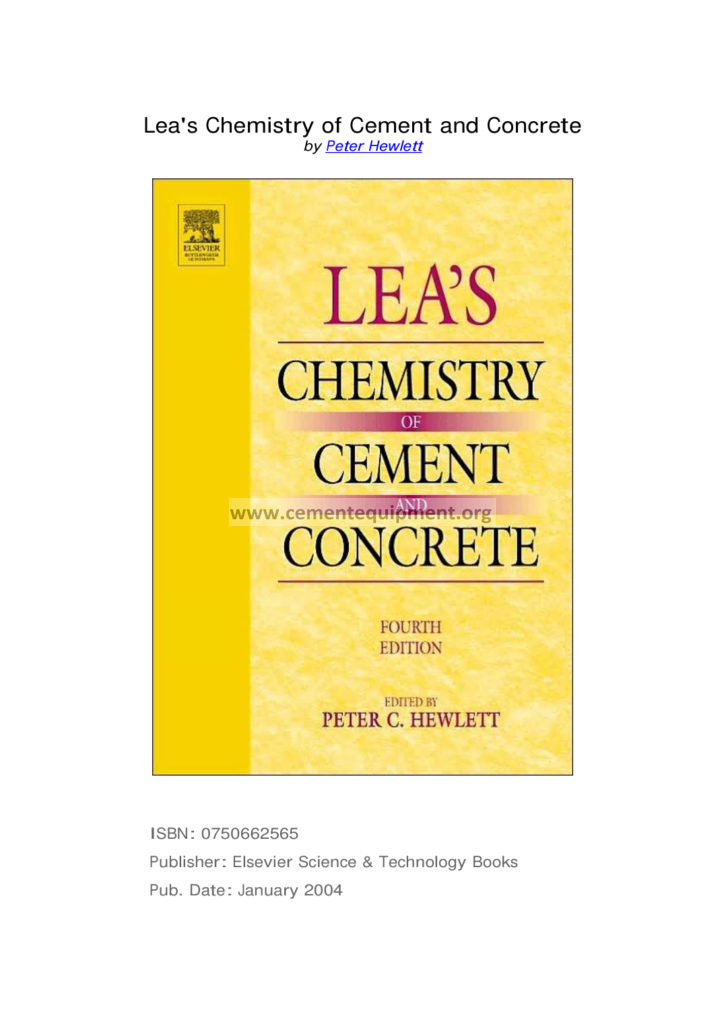
Lea S Chemistry Of Cement And Conc: Complete Guide & Downloa
Lea’s Chemistry of Cement and Concrete, the second volume of the classic reference in the package, carries the book’s chapters on the concrete itself: the companion file to the first part of the same classic: cement, the material; concrete, the structure: the industrial strength of the cement lies in the concrete, and Lea’s covers both with the same patience of the reference science: the paste, the aggregate, the microstructure, the transport of the fluids, the corrosion of the steel, the frost, the fire, the sea: the entire life cycle of the built concrete from the chemistry of the mixture to the chemistry of the failure.
The Complete Cement Technical Package (931 files: the books, courses, Excel tools and presentations: $249.99 one-time: instant download via PayPal) includes both parts of this classic together with the concrete courses: the reader of this second file learns the world of the hardened cement, the living part of the book: this article walks the file: the microstructure of the paste, the concrete as the composite, the durability mechanisms, the testing and the standards: the engineer reads the page with the completed concrete of the file.
Honest framing: no single guide makes the reader a chemist: the object of this file is the map: the reader uses the chapters as the terrain and returns to the specific ones when the site problems appear: the strength dips, the efflorescence, the cracks of the structure: every phenomenon in the concrete has a chemical explanation, and the explanation is the chapter of the book: the deposit: 931 files: the library of the cement, the answers of the shelf.
1. The Concrete Side of Lea: The Arc of the Book
“The Chemistry of Cement and Concrete” released the concrete chapters with the same seriousness as the cement chemistry: the paste alone is not the structure: the concrete is the composite of the paste and the aggregates, and the science of the composite is the bridge between the laboratory and the site:
- The composite idea: the cement paste binds the coarse and the fine aggregates: the paste occupies about 25-30% of the volume, the aggregates the rest: the paste is the reactive phase, the aggregates the skeleton: the properties of the concrete are the mixture of the two: the chapter reads both;
- The water-cement ratio: the W/C is the single strongest factor of the concrete: the strength, the permeability, the durability: the classical law of the concrete (Feret, Abrams) and the chapter the book devotes: the honest discussion of the water in and the excess bleeding;
- The book structure: the chapters divide the concrete science: the fresh concrete, the hardened, the properties, the aggregates, the environs and the structures: the classic arrangement that the modern books copy: the map of the science;
The companion split of the package (the “-and-c” file for the cement chapters and this “-and-conc” file for the concrete chapters) follows the book: the engineer who studies the two files studies the complete reference: the files are the two halves of the same whole, applied in the same package.
The concrete chapters of the classic are not an appendix: the book that explained the cement explains the built: the proportioning, the placement, the curing and the long-term behavior: the engineers of the structures open the book for the cement chapters once and for the concrete chapters every week: the file of the package carries the second half in full for the engineer of the site and the laboratory.
2. The Fresh Concrete: From the Mix to the Cast
The chemistry of the concrete begins in its fresh state: the wet stage where the workability, the segregation and the bleeding decide the quality of the final stone:
- The rheology: the fresh concrete is the suspension: the yield stress and the viscosity: the slump of the cone, the factors of the powder content and the admixtures: the superplasticizers change the flow without the added water: the chemistry of the polymers and the cement: the chapter of the fresh concrete;
- The setting and the hardening: the two different stages: the setting is the loss of the workability (the initial and the final Vicat), the hardening is the gain of the strength: the temperature accelerates both: the chemical story of the hydration and the physico-mechanical consequences: the chapter is the translation of the cement chemistry into the schedule of the site;
- The bleeding: the water rises to the surface of the fresh concrete, the cement settles: the channels of the bleeding later become the webs of the weakness: the surface of the slabs: the measures: the chapter of the bleeding and the segregation: the practical of the chemistry;
- The curing temperature: the hydration is the temperature game: the heat of the setting: the thermal cracking of the massive elements: the chapter of the cooling and the curing: the decision of the “cure the concrete” comes from the chemistry: the water must stay for the hydration;
The fresh concrete is the only stage the contractor can still change: once the concrete sets, the recipe is history: the book spends its opening concrete chapters on the fresh stage because the mistakes of the hour are the failures of the decades: the engineer reads the chapters before the pour, not after.
The fresh state is the stage of the temperature chemistry: the warm weather accelerates the hydration of the setting hours, the cold delays it: the hot-weather concrete shortens the working window at the chute, the cold extends it to the freeze risk: the chapter devotes its pages to the temperature management: the ice at the mixer, the heated water, the retarders and the accelerators: the chemistry and the practical clock of the site in the same pages.
The fresh concrete is also the stage of the paste chemistry in the most visible form: the water of the mix leaves the surface the bleeding channels and the settlement of the aggregates on the formwork: the book explains the remedies of the site: the air entrainment, the re-vibration, the curing covers: the fresh state of the concrete is the only state the site still controls, and the classic devotes its opening concrete chapters to exactly the hours the contractor can still save.
3. The Hardened Concrete: The Microstructure and the Porosity
All concrete technology is a struggle with emptiness: the porosity of the paste:
- The gel pores: the intra-C-S-H voids of the nanometer: the residence of the water of the gel: the Van der Waals forces: the gel porosity is insignificant for the durability;
- The capillary pores: the residual spaces between the hydrating cement grains: the micrometers: the vessels of the transport: the higher the W/C, the larger and more connected the capillaries: the highway of the aggressive ions into the steel;
- The air voids: the entrained air of the frost protection, 5-8% intentional: the bubbles that host the water expansion during the freeze: the endangered balance, the frost chapter; the air void system and the spacing factor of the concrete: the number of the durability;
Three orders: the gel, the capillary, the air. The strength follows the capillary: the transport follows the capillary: the failure follows in: the book chapter (the classical “the properties of the hardened concrete”) dedicates the pages to the porosity, and the modern codes show the same logic: the compressor of the water will be the porosity, always.
The porosity is not a static property of the paste: the hydration continues after the setting and slowly fills the capillary voids, the late densification that the book documents as the strength gain of the mature structure: the engineer of the diagnosis understands why the hydrated concrete of the low water ratio grows stronger with the decades, while the porous concrete simply stores the water that the cycles of the frost and the chlorides later turn against the structure.
4. The Strength of the Concrete: The Measurement and the Meaning
The compressive strength is the passport of the concrete: the symbol of the codes, the classes C25/30, the archives, the strength at 28 days of the world standard:
- W/C – strength law: the classic relation of the water-cement ratio and the compressive strength: the cement acts on the porosity: the law of the cement combinations such as the law of the binder: the simplified rule: strength = f(cement/water, cement type, age);
- The age development: the alite gives the 1-day and 7-day development, the belite the relentless late rise: the 90-day and the beyond: the logarithm of the relation: the own curve of the concrete: the chapter of the age factors;
- The test cube: the cylinder/cube pouring, curing at 20 °C and 97% humidity: the density, the strength: the sampling statistics: the mean minus the cheat: the code books of the site: chapter of the test methods of the book;
The strength numbers of the spec are therefore the chemical-metric of the paste quality: the concrete of 50 MPa and the concrete of 25 MPa have different W/C objectives, about 0.38 vs 0.55: the chapter gives the table: the strength class is also a chemistry class: the engineer of the package takes the physics of the strength back to the chemistry of the cement, the circle of the classic knowledge.
The strength is a distribution, not a number: the Tuesday pour is not identical to the Wednesday pour, the aggregates, the scribblings, the spread of the compaction vary: the chapter of the concrete statistics: the standard deviation of the site, the high characteristic strength, and the acceptance of the tests: the confidence of the codes is built on the honesty of the variation, and the classic refused to pretend otherwise.
The shape and the size of the specimen also matter: the cube strength exceeds the cylinder strength of the same concrete, the taller specimen measures the lower strength, the wet surface reduces the reading: the conversion tables of the classical allow the engineers of the world to compare the strengths across the national testing traditions: the same concrete, the corrected numbers, the same truth.
5. The Durability: The Transport of the Fluids and the Chemical Attack
The recorded the unbreakable philosophy of the classic: the concrete is not durable by default: it is durable by the design of the porosity and by the knowledge of the chemical enemies:
- The transport mechanisms: the permeation (the pressure-driven flow of the pores), the diffusion (the concentration gradient of the ions), the capillary suction and the wicking of the surfaces: every aggression of the structure enters through one of them, and the book treats each:
- The carbonation: the atmospheric CO2 dissolves in the pore water, the neutralization of the paste: the retreat of the 13.0 pH: the first defense of the steel: the carbonation depths measured by the indicator: the linear growth with the square root of the time: the chapter: the same thickness of the cover: the parameters;
- Sea and the chlorides: the chloride ions reach the steel at the cover, break the passivity, start the corrosion: the chlorides of the marine and the de-icing: the mass and the w overrules: the book is the classic of the chloride attack chapter: the engineers of the marine structures quote it;
- The frost: the freezing water expands by 9%, the internal pressure cracks the matrix: the air bubbles are the reservoirs, the reliefs; the aggregate itself must not be the frost fragile: the exposure classes of the standards grew from these chapters;
The philosophical counter of the classic: consider the concrete as the “porous body”: the chemistry decides the transport, the transport decides the life: the book’s message remains the specimen of a structure’s durability: the knowledge of these five chapters saved more piers, bridges and harbors than any other single page of the cement literature.
The transport chapter provides the numeric spine that the design codes later borrowed: the permeability coefficients, the chloride diffusion coefficients, the water absorption: the modern service models stand on the values that the book reports: the reader of the chapter understands why the codes demand the lower interfaces of the bridges and why audit cores are sampled at the deepest exposure zones.
6. The Corrosion of the Steel: The Electrochemistry of the Reinforcement
The reinforced concrete fails not because the concrete fails but because the steel rusts: the chemistry of the corrosion chapter:
- The passivation: the high pH of the (12.5-13.5) forms the passive oxide film on the steel: the film is the shield: the corrosion cannot start while the alkaline zone remains;
- The depassivation: the chloride pronounces the film locally (the pitting) or the carbonation dissolves it entirely: the steel becomes the anode of the macro-cell with the neighboring bar: the rust volume = 2-6 × the steel: the expansion pressure who cracks the cover;
- The repair chemistry: the bridge: the clean, the passivate the rebars, the hydrophilic coatings, the cathodic protection: the chapter of the book: the electrochemical treatment of the concrete: the laboratory to the bridge: the repairs: honest: the chapter: the prices: the chloride chemical cleaners;
- The design of the against: the cover depth, the concrete impermeability, the chloride the standards limits: the exposure classes of the European CEN: the combined advice of the charts;
The chapters of the steel corrosion collect: many of the debates: calculations, the demonstrations of the chloride thresholds, the “corrosion directors”: the engineers who open this chapter when the laboratory report arrives with the fractures: the concrete waiting after years: the exact science: in the life of the structures, the most valuable competence to which the classic of the package leads.
The corrosion chapter treats the reinforcement as an electrochemical cell: the steel in the humid concrete corrodes in the presence of the oxygen, and the current flows between the anodic and the cathodic zones separated by the centimeters: the modern cathodic protection systems revert the reaction with the applied currents, and the repair of the chloride-contaminated bridges follows the measured potential maps: the book presents the health of the rebar as a measurable system.
7. The Aggregates: The Chemistry of the Skeletons
Lea’s gives the aggregates a full attention that the modern courses forget:
- The aggregate of the chemistry: the siliceous gravels, the carbonates, the basalts: each has its chemistry and its behavior with the paste: the reactive potential of the silica, the alkali-silica reaction of even the innocuous-looking sand: the chapters list the rocks and their risks;
- ASI (the alkali-silica reaction): the opal, the chertis, the strained quartz: the reactive forms develop the expansive gel with the alkalis of the paste: the map: the ASR testing (the mortar bars, the pyrex rooms, the petrographic examinations): the protection: the low-alkali cement, the pozzolans, the limits;
- The pollution: the organic soil and the clay of the aggregate: the attack the hardening: the mica and the shales affect the strength interface: the alkali the clay: the honest: the tests of the book: the washing of aggregates in the plants;
- The moist of the aggregate: the free water and the absorbed: the effective W/C of the concrete: the compensation of the dosage: the moisture meter of the plant and the chapters: the chemist’s point of view of the batching;
The lesson of the chapter: the landscape under the concrete is an active chemical partner: the cheap aggregate may hide the alkali evidence of the whole structure: the book prevents: the skilled engineer: the aggregate survey: of the package: the testing: the laboratory: the arguments of the durable structures, decided before the mixer.
The aggregate contributes more than the fill: the stiffness properties, the thermal expansion couplings and the interfacial chemistry control the mature cracking of the concrete: the classic returns the stiffness tables of the aggregates that serve the modulus predictions of the design: the surprise of the chapter: the aggregate is the structural partner, and the numbers of its stability are the numbers of the service life.
8. The Admixtures and the Chemical Tools of the Concrete
The modern concrete is not water, cement, aggregate: it is the chemical portfolio:
- The water reducers (the plasticizers): the anionic surfactants that disperse the cement flocks: the water reduced 5-15% with the same slump: the superplasticizers – the polycarboxylates of the 20-35% water: the concrete class: lower W, the stronger, the denser: the chemical polymers of the modern building;
- The retarders and accelerators: the prolongs of the setting, the sugar, the hydroxyl-carboxyl: the rescue of the high-temperature pours the shortening: the accelerators of the cold weather: the chemistry of the setting: the chapter: the heat: the controls:
- The air entrainers: the stable air bubbles of the designed 5-8%: the chemical surfactants: the freeze-thaw armor: the air performed permanently: the flows and the frost: the dosage: the air meter of the site: the balance of the strength loss vs the frost gain;
- The durability aids: the corrosion inhibitors of the rebars, the waterproofing, the shrinkage-reducing admixtures: the building of the concrete world from the chemistry: the chapters of the construction chemistry: the last: the section of our package: the chemical architecture;
The admixtures exile the chapter of the “cement-admixtures interactions”, the fragile chemistry of the reactions between the C3A and the admixture molecules: the book explains why the same superplasticizer works with one cement and fails with the next: the chemistry of the ions in the first hour decides: the era of the “compatible package”: the chapter: the “yes” of the chemistry: the engineer: the admixtures of the site: the knowledge:
The admixture chapter documents the principle that the products build on: the molecules act at the interfaces of the cement particles and interact with the hydration products of the first minutes: the modern polycarboxylate superplasticizers control the dispersion with the lateral chains, while the interface principle remains the classic one: the engineer who masters the mechanism reads the product brochure critically and selects the admixture against the chemistry of the own cement.
9. The Testing of the Concrete: The Laboratory of the Site
The classic doesn’t stop at the theory: the chapters of the testing make the chemistry measurable:
- The fresh tests: the slump, the flow, the air content, the unit weight: the scorched: the fresh state laboratory of the site: the acceptance of the delivery: the chemistry into the quotidian of the ticket;
- The hardened tests: the compressed cubes and the cylinders, the split, the flexure: the code specimens of the site, the accepted specimen: the NDT (the hammer, the ultrasound): the in situ strengths: the booze: the report of the core;
- The durability tests: the rapid chloride permeability, the water permeability, the porosity of the water, the depth of the carbonation, the resistivity: the professional laboratory: the scan of the concrete by the physical probes, the prediction of the life: the modern: the chapters: the classic:
- The statistical interpretation: the analysis of the 28-day lets the concrete the field: the average/standard deviation, the conformity criteria of EN 206 and the fresh codes: the textbook: the honest reading of the numbers: the chapter: the plant: the quality of the concrete basis: the probability of the failure, the acceptance;
The curve: the testing chapters: the link from the chemistry to the contract: the concrete is accepted, paid, certified as per the tests: the civil engineer who knows the chemistry knows the limits of the numerical: the book: the two eyes of the successful engineer: the numbers and the chemistry: the package: “the working level”: the importance of the classic.
The testing chapters finish with the surveillance of the structures: the half-cell potential maps of the reinforcement, the resistivity and the cover measurements, the tomography of the interior: the maintenance of the modern infrastructure is the applied chapter of this book: the tests of tomorrow predict the condition of the next decade, and the bridge and tunnel inventories run on exactly these methods: the classic laboratory recorded the chronicle of the assets.
10. The Standards and the New Generations of the Concrete
The final chapters bridge the classic to the modern code:
- EN 206 and the exposure classes: the classification of the environments (XC, XD, XS, XF, XA): the choice of the concretes: the maximum W/C by the class: the classic chemistry codified into the tables: the reader sees the chapters behind the tables: the deep-kept knowledge of the codex;
- The mass concretes and the heat: the damage of the hydration heat in the thick casings: the temperature fields: the modeling: the chapter of the heat of the hydration: the thermal: the measures: the concreting of the power and the grid;
- The low-carbon and the modern binders: the calcined clays, the alkali-activation, the belite ye’elimite (BYF) cements: the package covers the modern chapters: the classic chemistry remains the base: the durability limitations of the new binders: the honest evaluation: the carbon: the industrial transition:
The book of the classic also closes with the responsible framework: the same chapter: memorable phrase of the modern editions about the environment: the cement industry 8% of the world CO2: the chapter of the decarbonization: the shadows of the classic: the new: the package: the reader from the Lea chapters to the low-carbon courses of the setup: the continuum of the knowledge.
The book closes the concrete chapters with the perspective of the codes: the standards change, the chemistry does not: the exposure classes entered the law with the threshold values derived from the classic transport studies, and the cover requirements came from the corrosion chapters: the engineer who reads the classic reads the code as the memory of the failures: the classic in one hand, the standard in the other: the complete professional.
11. Conclusion
The two Lea’s files of the package: the two readings of the classic: the chemistry of the cement, and the chemistry of its concrete: together, the complete scientific base of the engineering: the engineer old and the young, the laboratory, the process, the product: each finds the chapters of the classic, and the classic returns what it was written for: the answers.
The Complete Cement Technical Package: 931 files: the Lea’s pair, the Duda data book, the designing plants the handbooks, the courses, the Excel: one-time $249.99, the instant download: the PayPal button below: the library of the cement engineer: the classic on the shelf, the career complete: the cement: the chemistry of the classic: the purchase: the present and the concrete.
The concrete: the most used building material of the world, chemically the most underestimated: the paste, the aggregate, the steel and the environment: the performance is decided in the chemistry of the first hours: the classic carries the whole science of that decision.
The Frequently Asked Questions
Is this the concrete volume of Lea’s Chemistry?
This file is the concrete-side part of the same classic, the continuation of the first part (“Lea’s Chemistry of Cement and Concrete and the C” in the package): the two files: the complete book: the cement chemistry in part one, the concrete technology in this part: the experienced reader gets the two halves and the same leather spine.
I am a concrete engineer, not a chemist: should I read this file?
Yes: the classic is the reference of the concrete engineer’s own world: the porosity, the W/C, the durability, the ASR are the concrete’s daily: the chapters of this file walk through all of them: the style of the package is the same for the process and the product: the direct value: the site: the quality engineer of the plant: the seminar: the 28-day mystery: the classic solves the why.
How is the corrosion chapter still relevant with the modern codes?
The modern codes assume: the engineers apply the minimum W/C and the covers: the classic explains why they work and where the assumptions break: the parking decks, the bridges, the PVC structures: the code from the chemistry: the classic: the critical understanding, the entrance: the professional answer: the strength.
Does the package include the testing standards of the concrete?
The package includes the testing standards documents used by the plant and the lab: the cubes, the slumps, the cracking the VCT, the carbonation the kit: the Excel calculators of the strength-age etc.: the classic chapters + the standards files: the complete round of the study: the instant: the digital: the library.
How do I start with the concrete files if I am new?
Start with this guide: the order: the paste micro, the porosity, the strength, and the durability: follow the chapters 4, 5, 6 of this article: the rest the package: the cement courses: the concrete technology in the handbook: the reading list of the observer: the weeks: from the beginner to the literate: the cement library, the foundation.
Does the concrete file repeat the cement file?
No: the first file of the package covers the chemistry of the binder, this one the chemistry of the fresh and the hardened concrete: the pair follows the split of the original book: the cement chapters of the book and the chapters of the concrete: the owner of the two files owns the complete classic.
Get this Lea’s Concrete file + the full 931-file package
$249.99 — one-time purchase, instant download, lifetime access
This file is part of the Complete Cement Technical Package (931 files) available from cementequipment.org. Respective rights holders; library copy for the licensed single user.