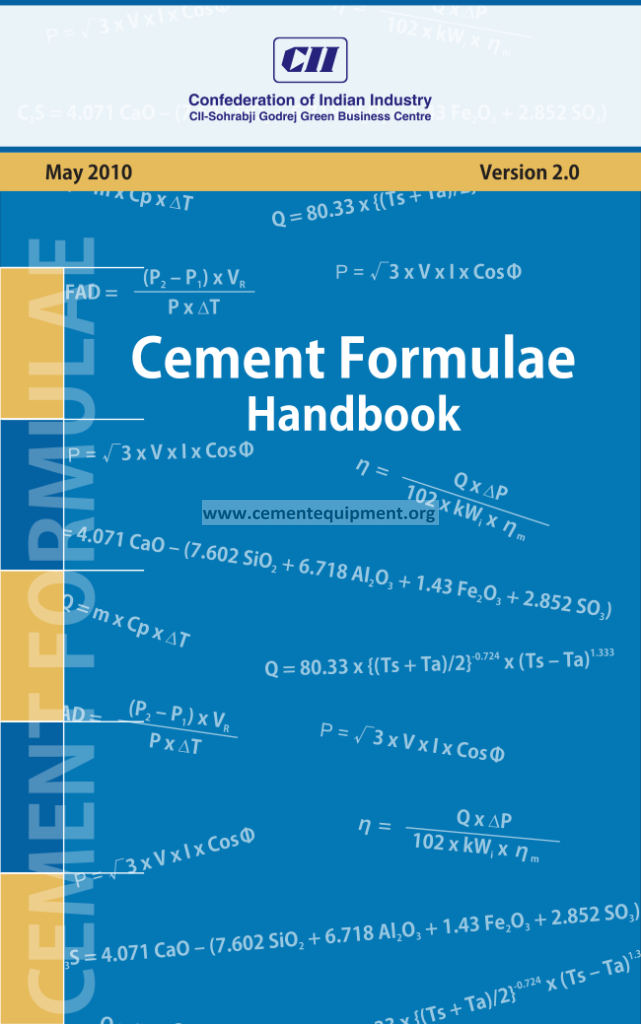
Cement Formula Handbook: Complete Technical Guide
The Cement Formula Handbook (version 2.0, 2010), published under the Confederation of Indian Industry — Godrej Green Business Centre, is a practical reference work of the Indian cement industry: 134 pages of formulas, definitions, conversion factors, process relationships and equipment data designed for the daily work of production, quality, maintenance and operations. From the capacity of raw mills to the thermal consumption of the kiln, from circulations of separators to the units of measurement used in the plant, this handbook puts the essential technical content of the cement industry in a compact, exam-friendly and desk-friendly format.
This document, the complete digital edition in the cementequipment.org library, is a part of the Complete Cement Technical Package (931 files — books, courses, Excel tools and presentations, $249.99, instant download via PayPal). This guide explains what the handbook contains, who uses it, how it overlaps and differs from the global textbooks (Lea, Duda, Taylor), and why it is an essential complement to the other files of the package — particularly for engineers working in the South Asian and Middle Eastern markets, where the conventions of this handbook are the industry standard.
1. Background: The Indian Cement Industry and the CII
The foreword of the handbook opens a crucial fact: the Indian cement industry stood at roughly 260 MTPA (million tons per annum) of capacity at the time of publication (2010) and was one of the fastest-growing sectors of the world, with a confirmed trend of reducing its specific energy consumption year after year. Since then, the industry has more than doubled its capacity, but the formulas and data conventions of this handbook remain the technical language of thousands of engineers.
The publication was developed under the Confederation of Indian Industry — a forum of the sector that continuously works on energy efficiency (the Godrej Green Business Centre is dedicated to green technology work). The handbook was designed precisely for the plant-floor and classroom use of the industry, and remains one of the most requested files in the full technical libraries of cement plants, both because of its compactness and because it collects in one document the formulas that other books spread over hundreds of pages.
2. The Complete Structure of the Handbook
The 134-page handbook is organized in chapters that mirror the departments of a cement plant. The following map summarizes the main sections of the volume and what they cover:
| Section | Content |
| Basics and convention | Units, conversions, symbols, density/void relations, common constants |
| Raw materials and raw mix | Oxide composition, LSF/SR/AR formulas, raw mix adjustment calculations, stockpile and blending data |
| Crushing and grinding | Crusher capacities and power formulas, Bond energy, ball mill charge and volume relations, separator circuits |
| Preheater and kiln systems | Heat transfer, thermal consumption formulas, exhaust gas volumes, burner and flame data, cooler efficiency |
| Coal and fuels | Coal fundamentals: calorific value, ash, moisture, VM, grind characteristics, pet coke comparison |
| Cement grinding & packing | Blaine and fineness, separator loops, packing plant and dispatch statistics |
| Quality assurance | Testing, control charts, sampling, laboratory practices, quality department KPIs |
| Energy and utilities | Power consumption, fans, compressors, drives, waste heat, MIS metrics |
Because the chapters cover the whole chain, a shift engineer going from the raw-mill to the kiln to the packing plant can run with a single book in his bag: formulas for each stage are one to two pages apart.
3. The Formulas of the Raw Mix: The Language of the Unit
The handbook gives the classic formulas as the cement profession of South Asia knows them. These formula conventions deserve a quick explanation, because they are exactly what the senior engineers and the exam preparation use:
- Lime saturation factor (LSF): the standard formula (CaO – 0.7SO3 / (2.8 SiO2 + 1.18 Al2O3 + 0.65 Fe2O3)) with the limits 0.9–1.02 for ordinary mixes, allowing a check of the saturation of the mix in lime.
- Silica ratio (SR): SiO2 / (Al2O3 + Fe2O3), the burning contrast; the normal range 2–3.
- Alumina ratio (AR): Al2O3 / Fe2O3, a indicator of the liquid in the burning zone; normal 1.5–2.5.
- Raw mix correction: the arithmetic of blending limestone, clay, laterite/iron ore and a silica corrector to hit the target — the classic two-pile blending exercise appears here in cleaning form.
For the young production engineer this is exactly the knowledge needed day 1: the mix calculations that the Excel tools execute in milliseconds are the same formulas the handbook presents in two pages.
4. Grinding and the Ball/Mill Departments
The grinding chapters are among the most used of the book because the mill is the department where the daily decisions happen (Blaine, throughput, separator, balance). The handbook covers:
- Ball mill design numbers: particle size distribution, bulk densities of ball and material, degree of filling, critical speed relations, power and output relations; the abbreviations of the modern mill roads.
- The Bond work index basics: the Wi for clinker, limestone, coal, slag, with the range values.
- Separator operations: circulation load (the return/milli feed ratio), specific loading, the fishhook curves, the “production” efficiency of classification, the relation of Blaine to the separator speed.
- Vertical roller mills: the specific pressure, grinding media systems, the gas quantities.
- Grinding aids: the types and concentration, and the moisture of the mill feed.
These formulas make the handbook the ideal “user manual” next to the Excel mill tools of the package: the tool calculates, the handbook explains the base.
4.1 Units, Conversions and the Base Data of the Plant
Before any formula comes the discipline of units, and the handbook opens with the conversion and convention tables that are the silent language of every plant report. In the concrete practice of the industry, the engineer finds four different systems in the same meeting room: the metric tonne and kilogram of the quality lab, the calories per kilogram that the kiln control reports, the megajoules of the energy manager and the kWh of the electrical department. The handbook provides the conversion between all these families in compact tables, exactly as used in the plant correspondence:
- Mass and volume: kilograms, tonnes, pounds, cubic metres of material and of gas, with the bulk density conventions: limestone in the 1.4–1.7 t/m3 range loose, clinker at about 1.3–1.4 t/m3, cement at 1.1–1.3 t/m3, and the relation of these values to stockpile and silo calculations.
- Energy: kcal/kg to kJ/kg to kWh/t; the handbooks of the plant are written in kcal/kg of clinker, the energy auditors require MJ and the electrical consumption is reported in kWh/t of product; the handbook gives the official multiplication factors.
- Pressure and air: millibar, mm wg, atm and gauge pressures, the air quantities at 0°C and “at conditions” — the conversion that causes more confusion in kiln and mill calculation work than any other.
- Temperature conventions: °C, °F and K, applied in the formulas such as the gas density at temperature (kg/m3 at T) which recurs everywhere in the preheater gas calculations.
The engineer who keeps this chapter at hand avoids the routine error of the best engineers everywhere: mixing the thermal figures of two different conventions. This is the value that a compact handbook brings that the large textbooks do not give: the conventions of the plant in one glance at one page.
4.2 The Raw Materials Department: Quarry, Stockpile and Blending
The handbook covers the raw materials chapter in full industrial depth because the performance of modern mills is decided by the feed they receive. Among the contents of the chapter, the permanent techniques are:
- The oxide analysis tree: the main components CaO, SiO2, Al2O3, Fe2O3 and the minor components MgO, SO3, alkalis, Cl-; both wet chemical and XRF practice with their typical accuracy and repeatability figures.
- Moisture and loss on ignition: the correction for carbonates and the clay moisture, the relation between LOI and the coal consumption estimate of the kiln.
- The limestone quality: the target limestone grade (in the Indian practice often 45–50% CaO in the quarry average), overburden and interburden, blending pits and horizontal stockpiles by jeep dumpers or stacker–reclaimer, with the classic formula of the mixing effect on the oxide deviation (“quadrature of the standard deviations”).
- Clay and substitute sources: SiO2, Al2O3 content of red ochre, laterite, sandstone, fly ash, and the corrections.
From these tables the raw mix and the standard deviation of the feed are controlled before the mill, which is the first line of quality: the whole plant receives its nourishment from the raw mill feed.
4.3 The Kiln System: Fuel, Burner and the Flame Formulas
In the chapter on the kiln system, beyond the thermal balance of the gas, the handbook brings the practical parts of the fuel to the combustion:
- The fuel requirement: the kg of coal per kg of clinker from the calorific value (for a typical 3500 kcal/kg coal at a thermal consumption of 850 kcal/kg, the consumption stands on the order of 240–260 kg coal per tonne of clinker, adjusted by the ash); the ash of the fuel enters the clinker as an oxide correction — a formula given with the ash chemistry tables.
- The burner basics: the primary air rate, the burner velocity, the flame momentum, the shape relations that the operator uses in adjusting the flame.
- The NOx basics and the CO discipline: the excess air and the O2% in the kiln gas (normally 1.5–2.5% dry at the kiln inlet in the modern practice), the recirculation.
4.4 The Cooler, the Clinker and the Presentation of the Product
Grate cooler chapter gives the coolant basics: the grate area ratios, the air rate per kg of clinker (1.8–2.4 kg air/kg in the modern), the secondary air temperature, the clinker temperature at the mill inlet (a determinative value for the grinding of the last stage). The clinker chapter brings hints that connect to the chemical tests: free lime expectations (below 1.5–2% free lime in normal burning), sulphate distribution and the quick quality checks at the cooler discharge.
The handbook closes this part with the presentations of product: the cement quality at packing, the moisture and temperature of cement at the packing plant and the dispatch practices of the review of the packed cement.
9.1 Additional Coverage: The Main Meteorological and the Wash-Heap Sections
To give it the complete width of a 134-page handbook that is a description of the sections: it also brings the following work sheets: the wash-heap and mineralogical standards; the “X” tables of the counters; the laboratory data of the packhouses for dispatch; and (importantly) the blanks of the daily production reports, where the plant engineer writes the numbers: the raw meal analysis report, the gas report at the kiln exit, the mill report, the packing report, the stock report and the energy report; the forms have a pedagogical value of their own because they teach the exact format and arithmetic that the modern industry adopts in its ERP/MIS.
Also, because the book is written in the compact style of the Indian engineering schools, the same formulas appear in the duplicate form that the exam uses: LSF, KSF, AR, SR, SP (solid Phase 90 or index), paste tests (paste command) and the various references of the quality control. This compactness is a genuine advantage when the requirement is quick.<
9.2 The Handbook in Combination with the Excel Tools of the Package
The Complete Cement Technical Package places next to the handbook a set of Excel calculation tools that implement identically the same formulas: By putting the handbook and the raw mix design tool side by side, the LiDs, the SR / AR optional and the LOI corrections are verified in two minutes; an engineer who learns the formulas in the handbook and executes them in the Excel tool gains the exact scientific formation: he knows what the number means and he knows how to check the tool. The same for the heat balance, the mill design and the coal analysis tools: every tool is a live copy of a formula page of the handbook.
9.3 The Relation to Duda, Lea and the Holderbank Courses
An important question of the professionals who already own the global library is where this handbook stops and where the big books start. The answer, in the light of the package, is: the handbook gives the formulas and the values; Duda (Cement Data Book) gives the enormous tables of the equipment of the industry (the same units and data, but global and with bibliography); Lea gives the deep scientific base of the material; Holderbank and the FLS Internal Training give the systematic training structure of the world plants; and the handbook gives the immediate hand “the formula” for quick every 10 minutes. They do not compete; they complete.
In the plant operation, the practical result of this distinction: when the process engineer receives a task (reduce the mill energy, bring the free lime in range, solve a circulation), the handbook provides the formulas to reach the number within a day; the big books provide the reason and the process; together they form the complete engineering toolset.
9.4 The Importance of the Handbook in the Career of the Engineer
Finally, it is worth saying what the users of the handbook uniformly testify: the compact formula book is the instrument of passage and starts. For the trainee, it converts the first year of learning to the first month: the required formulas are in the foreword-to-last pages, and the trainee is productive from the first week – a decisive advantage in the work environment. For the senior engineer, it is the ultimate reference at the machines: the number of a formula is verified before giving the range to an operator or a technician. For the engineer of the equipment supplier, it is the same: in a system-engineering work, the LSF of a company’s targets has already been made possible. No electronic library replaces the basis of formula handbooks: it is the DB that keeps ready in the pocket.
9.5 The Handbook in the Digital Practice: Search and Book keeping
The digital edition has the great advantage of the search: in the PDF of the package every formula, every section, every table, is found with the pressing of two keys: “Blaine”, “LSF”, “grate”, “Bond”, “NOx”, the page opens in 1 second. Than the printed handbook of 2010, that only had fast lookup in the table of contents, the digital edition adds the lookup of the contents and the OCR reference: this makes it more valuable. For engineering students a digital copy that is always at hand is worth a shelf of printed editions.
9.6 Expansion: Some detail of the daily formulas of the quality department
Since the handbook packs so many formulas per page, it is worth expanding on the three best-known daily formulas that the reader will exercise repeatedly, because these are also the ones on which the laborites cares about the method:
- Free lime and the raw kiln decision: the free lime (%, on clinker) is, day after day, the quick diagnostic of the burning; the formula / relationship the handbook gives is: too much free lime = under-burning or bad blend, too low = over-burning risk of the burning zone; for each raw mix and each plant family, the acceptable band exists and is printed in the handbook’s tables. In 1 minute the process engineer can translate an X-ray report.
- K it and the mineral composition formulas: the Bogue formula for C3S, C2S, C3A, C4AF from the oxide analysis is presented; it is the most repeated formula of the cementist; the limits of the data (the Bogue is a becoming approximation) and the corrections for the sulphate structure of the handbook.
- The separator circulation and the mill return: the ratio “circulation load” between the returns and the mill feed (normally 150–350% in ball mill tables), the Blaine/speed relation of the separator and the correction of a separator to the product. This is the daily challenge of the finish mill, and the handbook employs the formulas to apportion the mill between fine – coarse.
With these three blocks, the routine of the quality/process department is essentially the daily translation of handbook formulas into actions.
9.7 Summary of the main values typical of the plant
To close the content with a “six of numbers” that the user of the handbook will office: the following table summarizes the numbers most frequently in the cement plant calculations, and the same values appear in the tables of the handbook:
| Value | Typical range / value | Use |
| LSF | 0.90–1.02 | Raw mix saturation |
| SR | 2.0–3.0 | Ease of burning |
| AR | 1.5–2.5 | Liquid phase |
| Raw mill residue | ~14–16% on 90 µm | Raw mix fineness |
| Kiln exit O2 | 1.5–2.5% | Combustion efficiency |
| Thermal consumption | 700–850 kcal/kg cl | Kiln efficiency |
| Heat of the cooler | 1.8–2.2 kg air/kg cl | Cooler design |
| Cement blaine | 3000–3800 cm2/g | Strength/fineness |
| Circulation load | 150–350% | Separator |
These cross-values impress today all the productive departments; the handbook is the exact citation for each one of them, and the reader who can quote them from memory is recognizable to the most experienced operators of the floor.
The burning section of the handbook gives the numbers that the kiln operation needs:
- Thermal consumption: the classic figures for a dry kiln (well under 1000 kcal/kg of clinker with an efficient precalciner), the heat balance of the line (sensible, chemical, dust, radiation)
- Gas flows: the calculation of the gas volume at the kiln exit, the preheater stages, the cooler excess air, with the corrections at the temperature at the conditions; the mean of the ND raw gases of the practice.
- Flame and burner: NOx formation basics, combustion completeness, the excess air discipline (the book has its limit), and the coal-mill drying room.
- Cooler data: the grate area norms per clinker, the air ratios, the secondary air temperature expectations.
With these pages an engineer can evaluate a line quickly: the handbook gives the ballpark relation between the process parameters and the machine data in minutes, where a full would need to read a whole textbook.
6. Coal and Fuels: The Fuel Chapter
Coal dominates the energy of the Indian cement fleet. The handbook dedicates a full chapter to the fuel system:
- Proximate/ultimate data: moisture, ash, volatile matter, fixed carbon, heating groups: the basis of every combustion check.
- Calorific value conversions: the gross and net, the formulas to convert between grams and MJ, and the correction for the moisture of the coal.
- Coal grinding: the Hardgrove index and the mill selection, the coal hammer tooth, the dry room temperatures, the explosion safety window.
- Pet coke: the difference vs coal (low VM, high sulphur, high CV) and the design consequences, which are a matter of increasing importance in the co-processing plants.
For the alternative fuels roadmap of the industry (co-processing of waste, biomass, refuse-derived fuel) the handbook provides the calorific and analysis tables that are the basis of the substitution calculations.
7. Finishing: Cement Grinding and Packing
The final product quality is controlled in the finish mill and the packing plant, and the handbook does not leave the ground:
- Blaine & 90-micron residue pulsing, specific surface methods, and the relation of the strength of these indexes.
- Packing: the packing machine lines, the bags, the wealth and the logistics ratios.
- Cement storage: the dispatch, sampling and the quality of dispatch reports is presented with the MIS forms of the industry.
8. Quality Assurance and the Laboratory in the Handbook
The last technical chapter is a mini-manual for the QA department:
- The standard tests and the control chart method, the X and R charts the production chemist uses.
- The sampling of the raw mix, the clinker, the cement according to the laboratory schedule.
- The statistics of the results (average, standard deviation, coefficient of variation), and the setting of the quality limits.
- Laboratory samples and equipment, the exchange of samples, inter-lab correlation.
For the head of a quality department this block is a concise “how to run” document; it pairs perfectly with the quality courses and the quality Excel tools in the Complete Package.
9. Energy and Utilities: The KPIs of the Plant
The final main block is dedicated to the energy metrics of the whole plant — the discipline in India (with its energy-efficiency programs and star ratings) was a pioneer:
- Power consumption of the units: crushing, raw-mill, kiln, cement mill, packing, auxiliaries; these are presented as the classic energy benchmarks (SRC).
- Thermal energy: kcal/kg cl/consump, with diagnostic of the losses.
- Compressed air, water, and auxiliary: the flows and the efficiencies.
- The MIS tables: how the plant should report the consumption on a daily, monthly and annual base, with the formulas for the “% of the plant saturation” and the like.
10. Who Uses This Handbook
| Role | Use |
| Production engineer | Process calculations, mix adjustment, kiln and mill data, troubleshooting |
| Quality chemist | Formula references, limits, statistics, laboratory management |
| Energy manager | KPI calculations, audit basis, for performance reports |
| Process trainer | Exam material, classroom formulas, workbooks |
| Consultant | Quick reference with local conventions, cross-check with international formulas |
11. Differences and Similarities with the Global Textbooks
A question engineers often ask is: “If I have Lea, Duda and Holderbank’s courses, do I need this handbook?” The answer is: yes, and here is why:
- Compactness: the formula chapters bring in one document what the global texts spread over hundreds of pages.
- Local convention: the units, the local limestone, the coal, and the Indian & South Asian process conventions are the handbook reference of the region; foreign engineers assigned to the region open it first day.
- Exam-level structure: the handbook provides exam-style checklists and pickable formulas; it is the “revision sheet” that complements the fundamental textbooks.
- Completeness of the package: for the deep background the package includes Lea’s, Taylor and Duda; for the immediate formulas this handbook.
12. Frequently Asked Questions
Is this handbook for the Indian industry only?
It is written for the Indian industry, but its formulas, limits and values are identical to the universal cement process engineering (LSF, SR, AR, mill design, thermal figures). Because it is compact and straight to the number, engineers in every region use it as a practical day-to-day reference. The package itself is international: the FLS, Holderbank and Duda files support the same material from the global side.
Is the ‘2010 version’ old?
The formulas and the physical laws do not change with a date: units, relations, thermal and grinding basics are those of the 2026 plant. What has changed in the industry is the digital presentation, which is exactly what the package adds: the same formulas, implemented in usable Excel tools, plus the modern training deck.
Do I receive the entire handbook or an extract?
The complete volume: 134 pages in their original order, including foreword, chapters and formulas; immediately searchable by keywords in most PDF readers.
Can it replace the larger books?
It can replace a whole library of quick reference; for the deep reasoning (the why of each formula), use the fundamental books, Lea’s Chemistry and Taylor, also in the package: the combination that makes the professional complete.
How do I get it?
The package is $249.99 for the full library (931 files), paid via PayPal; after the payment, the download access arrives instantly by e-mail. The handbook itself is part of the library.
13. Conclusion
The Cement Formula Handbook is one of those documents that is small but irreplaceable: a desk companion with the complete kit of formulas, definitions and units of the industry, in the language of the plant. The professional who has it, plus the tools and the textbooks, can walk and think the plant: the raw mix out of the quarry, the milling, the clinker, the packing — every number clear. Take the package today and put this handbook, the books and the tools, at the disposal of your career and your plant.
Get this book + the full 931-file package
$249.99 — one-time purchase, instant download, lifetime access
This file is part of the Complete Cement Technical Package (931 files — books, courses, Excel tools and presentations) available from cementequipment.org. Contents © respective rights holders; library copy for the licensed single user.