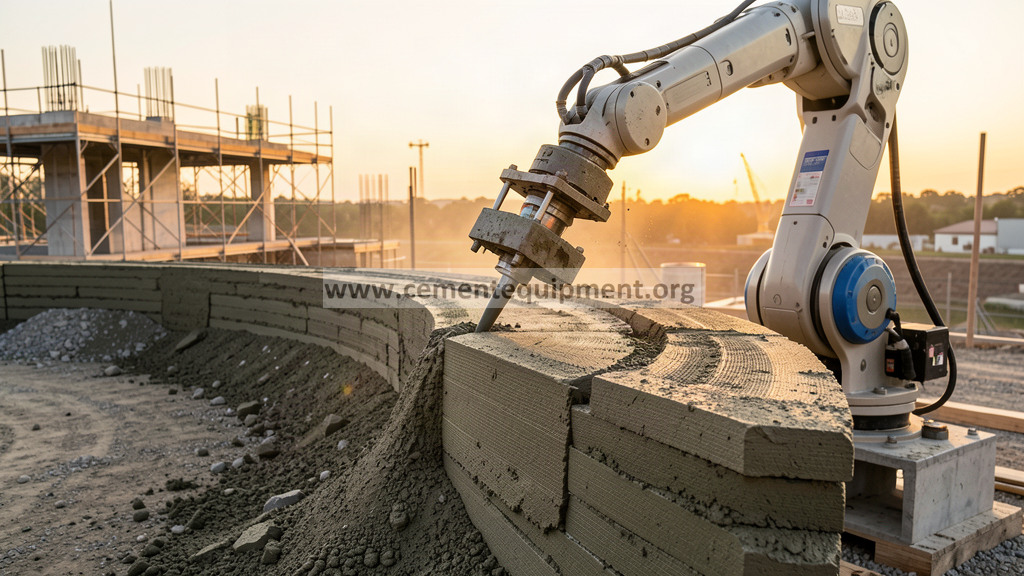
3D Printed Cement & Mortar: The Highest-Growth Cement-Adjacent Market
Three-dimensional printed construction — the additive manufacturing of buildings and building elements using specialised concrete and mortar mixtures — is one of the most striking technology stories in the construction materials world, and it is a story that touches the cement and mortar business in a direct and growing way. The market for 3D printed construction is growing at rates that are far higher than the overall construction market, and the cement and mortar that go into the printed structures are a specific and demanding product category. This article explains the 3D printed construction cement and mortar market: its size, its growth, its technical requirements, its current state, its applications, its challenges, and its commercial logic. It is written for cement and mortar technologists, construction materials developers, additive-manufacturing specialists, and anyone who wants to understand the 3D printed construction market as a materials business and as a long-run opportunity.
If you work in cement or mortar and you have heard about 3D printed construction as a futuristic concept but you have not seen a clear picture of the materials, the market, and the commercial reality, this article is for you. The short version is that the market is real, it is growing fast, and it is a market that demands specific cement and mortar properties — but it is also a market that is still on a long road to mainstream adoption, and the near-term opportunity is in the specialised applications and the materials development rather than in a broad replacement of conventional concrete.
The market size and growth of 3D printed construction
The 3D printed construction market is a market that is growing quickly from a small base, and the numbers are reported by multiple sources, with the usual variation that comes from different scope definitions. Dataintelo estimates the 3D concrete printing market at about $1.2 billion in 2025, growing to about $7.8 billion by 2034 at a compound annual growth rate of about 23.1 percent. Mordor Intelligence estimates the market at about $3.34 billion in 2026, growing to about $15.29 billion by 2031 at a CAGR of about 35.6 percent. Global Market Insights and other sources have reported similar high growth rates, and the variation reflects differences in scope, geography, and the definition of the market — whether it includes only the printer hardware, or the materials, or the services, or all of the above — but the direction and the growth rate are consistent: the 3D printed construction market is growing at a rate that is multiples of the overall construction market, and it is projected to be substantially larger by the early 2030s.
The cement and concrete segment is a major part of that market. Global Market Insights, for example, has reported that concrete accounts for about 63.9 percent of the 3D construction printing market, which means that the materials that go into the printed structures are predominantly concrete and mortar-based, and that the cement and mortar business is the materials heart of the 3D printed construction market. The exact share varies by source and by application, but the central point is clear: the 3D printed construction market is, in materials terms, largely a cement and mortar market, and the growth of the 3D printed construction market is, in materials terms, largely a growth market for specialised cement and mortar.
The high growth rates are headline-grabbing, but they need to be read with the right context. The 3D printed construction market is growing from a small base, which means that the percentage growth rates are high even if the absolute dollar and volume figures are still modest relative to the overall cement and concrete market. The market is projected to grow a lot, but it is starting small, and the path to a large market is a path of adoption, cost reduction, code acceptance, and mainstream integration — a path that takes time and that is not guaranteed to be smooth.
What 3D printed construction cement and mortar need to do
The cement and mortar that go into 3D printed construction are not ordinary concrete or mortar; they have to meet a set of properties that are specific to the additive manufacturing process. Understanding those properties is the key to understanding the materials market and the materials opportunity.
The first and most fundamental property is the extrudability and the buildability. The material has to be extrudable through the print nozzle in a continuous, stable filament, and it has to be buildable — it has to hold its shape after extrusion so that the next layer can be placed on top without the previous layer deforming or collapsing. That requires a material that flows when it is pumped and extruded, but that stiffens quickly enough to support the weight of the subsequent layers. The rheology of the material — the balance of fluidity and stiffness, the setting time, the yield stress, and the thixotropy — is the key materials science of 3D printed construction mortar and concrete, and it is a property that the ordinary concrete or mortar does not necessarily have.
The second property is the early strength and the inter-layer adhesion. The printed structure is built in layers, and the strength of the structure depends on the strength of the individual layers and the adhesion between the layers. The inter-layer adhesion is a specific property that depends on the setting time, the surface condition of the printed layer, and the time between layers, and it is a property that the materials science of 3D printed construction has to manage carefully. The early strength is also important because the structure has to support itself during the print and after the print, and the material has to develop strength quickly enough to do that.
The third property is the workability and the pumpability over the print duration. The material has to be pumpable and extrudable over the duration of the print, which can be long for larger structures, and it has to maintain its properties over that duration without setting in the pump or the nozzle or segregating in the mix. That requires a material that is stable in the mix and in the pump, and that has a setting time and a rheology that are consistent over the print duration. The admixture strategy, the mix design, and the materials control are the tools that the materials developer uses to achieve that stability.
The fourth property is the strength, the durability, and the finish of the printed structure. The printed structure has to meet the structural and durability requirements of the application, and it often has to meet a surface-finish requirement as well, because the surface of a 3D printed structure has a characteristic texture and appearance that may or may not be acceptable for the application. The material has to be designed to deliver the required strength, durability, and finish, and that design is a materials development task that is specific to the 3D printed construction process.
The applications and the current use cases
The applications of 3D printed construction are varied and growing, and they range from the specialised and the demonstrative to the more routine and the commercial. The current use cases include the printed houses and the housing projects that have been demonstrated in various markets — the low-cost housing, the emergency housing, and the demonstration homes that have been printed in various countries — and these are the use cases that have attracted the most attention. They are also the use cases that are still largely at the demonstration and early-commercial stage, with the cost, the code acceptance, the scale, and the mainstream integration still being worked out.
The printed architectural and decorative elements are another use case — the printed columns, the printed facades, the printed sculptural elements, and the printed interior features that are used for their aesthetic and architectural qualities. These are use cases where the 3D printed construction offers a design freedom and a material efficiency that the conventional construction does not, and where the value of the printed element justifies the materials and the process cost. The printed elements are a more near-term commercial opportunity than the printed buildings, because the elements are smaller, the specifications are more controlled, and the value of the design freedom and the material efficiency is clearer.
The printed infrastructure and the specialised structures are another use case — the printed bridges, the printed barriers, the printed drainage elements, the printed retaining structures, and the other infrastructure elements that can be printed for their functional and economic advantages. These are use cases where the 3D printed construction can reduce the formwork, the labour, and the waste of the conventional construction, and where the value of that reduction justifies the materials and the process cost.
The applications are not only in new construction; they are also in renovation, repair, and the specialised construction tasks where the 3D printed process offers a benefit. The materials and the process are being used for repair and restoration, for the addition of features to existing structures, and for the specialised construction tasks that the printed process can do better or cheaper than the conventional process. The breadth of the applications is part of the opportunity, and the depth of the adoption is part of the challenge.
The materials development challenge
The materials development challenge in 3D printed construction is a real and significant one, and it is the challenge that the cement and mortar business has to meet to serve the market. The materials have to be designed for the print process, and that design is not a trivial extension of the ordinary concrete or mortar design; it is a materials development task that requires the rheology, the setting time, the early strength, the inter-layer adhesion, the pumpability, the stability, and the finish to be balanced for the specific print process and the specific application.
The materials development is also a task that is application-specific. The material for a printed house is not necessarily the same as the material for a printed architectural column, and the material for a printed bridge is not necessarily the same as the material for a printed interior feature. The print process, the structure, the load, the environment, and the finish requirement all influence the material design, and the materials developer has to design the material for the specific application. That application-specificity is part of the value and the margin in the materials business, because the producer who can design and supply the right material for the specific application is selling a value that the commodity material producer cannot.
The materials development is also a task that is technology-specific. The print process — the print nozzle, the print speed, the layer height, the print path, the pump, and the control system — influences the material requirements, and the material has to be designed for the specific print process. The materials developer has to work with the print technology provider and the printer operator to design the material for the specific process, and that collaboration is part of the value and the margin in the materials business.
The commercial logic: where the value and the margin are
The commercial logic of the 3D printed construction cement and mortar market is built on the materials development, the application specificity, and the value of the printed process. The materials are not a commodity; they are a specialised product that is designed for the print process and the specific application, and the value is in the performance, the reliability, and the fit to the application. The margin is in the materials development, the application knowledge, the specification, and the supply reliability, and the producer who can deliver those is capturing a value that the commodity material producer cannot.
The commercial logic is also built on the relationship with the print technology provider and the printer operator. The 3D printed construction market is a market where the materials provider, the printer provider, and the printer operator are closely linked, and the materials provider who can work well with the printer provider and the printer operator — designing the material for the process, supporting the print, and solving the materials problems that arise — is capturing the value and the margin of the relationship. The relationship is the protection for the revenue and the margin, because the printer operator depends on the materials provider for the material that the process requires.
The commercial logic is also built on the applications. The printed architectural and decorative elements, the printed specialised structures, and the printed repair and restoration applications are the near-term commercial opportunities where the value of the printed process justifies the materials and the process cost, and where the materials provider can capture the value and the margin. The printed houses and the larger printed buildings are the longer-term opportunities, where the market is still developing and the cost, the code acceptance, and the mainstream integration are still being worked out. The materials provider who serves the near-term applications well is building the capability and the relationship that position it for the longer-term opportunities.
The competitive dynamics
The competitive dynamics in the 3D printed construction cement and mortar market are shaped by the specialised nature of the materials, the closeness of the relationship with the print process, and the stage of the market. The market is not yet a large, mature, commoditised market; it is a market that is still developing, and the competition is on the materials development, the application knowledge, the relationship with the print process, and the ability to deliver the right material for the right application. The producers who can do that are the ones who win in the market, and the producers who cannot are the ones who are squeezed out.
The incumbents in the cement and mortar business have the scale, the brand, the distribution, and the materials knowledge, and they have a natural advantage in the market. But the market is specialised enough, and the application-specificity and the relationship with the print process are important enough, that the specialist materials developers and the producers who focus on the 3D printed construction market can compete effectively and capture value. The specialists who develop the materials for the specific print processes and the specific applications, and who build the relationship with the printer providers and the printer operators, are the ones who are well-positioned in the market.
The printer providers and the technology providers are also part of the competitive landscape, because the print process is the driver of the material requirements, and the printer provider who can supply the material or who can work closely with the materials provider is well-positioned in the market. The competitive landscape is a landscape of partnerships and relationships, and the value is in the partnership and the relationship as much as in the material itself.
The challenges and the risks
The 3D printed construction cement and mortar market is not without challenges and risks. The market is still on a long road to mainstream adoption, and the path is not guaranteed to be smooth. The cost of the printed process and the materials is a challenge: the cost has to come down to the level that the mainstream construction market will accept, and the cost reduction is a function of the technology, the scale, and the materials efficiency. The code acceptance and the standards are a challenge: the building codes and the standards have to accept and govern the 3D printed construction, and that is a process that takes time and that varies by market. The scale and the integration are a challenge: the 3D printed construction has to scale to the level that the mainstream market requires, and it has to integrate with the conventional construction processes and the supply chains.
The materials challenge is a challenge as well: the materials have to be developed for the specific print processes and applications, and the development is a task that requires the materials science, the application knowledge, and the relationship with the print process. The materials challenge is also a challenge in the stability and the consistency of the material over the print duration, and the pumpability and the extrudability over the print scale, and the inter-layer adhesion and the early strength that the structure requires. The materials challenge is a real challenge, and it is the challenge that the materials business has to meet to serve the market.
The market-development challenge is a challenge for the materials provider as well: the market is still developing, and the materials provider has to develop the market, the applications, the specifications, and the relationships that are the basis of the revenue and the margin. The market-development challenge is a long-run challenge, and it requires the investment and the patience that the market-development task requires.
The case for the niche in brief
3D printed construction cement and mortar is the highest-growth cement-adjacent market, and it is a market that is growing fast from a small base toward a potentially large future. The market is, in materials terms, largely a cement and mortar market, and the growth of the 3D printed construction market is, in materials terms, a growth market for specialised cement and mortar. The materials have to meet specific properties — the extrudability and buildability, the early strength and inter-layer adhesion, the workability and pumpability, and the strength, durability, and finish — and the materials development is a real and significant task that is application-specific and process-specific. The commercial logic is built on the materials development, the application specificity, the relationship with the print process, and the value of the printed process, and the margin is in the development, the knowledge, the specification, and the supply reliability. The competitive dynamics favour the producers and the specialists who can design and supply the right material for the right application and who can build the relationship with the print process. The market is on a long road to mainstream adoption, and the challenges are real — the cost, the code acceptance, the scale, the integration, the materials, and the market development — but the growth is real and the opportunity is real. For the cement and mortar business that wants to be in the 3D printed construction market, the near-term opportunity is in the specialised applications and the materials development, and the long-run opportunity is in the mainstream adoption that the market is moving toward.
The chemistry and rheology of 3D-printable cement mortar
The chemistry and the rheology of 3D-printable cement mortar are the starting points for understanding the material, because the material has to satisfy two sets of requirements that pull in opposite directions and that the conventional cement mortars were never designed to meet. The first set of requirements is the structural and durability performance of the hardened mortar: the mortar has to have the strength, the durability, and the volume stability that the application requires, and those properties are the familiar products of the cement chemistry — the hydration reactions, the C-S-H gel, the calcium hydroxide, the pore structure, and the other familiar features of hardened cement paste and mortar. The second set of requirements is the extrudability and the buildability of the fresh mortar: the mortar has to be extrudable through the nozzle at the right rate, it has to hold its shape after extrusion so that the next layer can be deposited on top, and it has to do both of those things without too much water or too little strength. Those fresh-mortar requirements are the rheology requirements, and they are the ones that are different from the requirements of conventional mortar.
The rheology of fresh cement mortar is governed by the balance of the solid particles, the water, the chemical admixtures, and the other components, and the rheology that 3D printing requires is one where the mortar flows under the shear of extrusion but recovers its structure quickly after the shear is removed — what is often called shear-thinning and thixotropic recovery or yield stress recovery. The mortar has to flow through the nozzle when the pump or the extruder applies the pressure, and it has to stop flowing and hold its shape as soon as the extrusion stops, so that the layer stays where it is deposited and supports the next layer. That rheology profile — flow under shear, rapid structure recovery at rest — is the central rheological requirement for 3D printing of cement mortar, and it is the requirement that the formulators have to achieve.
The formulators achieve that rheology profile with a combination of the mix design and the chemical admixtures. The mix design — the cement type and content, the aggregate type and size and grading, the water content, and the other mix-design variables — sets the base rheology of the mortar. The chemical admixtures — water reducers, viscosity-modifying admixtures, superplasticizers, accelerators, and the other admixtures — tune the rheology to the profile that the printing requires. The formulator works on the mix design and the admixture combination to get the mortar to the extrudability and buildability that the printing process needs, and that is the core technical challenge of the material.
The chemistry of the hardened mortar is the familiar cement chemistry, but with some particular considerations. The water-cement ratio of 3D-printable mortar is often higher than the water-cement ratio of a conventional high-strength mortar, because the fresh-mortar requirements — extrudability and buildability — often call for more water than the structural requirements would call for on their own. That extra water is a problem for the strength and the durability, because the water-cement ratio drives the porosity and the strength of the hardened cement paste. The formulator has to manage that trade-off — using the admixtures and the mix design to get the extrudability from less water, or accepting the strength reduction from the extra water and designing the structure around it. The water-reducing admixtures are the key tool for managing that trade-off, because they let the mortar have the workability and flow that the printing needs at a lower water content, which protects the strength and the durability.
The hydration kinetics of the mortar are also important for the printing, because the setting and hardening of the mortar have to be timed so that the mortar is extrudable at the start of the print, sets during the print at the right rate, and hardens to the structural properties after the print. The setting time has to be calibrated to the print rate and the geometry of the print, because the mortar has to be soft enough to extrude at the nozzle at the beginning of the print and hard enough to support the later layers by the end. The formulator uses the accelerators, the retarders, the cement type, and the other chemistry levers to get the setting kinetics to the right profile for the print, and that calibration is part of the technical challenge.
The aggregate in 3D-printable mortar is also a special consideration. The aggregate has to be small enough to pass through the nozzle, and the grading of the aggregate has to be managed so that the mortar extrudes and builds without issues. The aggregate size is limited by the nozzle diameter, and the formulator has to work with the aggregate that the nozzle allows. The aggregate also affects the rheology and the strength and the durability, and the formulator manages the aggregate as part of the mix design. The use of fine aggregate — sand and fine sand — is typical in 3D-printable mortar, because the aggregate sizes are limited by the nozzle, and the mortar is often a fine mortar or a mortar with a high sand content.
The strength and durability of 3D-printed mortar are the properties that determine whether the material can be used for the larger and more demanding structural applications, and those properties are the subject of ongoing development and research. The 3D-printed mortar has to meet the structural and durability requirements of the application, and those requirements are the same as the requirements for any cement mortar — strength, durability, volume stability, and the other properties. The difference is that the 3D-printed mortar has to meet those requirements while also meeting the fresh-mortar requirements of extrudability and buildability, and that dual requirement is what makes the material development challenging. The research and development in the field is focused on improving the strength and durability of 3D-printable mortar while maintaining or improving the extrudability and buildability, and that is the technical frontier of the material.
The equipment and the process: how a 3D cement printer works
The equipment and the process of 3D cement printing are the other side of the material story, because the material has to work with the equipment and the process, and the equipment and the process are what make the printed structure. The typical 3D cement printer is a gantry or robotic system that moves a nozzle or an extruder in three dimensions over the print bed, depositing the mortar through the nozzle at the programmed position and rate to build the structure layer by layer. The printer is controlled by the print file — the digital model of the structure that the printer follows — and the print is a sequence of nozzle movements and mortar extrusions that build the structure from the bottom up.
The mortar delivery system is the part of the equipment that takes the mortar from the mixing and storage and delivers it to the nozzle at the right rate and consistency. The mortar has to be mixed and prepared to the right consistency and pumped or conveyed to the nozzle, and the delivery system has to keep the mortar flowing and the consistency consistent through the print. The delivery system is typically a pump — a piston pump, a progressive-cavity pump, or a comparable pump — that delivers the mortar at the rate the print requires, and the pump has to handle the mortar without damaging it or changing its consistency. The delivery system is the heart of the process, because the mortar has to arrive at the nozzle ready to extrude, and the delivery has to maintain that readiness through the print.
The nozzle is the part of the equipment that extrudes the mortar, and the nozzle geometry — the diameter, the shape, the length — affects the extrudability and the shape of the extruded bead. The nozzle has to be sized to the aggregate and the mortar, and the nozzle has to extrude the mortar in a controlled bead that can be deposited at the programmed position and that holds its shape after extrusion. The nozzle is the interface between the mortar and the printed structure, and the nozzle design is part of the process optimization.
The print head and the motion system are the parts that position the nozzle and control the extrusion. The print head moves in three dimensions — along the gantry rails or the robot arm — and positions the nozzle at the programmed x, y, and z coordinates, and the extrusion is coordinated with the motion so that the mortar is deposited at the right place and the right rate. The motion system has to be precise enough to follow the print file and to keep the bead and the layer geometry on target, and the coordination of the motion and the extrusion has to be accurate enough to build the structure at the designed geometry.
The print process is the sequence of operations — print preparation, mortar preparation, print execution, and post-processing — that takes the print file and the mortar and produces the printed structure. The print preparation includes the design and the optimization of the print file for the structure and the printer, the preparation of the print bed or the base, and the setup of the printer. The mortar preparation includes the mixing and the conditioning of the mortar to the right consistency and the delivery to the printer. The print execution is the actual printing — the nozzle movements and the mortar extrusions that build the structure layer by layer. The post-processing includes the finishing, the curing, and the quality inspection of the printed structure, and any additional steps that the application requires.
The print process has to be optimized and controlled for each structure and each mortar, because the print parameters — the layer height, the print speed, the extrusion rate, the nozzle geometry, the mortar consistency, and the other parameters — all affect the quality of the printed structure, and the process has to be tuned to get the structure that the design requires. The process optimization is part of the technical challenge of 3D cement printing, and it is part of the value that the supplier of the printing service or the printing equipment provides.
The current commercial landscape for 3D-printed cement and mortar
The commercial landscape for 3D-printed cement and mortar is still emerging, and it is a landscape of early adopters, pilot projects, and early commercial applications, with the large-scale structural applications still in development. The market is not yet a mature, large-scale market; it is a developing market with a set of applications that are being pursued and proven, and a set of material and equipment and process developments that are ongoing. The market data that is reported for 3D construction printing — the Dataintelo figure of about $1.2 billion in 2025 growing to about $7.8 billion by 2034 at a CAGR of about 23.1 percent, the Mordor Intelligence figure of about $3.34 billion in 2026 growing to about $15.29 billion by 2031 at a CAGR of about 35.6 percent — is the market that includes the whole 3D construction printing field, of which the cement and concrete portion is a significant part. The trajectory is one of rapid growth from a small base, which is the classic shape of an emerging technology market.
The current applications of 3D-printed cement and mortar fall into several categories. The first is the small-to-medium-scale architectural and decorative applications — the printed architectural elements, the decorative panels, the custom elements, and the other small-scale applications where the material and the process are proven and the market is developing. The second is the housing and shelter applications — the 3D-printed houses and shelters that have been demonstrated and are being developed in various markets, particularly where the speed and the cost of construction are important. The third is the repair and restoration applications — the printed repairs, the printed additions, and the printed reproductions where the precision and the customisation of 3D printing are valuable. The fourth is the research and development and pilot projects — the ongoing development of the material, the equipment, the process, and the applications that is building the base of knowledge and the base of proven capability.
The commercial players in the 3D-printed cement and mortar field are a mix of the equipment manufacturers, the material and mortar developers, the service and application providers, and the research and development organisations. The equipment manufacturers are developing and selling the 3D cement printers and the printing systems, and the material developers are developing the print-ready mortars and the mix designs, and the service providers are providing the printing service and the application expertise, and the research organisations are building the knowledge base. The field is a developing field with a developing commercial base, and the players are building the commercial and the technical base for the larger-scale market.
The cement and cement-materials opportunity in the 3D-printed cement and mortar field is in the materials and the materials knowledge. The 3D-printed mortar is a cement-based mortar, and the cement and the cement-materials knowledge — the cement chemistry, the mix design, the admixtures, the rheology, the strength and durability — is the foundation of the material, and the cement producer or the cement-materials supplier who understands that and can supply the right materials and the right knowledge is positioned to participate in the market. The opportunity is in the materials supply and the materials knowledge, and in the relationship with the equipment manufacturers, the material developers, the service providers, and the end-users who are building the 3D-printed cement and mortar market.
The rheology, the mix design, and the printable mortar
The rheology of a 3D-printable cement mortar is the central technical challenge of the material, because the mortar has to satisfy two requirements that are in natural tension: it has to be fluid enough to extrude through the nozzle and build the layer, and it has to be stiff enough — and gain enough early stiffness — to support the next layer without deformation. A mortar that is too fluid will spread under the weight of the next layer and collapse the geometry; a mortar that is too stiff will not extrude cleanly and will produce a rough, weak, discontinuous path. The printable mortar is an extrudable yet buildable material, and the rheology is the property that sits in between those two demands.
The rheology of printable cement mortar is characterised by the yield stress and the viscosity of the mortar in its fresh state, and the time evolution of those properties — the setting time, the early stiffening, and the buildability window — is just as important as the initial values. A printable mortar needs a yield stress that is low enough for extrusion but high enough, after a short time, to support the next layer. The viscosity has to be low enough for the mortar to pass through the nozzle at the printing speed without excessive pressure, and the thixotropy — the ability of the mortar to recover stiffness after shear — has to be tuned so that the mortar stiffens after extrusion but does not set so fast that it becomes unworkable or produces a weak interface between layers.
The mix design of a printable mortar reflects this rheological requirement. The cement content of a printable mortar is typically higher than an ordinary mortar — often in the range of 500 to 800 kg/m³ or higher, depending on the strength and buildability requirements — because the mortar has to deliver both the extrusion behaviour and the early strength. The water-to-binder ratio is kept low to control the strength and the deformations, but the workability has to be maintained by the admixture strategy, which typically relies on high-range water reducers (polycarboxylate superplasticisers) and sometimes viscosity-modifying agents. The particle-size distribution of the aggregate and the cement is important: the fine aggregate is usually well-graded sand, often with a narrow grading to control the rheology and the surface, and the absence of coarse aggregate in many printable mortars is itself a design choice — the fine-grained mix prints more cleanly and reliably than a mix with coarse aggregate, at the cost of lower strength per unit of cement.
The additives and admixtures of a printable mortar are tuned to the rheology and the setting. A viscosity-modifying agent can help the mortar hold its shape after extrusion and resist the deformation that the next layer imposes; a set accelerator can reduce the time to initial stiffening and support the buildability; a superplasticiser can maintain the workability at the low water content that the strength requires. The interaction between these admixtures — the superplasticiser and the VMA, the accelerator and the retarder, the different polymers and the cement — is a mix-design challenge that the printable-mortar developer has to solve for each specific material and printer combination, because the rheology of a printable mortar is sensitive to small changes in the materials and the process.
The particle size and shape of the sand, the type and content of the cement, the use of supplementary cementitious materials, and the fibre reinforcement — if any — are all mix-design variables that the printable-mortar developer works with. Fibre reinforcement — short discrete fibres, typically polymeric — is common in printable mortars to improve the tensile and fracture properties and to control the early-age cracking and the layer-to-layer bond, and the fibre content, length, and orientation in the print are mix- and process-variables that affect the printed structure. The mix design of a printable mortar is therefore a multidimensional optimisation — the rheology, the strength, the buildability, the durability, the printability, and the economics are all in play at once.
The barriers and the open technical questions
The 3D-printed cement and mortar field has a set of barriers and open technical questions that are the subjects of the ongoing development and research, and understanding them is the understanding of the state of the field. The first barrier is the scalability — the ability to print larger and larger structures and to print them at the speed and the economy that the construction market requires. The current printed structures are mostly small-to-medium-scale, and the scaling to larger structures and to the construction-industry scale is a challenge that the field is working on. The second barrier is the structural performance — the strength and the durability of the printed structures, particularly for the larger and more demanding structural applications, and the ability to meet the building codes and the structural requirements at scale. The third barrier is the material and the process reliability — the consistency of the material, the consistency of the process, and the reliability of the printed structure from print to print and from site to site.
The open technical questions include the optimisation of the material for the dual requirements of extrudability and structural performance, the long-term durability of the printed structures, the anisotropy of the printed structure and its effect on the structural behaviour, the integration of the 3D-printed elements with the conventional construction elements and systems, and the building-code and regulatory framework for the printed structures. These are the questions that the field is working on, and the answers to them are the technical progress that the market is waiting for.
The uncertainties in the market are also a barrier: the size and the shape of the eventual market are not settled, the applications that will scale are not yet proven, the commercial model is not yet settled, and the timeline for the larger-scale market is uncertain. The market data that is reported — the CAGR figures and the market sizes — are projections of the growth of the market, but the market is still emerging, and the projections are subject to the uncertainties of the emerging market. The 3D-printed cement and mortar market is a market with a large potential and a high growth rate, but it is a market that is still being built, and the certainty of the market and the timeline are still being established.
The investment thesis and the timeline
The investment thesis for 3D-printed cement and mortar is built on the growth trajectory and the construction-industry application, and the timeline is one of emergence to scale. The near term — the current to the next few years — is the period of the pilot projects, the early commercial applications, the material and the equipment and the process development, and the building of the base of knowledge and the base of proven capability. The medium term — the next five to ten years — is the period of the scaling of the applications, the maturation of the material and the equipment and the process, the development of the larger-scale structural applications, and the growth of the commercial base. The long term — the ten-to-twenty-year horizon — is the period in which the 3D-printed cement and mortar could become a significant part of the construction industry, if the material and the equipment and the process and the applications develop as projected.
The investment thesis is that the 3D-printed cement and mortar market is a high-growth emerging market in the cement-adjacent space, with a trajectory from a small base to a materially larger market, and that the cement producer or the cement-materials supplier who participates in the market early — with the materials, the knowledge, the relationships, and the positioning — is positioned to capture the value of the growth as the market develops. The thesis is that the market is worth participating in, but that the participation has to be calibrated to the state of the market and the uncertainty of the timeline, and that the participation is a long-run bet with near-term development and proof-of-concept work.
The investment thesis is also that the 3D-printed cement and mortar market is a market that rewards the materials knowledge and the materials capability, because the material is the foundation of the printed structure, and the material knowledge and the material capability are the things that the equipment manufacturers, the material developers, the service providers, and the end-users need. The cement producer or the cement-materials supplier who has the materials knowledge and the materials capability is positioned to supply the materials and the knowledge and the capability that the market needs, and that is the value that the market pays for.
Frequently Asked Questions
I work in a cement plant; will this be useful to me as an engineer?
Basic cement chemistry is useful but not required: the article relates to the complete library in the package. As an engineer in the plant, the article is useful because it explains the 3D printed construction market and the specific cement and mortar properties that the market requires, and that understanding is directly relevant if your plant or your R&D is looking at the specialised cement and mortar products that the 3D printed construction market calls for, or if you are evaluating the market as a long-run opportunity.
Is the COMPLETE Technical Package going to be worth the price for the team?
It is worth it because the 3D printed construction cement and mortar topic connects to the broader cement chemistry, mix design, rheology, setting, strength development, and application knowledge that the Complete Cement Technical Package is built to cover. The package is not a single book; it is a technical desk for the real engineer on the shift, covering the materials science and the process knowledge that connect to the specialised cement and mortar products described in this article. At $249.99 for the pack, it is the reference library that lets a team go deeper on exactly the topics this article raises.
Will this help me get my project approved?
Yes. Understanding the market size, the growth rate, the technical requirements, the applications, the materials development challenge, and the commercial logic of the 3D printed construction cement and mortar market helps justify the investment in the materials development, the application knowledge, and the market development that serve that market — and that justification is what is needed to get a 3D printed construction materials project approved on a value rather than a speculative basis. For teams that want the related process, mix-design, and materials-science reference material in one place, the Complete Cement Technical Package from the cementequipment.org library brings it together.