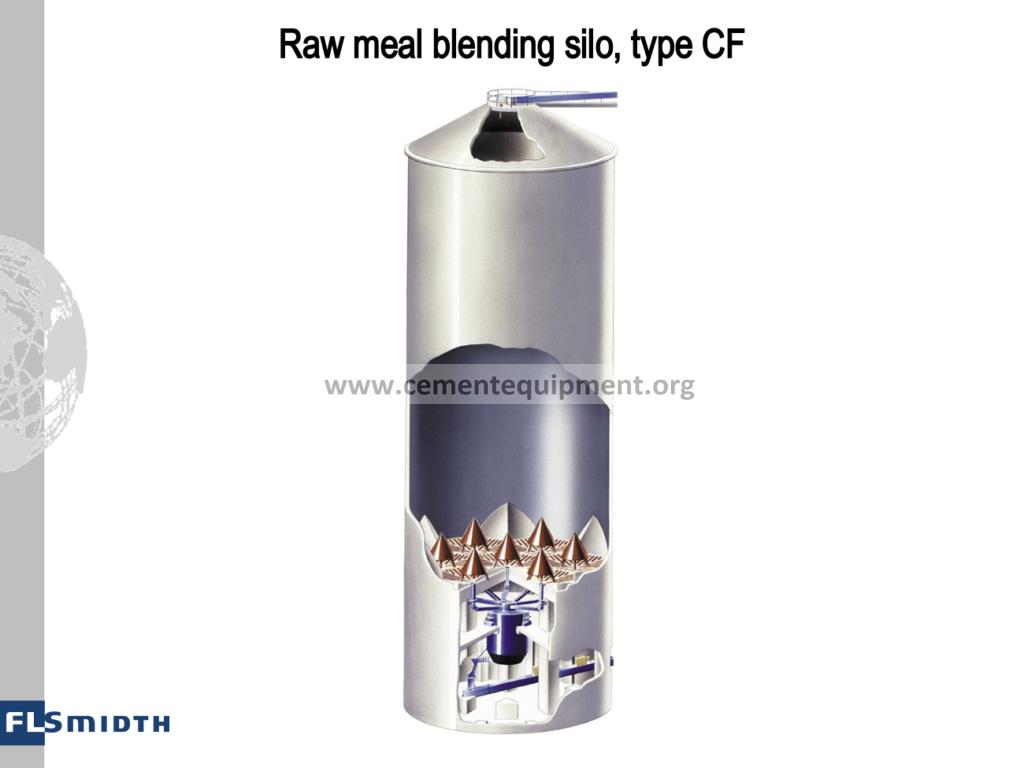
CF Raw Meal Blending Silo: Design & Operation
The raw meal blending silo is the last quality control stage before the kiln: it receives the raw meal from the raw grinding department, stores it, and delivers it to the kiln feed system with a chemical composition as uniform as the process requires. Among the homogenizing systems used in the industry, the CF type silo, the continuous fluidizing silo developed originally by F.L. Smidth and licensed widely, is one of the most widely installed designs because it combines continuous operation, high homogenizing efficiency and relatively low operating cost. This article provides a complete technical treatment of the CF blending silo: the principles of homogenization, the construction of the silo and its aeration system, the mechanics of the fluidizing and blending process, the blending index and its calculation, the operation and the control of the silo, the maintenance of the aeration equipment, and the comparison of the CF system with the other homogenizing designs. It is written for process engineers, quality managers, mechanical engineers and plant operators who are responsible for the raw meal quality and the kiln feed stability.
1. The Purpose of Raw Meal Homogenization
The raw material preparation of the cement plant must deliver a kiln feed whose composition varies within narrow limits, because the clinker chemistry and the burning conditions depend directly on it. The raw materials, limestone, clay, sand and corrective materials, are themselves variable: the quarry delivers natural materials whose composition drifts with the geology, the weather and the mining sequence, and the raw mill system can correct only part of this variation through its own blending. The homogenizing silo is therefore the final stage of the correction chain: the raw mill blends the materials to an average composition, the silo reduces the remaining fluctuation, and the kiln feed system doses the stored meal to the kiln at a uniform rate.
The quality requirement is quantified in terms of the composition parameters that matter for the burning process: the lime saturation factor, the silica ratio and the alumina ratio, together with the individual oxides. The homogenizing system is required to reduce the variation of these parameters to the range that the kiln can absorb without quality loss, typically a standard deviation of the lime saturation factor of 0.2 to 0.5 percent absolute, depending on the plant’s raw mix design and the kiln’s robustness. The blending silo is also the buffer between the raw mill and the kiln: it allows the raw mill to operate independently of the kiln feed demand, which is essential because the two systems have different availability patterns and the raw mill may be stopped for maintenance while the kiln continues to consume meal.
The homogenization of a granular solid in a silo is achieved by the creation of many small, randomly selected portions of material and their re-mixing. The statistical effect is governed by the law of large numbers: if the silo extracts the meal from many different locations and mixes the portions, the composition of the blended stream approaches the average of the stored material, and the fluctuation is reduced by a factor related to the square root of the number of independent portions mixed. The engineering task of the blending silo design is to maximize this statistical mixing effect with the minimum energy consumption and the maximum reliability, and this is exactly what the CF system achieves through its controlled aeration and fluidizing design.
2. The CF Silo Concept and Construction
The CF silo, the continuous fluidizing blending silo, is a large cylindrical concrete or steel vessel, typically 15 to 30 meters in diameter and 20 to 40 meters in height, with a capacity of several thousand tonnes of raw meal. The meal enters at the top through the distribution system and is extracted at the bottom through a system of discharge openings, from which it is conveyed to the kiln feed system. The distinguishing feature of the CF silo is the aeration system in the bottom: the silo bottom is equipped with a series of aeration sectors, supplied with compressed air through a ring of air valves, which fluidize the meal and create the controlled mixing currents inside the silo.
The construction of the CF silo comprises the following elements:
- The silo shell, which stores the meal; the height-to-diameter ratio is designed for the storage capacity and the homogenizing effect.
- The inlet and distribution system, which spreads the incoming meal evenly across the silo cross-section and prevents the segregation of the fine and the coarse particles.
- The silo bottom, typically conical or flat with aeration, forming the extraction zone where the meal is fluidized.
- The aeration sectors: the bottom is divided into a number of sectors, typically 4 to 12, each with its own aeration area and air supply line.
- The air supply system: the blowers, the air lines, the control valves and the pressure instrumentation that distribute the compressed air to the sectors.
- The aeration elements: the porous aeration pads or the fluidizing membranes through which the air enters the meal bed.
- The discharge system: the extraction openings, the discharge boxes and the conveying system that removes the blended meal to the kiln feed silo or the weigh feeder.
- The instrumentation: the level measurement, the air pressures, the temperatures, the weight of the meal and the composition sampling.
The homogenizing action of the CF silo is based on the controlled activation of the aeration sectors: the air supply to the sectors is switched in a sequence, so that at any moment only one or a few sectors are fully fluidized while the others are passive. The fluidized meal flows toward the active extraction sector, the meal above the active zone collapses and mixes, and the successive activation of the sectors creates a continuous, statistical extraction of the meal from all the zones of the silo. The result is the continuous blending of the stored material with the homogenizing efficiency that the CF design is known for.
3. The Aeration System of the CF Silo
The aeration system is the heart of the CF silo, and its design determines both the blending efficiency and the energy consumption. The air is supplied by roots blowers or screw compressors, typically operating at a pressure of 0.5 to 1.5 bar gauge, through a ring main and the individual sector valves. The air flow to each sector is controlled by the valve opening and by the sequence program, and the air pressure in each sector is monitored, because the pressure reflects the state of the meal bed above the sector: a higher pressure indicates a higher meal head, and a pressure drop indicates the emptying of the zone.
The key design parameters of the aeration system are:
- The specific air flow: the air volume per tonne of meal, typically 0.5 to 1.5 cubic meters per minute per square meter of aeration area, which determines the fluidizing velocity.
- The aeration area: the total area of the sectors, which must cover the silo bottom so that every zone of the meal can be fluidized.
- The aeration elements: the porous pads, usually made of sintered metal, ceramics or polymer membranes, which distribute the air uniformly over the sector area; the pore size and the pressure drop of the pads determine the uniformity of the fluidization.
- The sector arrangement: the number and the geometry of the sectors, which set the selectivity of the extraction and therefore the blending index.
- The air distribution: the pipe sizes and the valve characteristics, which must deliver the correct air to each sector regardless of the differences in the line lengths and the pressures.
- The control system: the sequence program that activates the sectors in the designed order, with the timing optimized for the blending efficiency and the energy consumption.
The fluidizing behavior of the raw meal is governed by its particle properties: the meal is a dry powder with a typical median particle size of 20 to 50 microns, and it fluidizes readily when the upward air velocity exceeds the minimum fluidizing velocity, typically a few centimeters per second. In the fluidized state, the meal behaves like a liquid: it flows under the hydrostatic head differences, and the pressure in the bed is distributed hydrostatically. The CF system exploits this behavior: when one sector is aerated, the meal in the fluidized zone flows toward the extraction point, and the meal from the surrounding zones, collapsing into the fluidized zone, is mixed with it, creating the homogenizing currents.
4. The Homogenizing Mechanism and the Blending Index
The homogenizing efficiency of a blending silo is quantified by the blending index, which compares the variation of the composition in the kiln feed with the variation of the incoming meal. The blending index is defined as the ratio of the standard deviation of the incoming composition to the standard deviation of the blended output, measured over a comparable period, and it is normally expressed for a specific parameter such as the lime saturation factor or the calcium carbonate content:
Blending Index BI = standard deviation of input / standard deviation of output.
A blending index of 10 means that the silo reduces the fluctuation by a factor of ten: if the raw mill delivers a feed whose lime saturation factor varies with a standard deviation of 1.0, the kiln feed varies with a standard deviation of 0.1. The CF silo achieves blending indices in the range of 8 to 15 in practice, with design values up to 20 in favorable conditions, depending on the silo size, the aeration design and the operation.
The theoretical basis of the blending index is the statistical mixing of independent portions. If the silo extracts the meal in N statistically independent portions per unit time, the standard deviation of the blended output is reduced by the square root of N compared with the single portions. The CF silo’s extraction creates this independence through the sector activation: each activation cycle extracts meal from a different zone, and the number of independent portions per hour is the product of the number of sectors and the cycle frequency. In practice, the mixing is not perfectly independent, because the meal within a zone is partly pre-mixed and the extraction draws from a zone of finite volume, so the achieved index is lower than the theoretical maximum, but the design and the operation can still deliver the required homogenization with a comfortable margin.
The calculation of the blending index in plant practice is performed with the routine quality data: the calcium carbonate or the lime saturation factor is measured in the kiln feed at a defined sampling frequency, and the same parameter is measured in the raw mill product or the raw materials over the same period. The standard deviations are calculated, and the ratio gives the achieved index. The interpretation of the index requires care: the measured index depends on the sampling frequency and the time lag between the input and the output samples, and the plant should establish its own standardized measurement procedure so that the index is comparable over time.
5. Operation of the CF Blending Silo
The operation of the CF silo is continuous: the raw mill delivers meal continuously to the silo top, and the discharge system extracts the blended meal continuously to the kiln feed. The operator’s task is to maintain the silo level within the operating range, to keep the aeration sequence running correctly and to manage the transition between the filling and the consumption rates. The silo level is the central operating parameter: a low level reduces the hydrostatic head and the mixing effect, while a high level approaches the silo capacity and the risk of overflow; the operating range, typically 50 to 80 percent of the capacity, is defined by the plant based on the storage and the blending requirements.
The operating routines of the CF silo include:
- The monitoring of the aeration pressures and the air flows: the pressures must follow the expected pattern as the sectors activate, and a deviation indicates a mechanical problem or a change in the meal condition.
- The verification of the fluidizing behavior: the correct fluidization is visible in the discharge stability and the pressure signals, and the operator detects the onset of ratholing or bridging.
- The management of the level: the level is controlled by the balance between the raw mill output and the kiln feed consumption, and the operator coordinates the two departments to hold the level in range.
- The control of the meal quality: the kiln feed is sampled continuously, and the operator and the quality department respond to any drift of the composition parameters.
- The management of the special situations: the raw mill stops, the kiln feed stops, the power failures and the silo cleaning are the standard situations that the operating procedures cover.
The transition situations deserve particular attention. When the raw mill delivers a meal whose composition shifts, for example after a quarry change or a raw mix correction, the silo acts as a buffer: the kiln feed composition changes gradually as the new meal works its way through the silo, and the operator and the quality department use this transition time to verify the new composition before it reaches the kiln. The CF silo’s continuous mixing also smooths the short-term fluctuations, so that the kiln feed quality is more stable than the raw mill product, which is precisely the silo’s function.
6. The Control System of the CF Silo
The control of the CF silo is largely automatic: the sequence program controls the sector activation, the level control manages the silo level, and the quality control sets the raw mix and verifies the result. The operator’s interface provides the complete picture: the silo level, the sector status, the air pressures, the discharge rate and the quality trends. The control strategies of the silo include the following:
- The aeration sequence: the sectors are activated in a defined order, typically one sector at a time or two adjacent sectors, with the activation time per sector of 30 seconds to several minutes; the sequence is optimized for the blending index and the energy consumption.
- The level control: the discharge rate is adjusted to the kiln feed demand, and the raw mill output is adjusted to hold the silo level in the operating range; the control loop coordinates the two flows.
- The air supply control: the blowers deliver the air to the ring main, and the individual sector valves open and close in the sequence; the pressure in the main and the sectors is monitored for the fault detection.
- The quality control: the kiln feed quality is monitored, and the raw mix corrections are communicated to the raw mill; the transition management ensures that the kiln feed composition remains in range during the changes.
- The safety functions: the level limits, the pressure limits and the equipment interlocks protect the silo and the conveying equipment, and the emergency procedures cover the power failure and the blower failure.
The tuning of the control system is an engineering task: the activation timing, the air flows and the level set points are adjusted against the measured blending index and the operating experience. The optimization objective is the minimum air consumption at the required blending index, because the aeration air is a significant energy cost of the plant: the specific air consumption of a CF silo is typically 0.2 to 0.6 cubic meters per minute per tonne of silo capacity, and the optimization of the sequence can reduce it by 20 to 30 percent without losing homogenization.
7. Maintenance of the Aeration and Discharge Equipment
The maintenance of the CF silo concentrates on the aeration system, the discharge equipment and the conveying system, because these are the components that operate continuously and wear or degrade in service. The maintenance program is organized around the planned stops and the condition monitoring, and it covers the following areas:
- The blowers and the compressors: the routine maintenance of the machines, the oil changes, the filter cleaning, the belt and coupling checks, and the pressure and flow verification.
- The air lines and the valves: the inspection of the pipework for leaks, the verification of the valve operation and the calibration of the pressure instruments.
- The aeration elements: the porous pads and the membranes are the wear components; they clog with the fine dust and the moisture, their pressure drop rises, and they are cleaned or replaced according to the schedule and the condition.
- The discharge boxes and the rotary valves: the wear of the housings and the rotors, the seal condition and the drive maintenance.
- The conveying system: the airslide conveyors and their aeration, the elevator and the belt conveyors, with their alignment, the lubrication and the wear parts.
- The silo internals: the inspection of the distribution system, the detection of the deposits and the cleaning of the silo when required.
- The instrumentation: the level transmitters, the pressure transmitters and the flow meters are calibrated and verified.
The silo is also periodically emptied and cleaned, typically during the annual kiln stops or when the material condition requires it. The cleaning is a confined space operation with the full safety precautions: the silo is isolated, ventilated and gas tested, the entry permit is issued, and the cleaning crew works with the standby personnel and the rescue plan. The cleaning also provides the opportunity for the internal inspection of the aeration elements and the distribution system, which cannot be inspected from outside.
8. Comparison of the CF Silo with Other Homogenizing Systems
The choice of the homogenizing system is a plant design decision that balances the blending efficiency, the capital cost, the operating cost and the reliability. The CF silo is compared with three other main approaches: the batch or intermittent mixing silo, in which the meal is stored in sections and extracted by the successive aeration of the sections; the simple storage silo with the external homogenization, in which the mixing is achieved in the conveying and the blending system rather than in the silo itself; and the multi-compartment or continuous gravity silos, which rely on the differential extraction of the meal by gravity through the different zones of the silo.
| System | Blending Index | Energy Consumption | Cost and Complexity |
|---|---|---|---|
| CF continuous fluidizing silo | 8 – 15 | Moderate (aeration air) | Medium capital, medium complexity |
| Intermittent / batch mixing silos | 6 – 12 | Higher (multiple aeration) | Higher capital, more valves |
| Gravity / multi-outlet silos | 4 – 8 | Low | Low capital, simple operation |
| External homogenization | Depends on system | Low in silo, higher in transport | Simple silo, external mixing equipment |
The CF silo’s advantages are its continuous operation, its high blending index and its moderate energy consumption; its disadvantages are the need for the compressed air, the maintenance of the aeration elements and the limitation of its homogenizing capacity to a single silo volume. The selection therefore depends on the plant’s requirements: a plant with a difficult raw material variation may install two CF silos in parallel, while a plant with a stable raw material may rely on a simpler storage and external correction. The modern trend of the raw mix control, with the online analyzers and the automatic raw mix correction, has reduced the homogenizing burden on the silo, but the CF design remains the standard for the plants that need the highest kiln feed stability.
9. Frequently Asked Questions
Q1: What does the CF in the CF silo mean?
CF stands for the continuous fluidizing blending silo design, in which the raw meal is continuously extracted from the bottom of the silo through the fluidized zones created by the sequenced aeration of the bottom sectors. The design combines the continuous operation with the high homogenizing efficiency.
Q2: How is the blending index measured in practice?
By comparing the standard deviation of a composition parameter, usually the lime saturation factor or the calcium carbonate, in the kiln feed with the standard deviation in the raw mill product over the same period. The ratio of the input to the output standard deviation is the blending index.
Q3: Why is the aeration of the sectors sequenced rather than continuous?
The sequenced activation creates the selective extraction: the meal flows from the different zones of the silo toward the active sector, and the collapse and mixing of the meal above the zones provide the statistical homogenization. Continuous aeration of the whole bottom would extract the meal uniformly without the selective mixing effect and would consume more air.
Q4: What happens if the aeration elements clog?
The clogged sectors lose their fluidizing ability, the meal above them stops moving, the extraction becomes uneven and the blending index drops. The symptoms are the pressure changes in the sectors and the rising kiln feed variation, and the response is the cleaning or the replacement of the affected elements.
Q5: What is the ideal silo level for the best homogenization?
The middle range of the silo, typically 50 to 80 percent of the capacity, is the standard operating range. At very low levels, the hydrostatic head and the mixing currents are insufficient; at very high levels, the silo approaches its capacity and the risk of the overflow and the operational limits increase.
Q6: Can the CF silo correct the raw mix errors by itself?
No. The silo homogenizes the variation around the average composition, but it cannot shift the average. The correction of the average composition is the task of the raw mix control in the raw mill, and the silo and the raw mix control work together: the silo smooths the fluctuation, and the raw mix control sets the level.
10. Final Summary
The CF blending silo is the standard solution for the raw meal homogenization in the modern cement plant, combining the continuous operation, the high blending index and the moderate operating cost. Its homogenizing action is based on the fluidizing aeration of the bottom sectors, sequenced to extract the meal selectively from all the zones of the silo and to mix the collapsing meal into a uniform kiln feed. The engineering of the system covers the silo construction, the aeration design, the control of the sequence and the level, and the maintenance of the blowers, the valves, the aeration elements and the conveying equipment. The plant measures the system’s performance through the blending index, the ratio of the input to the output variation, and optimizes the operation toward the minimum air consumption at the required index. Together with the raw mix control and the raw mill blending, the CF silo delivers the stable kiln feed that is the precondition for the consistent clinker quality and the stable burning operation, and this article has provided the complete technical understanding of its design, operation and maintenance.
13. The CF Silo Operation and the Aeration Control
The Controlled Flow (CF) blending silo achieves the homogenization through the controlled aeration: the silo bottom is divided into the concentric or the parallel aeration zones, each zone is aerated in the programmed sequence with the compressed air, the material is fluidized zone by zone and drawn to the central discharge, and the continuous blending homogenizes the raw meal as it flows to the extractor. The aeration control is the heart of the operation: the air flow per zone (the 0.5-1.5 Nm3 per minute per zone for the typical installations), the cycle times (the 15-60 minutes per the full sequence) and the fluidization intensity (the 70-90% of the fluidization velocity) determine the blending efficiency: the CF silo achieves the homogenizing effect of the 5-10 (the ratio of the input standard deviation to the output standard deviation) compared to the 2-4 of the simple mixing silos, and the aeration energy of the blending is the 0.5-1.5 kWh per tonne of the raw meal.
14. The Blending Indices and the Homogenizing Effect
The blending performance of the CF silo is quantified by the homogenizing indices: the standard deviation of the key oxide (the CaCO3 or the CaO content) at the silo inlet versus the silo outlet, the homogenizing effect (the ratio of the inlet to the outlet standard deviations, typically the 5-10 for the CF silos), and the mixing efficiency of the individual oxides (the silica, the alumina and the iron homogenize differently because of their particle size and the density differences). The blending calculations use the mass balance models of the silo mixing: the time series of the inlet quality are transformed through the silo transfer functions (the continuous stirred tank models) into the predicted outlet variations, and the calculated homogenizing effect is validated with the frequent sampling during the operation: the blending indices close the quality loop of the raw meal preparation and the kiln feed stability.
15. The Maintenance and the Troubleshooting of the Blending Silo
The maintenance of the CF blending silo focuses on the aeration system: the air blowers, the air lines, the aeration pads (the fabric-covered panels that distribute the air), the valves and the control instrumentation: the aeration pads wear and blind over the years (the typical life of the 5-10 years), the air line leaks reduce the zone pressures, and the moisture in the air lines plugs the pads. The troubleshooting of the blending problems follows the symptoms: the rising outlet quality variations signal the aeration system problems (the dead zones, the plugged pads, the valve failures), the discharge problems signal the material properties (the sticky raw meals, the high moisture) or the extractor issues, and the silo emptying for the inspection is the definitive diagnostic. The preventive maintenance program of the blending silo includes the regular pressure checks, the air flow measurements, the pad inspections and the planned pad replacements: the blending silo reliability is the foundation of the kiln feed stability.
13. The CF Silo Operation and the Aeration Control
The Controlled Flow (CF) blending silo achieves the homogenization through the controlled aeration: the silo bottom is divided into the concentric or the parallel aeration zones, each zone is aerated in the programmed sequence with the compressed air, the material is fluidized zone by zone and drawn to the central discharge, and the continuous blending homogenizes the raw meal as it flows to the extractor. The aeration control is the heart of the operation: the air flow per zone (the 0.5-1.5 Nm3 per minute per zone for the typical installations), the cycle times (the 15-60 minutes per the full sequence) and the fluidization intensity (the 70-90% of the fluidization velocity) determine the blending efficiency: the CF silo achieves the homogenizing effect of the 5-10 (the ratio of the input standard deviation to the output standard deviation) compared to the 2-4 of the simple mixing silos, and the aeration energy of the blending is the 0.5-1.5 kWh per tonne of the raw meal.
14. The Blending Indices and the Homogenizing Effect
The blending performance of the CF silo is quantified by the homogenizing indices: the standard deviation of the key oxide (the CaCO3 or the CaO content) at the silo inlet versus the silo outlet, the homogenizing effect (the ratio of the inlet to the outlet standard deviations, typically the 5-10 for the CF silos), and the mixing efficiency of the individual oxides (the silica, the alumina and the iron homogenize differently because of their particle size and the density differences). The blending calculations use the mass balance models of the silo mixing: the time series of the inlet quality are transformed through the silo transfer functions (the continuous stirred tank models) into the predicted outlet variations, and the calculated homogenizing effect is validated with the frequent sampling during the operation: the blending indices close the quality loop of the raw meal preparation and the kiln feed stability.
15. The Maintenance and the Troubleshooting of the Blending Silo
The maintenance of the CF blending silo focuses on the aeration system: the air blowers, the air lines, the aeration pads (the fabric-covered panels that distribute the air), the valves and the control instrumentation: the aeration pads wear and blind over the years (the typical life of the 5-10 years), the air line leaks reduce the zone pressures, and the moisture in the air lines plugs the pads. The troubleshooting of the blending problems follows the symptoms: the rising outlet quality variations signal the aeration system problems (the dead zones, the plugged pads, the valve failures), the discharge problems signal the material properties (the sticky raw meals, the high moisture) or the extractor issues, and the silo emptying for the inspection is the definitive diagnostic. The preventive maintenance program of the blending silo includes the regular pressure checks, the air flow measurements, the pad inspections and the planned pad replacements: the blending silo reliability is the foundation of the kiln feed stability.
Get this cement file + the full 931-file package
$249.99 — one-time purchase, instant download, lifetime access
This file is part of the Complete Cement Technical Package (931 files) available from cementequipment.org. Respective rights holders; library copy for the licensed single user.