Innovations In Cement Manufacturing: Complete Guide & Downlo
Innovations in Cement Manufacturing Chapter 2.1, Raw Materials Selection by A. K. Chatterjee, is the chapter of the Portland Cement Association’s master reference that lays the geological and technical foundations of everything a cement plant does: the selection of the limestone and the aluminosilicate raw materials whose composition, homogeneity and reactivity decide the clinker quality, the energy consumption and the life of the quarry. The raw mix of the kiln is built from two generically different natural materials, the calcareous component (calcium carbonate, the limestone, the chalk and the marl) and the argillaceous component (the aluminosilicates, the clay, the shale and the marlite), complemented by the small correctives of iron, silica and alumina, and the chapter develops the complete discipline of their selection: the geology of the deposits and the mechanisms of their formation, the exploration and the sampling that quantify the reserves and their variability, the chemical and the mineralogical quality requirements including the burnability, the design of the quarry exploitation, and the preparation and the homogenisation technology that converts a variable deposit into the steady feed of the kiln. This guide develops Chapter 2.1 for the professional: the quality framework with the moduli, the exploration methodology, the burnability science, the role of the alternative raw materials of the modern industry, the long-term quality control of the deposit, and the way the raw material selection shapes the political, the environmental and the economic future of a cement company, because the quarry is the one resource that the plant cannot buy on the market.
1. The Two Generations of the Raw Mix: Calcareous and Argillaceous
The clinker is built from four oxides, calcium oxide, silica, alumina and iron oxide, and nature offers them in the complementary pair that the cement chemist separates: the calcareous materials, rich in calcium carbonate, and the argillaceous materials, rich in the aluminosilicates. The limestone supplies the calcium, the clay or the shale supplies the silica and the alumina, and the small correctives trim the final proportions. The ratio between the two is fixed by the chemistry of the clinker: the stoichiometric need of the clinker phases translates into a target lime saturation factor (LSF) of the mix, usually between 90 and 100%, which in turn fixes the limestone-to-clay proportion of the deposit, and the plant is designed around a ratio that the selected deposit can deliver with the smallest consumption of the correctives and the fuels.
No deposit is perfectly suited, and the chapter’s central realism is that the cement maker rarely chooses the ideal raw material; he chooses the best of what the geology offers, and then he corrects, blends and homogenises. The skill of the raw material selection is therefore not the skill of finding the perfect rock (which almost never exists) but the skill of measuring a deposit honestly, predicting its behaviour in the process, exploiting it in the order that minimises its variability, and designing the preparation line that absorbs what cannot be avoided. The selection of the raw materials is consequently the first and the most strategic engineering decision of the plant: it fixes the chemistry of the product for decades, the energy per tonne (a hard, silica-rich limestone costs more to grind and to burn), and the capital of the quarry and the preparation line.
2. The Geology of the Raw Materials: Where the Limestone Comes From
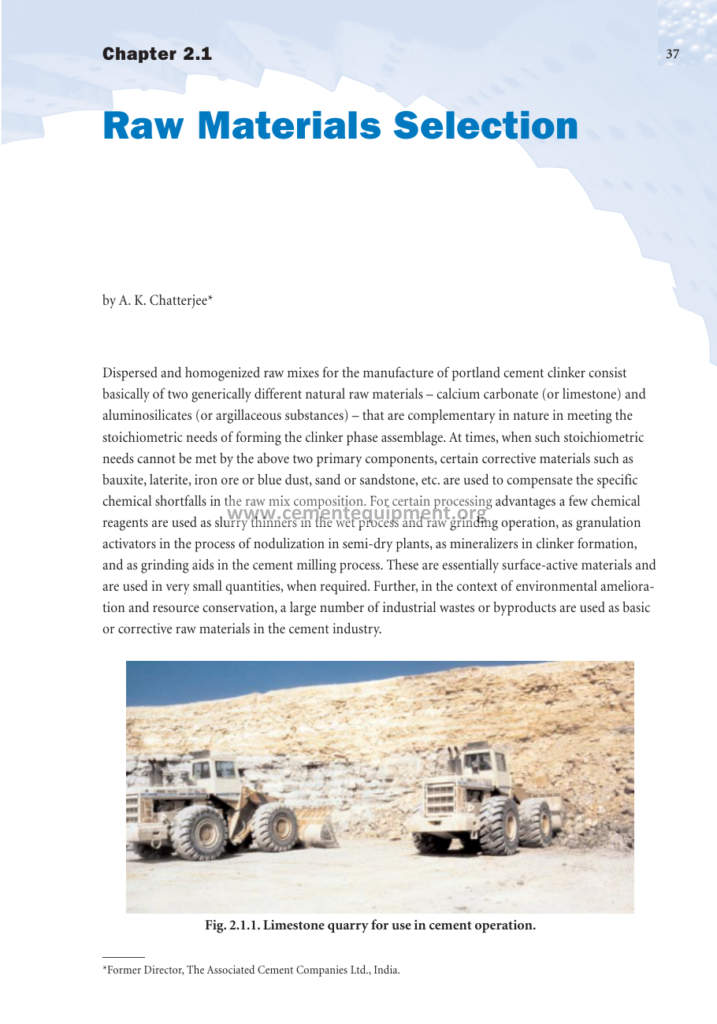
The limestone deposits used by the industry are sedimentary rocks formed by the accumulation of calcium carbonate in the ancient seas, and their quality is decided by the mode and the environment of their formation, which the chapter explains as the foundation of the selection. The inorganic mechanism deposits the carbonate by the chemical and the physico-chemical precipitation from the supersaturated sea water, forming the crystalline and the fibrous limestones; the organic mechanism accumulates the shells, the tests and the debris of the calcareous organisms, from the coral reefs and the shell banks to the microscopic plankton of the chalk seas, forming the fossiliferous and the chalk deposits; and the diagenesis, the compaction, the cementation and the recrystallisation that follow the burial, transforms the soft sediment into the hard rock of the geological record. The distribution of the deposits in space and time follows the history of the seas and the epicontinental basins, which is why the limestone belts of the world are the old sedimentary basins, and why a cement company’s geography, the location of its plants following the carboniferous and the cretaceous belts, is a direct child of the geology of its region.
The practical consequences of the geology are many. The crystalline and the hard limestones are strong (and therefore expensive to crush and grind) but pure and predictable; the chalk and the soft limestones are cheap to extract (some quarries need no blasting) but carry the moisture and need the drying; the dolomitic limestones bring the magnesia that the clinker limits; the siliceous limestones bring the silica that raises the silica ratio; and the marls, the natural mixture of carbonate and clay, were the deposits on which the industry’s first plants were built, because a marl alone can make the clinker. The exploration geologist’s report, the section, the core logs and the chemical maps are the document from which the whole selection is argued, and the chapter’s treatment of the geo-historical distribution is precisely the preparation that the plant staff needs to interpret the local deposit with understanding rather than with prejudice.
3. The Argillaceous Side: Clays, Shales and the Correctives
The argillaceous component of the mix supplies the silica and the alumina, and its family covers a wide range: the alluvial clays (soft, easily worked, but often carrying the sand and the organic matter), the shales and the mudstones (older, harder, laid in the deeper basins), the marlite and the argillaceous limestones (the natural intermediates), and the weathered rocks of the tropical profiles that the industry of the warm countries uses where the classical deposits are absent. The quality parameters of the clay are the silica and the alumina contents (which set the moduli of the mix), the alkali content (the clay is the principal source of the potassium and the sodium that the clinker carries), the magnesia, the iron (which raises the alumina-to-iron ratio when low), the moisture (a soft wet clay costs fuel to dry), and the quartz: coarse free quartz in a clay is one of the classic causes of the burnability problems, because the coarse quartz dissolves slowly in the clinker melt and leaves the core of the particle unreacted, and the new generation of the burnability tests checks exactly this fraction.
The correctives complete the palette. When the deposit is low in iron (common with the pure limestones and the kaolinitic clays), the mix needs an iron corrective: the iron ore, the mill scale, the pyrite cinders, the bauxite tailings; when the alumina is low, an aluminous corrective: the bauxite, the high-alumina clays, the fly ash concentrated in alumina; when the silica ratio runs high, a silica source: the quartz sand or the siliceous shales; and when the sulfates are deficient, the gypsum addition of the finish mill. Each corrective is a supply line with its own price, its own variability and its own chemistry, and the selection of the deposit is in part the selection of the correctives that the deposit will force: a deposit whose own chemistry meets the target LSF, SR and AR with the smallest corrective dosage is the deposit with the lowest operating cost, and the comparison of deposits is therefore made on the full recipe, not on the limestone alone.
4. The Exploration and the Sampling: Quantifying the Deposit
The raw material selection is an act of quantification, and the exploration programme is its instrument. The professional exploration proceeds in stages matched to the investment decision: the regional stage (the geological mapping, the aerial and the satellite imagery, the regional sampling) identifies the candidate areas; the preliminary stage (the trenches, the shallow drilling, the bulk sampling) estimates the order of magnitude of the reserves and the quality and supports the feasibility study; and the detailed stage (the grid drilling with the core recovery, the down-the-hole logging, the chemical analysis of the cores at regular intervals, and the pilot-scale tests of the grindability and the burnability) defines the proven reserves, the layered quality model of the deposit and the quarry plan. Each stage reduces the uncertainty, and the exploration is designed so that the uncertainty of the reserves classification (inferred, indicated, measured) is documented against the international codes of the mineral reporting.
The sampling discipline is the heart of the honesty: the core samples are analysed for the full oxide suite, the sample spacing matches the variability of the geology (the drill grids are tightened where the quality changes fast), the analytical quality is verified by the laboratory standards and the duplicate samples, and the composite samples represent the layers that the quarry will actually deliver. The modern exploration adds the on-site mobile laboratories and the portable X-ray fluorescence that analyse the faces and the drill chips in the field, and the geostatistical treatment (the variograms and the kriging of the modern practice) converts the scattered analyses into the continuing quality map of the deposit, which then drives the quarry scheduling. The exploration that the chapter describes, completed with the geostatistics of the modern era, is the difference between a company that knows its resource and a company that guesses it, and the selection decision is only as good as the exploration that stands behind it: the chapter’s lesson, quantify before you commit, is the lesson on which the multi-decade economics of the quarry rest.
5. The Chemical and the Mineralogical Quality Requirements
The acceptance of a raw material is argued against the target chemistry of the clinker, expressed by the three classical moduli. The lime saturation factor (LSF) is the balance between the calcium oxide and the sum of the silica, the alumina and the iron, targeted so that the clinker forms the maximum alite without the useless and the harmful free lime; the typical target lies between 90 and 100%, and the deposit’s limestone-to-clay ratio is set to deliver it. The silica ratio (SR) is the ratio of the silica to the alumina plus the iron, governing the melt content of the burning zone: a high SR (above 3.5) dries the melt, hardens the burn and raises the fuel; a low SR (below 2) floods the kiln with the liquid and makes the burning uncontrollable and liable to the rings and the snowmen. The alumina ratio (AR) fixes the aluminate to the ferrite balance, which decides the burnability, the sulfate resistance and the setting behaviour of the product, and together the three moduli define the recipe box in which the selected materials must operate.
Beyond the moduli, the mineralogical requirements matter as much as the chemical ones. The quartz content and its crystal size control the burnability (the coarse quartz is the slow-dissolving hazard); the carbonate mineralogy (calcite versus aragonite, the dolomite and the siderite) affects the decarbonation and the magnesia balance; the smectitic clays swell and handle badly in the raw mill; the amorphous silica (the opal of the flints) is reactive in the process but also in the concrete aggregates of the region; the organic matter of the black shales adds the calorific value but also the volatiles and the colour effects; and the minor and trace elements, the alkalis, the chloride, the sulfate as pyrite, the phosphate and the heavy metals, constrain the product quality, the emission compliance and the use of the alternative fuels. The perfect raw material is a balanced mineral assemblage, and the chapter’s quality system, the chemistry in the rule box, the mineralogy in the understanding, is the framework that the selection process applies layer by layer during the exploration.
6. Burnability: The Raw Material as the Fuel Consumer
Burnability is the property of the raw mix that describes how easily it converts into well-burned clinker, and it is the raw material selection’s bridge to the energy economics, because a hard-burning mix costs fuel, shortens the refractory life and stresses the kiln. The burnability of a mix depends on its chemistry (the LSF, SR and AR), on its mineralogy (the quartz, the clay type, the carbonate crystallinity) and on its particle size distribution (the coarsest fraction of the limestone and the quartz dominate the kinetics), and the industry measures it by the laboratory simulation: the raw mix is pelletised and fired at the kiln temperatures, and the free lime of the resulting clinker is measured (the standard tests at 1400, 1450 and 1500 °C), or the burnability is computed by the empirical indices that correlate the moduli and the fineness with the required burning temperature. The result is the recipe of the trial: the mix is improved by the fineness (fine grinding helps the hard quartz), by the corrective dosages (an iron corrective lowers the melt temperature) or by the fluxes and the mineralisers (the fluorides, the sulfates) that accelerate the clinkering.
The selection consequences are direct. A deposit that delivers a mix with a burnability in the normal window (a measured free lime of about 1 to 3% at the target firing) is a standard deposit; a deposit whose natural recipe burns hard forces the plant to grind finer (electrical energy), to raise the flame (fuel), or to dose the expensive correctives and the mineralisers, and the marginal cost of each point of the free lime climbs. The modern plants therefore run the burnability of the mix as a routine quality parameter, maintained by the raw mill fineness and the corrective strategy, and the selection of the raw material includes the burnability trials of the exploration samples, so that the quarry of the future is chosen with the burning cost already known. This coupling, between the geology of the deposit and the fuel of the kiln, is one of the most valuable insights of the raw material discipline, and the chapter’s exposition of the burnability is the technical heart of the selection.
7. The Raw Mix Design and the Selection of the Recipe
Once the candidate materials are characterised, the raw mix design selects the proportions that meet the targets, and the selection among the deposits finally expresses itself in this recipe. The classical procedure computes the proportions from the oxide analyses by solving the balance equations for the target LSF, SR and AR, then the trial burns validate the burnability, and the corrections iterate the recipe until both the chemistry and the process behaviour are met. The modern procedure adds the optimisation: the recipe is chosen to minimise the total cost (the quarrying, the grinding, the corrective purchase, the fuel, the emission allowances) subject to the quality constraints, and the linear programming and the cloud-based optimisers handle tens of materials and hundreds of constraints, including the constraints of the alternative materials and the internal recycle of the kiln dust. The recipe results are expressed as the hourly set points of the proportioning feeders of the raw mill, and the on-line X-ray analysis of the mill product closes the loop, correcting the doses before the deviation leaves the mill.
The raw mix design is also the instrument of the future-proofing of the deposit. The designed recipe defines which layers of the deposit are usable and in which proportion, and the quarry scheduling is derived from the recipe: the extraction plan blends the benches so that the layered quality of the delivered material stays inside the recipe box month after month, and the blending stockpiles absorb the remaining variability. The selection of a deposit is therefore not completed at the moment of the choice; it is executed continuously, in the daily recipe, in the quarry face and in the homogenisation bed, and the professional understanding of the whole chain, from the exploration to the dose, is what the chapter calls the complete raw material engineering, the discipline that the modern plant cannot delegate.
8. Preparation and Homogenisation: From the Deposit to the Steady Feed
The quarry delivers a variable material (the layers differ, the moisture fluctuates, the soft and the hard benches alternate), and the preparation line must convert this variability into the steady raw meal of the kiln, through the five classical unit operations. The extraction is planned so that the delivered layers are blended at the source by the order of the benches; the crushing reduces the rock to the mill feed size, and the crusher selection follows the abrasiveness and the moisture of the material; the prehomogenisation stores the crushed material in the long or circular blending beds, stacking in the thin layers and reclaiming perpendicular to the stacking, so that the inherent variability of the deposit is averaged out; the grinding and drying in the raw mill convert the blended material to the powder and add the synthetic homogenisation inside the mill; and the homogenisation silo (the continuous blending silo with the aeration, or the batch silos) delivers the final smoothing, feeding the kiln with a raw meal whose LSF stays within a narrow band. Each stage contributes its reduction of the variance, and the design of the chain fixes the total homogenisation capacity of the plant, which the operators then manage by the continuous analysis of the mill product and the silo discharge.
The importance of the homogenisation to the selection is that it extends the usable resource: a deposit that is variable but well layered, mixed and blended can feed the same kiln as a remarkably uniform deposit, at the price of the capital and the operating energy of the preparation line; a deposit that cannot be steadied (discontinuous lenses, erratic quality jumps beyond the blend capacity) is simply not selectable. The trade-off between the deposit quality and the preparation investment is one of the great quantifications of the feasibility studies, and the modern geostatistics, simulating the delivery of the designed quarry into the simulated preparation line, computes the expected raw meal variance and the resulting clinker quality and energy before a tonne is extracted. The chapter’s vision, the raw material chain as a single engineered system from the drill core to the kiln feed, is the framework in which the selection of the limestone is finally judged, and the engineering of the chain is the daily task of the raw department.
9. The Alternative Raw Materials: The Widening of the Selection
The modern chapter of the raw material selection is the integration of the alternative and the industrial by-product materials, which widen the resource base and lower the footprint of the industry, as developed in the alternative materials guide. The selected primary deposit is increasingly complemented by the by-product streams of the region: the slag of the steel plants and the fly ash of the power stations as the argillaceous and the siliceous sources, the sludges and the ashes of the industrial processes as the lime and the iron sources, the foundry sands, the phosphogypsum, the red mud and the construction and demolition fines as the correctives and the fillers. Every alternative stream is a raw material like any other: it must be measured, constrained and blended, its chemistry must fit the recipe box, its variability must be absorbed by the homogenisation, and its environmental and the logistics profile must be documented, and the selection discipline of the chapter applies to it identically.
Two consequences follow. The first is the optimisation problem of the plant: the by-products are limited and competing (the fly ash can feed the raw mill or the finish mill), so the selection of the raw materials is now an allocation problem across the whole plant, solved with the same optimisation tools that schedule the recipe. The second is the security of supply: a plant whose raw mix depends on the by-product streams of the neighbouring industries carries the risk of their cessation (a closed steel plant, a decommissioned coal power station), so the modern selection adds the supply-risk analysis to the quality analysis, and the primary deposit, the one resource that cannot fail, remains the strategic anchor of the plant. The chapter’s framework, extended this way, is exactly the framework with which the modern plants design their material portfolio: the geology in the centre, the circular economy around it, and the cost, the carbon and the risk as the three walls of the selection.
10. The Quality Control of the Quarry in the Long Term
The raw material selection is a living activity because the quarry is a living resource, and the long-term quality control of the deposit is the guarantee that the decisions of the design remain valid for the decades of the operation. The control system is built on four elements. The face sampling and the layer tracking maintain the chemical and the mineralogical knowledge of the exposed benches, and the actual delivered quality is compared with the model of the exploration, updating the reserves classification as the mining exposes the reality. The blending management schedules the extraction so that the delivered mix stays inside the recipe window, and the stockpile management rotates the material so that the homogenisation property of the beds is preserved. The continuous measurement, the on-line analysis of the raw meal together with the periodic bulk analysis of the quarry, feeds the statistical control charts that reveal the gradual drift of a layer long before it would disturb the product. And the deposit monitoring, the updates of the geological model with the new drilling of the advancing faces, extends the proved reserves and signals the approaching changes of the quality far enough in advance for the corrective strategy to adapt.
The reporting of the quarry control follows the same discipline as the reporting of the process: the monthly report of the delivered quality versus the target, the reserves statement updated to the year and audited, and the risk register (the flooding, the land instability, the licences and the community relations of the quarry) maintained with the evidence of the permits and the environmental monitoring. The companies that run this long-term control of their deposits are the companies whose plants do not drift, whose recipes do not fight the geology and whose feedstock is predictable at the horizon of the investment; the companies that neglect it discover the cost of the neglect only in the kiln, in the fuel bills and in the quality deviations, which is why the chapter’s insistence on the quantification and the control of the raw material resource remains the first principle of the profession.
11. The Selection as a Strategic Decision: The Table of the Criteria
The selection of the raw materials is finally a multi-criteria decision, and the professional conclusion of the chapter can be summarised in the decision table that every feasibility study applies to its candidate deposits:
| Selection criterion | What is verified | Why it matters |
|---|---|---|
| Reserves and geography | Proved tonnage, thickness, overburden, access | Decades of supply at the designed capacity |
| Chemistry against the moduli | LSF, SR, AR and the corrective need | Clinker composition and the recipe cost |
| Mineralogy and grindability | Quartz, carbonate type, abrasiveness, work index | Grinding energy, media wear, mill design |
| Burnability | Free lime of the trial clinker | Fuel per tonne and the kiln stability |
| Variability and blending need | Geostatistical variance, layer structure | Homogenisation investment and the control load |
| Minor and trace elements | Alkalis, chloride, sulfate, MgO, heavy metals | Product limits, emissions, bypass need |
| Moisture and handling | Water content, stickiness, plasticity | Drying fuel and the handleability |
| Environmental and social | Permits, water, community, restoration | Licence to operate and the risk |
| Logistics of the correctives | Supply, price, quality of the by-products | Marginal cost of the recipe |
No deposit wins every criterion, and the decision is the weighted balance of the table against the strategy of the company: a company in a market of cheap energy may accept a harder limestone; a company under a strict carbon regime prefers the deposit that allows the highest use of the alternative materials; a company in a land-constrained region weighs the reserves and the licences above all. The selection is therefore a decision of the board as much as of the geologist, and the chapter’s contribution is to give both parties the quantified language of the decision: the same tables, the same burnability numbers, the same geostatistical uncertainty, so that the geological truth and the commercial judgement meet on the same page.
12. Frequently Asked Questions
Why is the raw material selection considered the first decision of a cement plant?
Because the quarry fixes the chemistry of the product, the energy per tonne, the grinding wear, the emissions and the capital of the preparation line for the decades of the operation, and the plant cannot buy its primary resource on the market: the selection is the strategic anchor of the whole company.
What is the difference between the calcareous and the argillaceous components?
The calcareous component (limestone, chalk, marl) supplies the calcium oxide of the clinker; the argillaceous component (clay, shale) supplies the silica and the alumina; the correctives of iron, silica and alumina trim the final proportions of the recipe.
What are the three moduli of the raw mix?
The lime saturation factor (LSF), the silica ratio (SR) and the alumina ratio (AR); they express the balance of the four oxides that the clinker phases require, and the raw mix is designed to hold them in their target windows.
What is burnability and how is it measured?
Burnability is the ease with which a raw mix converts into well-burned clinker; it is measured by firing the laboratory pellets at the kiln temperatures and determining the free lime, and it links the mineralogy of the deposit to the fuel cost of the kiln.
How much sampling is needed to prove a limestone deposit?
It depends on the variability of the geology: the exploration proceeds in stages from the regional reconnaissance to the detailed grid drilling, and the spacing of the drilling is tightened where the quality changes fast, always documenting the uncertainty against the reserves classification codes.
Can a variable deposit be used at all?
Yes: the preparation line, the quarry blending, the prehomogenisation beds and the homogenisation silo are designed precisely to convert a variable deposit into a steady kiln feed; a deposit is selectable if its variability is within the blending capacity of the designed chain.
Do the alternative raw materials change the selection process?
Yes: the by-products of the region (slag, fly ash, sludges, correctives) enter the recipe as raw materials like any other, measured, constrained and blended, and the selection becomes an allocation problem between the primary deposit and the circular streams, with the supply risk as a new criterion.
13. Summary and Conclusion
Raw materials selection, the chapter of A. K. Chatterjee in the PCA volume, is the discipline that stands at the geological origin of the cement industry: the understanding of the limestone and the clay deposits through their genesis, their exploration and their honest quantification; the expression of their quality in the language of the moduli, the mineralogy and the burnability; the design of the recipe and the preparation chain that convert the layered quarry into the steady feed of the kiln; the widening of the selection toward the alternative and the circular raw materials; and the long-term control of the deposit that keeps the decisions valid for the decades of the operation. Each of these elements is quantified, evidenced and optimised, and together they form the strategic decision on which the chemistry, the energy, the capital and the risk of the plant rest. The companies that select their raw materials with this discipline build their plants on foundations that the market cannot erode and the geology cannot betray; the engineers who master the chapter see in every rock of the quarry the oxides, the moduli and the burnability of the clinker of the next thirty years, and that vision, the geological distance of the profession, is the first and the most enduring competency of the cement industry.
Get this cement file + the full 931-file package
$249.99 — one-time purchase, instant download, lifetime access
This file is part of the Complete Cement Technical Package (931 files) available from cementequipment.org. Respective rights holders; library copy for the licensed single user.