Cement Air Pollution Control: Complete Guide
Cement manufacturing is, in an intentionally simplified view, a four-step process: raw material acquisition, preparation of the raw materials for pyroprocessing, transformation of those materials into Portland cement compounds in a kiln fired by fossil or alternative fuels with subsequent cooling of the clinker, and finally grinding of the clinker into cement with its handling, storage, and shipment. Every one of these steps interacts with the atmosphere, and every one of them can be managed. Air emissions from a cement plant fall into two broad categories: point-source emissions from stacks, and fugitive emissions from handling, storage, and process leakage. The pollutants of concern are particulate matter (PM), nitrogen oxides (NOx), sulfur dioxide (SO2), carbon monoxide, carbon dioxide, and trace constituents such as heavy metals and organic compounds. This article provides a complete technical overview of air pollution in the cement industry: where each pollutant comes from, how it is measured, the regulatory limits that apply, and the control technologies, from fabric filters and electrostatic precipitators to selective non-catalytic reduction and wet scrubbers, that keep modern plants within 10-20 mg/Nm3 dust limits and increasingly strict gaseous emission limits. It is written for process engineers, environmental managers, and plant operators who need a practical reference on the design, operation, and optimization of air pollution control systems.
The Cement Plant as an Air Pollution Source
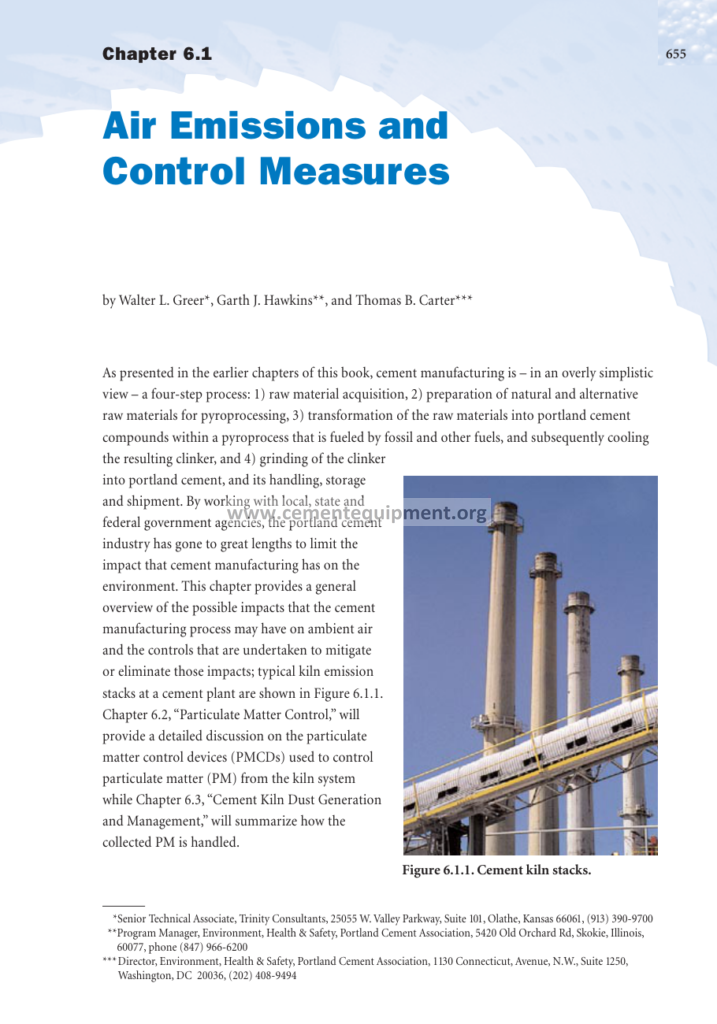
A typical integrated cement plant presents a dozen or more separate emission points, each with its own pollutant profile. The kiln system is the dominant point source and carries the bulk of combustion and process gases. The raw mill, coal mill, and cement mills are secondary point sources that must be handled carefully because they operate in the same gas streams as the kiln through the kiln-mill mode of operation. The cooler, crusher, and packing plant are tertiary sources. Beyond the stacks, fugitive emissions escape from conveyor transfer points, storage piles, quarry operations, and roadways, and in a poorly maintained plant fugitive dust can equal or exceed the stack emissions.
Understanding this source structure is the first step in air pollution control, because each source requires a different control strategy. Stack emissions are controlled with collection devices and combustion optimization, while fugitive emissions are controlled with enclosure, extraction, and suppression. A plant that installs the best baghouse in the world but leaves its conveyors open will still fail its emission targets. The table below summarizes the main emission points and their pollutants.
| Source | Main pollutants | Control device / measure |
|---|---|---|
| Kiln / preheater / precalciner stack | PM, NOx, SO2, CO, CO2, metals, HCl, dioxins | Baghouse or ESP, SNCR, scrubber, CEMS |
| Raw mill and kiln combined gas | PM, volatile salts | Dedicated or shared baghouse/ESP |
| Clinker cooler | PM | Baghouse or ESP |
| Coal mill | PM (coal dust), CO (risk) | Baghouse with CO and spark detection |
| Cement mills | PM | Baghouse, often with separator recycle |
| Crushers, screens, conveyors | Fugitive PM | Enclosure, hoods, extraction, suppression |
| Storage silos and packing plant | Fugitive PM | Dust collectors on silo vents, packers |
| Quarry and haul roads | Fugitive PM | Watering, wheel washing, paving |
Emission Characteristics of the Kiln System
The kiln exhaust gas is the defining gas stream of a cement plant. A modern preheater/precalciner kiln producing 5000 t/d of clinker moves on the order of 600,000 to 900,000 Nm3/h of gas through the raw mill to the stack. The gas temperature, composition, and moisture vary continuously with the kiln-mill operating mode: when the raw mill is running on kiln gas, the temperature drops from roughly 300-350°C to about 90-120°C, and the gas picks up moisture from the raw material, fundamentally changing the dew point and the behavior of the collection device.
Finely divided particles of raw mix, calcined kiln feed, clinker dust, and volatile constituents such as potassium sulfate are entrained in the gas stream. These particles are almost entirely removed before the gas is vented, and the collected material is cement kiln dust, which is recycled to the process whenever its chemistry permits. The gas also carries gaseous pollutants: NOx formed in the flame, SO2 released from sulfur minerals and fuel, CO from incomplete combustion, and trace metals that volatilize in the burning zone and recondense in the cooler parts of the system. Understanding where each pollutant concentrates is essential: mercury, for example, tends to leave with the raw mill off, when the gas is not scrubbed by the cold raw material.
Particulate Matter: Formation, Measurement, and Limits
Particulate matter is the pollutant that historically defined the cement industry’s environmental reputation, and it remains the most visible emission. Particles originate from every dry material handling step, from grinding dust, from the entrainment of raw feed in kiln gases, and from condensation of volatile salts. The size distribution matters: the coarse fraction above 10 microns settles quickly near the plant, while PM10 and especially PM2.5 penetrate deep into the human respiratory system and travel over long distances.
Stack emission limits for dust have tightened continuously. Typical modern permits require 10-20 mg/Nm3 on the kiln stack, with many new installations designed for 5-10 mg/Nm3. The European best available technique conclusion for cement kiln dust from fabric filters is 10-20 mg/Nm3 and 20-30 mg/Nm3 for electrostatic precipitators. These numbers are concentrations measured under standard conditions of temperature and pressure with correction for oxygen content where applicable, and they are verified by periodic manual measurements with reference methods and by continuous opacity or light-scattering monitors between tests.
- PM from process exhausts: kiln, raw mill, coal mill, and clinker cooler stacks are the main point sources, controlled with baghouses or ESPs.
- PM from handling and transport: crushers, conveyors, transfer points, silos, and packers emit fugitive dust controlled by enclosure and hooded extraction.
- PM from storage and traffic: stockpiles, roads, and quarry faces require watering, chemical dust suppressants, wind barriers, and speed controls.
- PM from maintenance events: bag failures, duct leaks, and start-up conditions are episodic sources that must be handled procedurally.
Nitrogen Oxides: Formation and Control
NOx in cement kilns forms by three mechanisms. Thermal NOx is produced by the oxidation of atmospheric nitrogen at flame temperatures above 1500°C and is the dominant mechanism in the main kiln flame. Prompt NOx forms in the flame front through hydrocarbon radical reactions. Fuel NOx forms from nitrogen chemically bound in the fuel. In a cement kiln, the countercurrent flow and the alkaline feed also mean that part of the NOx is recycled into the kiln with the returning kiln dust and preheater feed, so kiln NOx emissions reflect a balance between formation and reduction.
Typical uncontrolled NOx concentrations from a precalciner kiln range from 400 to 1200 mg/Nm3 as NO2. The principal control technologies are process optimization, staged combustion, low-NOx burners, and selective non-catalytic reduction (SNCR). Staged combustion controls flame temperature and oxygen availability, and the precalciner gives the operator a powerful reduction tool: by burning part of the fuel in a reducing environment, NOx formed in the kiln can be reduced by 30 to 50 percent. SNCR injects ammonia or urea into the gas stream at a temperature window of roughly 850-1050°C, achieving 50-70 percent reduction depending on injection design, with the constraint that ammonia slip must be controlled and that the high dust load can blind injection nozzles. Selective catalytic reduction (SCR) can achieve over 80 percent reduction but has seen limited application in cement because of catalyst poisoning and plugging by alkaline dust, although high-dust and tail-end configurations are now commercial. Best available technique limits for NOx are typically 200-500 mg/Nm3 depending on the process and the fuel.
Sulfur Dioxide: Sources and Mitigation
SO2 in kiln gas comes from two sources: sulfur in the fuel, and sulfur minerals in the raw materials. Fuel sulfur, mostly in coal and petroleum coke, oxidizes in the burning zone and forms SO2 that is largely absorbed by the alkaline raw feed in the preheater, so fuel sulfur alone rarely causes emission problems. The troublesome source is raw material sulfur, particularly pyrite and organic sulfur, which releases SO2 in the preheater at temperatures where the feed is not yet sufficiently alkaline to absorb it. Sulfide sulfur in the kiln feed can be oxidized in the preheater cyclone stages, producing SO2 that bypasses the absorption zone and appears in the stack gas.
Mitigation strategies follow a hierarchy. First, reduce the input: selective quarrying or raw mix blending to limit sulfide sulfur, and fuel selection. Second, absorb in-process: the raw mill can serve as a desulfurization reactor when it is running, because cold moist feed absorbs SO2, which is why SO2 emissions typically rise when the raw mill stops. Third, add dedicated absorption: hydrated lime injection into the gas stream, a dry or semi-dry scrubber, or a wet scrubber. Wet scrubbers in cement plants remove SO2 by contacting the gas with an alkaline slurry, typically achieving 85-98 percent removal, and they also capture HCl, HF, and part of the mercury. Permit limits for SO2 on modern plants typically range from 50 to 400 mg/Nm3, with wet scrubber installations achieving far lower values.
Carbon Monoxide and Organic Compounds
CO is the direct indicator of incomplete combustion in the kiln system. Normal steady-state operation produces CO concentrations well below 100 mg/Nm3, but start-up, kiln coating disturbances, burner adjustments, and raw mix or fuel changes can produce CO spikes. CO is monitored continuously on the main stack, and high CO is operationally significant beyond the emission issue because it is the trigger for explosion protection systems on coal mills and electrostatic precipitators: an ESP cannot operate safely when CO exceeds its design threshold, typically in the range of 1.0 to 1.5 percent.
Volatile organic compounds in cement kiln gas originate from the raw materials, particularly organic matter in limestone and shales, and from alternative fuels. Most organics are destroyed in the burning zone, which operates well above the required destruction temperature, but organic carbon in raw material can vaporize in the preheater and appear as unburned VOC and CO in the stack. The cement kiln environment, with its high temperature, long residence time, and alkaline dust, is recognized as one of the best available destruction technologies for organic wastes, which is the basis of the industry’s waste co-processing practice.
Heavy Metals and Trace Emissions
Trace metals in cement kiln gas are classified by their volatility. Non-volatile elements, such as chromium and nickel, pass largely into the clinker and appear in emissions only as particulate matter. Semi-volatile elements, such as lead and cadmium, partially volatilize and condense on fine dust, and are controlled by the particulate collection device. Volatile elements, primarily mercury and thallium, circulate in the gas phase and condense on dust at low temperature, which creates a distinctive operating challenge: mercury emissions are minimized when the raw mill is running, because the cold mill feed absorbs mercury from the gas, and they peak when the mill is off.
Permit limits for metals are expressed both as individual limits, for example 0.05 mg/Nm3 for mercury, and as mass flow limits such as grams per tonne of clinker. Control measures include dust control (metals attached to particles), mercury adsorption on the raw mill (mill-on operation), activated carbon injection where extremely low mercury limits apply, and purge of high-metal dust from the system. Because metals concentrate in the fine dust and in the bypass dust, management of these streams, including their disposal or re-cycle, is part of the emission control system.
Particulate Matter Control Devices
The particulate matter control device (PMCD) is the workhorse of cement air pollution control, and its selection determines the achievable dust emission level. Four technologies dominate the industry: fabric filters (baghouses), electrostatic precipitators (ESPs), cyclones, and wet scrubbers. Cyclones are used as primary collectors and pre-collectors because they cannot achieve modern limits alone. Wet scrubbers are used for combined SO2 and dust removal. The two high-efficiency devices are the baghouse and the ESP.
| Device | Typical outlet dust | Advantages | Limitations |
|---|---|---|---|
| Pulse-jet fabric filter | 5 – 20 mg/Nm3 | Very high efficiency, insensitive to dust resistivity, low pressure loss with modern media | Media sensitivity to temperature, moisture, and sparks |
| Electrostatic precipitator | 20 – 50 mg/Nm3 | Low operating cost, handles high temperatures and large gas flows | Sensitive to dust resistivity and process upsets; CO interlock |
| Cyclone / multi-cyclone | 150 – 400 mg/Nm3 | Robust, cheap, good for coarse dust | Inadequate alone for modern limits |
| Wet scrubber | 10 – 50 mg/Nm3 | Simultaneous SO2, HCl, and metal capture | Water and slurry handling, plume visibility |
Selection depends on gas volume, temperature, dust characteristics, space, power cost, and the required emission level. The worldwide trend is decisively toward fabric filters, because they achieve the lowest outlet concentrations, are insensitive to dust resistivity, and are robust across the kiln-mill operating modes. ESPs remain in service at many older plants, often retrofitted with larger collecting areas or converted to baghouses when permit limits tighten.
Fabric Filters: Design and Operation
The fabric filter collects dust by passing the gas through a filter medium, building a dust cake that becomes the actual filtration surface. In the cement industry, the pulse-jet design with cartridge or bag-type media has become standard: gas enters the hopper, passes through the bag fabric from outside to inside, and clean gas exits through the top. A venturi-operated jet pulse at 5-8 bar releases compressed air into the bag top, flexing the bag and dislodging the cake, which falls into the hopper and is returned to the process.
The critical design parameter is the air-to-cloth ratio, the gas flow per unit of fabric area, typically 0.9 to 1.3 m3/m2/min for kiln gas and higher for lighter dust loads on mill vents. The pressure drop across the bags, typically 800-2000 Pa, is the operating indicator: rising pressure drop signals over-cleaning cycles, moisture, or insufficient pulse pressure, while falling pressure drop can signal bag damage. Temperature is the second critical parameter: polypropylene media fail above 90°C, polyester above 150°C, acrylic and aramid media reach 180-200°C, and PTFE or glass fiber with PTFE membranes are used where the gas reaches 200-260°C. Moisture is the third: if the gas is cooled below its dew point, condensation cements the dust onto the fabric, blinding the bags permanently. This is why start-up and shutdown procedures, and the kiln-mill mode transitions, are so important in baghouse operation.
Electrostatic Precipitators
The ESP collects dust by charging particles in a corona discharge field and collecting them on grounded plates. Collection efficiency depends on the particle size, the specific collecting area, and the dust resistivity, which is the critical cement-specific parameter: cement kiln dust resistivity is high at temperatures between roughly 150 and 250°C, where the dust is dry and not conductive enough for efficient collection, and low at both ends of the temperature range, where surface moisture (low temperature) or bulk conductivity (high temperature) helps. In practice, kiln ESPs operate on gas entering at 250-350°C (mill off) or 90-120°C (mill on), and the resistivity behavior determines performance.
ESP operation is sensitive to process disturbances. High CO interlocks must trip the high voltage to prevent explosion, which means the precipitator cannot collect during combustion upsets. Dust re-entrainment, rapping losses, and uneven gas distribution degrade efficiency, and the modern approach to meeting 20-30 mg/Nm3 limits often involves adding collecting fields, optimizing gas distribution with perforated plates, and installing voltage controls that follow the gas conditions. Because of their sensitivity, ESPs are increasingly replaced or upgraded when plants need to guarantee the low limits that customers and regulators now demand.
NOx Control Technologies in Detail
Selective non-catalytic reduction is the standard NOx control technology on modern kilns. Ammonia or urea solution is injected into the kiln or preheater gas at the temperature window of 850-1050°C, where it reacts selectively with NOx to form nitrogen and water. The challenge in cement kilns is that the gas is loaded with dust, so injectors must be designed to resist erosion and blinding, and the spray must cover the duct cross-section uniformly. Urea is preferred in many plants because it is easier to store and handle than ammonia, but it must be atomized and vaporized before injection to avoid excess ammonia slip. SNCR typically achieves 50-70 percent NOx reduction, and the ammonia slip must be kept below its permit value, typically 5-10 mg/Nm3.
Where lower limits require more than SNCR can deliver, staged combustion and process measures come first: optimizing the kiln flame with a low-NOx burner, increasing the fuel share in the calciner with reducing conditions, and controlling excess air. Kiln operation itself is a NOx tool: a well-formed, well-positioned flame with stable clinker temperatures emits less NOx than a dispersed flame with fluctuating temperatures. Combined, these measures plus SNCR bring most plants within 200-400 mg/Nm3, and tail-end or high-dust SCR installations are available for the strictest limits, at the cost of catalyst management in the alkaline dust environment.
SO2 Control in Detail
In-process absorption is the most cost-effective SO2 measure in cement plants because the process itself is alkaline. When the raw mill is running, the cold, moist, high-surface-area feed absorbs SO2 efficiently, achieving 60-95 percent removal depending on the mill and the moisture. Operators therefore schedule raw mill operation to cover periods of high raw-material sulfur input, and some plants install a bypass around the mill so that gas can be routed through it for desulfurization even when the mill is not grinding.
Where absorption cannot meet the limit, add-on systems are used. Lime or hydrated lime injection delivers 50-80 percent removal depending on the injection point and the gas temperature. A dry scrubber with a dedicated lime dosing system integrated into the baghouse achieves higher removal and also captures HCl and HF. Wet scrubbers, operating with an alkaline slurry in a tower with internal packing or a venturi section, achieve 85-98 percent removal and are the definitive solution for plants on high-sulfur raw materials. The wet scrubber produces a slurry or solid by-product that must be managed, but the removal performance justifies the cost at plants where SO2 limits are strict.
Continuous Emission Monitoring and Reporting
Modern permits require continuous emission monitoring systems (CEMS) on the main kiln stack for dust, NOx, SO2, and CO, and periodic reference-method measurements for metals, dioxins, and organic compounds. Dust is monitored with light-scattering or beta-gauge analyzers; gaseous pollutants with extractive or in-situ infrared/UV analyzers. The data are logged, validated against reference measurements, and reported to the regulator, typically with quarterly or annual summaries and mandatory reporting of exceedances. Many jurisdictions now publish these data publicly.
The monitoring system is also an operational tool. The kiln operator uses the continuous readings to trim fuel, air, and SNCR dosing, and the maintenance team uses the dust meter to detect bag leaks and rapping problems. A well-maintained CEMS is a prerequisite for operating at low emission limits, because the plant cannot correct what it cannot measure. Calibration, verification, and data quality assurance therefore are formal programs, with reference tests conducted several times per year by accredited laboratories.
Fugitive Emission Control
Fugitive emissions can contribute more than half of a plant’s total dust if they are not managed. The control strategy is a combination of engineering and housekeeping. Emission sources are enclosed wherever possible: crushers, screens, transfer points, and mill feed housings are covered and connected to hoods and ducts that extract the dusty air to a small baghouse. Belt conveyors are fitted with skirt boards, scraper systems, and sometimes covers along the full length. Storage is isolated: silos are vented through dust collectors, and stockpiles are managed with wind barriers, water sprays, and chemical dust suppressants.
- Identify all fugitive sources and rank them by emission potential and public visibility.
- Enclose the source and extract dusty air to a dust collector where feasible.
- Apply suppression where extraction is not feasible: water sprays, foam, and chemical binders.
- Minimize drop heights and install chutes that keep material on the conveyor belt center.
- Pave and sweep roads, install wheel washing, and enforce speed limits on haul roads.
- Monitor with boundary dust deposition gauges and respond to complaints within a defined time.
- Audit the program periodically and correct the sources that appear in boundary measurements.
Fugitive control is also a productivity issue: dust that escapes is product that is lost, dust that blinds machinery is maintenance cost, and dust that settles on roads is a safety hazard. Plants that run effective fugitive programs report measurably better housekeeping, fewer equipment failures, and lower maintenance budgets.
Start-up, Shutdown, and Abnormal Operation
Emissions are not constant: they spike during start-up, shutdown, and process upsets, and modern regulation increasingly addresses these periods explicitly. During kiln start-up, the gas temperature is initially too low for the baghouse or ESP to operate safely, the flame is unstable, and CO and unburned organics are elevated. The standard approach is to vent the gas to a secondary line or a standby collector until the system reaches stable operating conditions, or to start with the raw mill as an absorber for SO2 and metals. Baghouse protection during start-up typically includes pre-heating of the filter housing and by-pass of wet or cold gas.
Shutdown follows the reverse sequence, and both periods must be planned in the operating procedure so that the stack gas is routed and monitored continuously. Permit rules in several jurisdictions now require plants to report start-up and shutdown emissions separately and to demonstrate that they are minimized. The lesson for the plant is that air pollution control is an operating discipline, not just equipment: the same baghouse that meets 10 mg/Nm3 in steady operation can emit badly if the procedures around its operating envelope are not respected.
Air Pollution Control Economics
Emission control costs are dominated by capital investment and by operating energy. A baghouse on a 5000 t/d kiln line may handle 800,000 Nm3/h and represent an investment of several million US dollars; the ESP alternative is similar but with different operating cost. The operating costs are compressed air for bag cleaning, fan power for the pressure drop, replacement bags every 3-6 years, and maintenance labor. SNCR adds reagent cost that scales with the NOx load, and wet scrubbing adds water, alkali, and by-product handling costs.
Against these costs stand the benefits: recovered dust that returns to the process as product, reduced maintenance from clean equipment, permit compliance that protects the operation from shutdown orders, and the environmental reputation that increasingly determines access to markets. The economic analysis of pollution control in cement is therefore not a question of whether to control, but of which technology achieves the required limit at the lowest life-cycle cost, which is exactly the question the best available technique process is designed to answer.
Frequently Asked Questions
What are the typical dust emission limits for cement kilns?
Modern permits require 10-20 mg/Nm3 for the kiln stack, with fabric filters typically achieving 5-10 mg/Nm3 and electrostatic precipitators 20-30 mg/Nm3. Fugitive dust is controlled by boundary deposition limits rather than stack limits.
How is NOx reduced in cement plants?
By process measures (low-NOx burner, staged combustion, calciner fuel distribution), selective non-catalytic reduction with ammonia or urea achieving 50-70 percent removal, and in strict cases selective catalytic reduction. Typical permit limits are 200-500 mg/Nm3.
Why does SO2 rise when the raw mill stops?
The cold raw mill feed absorbs SO2 efficiently. When the mill is off, gas bypasses this absorption, and SO2 from sulfides in the raw material appears at the stack. Plants schedule mill operation or add lime injection and scrubbers to cover mill-off periods.
What is the difference between a baghouse and an ESP?
A baghouse filters dust mechanically through fabric and achieves the lowest outlet concentrations; an ESP charges and collects particles electrostatically and is cheaper to operate but sensitive to dust resistivity and process upsets. The industry trend is strongly toward baghouses.
What is the kiln-mill mode and why does it matter?
It is the operating arrangement where the raw mill runs on kiln exhaust gas, cooling it from 300-350°C to 90-120°C and scrubbing SO2 and mercury. Emission behavior, dew point, and filter performance change completely between mill-on and mill-off modes.
Are cement kilns a good way to destroy organic waste?
Yes. The flame at 1400-2000°C, long gas residence time, and alkaline dust environment destroy organic compounds effectively, including dioxin precursors. Co-processing of waste-derived fuels is a recognized best available technique when feeding, monitoring, and metal management are properly controlled.
How are emissions verified?
Continuously with CEMS for dust, NOx, SO2, and CO, and periodically with reference-method manual tests for metals, dioxins, and organics. Data are reported to the regulator, and exceedances trigger corrective action and reporting obligations.
Summary
Air pollution control in the cement industry has matured into a systematic engineering discipline. The pollutant inventory is fully understood: dust from every dry process step, NOx from the high-temperature flame, SO2 from sulfur minerals and fuel, CO and organics from incomplete combustion, and trace metals that follow volatility-driven cycles through the system. The control toolbox is equally complete: fabric filters achieving 10 mg/Nm3 and below, electrostatic precipitators with their process-sensitivity constraints, SNCR and combustion staging for NOx, in-process absorption, lime injection, and wet scrubbers for SO2, and continuous monitoring that closes the loop between equipment and regulator. What distinguishes a clean plant from a dirty one is less often the technology than the discipline: operating procedures that respect the dew point and the temperature windows, scheduling that uses the raw mill as an absorber, start-up and shutdown protocols that protect the collectors, and a fugitive dust program that treats handling and storage as seriously as the kiln. This article has provided the technical foundation for that discipline.
Get this cement file + the full 931-file package
$249.99 — one-time purchase, instant download, lifetime access
This file is part of the Complete Cement Technical Package (931 files) available from cementequipment.org. Respective rights holders; library copy for the licensed single user.