Advances In Cement Clinkering: Complete Technical Guide
The clinkering process is the chemical heart of the cement industry: the raw meal of the four oxides, the calcium, the silicon, the aluminum and the iron, is transformed in the rotary kiln through the calcination, the subsolidus reactions and the liquid phase sintering into the clinker minerals that the cement chemistry measures and the concrete strength depends on: the chapter of the file, the “Advances in Cement Clinkering” of F. P. Glasser, the professor of the University of Aberdeen, delivers the modern scientific treatment of the transformation: the raw meal composition, the oxide limits, the reaction sequence, the liquid phase, the phase formation and the practical consequences for the kiln operation: this article walks the chapter with the numbers, the phase diagrams and the chemistry that the cement technologist applies every day.
The Complete Cement Technical Package (931 files including the books, the courses, the Excel tools and the presentations: $249.99 one-time: instant download via the PayPal payment) includes this clinkering chapter with the raw meal transformation, the oxide chemistry, the phase relations, the burnability science and the process consequences: the practical reference for the quality engineers, the kiln operators, the process chemists and the students of the cement chemistry: this article follows the chapter’s structure: the raw meal, the four oxides, the minor components, the heating reactions, the liquid phase, the phase formation, the cooling and the modern advances: every section with the real numbers of the industry.
The interesting frame of the chapter is the word “advances”: the clinkering science did not stand still while the kilns grew from the wet process plants of the past to the precalciner lines of 10,000 tons per day: the understanding of the oxide chemistry, the minor component management and the phase formation advanced with the analytical tools and the operating experience, and the chapter of the file collects the advances into the systematic treatment: this page is the guided tour, and the chapter is the complete map of the clinkering science.
1. The Raw Meal and Its Transformation: The Four Oxides and the Reaction Path
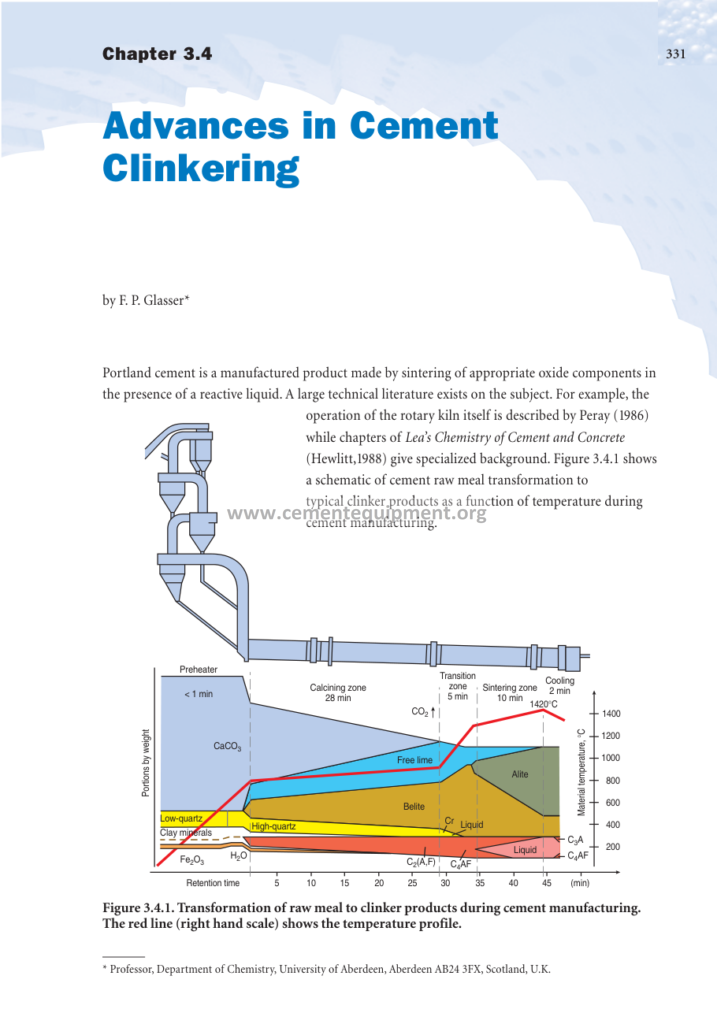
The starting material of the clinkering process is the raw meal, the finely ground and homogenized mixture of the limestone, the clay and the corrective materials: the meal of the modern plants consists of the calcium carbonate, the silica of the clays and the quartz, the alumina of the clays, and the iron oxide of the ferruginous components, and its transformation into the clinker follows a reaction path that the chapter of the file maps with the temperature: the dried meal of the preheater enters the calciner and the kiln, loses its water, releases its carbon dioxide, reacts in the solid state and finally sinters with the liquid phase into the clinker nodules of 10 to 25 millimeters.
| Transformation stage | Temperature range | Reaction products |
|---|---|---|
| Drying and dehydroxylation | 100 to 600 C | evaporation of the water, breakdown of the clay minerals |
| Calcination | 600 to 900 C, substantial near 800 to 900 C | CaCO3 releases CO2, CaO and the reactive oxides form |
| Subsolidus reactions | 800 to 1200 C | C2S (belite), C3A and C4AF precursors form in the solid state |
| Liquid phase formation | above 1250 to 1300 C | aluminate-ferrite melt appears, dissolving the lime |
| Clinkerization (sintering) | 1300 to 1450 C | alite (C3S) forms in the liquid, free lime falls |
The transformation map of the table is the backbone of the chapter: the reader sees the whole chemistry as the cascade of the temperature stages, each stage preparing the reactants of the next: the calcination releases the lime, the lime combines with the silica into the belite, the belite and the lime dissolve into the liquid phase, and the liquid phase precipitates the alite: the reaction path of the file explains the kiln observations: the free lime profile along the burning zone, the nodule structure, the coating formation and the clinker quality: the transformation science is the central chapter of the cement chemistry, and the file delivers it with the modern rigor and the practical numbers of the industry.
2. The Four Oxides and the Clinker Phases: The Lime Saturation and the Moduli
The clinker composition is expressed in the four major oxides, the CaO, the SiO2, the Al2O3 and the Fe2O3, and the phase chemistry of the chapter relates the oxides to the four main clinker phases: the alite (C3S), the belite (C2S), the tricalcium aluminate (C3A) and the tetracalcium aluminoferrite (C4AF): the proportions of the phases are controlled by the raw mix design, expressed in the moduli of the industry: the lime saturation factor (LSF), the silica ratio (SR) and the alumina ratio (AR), and the chapter of the file develops the phase chemistry from the oxide chemistry with the Bogue calculations and their limits.
- The lime saturation factor: the ratio of the lime actually available to the lime needed to saturate the silica, the alumina and the iron into the ideal phases: the modern grey clinkers run at the LSF of 90 to 98, and the higher LSF means the higher alite and the higher burning difficulty: the chapter’s LSF development shows the consequences: the LSF above the design point demands the higher burning temperature, the longer residence and the higher risk of the free lime;
- The silica ratio and the alumina ratio: the SR of 2.0 to 3.0 and the AR of 1.3 to 2.5 characterize the modern grey clinkers: the high SR gives the high belite and the more difficult burn, the low AR (the high iron) increases the liquid phase at the lower temperature, and the file’s tables map the moduli to the process behavior: the burnability, the liquid content, the coating and the clinker quality;
- The Bogue calculation: the classical formula converts the oxide analysis into the phase proportions: the C3S from the LSF, the C2S as the residual silica, the C3A from the alumina after the ferrite and the C4AF from the iron: the Bogue phases of the file agree with the microscopically measured phases within the tolerance of a few percent, and the deviations (the alkali and the sulfate inclusions, the equilibrium assumptions) are explained by the chapter: the Bogue is the daily instrument of the quality office, and its limits are as important as its formula;
- The phase properties: the alite is the strength-giving phase of the early and the long-term strength, the belite contributes the slower strength with the lower heat, the aluminate contributes the early strength and reacts with the gypsum in the cement, and the ferrite is the low-heat fluxing phase: the phase proportions of the file’s tables (typical grey clinkers: C3S 55 to 70%, C2S 10 to 25%, C3A 5 to 12%, C4AF 8 to 12%) translate into the cement performance, and the quality engineer manages the mix to the phase targets;
The oxide-to-phase chemistry of the chapter is the language of the cement quality office: the raw mix design, the kiln feed control, the clinker analysis and the cement performance are all connected through the moduli and the Bogue phases, and the file delivers the complete chain with the calculation methods and the interpretation rules: the reader who masters the chapter reads the oxide analyses, the burnability indicators and the clinker microscopy with the same mental model, and the kiln operator understands why the mix changes demand the process changes: the four oxides are the vocabulary, the phases are the sentences, and the chapter of the file teaches the complete grammar of the clinkering chemistry.
3. The Minor Components: The Oxide Limits and the Chemical Reasons for the Upper Bounds
The raw meal carries the minor components at the 0.1 to 5% level: the magnesium oxide, the sulfur trioxide, the alkalis, the titanium oxide, the phosphorus oxide, the chlorine and the fluorides, and the chapter of the file gives the chemical reasons for the upper limits on several of these oxides: the minor components are not inert: they change the liquid phase, the burnability, the phase stability and the cement quality, and the chapter’s treatment of the limits is one of its most practical contributions.
| Minor component | Typical content | Chemical role and the limit of the file |
|---|---|---|
| MgO | 1 to 3% in the grey clinkers | stabilizes the belite, enters the liquid phase, up to about 2% functions as a flux; above the limits forms the periclase |
| SO3 | 0.5 to 2% as the sulfate | alkali sulfates, SO3 in the clinker above the limit raises the cement expansion |
| Na2O and K2O | 0.3 to 1.5% total alkalis | alter the clinker phases, alkalis in the cement raise the ASR risk |
| TiO2 | 0.2 to 0.8% | enters the ferrite phase, affects the liquid properties |
| P2O5 | 0.1 to 0.5% | decomposes the alite, the phosphorus above 2.5% makes the alite formation impracticable |
| Cl | 0.01 to 0.1% | volatile cycle element, strong flux, chlorides in the feed disturb the preheater passages |
The oxide limits of the file are derived from the phase chemistry: the magnesium oxide beyond about 2% of the raw feed does not flux the melt but crystallizes as the periclase, which hydrates slowly and can expand in the concrete: the phosphorus oxide stabilizes the belite and destabilizes the alite, and the clinkers with the high phosphorus cannot reach the normal alite contents: the alkalis substitute into the phases and alter the clinker and the cement properties, and the chloride is the strongest flux but its volatility concentrates it in the kiln cycles: the chapter of the file gives each component its chemistry, its limit and its management practice: the quality engineer uses the table as the boundary of the acceptable raw materials, and the process engineer uses it to interpret the kiln behavior: the minor components are the small percentages with the large effects, and the file’s treatment is the complete management of the effects.
4. The Heating Reactions in the Solid State: The Subsolidus Chemistry of the Raw Meal
Before the liquid phase appears, the raw meal passes through a rich sequence of the solid-state reactions, and the chapter of the file classifies the subsolidus products into the categories of their fate: the early-formed products that persist into the final clinker (the belite), the transient products that form and decompose (the spurrite, the intermediate compounds) and the products that never survive to the clinker: the subsolidus chemistry explains the burnability differences of the raw meals and the kiln behavior before the burning zone.
- The early reactions: the dehydroxylated clay minerals react with the lime at the 600 to 900 C range, the calcium carbonate begins its decarbonation near 600 C and completes it substantially by 900 C, and the released lime reacts with the silica and the alumina into the calcium silicates and the aluminates: the reactivity of the meal depends on the clay minerals (the kaolinite reacts readily, the quartz and the feldspar reluctantly) and the fineness, and the chapter’s reactivity development explains the burnability differences;
- The transient products: the spurrite (2Ca2SiO4.CaCO3) forms around 800 C from the reaction of the lime with the silica and the carbonate and decomposes again above 850 to 900 C: the intermediate calcium silicates and the lime compounds appear and disappear along the heating path, and the analytical campaigns of the file (the quenched samples of the pilot and the production kilns) map the transient chemistry;
- The belite formation: the belite (C2S) forms in the solid state above 800 to 900 C in the several polymorphs, the alpha and the beta forms with the stabilizers: the belite is the persistive product of the subsolidus chemistry, and its formation consumes a share of the lime before the liquid phase appears: the belite content of the subsolidus path sets the stage for the alite formation in the melt;
- The burnability consequences: the meal with the reactive clay silica and the fine particle size burns easily, the meal with the coarse quartz and the chert burns slowly, and the chapter’s burnability treatment quantifies the difference: the coarse quartz of the 45 to 90 micron size demands the higher temperature and the longer residence, and the free lime of the incompletely reacted meal rises: the subsolidus chemistry of the file is the scientific basis of the burnability indices used in the quality control;
The subsolidus chapter of the file gives the kiln chemist the complete reaction inventory of the feed section: the reader knows which products form where, which are transient and which persist, and how the raw material quality decides the reaction speed: the observations of the kiln (the temperature profile, the free lime, the coating formation) are interpreted with the reaction map of the file: the solid state chemistry is the quiet prologue of the clinkering drama, and the chapter delivers the complete prologue with the analytical evidence of the quenched samples and the phase analyses.
5. The Liquid Phase: The Melt Formation and the Transport Medium of the Sintering
The formation of the liquid phase above 1250 to 1300 C is the turning point of the clinkering process: the melt of the aluminates and the ferrites appears in the pores of the meal, the liquid provides the transport medium in which the lime and the belite dissolve, the alite crystals nucleate and grow, and the sintering of the nodules proceeds: the chapter of the file develops the liquid phase chemistry: the amount of the melt, its composition, its viscosity, its solvent power and its temperature behavior, and the process consequences of each.
| Liquid phase parameter | Typical value for the grey clinker | Process consequence |
|---|---|---|
| Liquid phase content at 1400 C | 20 to 30% by weight | transport medium for the alite formation |
| Appearance temperature | 1250 to 1338 C | sets the lower limit of the burning zone temperature |
| Melt composition | aluminate-ferrite rich, alkali-sulfate modified | decides the viscosity and the solvent power |
| Viscosity | 0.1 to 1 Pa.s in the burning zone | affects the nodule growth and the coating |
| Alite growth rate | strongly temperature dependent | drives the burning temperature selection |
The liquid phase treatment of the file quantifies the fluxing chemistry: the iron oxide lowers the melt appearance temperature, the magnesia up to about 2% enhances the melt formation, the alkalis and the sulfur modify the melt composition and the viscosity, and the fluorides and the mineralizers can lower the liquid formation temperature by the tens of degrees: the reader of the chapter understands the trade-offs: the more liquid, the faster the clinkerization but the greater the coating and the ring risks; the lower the melt viscosity, the better the transport but the stickier the nodule: the liquid phase is the melt that both forms the clinker and threatens the operation, and the file’s treatment gives the complete chemistry of the balance: the burning zone of the kiln operates in the narrow window where the melt quantity and the temperature satisfy the alite formation without the operation problems, and the chapter delivers the science of the window.
6. The Alite and the Belite: The Two Silicates and Their Formation in the Melt
The two calcium silicates dominate the clinker mineralogy and the cement performance: the alite (C3S) forms in the liquid phase from the lime and the belite, and the belite (C2S) either survives from the subsolidus reactions or forms from the alite’s decomposition: the chapter of the file develops the formation mechanisms, the crystal habits, the stabilization and the practical control of the two phases, and this section presents the silicate chemistry with the numbers of the industry.
- The alite formation: the alite nucleates in the liquid when the lime is dissolved and the temperature is high enough: the growth is strongly temperature dependent, and the industrial practice keeps the burning zone at the 1400 to 1450 C so that the alite crystals grow to the 20 to 60 microns in the 10 to 20 minutes above 1400 C: the alite content of the grey clinkers is the 55 to 70% of the chapter’s tables, and the free lime of the well-burned clinker is below the 0.5 to 2% limit;
- The alite polymorphism: the alite exists in the triclinic, the monoclinic and the rhombohedral forms, stabilized by the minor components: the alkali-stabilized monoclinic alite is the usual form of the grey clinkers, and the microscopy of the file distinguishes the forms by their crystal habits: the reader of the chapter interprets the microscopic alite patterns in terms of the burning and the cooling history;
- The belite behavior: the belite forms in the subsolidus and persists in the melt, where it dissolves and re-precipitates as the rounded crystals: the alpha and the beta forms are stabilized by the minor components, and the belite content of the typical clinkers (10 to 25%) complements the alite: the belite contributes the slower strength and its hydration heat is lower, so the high-belite cements find the special applications;
- The practical control: the alite-to-belite ratio follows the lime saturation: the high LSF gives the high alite and the stronger cement, up to the point where the free lime begins to rise and the burnability deteriorates: the chapter’s control charts relate the LSF, the free lime and the alite content, and the quality engineer sets the target LSF with the kiln’s burning capability in mind: the silicate balance is the central adjustment of the clinker quality;
The silicate chemistry of the chapter explains the daily observations of the quality office: the free lime that rises with the high LSF or the kiln upsets, the alite crystals that are small in the underburned clinker and large in the well-burned, the belite clusters that mark the cooling history: the reader who masters the section reads the clinker microscopy as the process history, and the operator who understands the alite kinetics manages the burning zone temperature with the knowledge of what the temperature buys: the two silicates are the strength story of the cement, and the file delivers the complete chemistry and the practical control of the story.
7. The Aluminate and the Ferrite Phases: The C3A and the C4AF in the Clinker
The interstitial phases of the clinker, the tricalcium aluminate (C3A) and the tetracalcium aluminoferrite (C4AF), fill the space between the silicate crystals and carry the liquid phase legacy of the burning zone: the chapter of the file treats the two phases with their compositions, their solid solutions, their hydration behavior and their process roles, and the reader inherits the complete interstitial chemistry.
| Phase | Typical content | Role in the clinker and the cement |
|---|---|---|
| C3A | 5 to 12% | fast early hydration, reacts with the gypsum, high heat of hydration |
| C4AF (brownmillerite family) | 8 to 12% | fluxing phase, low heat, sulfate resistance, dark color |
| Solid solutions | variable | alumina-ferrite solid solutions with the magnesia and the silica substitution |
| Alkali and sulfate modification | variable | alkali sulfates and the sulfate-substituted phases in the interstitials |
The interstitial phases of the file form the liquid phase of the burning zone and solidify in the cooling clinker: the C3A crystallizes from the melt as the cubic or the orthorhombic form, the ferrite family (the C4AF with the extended solid solution toward the C6A2F and the C2F) accepts the magnesia, the silica and the titania into its structure, and the alkalis partition between the silicates and the interstitials: the hydration chemistry of the interstitials decides the cement behavior: the C3A reacts with the water rapidly and with the gypsum to control the setting, and the ferrite hydrates slowly with the low heat: the clinker with the high C3A gives the high early strength and the sulfate vulnerability, and the high ferrite clinkers give the sulfate resistance: the chapter of the file gives the phase composition management: the AR (alumina ratio) setting, the iron addition and the alkali control shape the interstitial mineralogy, and the reader understands how the raw mix changes translate into the cement properties: the interstitials are the minority phases with the majority influence on the setting and the durability, and the file’s treatment is the complete chemistry of the influence.
8. The Cooling of the Clinker: The Phase Stability, the Polymorphism and the Cooling Rate Effects
The clinker leaves the burning zone at the 1300 to 1400 C and must be cooled rapidly to the 100 to 200 C in the coolers, and the cooling path decides the final phase assemblage: the chapter of the file treats the cooling chemistry: the alite stability, the belite polymorphism, the aluminate recrystallization, the glass formation and the ferrite solid solutions, and the process consequences of the cooling rate: the rapid cooling preserves the burning zone phases, and the slow cooling degrades them.
- The alite preservation: the alite is stable above the 1250 to 1300 C range, and the slow cooling lets the alite decompose into the belite and the lime: the decomposition (the “dusting” of the clinker) destroys the strength potential, and the rapid cooling below the stability limit preserves the alite: the cooling rate of the chapter’s practice carries the clinker below the 1250 C within the minutes, and the good coolers achieve the preservation;
- The belite polymorphism: the beta belite transforms toward the gamma form on the slow cooling, with the 10% volume expansion that dusts the clinker into the powder: the stabilizers (the alkalis, the magnesia, the phosphorus) hold the beta form, and the rapid cooling freezes the beta: the dusting clinker of the poorly cooled or the poorly stabilized kilns loses its alite as well, and the file’s cooling practice prevents the phenomenon;
- The aluminate and the glass: the rapid cooling freezes a share of the liquid phase into the glass and the fine aluminate crystallites, while the slow cooling gives the coarse recrystallized aluminate: the glass and the fine interstitial material react differently with the water and the gypsum, and the cooling history of the file’s chapter links the cooling rate to the cement setting and the early strength behavior;
- The ferrite and the minor phases: the ferrite solid solutions and the alkali sulfate phases crystallize in the interstitial space during the cooling, and the cooling rate affects their distribution: the rapidly cooled clinker shows the fine, evenly distributed interstitial phases, and the slowly cooled shows the coarse segregations: the microscopy of the file reads the cooling history from the interstitial texture, and the quality engineer verifies the cooler performance with the sections;
The cooling chemistry of the chapter closes the reaction path that the first section opened: the transformation of the meal into the clinker is not complete at the burning zone exit; it finishes in the cooler, and the cooling rate is the last control instrument of the quality: the chapter’s numbers (the cooling below 1250 C within the minutes, the target clinker temperature of 100 to 200 C at the cooler discharge, the glass and the interstitial textures) guide the cooler operation and the clinker quality verification: the reader who masters the cooling section understands why the cooler is the quality instrument as much as the kiln, and why the clinker microscopy is the cooling historian: the complete transformation of the meal is delivered by the file from the first reaction to the final texture.
9. The Modern Advances in Clinkering: The Energy Efficiency, the Mineralizers and the Novel Approaches
The final theme of the chapter is the advances themselves: the modern clinkering science drives the energy efficiency, the mineralized clinkers, the alternative fuels and the process control, and the file’s treatment gives the reader the state of the art: the thermal energy consumption of the clinkering fell from the 5 gigajoules per ton of the long dry kilns to the 2.9 to 3.3 gigajoules per ton of the modern precalciner lines, and the advances of the chapter explain how the process chemistry and the engineering cooperated to achieve the reduction.
| Clinkering advance | Mechanism | Typical effect |
|---|---|---|
| Preheater and precalciner systems | heat exchange and the calcination outside the kiln | energy consumption from 5.0 GJ/t to 2.9-3.3 GJ/t |
| Mineralizers (CaF2, sulfate, alkali) | lower the melt appearance temperature | burning temperature reduced by 50 to 100 C |
| Alternative fuels | substitute the fossil fuels | fuel cost and CO2 reduction, up to 80% substitution |
| Process control and models | stabilize the burning zone conditions | lower the specific fuel, steadier quality |
| White clinker technologies | reducing atmosphere, low iron | higher energy per ton, specialized product |
The advances of the chapter include the mineralized clinker chemistry: the fluorides and the sulfate fluxes lower the liquid formation temperature by the tens of degrees, enabling the reduced burning temperature and the energy savings, at the cost of the process management (the fluoride volatility, the coating behavior): the alternative fuel integration changed the energy economy of the clinkering while the process chemistry absorbed the new fuel ashes, and the process control of the modern plants (the kiln models, the expert systems) stabilized the burning zone near the optimum: the chapter of the file presents each advance with its chemistry, its engineering and its limits, and the reader inherits the complete modern landscape of the clinkering science: the advances of the chapter are not the laboratory curiosities but the operating reality of the modern plants, and the file’s treatment delivers them with the numbers and the mechanisms that the industry applies.
10. The Frequently Asked Questions
Why is the lime saturation factor kept below the theoretical maximum in the grey clinkers?
Because the theoretical saturation (the LSF of 100 and above) demands the complete combination of the lime with the silica, and the real kilns cannot deliver the equilibrium: the burning temperature, the residence time and the particle sizes set the practical limit, and the free lime rises sharply as the LSF approaches the saturation: the grey clinkers of the industry run at the LSF of 90 to 98, balancing the alite content (55 to 70%) against the burnability and the free lime target below 0.5 to 2%: the chapter of the file quantifies the balance and the quality office sets the target with the kiln’s capability in mind.
What is the role of the liquid phase in the clinkering process?
The liquid phase is the transport medium of the sintering: above 1250 to 1300 C the aluminate-ferrite melt appears in the pores, the lime and the belite dissolve into it, the alite nucleates and grows in it, and the melt binds the growing crystals into the nodules: the liquid content of the grey clinkers at 1400 C is the 20 to 30% by weight, and its quantity and viscosity decide the alite formation rate, the nodule growth and the coating behavior: the more and the better the liquid, the faster the clinkerization, but also the greater the coating and the ring risks: the burning zone operation is the management of the liquid phase balance.
How do the minor components affect the clinker and the cement quality?
The minor components enter the phases and change their properties: the magnesia up to about 2% fluxes the melt and stabilizes the belite, but above the limit it forms the periclase that can expand in the concrete; the alkalis substitute into the silicates and the interstitials and raise the alkali-sulfate content of the cement with the ASR risk; the phosphorus destabilizes the alite; and the chloride is the volatile flux that disturbs the kiln cycles: the quality engineer manages the minor components with the limits of the file’s tables, because the small percentages decide the clinker phases, the cement performance and the kiln stability.
Why must the clinker be cooled rapidly in the cooler?
Because the slow cooling degrades the burning zone phases: the alite decomposes into the belite and the lime below about 1250 C, the beta belite transforms to the gamma form with the volume expansion that dusts the clinker, and the interstitial phases recrystallize coarsely: the rapid cooling below 1250 C within the minutes preserves the alite, freezes the beta belite and produces the fine interstitial texture that hydrates well: the coolers of the modern plants bring the clinker from 1300 C to the 100 to 200 C at the discharge, and the cooling rate is the last quality instrument of the process.
What is the energy consumption difference between the kiln systems, and where does the energy go?
The long wet kilns consume about 5.0 to 5.9 gigajoules per ton of clinker, the long dry kilns 3.8 to 5.0, the suspension preheater kilns 3.0 to 3.8 and the modern precalciner lines 2.9 to 3.3: the energy leaves as the exhaust gas, the shell radiation and the clinker sensible heat, and the preheater systems recover the exhaust heat into the feed while the coolers recover the clinker heat into the combustion air: the theoretical minimum of the clinkering chemistry is about 1.7 to 1.9 gigajoules per ton, so the modern systems approach the practical limits of the energy efficiency: the chapter of the file quantifies the budgets and the recovery machinery of each system.
11. Conclusion
The advances in cement clinkering deliver the complete scientific treatment of the process that turns the limestone and the clay into the clinker: the raw meal transformation, the four oxides and the moduli, the minor component limits, the subsolidus chemistry, the liquid phase, the alite and the belite, the interstitials, the cooling and the modern advances: the chapter of the file is the modern statement of the clinkering science, and this article has walked its complete path with the numbers and the mechanisms that the industry uses: the reader now holds the chemistry of the kiln’s heart.
The Complete Cement Technical Package includes the advances in cement clinkering chapter with the oxide chemistry, the phase relations, the burnability science, the liquid phase treatment and the modern advances: the one-time $249.99 purchase, the instant download and the lifetime access: the clinkering science of the industry, organized for the working engineer: the transformation of the meal into the clinker, understood stage by stage, reaction by reaction: the chemistry of the kiln’s heart, delivered complete.
Get this cement clinkering guide + the full 931-file package
$249.99 — one-time purchase, instant download, lifetime access
This file is part of the Complete Cement Technical Package (931 files) available from cementequipment.org. Respective rights holders; library copy for the licensed single user.