Kc Conclusion: Complete Technical Guide
Module 3.10 closes the emission part of the kiln chemistry course by drawing the complete picture that the nine previous modules built in their separate pieces: the cement kiln flue gas leaves its stack with the carbon dioxide of the calcination and the combustion, the nitrogen oxides of the three formation routes, the sulfur dioxide of the pyrite and the fuel, the carbon monoxide and the organics of the imperfect combustion, the dioxins of the cool-surface reformation, the dust and the trace metals of the partitioned inputs, and the ammonia of the reagent chemistry, and this closing module walks the reader through the whole balance once more, now with the eyes that the nine modules trained: the chemistry of every pollutant restated in the summary form, the complete limits table of the European and the American frames assembled in one view, the abatement logic that ties the shared temperature windows and the oxygen trades into one integrated strategy, and the operator’s checklist that converts the whole course into the daily, the weekly, the monthly and the quarterly routines, closing with the future direction of the decarbonizing, tightening, capturing kiln that the reader of the course will spend the next decades operating.
The Complete Cement Technical Package (931 files including the books, the courses, the Excel tools and the presentations: $249.99 one-time: instant download via the PayPal payment) includes this course and its emission modules with the calculation sheets, the monitoring plans and the checklists: the same package that carries the full kiln chemistry course, the combustion and the gas analysis books and the environmental engineering documents: this article walks the module: the reader finishes it with the emission balance of the cement kiln assembled in one hand, able to walk the whole story from the raw meal carbonate to the stack with the mechanisms, the numbers and the limits in order, and ready to put the course to work in the control room, the quality laboratory and the reporting office.
The style of the module is the style of the course: the numbers first, the mechanisms second, the plant practice third: the conclusion adds no new chemistry and every new view: the summary tables, the integrated logic and the checklists that the reader carries away from the course, the instruments that make the emissions part a working knowledge rather than a reading list.
1. The Emission Balance Reviewed: The Assembled Picture
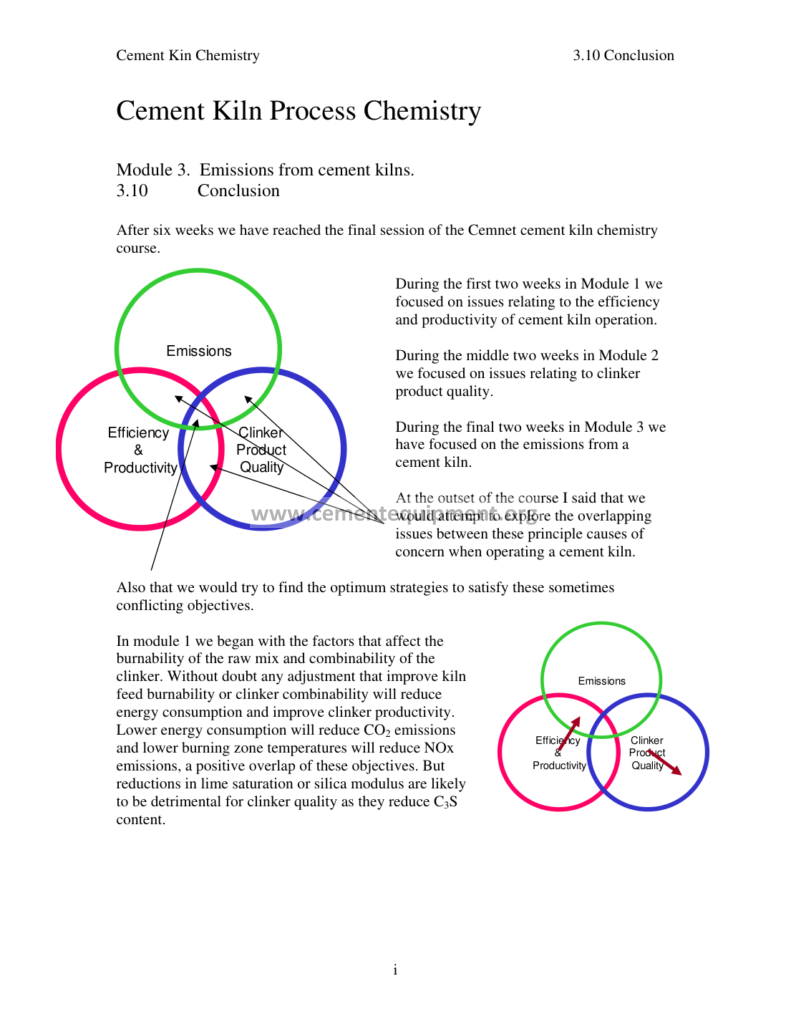
The closing module opens with the whole balance in one view, the picture that the modules 3.1 to 3.9 built piece by piece:
- The gas and the mass scale: the flue gas of the modern kiln runs the order of 1.4 to 1.8 normal cubic meters per kilogram of clinker, carrying the 0.8 to 0.9 tonnes of the carbon dioxide per tonne of clinker, the hundreds of milligrams of the nitrogen oxides, the tens to the hundreds of the sulfur dioxide, the hundreds of the carbon monoxide in the operation, the single digits of the dust behind the modern filters, and the fractions of a milligram of the mercury and the dioxins, the concentration scale that the module 3.1 fixed and that the closing module now quotes as the whole;
- The three input doors: the pollutants entered through the doors that the module 3.1 drew: the raw material door with the carbonate, the pyrite and the trace metals, the fuel door with the nitrogen, the sulfur and the organic content, and the process chemistry door with the thermal NO, the dioxin windows and the reagent ammonia, the three-door ledger that the closing module walks one last time;
- The fate map: every input species met its fate across the course: the carbonate became the process CO2 of the module 3.2, the pyrite sulfur partly captured by the alkalis of the module 3.7, the fuel nitrogen partly absorbed by the meal of the module 3.5, the organic carbon destroyed by the 850 degree window of the module 3.3, and the metals partitioned by the volatility of the module 3.9, the fate map that the conclusion draws as the single diagram of the whole part;
- The stack as the meeting point: the stack gathered the survivors: the process CO2 that no filter touches, the elemental mercury of the vapor pathway, the dioxins that the reformation re-built, the ammonia that the window missed, and the water vapor that the cold weather condenses into the visible plume, the survivors that defined the work of the emission engineer;
- The balance discipline: the whole part was carried by the balance discipline: the sulfur, the alkali, the metal and the carbon ledgers that the modules taught close the inputs against the outputs, and the closing module reaffirms the master lesson: the plant that balances its species understands its emissions, and the plant that only reads its stack understands nothing more than the report;
The assembled balance is the summary view of the course: the gas, the inputs, the fates and the survivors in one frame, and the reader leaves the first section of the conclusion with the whole emission system of the kiln in mind, the frame that the recaps of the following sections will fill with the chemistry and the numbers once more, now at the summary depth.
2. The Carbon and the Energy Chemistry Recap: The CO2 of the Module 3.2
The largest emission recap leads the review, and the module restates the carbon story in the summary form:
- The two sources: the carbon dioxide of the kiln comes from the calcination reaction, the calcium carbonate splitting into the calcium oxide and the CO2 with the 44 over 100 stoichiometry, and from the fuel combustion, the two sources together producing the 0.8 to 0.9 tonnes per tonne of clinker with the process share of the order of 55 to 65 percent;
- The four reduction levers: the module 3.2 taught the ladder: the thermal efficiency of the order of 3.0 to 3.6 gigajoules per tonne, the clinker factor that each 10 points cut by the 8 to 9 percent of the cement emission, the alternative fuels with their biogenic fractions and the substitution rates to the 70 to 90 percent, and the capture families of the post-combustion, the oxyfuel, the direct separation and the looping with the 85 to 95 percent rates;
- The economics remembered: the capture costs of the order of 60 to 120 euros per tonne of the CO2 against the 50 to 100 euro carbon prices of the trading systems, the crossover that the reader carries into the boardroom, and the 2050 roadmap where the capture carries the 40 to 50 percent of the sector’s reduction;
- The ledger practice; the monthly CO2 ledger of the section 12 of the module 3.2, the calcination, the fuel and the electricity lanes with the verified reporting, the practice that the closing module names among the permanent instruments of the plant;
- The carbon as the frame: the carbon story framed the whole part: the kiln’s emission identity is defined by its CO2 before any other pollutant, and the module closes the recap with the reminder that the environmental chemistry of the cement kiln is debated at the tonne scale and regulated at the milligram scale, the two scales that the engineer must hold simultaneously;
The carbon recap restates the largest account of the emission balance: the calcination and the combustion arithmetic, the four levers and the capture economics, and the reader closes the section with the CO2 story at the summary depth, the story that the modules of the whole part have carried from the introduction to the conclusion.
3. The Combustion Chemistry Recap: The CO, the VOC and the Dioxins
The incomplete and the re-formation chemistries join the review, and the module restates the carbon family:
- The CO recap: the carbon monoxide of the module 3.3 is the intermediate of the combustion that the oxygen, the temperature and the time sometimes leave unfinished: the healthy kiln runs the 100 to 500 milligrams per normal cubic meter with the spikes into the thousands at the upsets, the CO doubles as the safety interlock species of the filters and the diagnostic voice of the flame, and the 1.25 milligram per part per million conversion stays in the reader’s hand;
- The VOC recap: the volatile organics of the fuels meet their destruction in the 850 degree, 2 second, 6 percent oxygen window with the 99.9 percent efficiency: the FID and the TOC measurement in the carbon units, the co-incineration limit of the 10 milligrams per normal cubic meter and the normal operation in the single digits, the destruction ledger that the module 3.3 quantified;
- The dioxin recap: the dioxins and the furans of the module 3.4 re-form on the dust surfaces in the 250 to 450 degree windows through the de novo chemistry with its chlorine, its copper and its carbon requirements: the 2-3-2 destruction rule and the quench, the filtration and the activated carbon controls hold the stack below the 0.1 nanogram TEQ limit, the parts-per-trillion chemistry managed by the temperature discipline;
- The shared window logic: the three carbon families share the thermal logic: the hot, oxygenated, well-mixed gas destroys the organics and the dioxins while the cool dust surfaces and the fuel-rich pockets create them, so the combustion and the temperature discipline of the modules 3.3 and 3.4 is one chemistry viewed from the two sides, the shared logic that the closing module draws explicitly;
- The energy connection: the unburned carbon of the CO and the organics is the lost fuel of the kiln, and the module closes the recap with the triple account: the complete combustion serves the emissions, the energy and the carbon ledger at once, the account that the whole course has taught in every module;
The combustion family recap joins the carbon story: the CO, the organics and the dioxins are the three faces of the combustion and the re-formation chemistry, and the reader closes the section with the temperature-window logic of the hot destruction and the cool reformation as the master view of the three pollutants together.
4. The Nitrogen Chemistry Recap: The NOx of the Modules 3.5 and 3.6
The nitrogen story restates its mechanisms and its abatements, and the module walks the recap:
- The formation recap: the NOx forms through the three routes that the module 3.5 taught: the thermal Zeldovich chain that the 1,800 to 2,000 degree kiln flame drives exponentially, the prompt route of the fuel-rich cores and the fuel route of the bound nitrogen, with the kiln exit values in the 400 to 1,200 milligrams per normal cubic meter and the raw meal absorbing a share before the stack;
- The abatement recap: the ladder of the module 3.6 delivers the reductions: the low-NOx burners and the staged calciner with the process-close levers for the free tens of percent, the SNCR with its 850 to 1,050 degree urea and ammonia window and its 40 to 70 percent rates, and the SCR with its 280 to 350 degree vanadium catalysts and its 70 to 95 percent rates, taking the kiln to the 50 to 100 milligram depths;
- The trade-off memory: the oxygen trades the NOx against the CO, the excess reagent trades the reduction against the slip, and the module recaps the two trade-off curves that the NOx engineer rides daily, the curves that the plants hold in their correlation charts;
- The ammonia interface: the ammonia slip of the NOx control is the third regulated species: the 5 to 30 milligram slips of the SNCR and the 5 milligram targets of the SCR manage the blue plume chemistry that the module 3.8 taught, the interface that the closing module keeps in the reader’s mind as the coupling point of the nitrogen and the sulfur chemistries;
- The N2O reminder: the nitrous oxide of the low-temperature zones and the reagent chemistry rides with the NOx story, the small concentrations with the warming factor of the order of 270 times the CO2, the ledger that the carbon-accounting reader of the module 3.2 keeps in the same paragraph;
The nitrogen recap restates the second great story of the part: the three formation routes, the abatement ladder and the trade-offs, the ammonia interface and the N2O side, and the reader closes the section with the nitrogen chemistry of the kiln at the summary depth, able to walk the NOx story from the flame radical to the catalyst honeycomb without opening a single module.
5. The Sulfur and the Visibility Chemistry Recap: The SO2 and the Plumes
The sulfur story and its visible faces join the review, and the module walks the recap:
- The SO2 recap: the sulfur dioxide of the module 3.7 enters with the pyrite and the organic sulfur of the raw meal and the sulfur of the fuels: the pyrite oxidizes in the 300 to 600 degree preheater band where the capture fails, while the kiln-released sulfur meets the alkali and the lime capture of the 70 to 95 percent, so the stack emissions run the 10 to 50 percent of the input with the pyritic plants at the hundreds of milligrams;
- The sulfur toolbox recap: the reduction ladder of the module 3.7 spans the quarry selection and the blending, the sorbent injections with the 40 to 70 percent removals and the wet scrubbers with the 90 to 99 percent, against the 50 milligram European limit with the pyritic derogations and the 4 pound per ton American load value;
- The SO3 recap: the trioxide face of the sulfur chemistry condenses as the sulfuric acid at the dew points of the order of 90 to 140 degrees, driving the corrosion and feeding the aerosols, the face that links the module 3.7 to the plume optics;
- The plume recap: the visible plume of the module 3.8 is the optics of the stack: the white water vapor plume of the winter condensation with its dew point physics, the blue sulfate haze of the SO3 and the ammonia meeting at the sub-micron scale through the Rayleigh scattering, and the grey and the black casts of the dust and the soot events, with the opacity measurement of the 10 to 20 percent and the Method 9 observations;
- The coupling chemistry: the module recaps the coupling that the whole course traced: the ammonia of the module 3.6, the SO3 of the module 3.7 and the moisture of the gas meet into the blue plume of the module 3.8, the three-module coupling that the closing summary draws as the single sentence of the sulfur-nitrogen-visible chemistry;
The sulfur and the visibility recap joins the great stories: the pyrite journey, the capture and the removal ladder, the acid and the corrosion faces and the plume optics of the visible sky, and the reader closes the section with the sulfur chemistry of the kiln at the summary depth, from the quarry grain to the blue haze of the morning.
6. The Trace Metal Chemistry Recap: The Metals, the Mercury and the Thallium
The small concentrations of the module 3.9 join the review, and the module walks the metal recap:
- The volatility map recap: the trace metals of the kiln sort by their volatility: the mercury and the thallium of the volatile class that vaporize and cycle, the cadmium, the lead and the zinc of the semi-volatile class that condense, enrich and recycle with the dust, and the chromium, the nickel and the vanadium of the low-volatility class that leave with the clinker, the map that the module 3.9 drew and the conclusion restates;
- The mercury recap: the elemental mercury vapor defies the filters while the oxidized share condenses and is captured: the cycle in the preheater concentrates and re-vaporizes the mercury, and the promoted activated carbon of the module 3.9 with the 50 to 95 percent removals and the wet scrubbers close the vapor pathway, the 0.05 milligram limit of the mercury governing the story;
- The thallium recap: the thallium volatilizes but condenses earlier than the mercury, enriching the kiln dust by the orders of magnitude, the dust-side volatile element that the handling and the bleed management control, reported in the cadmium-plus-thallium sum of the 0.05 milligram limit;
- The limits recap: the metal limits of the co-incineration frame assemble into the summary: the mercury 0.05, the cadmium plus the thallium 0.05 and the other metals sum 0.5 milligrams per normal cubic meter, the small numbers that the metal balances and the campaigns of the module 3.9 serve;
- The balance recap: the metal management rests on the six-stream balances that close the inputs against the clinker, the dust, the by-products and the stack, and the reader closes the recap with the metal ledger at the summary depth, the ledger that the conclusion will place into the master checklist of the final sections;
The metal recap completes the species review of the module: the volatility classes, the mercury’s elemental escape, the thallium’s dust enrichment and the milligram limits assemble into the single view, and the reader now holds the entire pollutant family of the cement kiln, from the tonne-scale CO2 to the fraction-scale mercury, all at the summary depth that the closing module provides.
7. The Complete Limits Table: The Numbers of the Permits in One View
The regulatory frame assembles into its table, and the module gives the reader the master view:
| Pollutant | Typical permit range of the cement frame | Module of the course |
|---|---|---|
| Dust (particulate matter) | 20 – 30 mg/Nm³ | Module 3.1 frame |
| SO2 | 50 mg/Nm³ (200 – 400 pyritic derogation) | Module 3.7 |
| NOx | 200 – 500 mg/Nm³ (BAT 200 – 450) | Modules 3.5 – 3.6 |
| TOC (organics) | 10 mg/Nm³ (co-incineration) | Module 3.3 |
| Dioxins and furans | 0.1 ng TEQ/Nm³ | Module 3.4 |
| Mercury | 0.05 mg/Nm³ | Module 3.9 |
| Cadmium + thallium | 0.05 mg/Nm³ (sum) | Module 3.9 |
| Other metals (sum) | 0.5 mg/Nm³ | Module 3.9 |
| Ammonia slip | 10 – 30 mg/Nm³ | Module 3.6 |
| Opacity (visible plume) | 10 – 20 % | Module 3.8 |
- The reading discipline: the table is the summary and not the contract: the actual values of every plant live in its own permit, with the reference oxygen of the 10 percent and the dry normal cubic meter conditions of the module 3.1, and the module teaches the reader to read the own permit table against this generic master view;
- The scale structure: the limits descend the scales: the grams of the dust and the SO2 through the milligrams of the NOx, the metals and the ammonia to the nanograms of the dioxins, the structure that the whole course has carried and the conclusion now presents as the single view;
- The American counterpart: the American values of the MACT frame express the dust, the SO2, the HCl and the mercury in the load-based units with the opacity percent and the sub-nanogram dioxin values, the parallel frame that the transatlantic reader converts with the practice of the modules;
- The compliance margins: the well-run plants operate at the fractions of their limits: the dust in the single digits against the 20 and 30, the metals in the hundredths and the dioxins in the hundredths of the nanogram, the margins that the module teaches the plants to demonstrate rather than to test, the demonstration being the campaigns and the trends;
- The trajectory: the table values tighten across the decades: the NOx moves toward the 200, the dust toward the 10 and the dioxins toward the 0.05, and the module closes the limits section with the trajectory note that the reader of the course carries into the planning of the future abatement;
The limits table is the master contract of the emission course: the pollutants, the modules and the numbers in one view, and the reader leaves the section able to quote the complete regulatory frame of the cement kiln from the memory of the course, the master view that the reporting office and the inspector’s visits both reward.
8. The Integrated Abatement Logic: The Shared Windows and the Trade-offs
Beyond the individual pollutants, the course taught the integration, and the module draws the master logic:
- The shared temperature windows: the temperature map of the kiln serves every pollutant at once: the hot gas above 850 degrees destroys the organics and the dioxins and the CO and shapes the NOx, the 250 to 450 band risks the dioxin reformation, the 300 to 600 band releases the pyrite sulfur, and the 90 to 140 degree acid dew point governs the corrosion, so the temperature profile of the plant is the single master instrument of the whole emission balance;
- The oxygen trade frontier: the oxygen of the gas trades the combustion completeness against the NOx and drives the release windows: the low oxygen starves the NOx and the pyrite oxidation while it spawns the CO and the reducing conditions, and the module presents the oxygen as the second master dial that every pollutant read;
- The reagent couplings: the ammonia of the NOx control carries the slip that feeds the blue plume with the SO3, the carbon of the mercury control carries the dust that the recycle discipline must manage, and the lime of the SO2 control adds the dust that the filter carries: every reagent of the course couples forward into the next pollutant, the coupling web that the integrated engineer manages as the single system;
- The balanced operation: the balanced operation of the modern plant is the multi-objective ride: the oxygen, the temperatures, the loads and the reagent doses hold the NOx, the CO, the SO2, the ammonia, the dioxins and the energy on their joint fronts, the ride that the control systems and the operators share, and the module recaps the multi-variable discipline that the individual modules taught by the pollutant and the conclusion assembles by the system;
- The measurement as the integration: the CEMS, the campaigns and the balances report the joint picture: the correlation charts of the modules, the mass and the metal ledgers and the plume cameras assemble the single environmental view of the plant, the view that the conclusion presents as the working instrument of the emission engineer;
The integrated logic gives the course its master chapter: the temperature profile, the oxygen dial, the reagent couplings and the balanced operation assemble the individual chemistries into the system view, and the reader closes the section able to argue every abatement decision against the whole balance, the argument depth that separates the emission engineer from the report reader.
9. The Operator’s Checklist: The Course as the Daily Practice
The course converts into the routines, and the module gives the reader the complete checklist:
- The daily routine: the shift reads the kiln exit O2, the CO, the NOx, the SO2 and the temperatures with the CEMS and the process trends, watches the plume with the trained eye and the cameras, checks the reagent doses and the slip, and logs the combustion events against the emission peaks, the daily loop that the modules 3.3, 3.5, 3.6 and 3.8 taught;
- The weekly cadence: the week runs the analyzer validations, the correlation chart updates, the dust and the raw material sampling and the deposit inspections, the cadence that keeps the measurement chain of the module 3.1 and the dioxin temperature envelope of the module 3.4 current;
- The monthly book: the month closes the ledgers: the CO2 ledger of the module 3.2, the sulfur balance of the module 3.7, the metal balance of the module 3.9 and the NOx and the SO2 summaries against the permit averages, the monthly book that converts the operation into the reported compliance;
- The quarterly campaigns: the quarter runs the reference measurements: the dioxin sampling trains of the module 3.4, the stack metals and the mercury campaigns of the module 3.9, and the opacity and the dispersion reviews of the module 3.8, the campaigns that the permits and the improvement reviews demand;
- The annual review: the year closes with the abatement performance reviews, the permit compliance statistics, the improvement project priorities and the capital plans, the review that places the course’s chemistry into the plant’s future, the annual loop that the closing module presents as the final rung of the checklist ladder;
The checklist converts the course into the calendar: the daily, the weekly, the monthly, the quarterly and the annual routines assemble the emission discipline of the cement plant, and the reader leaves the section with the operating program of the whole part 3 in one hand, the program that the modules taught separately and the conclusion assembles as the working calendar.
10. The Course Arc: From the Raw Meal to the Stack
The conclusion places the emission part inside the whole kiln chemistry course, and the module draws the arc:
- The parts 1 and 2 recap: the course parts 1 and 2 taught the making of the clinker: the raw meal preparation, the burnability, the calcination, the sintering and the clinker phases of the part 1, and the composition, the Bogue chemistry, the alkali and the sulfate cycles and the combustion and the fuel chemistry of the part 2, the chemistry that the emission part 3 now balances on its gas side;
- The two-sided kiln: the arc teaches the double identity of the kiln: the reactor that makes the clinker and the reactor that makes the flue gas, the two outputs of the same flame, the same feed and the same fuel, and the module presents the course arc as the training of the engineer who holds the two ledgers, the product ledger and the emission ledger, on the same desk;
- The chemistry continuities: the arc traces the continuities: the alkali and the sulfate cycles of the part 2 are the capture chemistry of the SO2 of the part 3, the combustion and the fuel modules of the part 2 are the NOx and the CO formation of the part 3, and the chloride cycles of the part 2 are the volatility and the dioxin enablers of the part 3, the continuities that make the course one chemistry;
- The process decisions as the emission decisions: the arc’s operating lesson: every process decision of the parts 1 and 2, the raw mix, the fuel, the temperature, the dust recycle, is an emission decision of the part 3, and the engineer who has taken the whole course makes the two decisions at once, the integrated view that the separate readings never provide;
- The complete engineer: the module closes the arc with the portrait of the complete engineer: the reader who has walked the parts 1 to 3 reads the kiln as the single reactor with the two ledgers, praises the clinker and the plume with the same knowledge, and runs the plant with the product and the permit jointly in the mind, the portrait that the conclusion names as the goal of the course;
The course arc gives the conclusion its place in the curriculum: the emission part is the gas-side completion of the kiln chemistry that the parts 1 and 2 taught on the solid side, and the reader leaves the section with the whole arc in view, the arc that turns the three parts into the one course on the chemistry of the cement kiln and its two outputs.
11. The Future Direction: The Decarbonizing, Tightening Kiln
The conclusion closes the review with the forward view, the trajectory that the reader will live in:
- The tightening curve: the emission limits of the table of the section 7 tighten across the decades: the dust, the NOx and the metals values descend, the BAT ranges narrow, and the plants plan their abatement against the trajectory that the modules have taught them to read, the planning horizon that the closing module draws for the capital decisions;
- The decarbonization horizon: the carbon story of the module 3.2 dominates the future: the capture projects, the oxyfuel and the electrified calciners enter the plant designs, and the emission hall of the future kiln adds the CO2 compression and the storage interfaces to the dust, the NOx, the sulfur and the mercury systems of the course, the horizon that the reader of the module 3.10 enters with the carbon ledger in hand;
- The monitoring evolution: the measurement chain evolves with the tightening: the continuous mercury and the dioxin-capable systems, the remote sensing and the drone plume observations, and the integrated data platforms that merge the CEMS, the balances and the cameras, the evolution that the modules 3.1 to 3.9 taught the reader to follow;
- The fuel and the material transitions: the alternative fuels, the hydrogen and the electrified heating change the fuel door of the module 3.1: the biogenic shares rise, the nitrogen and the sulfur profiles shift and the cycle chemistries respond, the transitions that the reader of the course is prepared to re-balance with the same ledgers;
- The knowledge as the constant: the module closes the future section with the constant: the chemistry of the course does not change with the technology, the calcination ratio, the Zeldovich temperature law, the de novo window and the volatility classes persist under every new hardware, so the reader who owns the chemistry owns the future operations, the closing thought that the conclusion leaves with the reader;
The future direction completes the course: the tightening limits, the decarbonization projects and the fuel transitions arrive on the same chemical foundations that the parts 1 to 3 have taught, and the reader leaves the module 3.10 with the confidence that the chemistry does not date, the confidence that makes the course a working instrument for the decades of the kilns that follow.
12. The Final Summary: The Emission Course in Ten Sentences
The module ends the teaching with the ten-sentence summary, the master statement of the whole part:
- The balance: the cement kiln makes the clinker and the flue gas together, and the gas carries the CO2 of the calcination and the combustion, the NOx of the three routes, the SO2 of the pyrite and the fuel, the CO, the organics and the dioxins of the imperfect and the re-forming chemistries, the dust and the metals of the partitioned inputs and the ammonia of the reagents;
- The carbon: the calcination fixes the half-tonne process CO2 that no filter touches, and the reduction walks the efficiency, the clinker factor, the fuels and the capture ladder;
- The combustion: the 850 degree, 2 second, 6 percent oxygen window destroys the organics and the dioxins while the cool dust re-forms them, so the temperature profile is the master instrument;
- The nitrogen: the flame temperature drives the NOx exponentially, the raw meal absorbs a share, and the SNCR window and the SCR catalyst close the rest with the ammonia slip as the balance;
- The sulfur: the pyrite releases where the capture fails and the alkali and the lime capture where the gas is hot, and the sorbents and the scrubbers serve the rest;
- The visibility: the white plume is the water of the winter, the blue the sulfate and the ammonia, and the opacity measures the light, not the mass;
- The metals: the volatility classes decide the fates, the mercury’s elemental form escapes the filters, and the carbon and the scrubbers and the bleeds manage the milligrams;
- The measurement: the CEMS, the campaigns and the balances are the evidence culture, and the ledgers are the living instruments of the plant;
- The integration: the temperature, the oxygen and the reagents couple every pollutant to every other, and the balanced operation rides the joint frontiers;
- The future: the chemistry dates not, the limits tighten and the decarbonization arrives, and the engineer who owns the chemistry owns the kiln’s tomorrow;
The ten-sentence summary is the capsule of the course: the balance, the chemistry and the discipline of the whole part 3 in one view, and the reader closes the module 3.10 with the complete statement of the emissions and the environmental chemistry of the cement kiln, the statement that the course taught in the ten modules and the conclusion now leaves in ten sentences.
The Frequently Asked Questions
What is the most important emission of the cement kiln and why?
By the mass, the carbon dioxide: the 0.8 to 0.9 tonnes per tonne of clinker from the calcination and the combustion, the emission that dominates the climate debate and the future of the industry, while by the regulatory intensity the small concentrations of the mercury and the dioxins carry the tightest limits of the 0.05 milligrams and the 0.1 nanograms, so the importance of the emissions varies with the scale and the frame that the question is asked in.
Which single operating discipline serves the most pollutants at once?
The temperature and the oxygen discipline of the stable, well-mixed, complete combustion: the hot gas above 850 degrees destroys the organics and the dioxins, the controlled oxygen balances the NOx against the CO, the stable feed removes the spikes, and the clean cool paths hold the reformation and the condensation at bay, so the combustion discipline that the modules 3.3 to 3.7 taught is the master instrument of the whole balance.
How are the emission limits of the cement kiln organized?
By the pollutant with the reference conditions of the dry gas and the 10 percent oxygen: the dust at the 20 to 30 milligrams, the SO2 at the 50 with the pyritic derogations, the NOx in the 200 to 500, the TOC at the 10, the dioxins at the 0.1 nanograms, the mercury and the cadmium-plus-thallium at the 0.05, the metals sum at the 0.5 and the ammonia in the 10 to 30 milligrams per normal cubic meter, with every plant’s exact values in its own permit.
Why does the conclusion of the course emphasize the balances over the measurements?
Because the balances predict and the measurements only report: the sulfur, the alkali, the metal, the carbon and the water ledgers close the inputs against the outputs and forecast the emission response of every raw material and fuel change, so the balanced plant anticipates its emissions and the report-reading plant only discovers them, the difference that the whole course has taught between the chemistry and the filing.
What should the newly appointed emission engineer of a cement plant do first?
Build the ledgers and read the permit: the sulfur, the alkali, the metal and the CO2 balances of the plant with the process and the CEMS data, the own permit table with the limits and the reference conditions, and the correlation charts of the NOx, the CO, the SO2 and the temperatures, the instruments that the course has taught and the conclusion lists as the first three steps of the new engineer’s first quarter.
Will the emission chemistry of the course change with the new technologies?
The hardware will change and the chemistry will not: the oxyfuel and the electrified kilns keep the calcination stoichiometry, the SNCR and the SCR keep their windows, the de novo synthesis keeps its temperature band and the volatility classes keep their logic, so the engineer who owns the chemistry of the course owns the future operations under every new technology.
The module 3.10 has closed the emission part of the kiln chemistry course with the complete review: the assembled emission balance, the chemistry recap of every pollutant from the CO2 through the dioxins to the metals, the complete limits table, the integrated abatement logic of the shared windows and the trade-offs, the operator’s checklist of the daily and the quarterly routines, the course arc from the raw meal to the stack, and the future direction of the decarbonizing kiln, and the reader leaves with the emissions and the environmental chemistry of the cement kiln assembled into one working knowledge, the balance, the mechanisms and the numbers all in hand.
The Complete Cement Technical Package includes this course with the emission calculation sheets, the monitoring plans and the checklists: the one-time 249.99: the instant download: the conclusion of the course part 3 closes the full kiln chemistry curriculum of the package, and the reader now holds the emission balance of the cement kiln as the working instrument that the control room, the quality laboratory and the reporting office share, the instrument that the modules 3.1 to 3.9 built and the module 3.10 has assembled.
The module closes with the master statement of the part: the cement kiln makes its clinker and its flue gas with the same chemistry, the calcination and the combustion write the carbon, the flame and the windows write the nitrogen and the sulfur and the organics, the dust and the volatility write the metals, and the measurement and the balance write the truth, so the emission engineer of the module 3.10 reads the kiln as the single reactor with the two ledgers, and runs it with the product and the permit in the same view.
The reading plan for the engineer: keep the ten-sentence summary of the section 12 on the desk, run the checklist of the section 9 through the calendar, and return to the individual modules whenever the inputs, the fuels or the permits change, because the emission balance of the module 3.10 is the living instrument that the whole course has taught the reader to build, to read and to re-balance with every season of the plant.
Get this kiln chemistry file + the full 931-file package
$249.99 — one-time purchase, instant download, lifetime access
This file is part of the Complete Cement Technical Package (931 files) available from cementequipment.org. Respective rights holders; library copy for the licensed single user.