Bag Filters for Cement Plants: Complete Guide
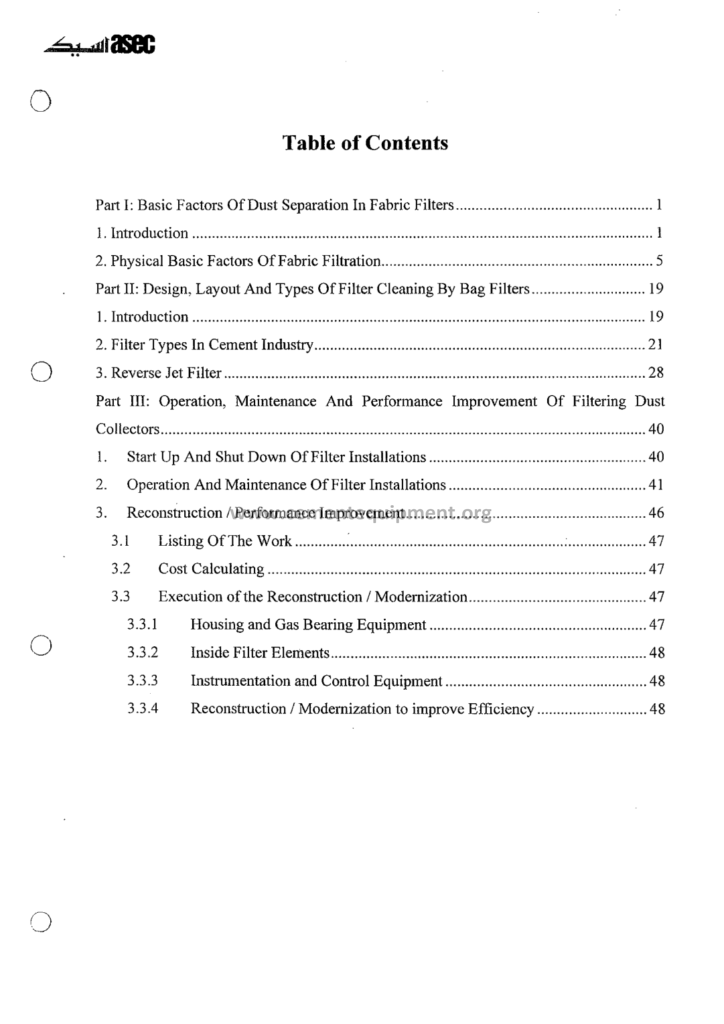
The bag filter guide is the dedusting manual of the cement industry: the file that explains how the baghouse collects the dust of the kiln gas, the raw mill, the cement mill, the cooler and the silo vents: the bag filter is the final guard of the plant’s emissions and the largest energy consumer of the gas train after the main fan: the modern cement plant without the bag filters is unthinkable under the emission limits of the 10-30 mg/Nm3: this guide is the complete course of the fabric filtration: the principles, the filter types, the bag fabrics, the sizing calculations and the operating discipline.
The Complete Cement Technical Package (931 files including the books, the courses, the Excel tools and the presentations: $249.99 one-time: instant download via the PayPal payment) includes the bag filter guide with its design tables, the fabric comparison sheets, the pressure drop models and the maintenance schedules: this article walks the file: how the bag filter collects the dust, how the pulse-jet and the reverse-air machines differ, how the fabrics are chosen for the temperature and the chemistry, and how the filter is operated at the minimum pressure drop: the reader finishes with the complete picture of the plant’s dust collection from the weighing hoppers to the stack.
Fabric filtration works on a paradox the guide explains in its first pages: the bag itself is not the filter: the dust cake deposited on the bag is the filter: the cake of the collected dust sieves the incoming gas while the bag fabric is only the mechanical substrate: this understanding decides everything that follows: the cleaning intensity, the bag life, the emission outlet and the pressure drop: the guide builds the whole body of the file on this single principle, and this article follows the same architecture.
1. The Dedusting Network of the Cement Plant: Where the Filters Live
The bag filter network of a dry process cement plant covers every dusty process, and the guide maps the fleet before it teaches the parts:
- The kiln gas filter: the largest filter of the line: handles the tower exit gas at 290-330°C plus the raw mill gas in the combined arrangement: the gas volume of 1.0-2.0 Nm3 per kilogram of clinker and the dust load of 30-100 g/Nm3: the filter that guards the main stack;
- The raw mill filter: often shared with the kiln in the combined grinding-drying circuit: the gas at 90-120°C with the high moisture of the drying: the mill evaporation puts the dew point close to the operating temperature, and the condensation protection dominates the design;
- The cement mill filters: the finish grinding dedusting at 80-110°C with the finely ground cement dust: the air volume per ton of cement is the key economy because the mill ventilation is paid in the fan kilowatts;
- The cooler filter: the vented cooler air at 120-250°C: the fine clinker dust with the abrasive character: the filter of the cooler vent completes the gas balance of the grate;
- The product and the raw material silo filters: the small cartridge and the bag filters on every silo vent and every conveying point: the dozens of small units that keep the plant clean internally and externally;
The mapping chapter assigns each filter its purpose in the mass balance: the collected dust returns to the process in most cases, the kiln filter dust back to the raw meal, the cooler filter dust to the clinker transport: the filter is a material-handling unit before it is an environmental unit, a fact the design practice of the guide respects: the dust return systems are designed with the same care as the filter itself.
2. The Principle of the Fabric Filtration: The Dust Cake and the Collection Mechanisms
The physics of the bag filter is the physics of the dust cake, and the guide teaches the mechanisms of the collection:
- The sieving: the mechanical retention of the particles larger than the cake pores: the dominant mechanism once the cake is built: the cake pores of 5-20 micrometers capture the particles above the pore size;
- The inertial impaction: the particles crossing the gas streamlines hit the filter fibers: the collection of the coarse particles of 1-10 micrometers: the dominant mechanism at the medium velocities;
- The interception: the particles following the streamline touch the fiber as the streamline passes within one particle radius: the collection of the particles of 0.1-1 micrometer;
- The diffusion: the submicrometer particles of 0.01-0.1 micrometers wander by the Brownian motion onto the fibers: the mechanism that collects the finest dust, and the reason the bag filters excel at the fine cement dust where the cyclones fail;
- The electrostatic attraction: the charge differences between the particles and the fabric assist the collection in the synthetic fabrics: the secondary mechanism that the conductive fabrics exploit;
The mechanisms combine into the collection efficiency that makes the bag filter the standard for the emission limits: the outlet dust below 5-20 mg/Nm3 across the process conditions, with the collection efficiency of 99.9% and more on the mass basis: the guide explains that the efficiency rises after the first minutes of the cake formation, and that the freshly cleaned bag is the weakest moment of the cycle: the emission peaks at the cleaning pulse are a measurable phenomenon the guide quantifies.
3. The Bag Filter Types: The Pulse-Jet, the Reverse-Air and the Cartridge Filters
The three generations of the fabric filters serve the cement plants, and the guide presents them with their application areas:
- The pulse-jet filter: the dominant type of the modern plants: the bags are supported by the wire cages, and the high-pressure air pulse of 4-7 bar is injected from the top through the venturi into the bag, creating the shock wave that flexes the fabric and dislodges the cake: the cleaning happens in 0.1-0.3 seconds per bag or row: the air-to-cloth ratio of 1.0-1.5 m3/m2/min, the continuous operation, and the compact footprint: the workhorse of the kiln, the mill and the cooler applications;
- The reverse-air filter: the older robust design of the big kiln filters: the gas flow is periodically reversed through the bag with the low-pressure air or the gas, collapsing the bag and cracking the cake: the gentle cleaning suits the woven fabrics, the air-to-cloth ratio of 0.6-1.0 m3/m2/min, and the larger footprint: the type of the installed bases of the 1980s and the 1990s lines, still maintained and studied in the guide;
- The shaker filter: the mechanical shaking of the bags at the top: the simple and the robust machine of the small applications and the older mills: the intermittent operation and the moderate air-to-cloth ratios;
- The cartridge filter: the pleated cartridge elements with the high filter area per volume: the compact units of the silo vents, the conveying points and the workshops: the cartridges tolerate the lower temperatures and the lighter dust loads;
The comparison table of the guide puts the types side by side: the cleaning energy, the bag life, the footprint, the pressure drop and the maintenance: the selection logic of the file takes the process conditions first, the space second and the energy cost third: the pulse-jet wins the modern installations almost everywhere, while the reverse-air machines live out their long lives in the existing plants.
4. The Bag Fabrics: The Fiber Families and Their Limits
The fabric is the heart of the filter, and the fiber choice is the first engineering decision of the design: the guide covers the fibers of the cement industry with their temperature and chemistry limits:
| Fiber | Max continuous temperature | Resistance | Typical cement application |
|---|---|---|---|
| Polyester (PET) felt | 130-150°C | Good acids, poor hydrolysis at high moisture | Cement mills, silos, low-moisture points |
| Acrylic felt | 125-140°C | Excellent hydrolysis resistance | Raw mill and kiln combined circuits with moisture |
| Polyphenylene sulfide (PPS) | 180-190°C | Good acids and hydrolysis | Coal mill filtration and medium-temperature kiln points |
| Polyimide (P84) | 240-260°C | Exceptional fine-dust capture, needs alkaline care | Kiln and cooler filters with fine submicron dust |
| PTFE (Teflon) felt and membranes | 250-260°C | Inert to nearly all chemistry | Demanding kiln filters and high-alkali applications |
| Glass fiber with PTFE finish | 230-260°C | Good temperature, sensitive to abrasion | Large reverse-air kiln filters of the older lines |
- The felt versus the woven: the needle felts with their 500-700 g/m2 basis weight give the higher collection efficiency and dominate the pulse-jet machines; the woven fabrics with the lower permeability suit the reverse-air gentle cleaning;
- The membranes: the ePTFE membrane laminated on the felt surface: the membrane pores of 0.2-0.5 micrometers collect the dust at the surface, the cake releases easily, and the pressure drop stays low: the membrane bags double the bag life in the sticky applications at the premium price;
- The acid dew point: the alkali and the sulfur chlorides of the kiln gas condense below 180-220°C: the fabric must survive the condensate periods and the filter is protected by the operating temperature margin above the dew point, typically 20-30°C:
The fabric chapter closes with the failure modes: the hydrolysis of the polyester in the moist warm gas, the acid attack of the glass fibers, the abrasion at the bag bottom from the dust inlet, the spark and the ember damage of the bag: each failure has its physical signature, and the guide’s photographs and the inspection sheets teach the identification.
5. The Sizing of the Bag Filter: The Air-to-Cloth Ratio and the Dimensions
The filter sizing is an arithmetic of volumes and areas, and the guide walks the calculation with the industrial values:
- The air-to-cloth ratio: the gas flow per unit of the filter area: the gross ratio of 1.0-1.5 m3/m2/min for the pulse-jet filters of the cement plants, reduced to 0.8-1.2 when the dust is fine and sticky: the net ratio accounts for the off-line cleaning: the ratio is the master design variable, balancing the footprint against the pressure drop and the bag life;
- The gas volume: the design gas flow at the filter working temperature: the kiln filter handles 1.0-2.0 Nm3/kg clinker from the tower and the mill: a 5000-tpd line with the raw mill shows the filter inlet volumes near 600,000-900,000 Nm3/h: the volume is corrected for the moisture and the temperature with the ideal gas laws;
- The filter area: the volume divided by the ratio: the 5000-tpd kiln filter area of 10,000-15,000 m2: the number of the bags from the area and the bag dimensions: the standard bags of 130-160 millimeters in diameter and 3-6 meters in length: the casing columns and the hoppers layout;
- The gas velocity inside the casing: the can velocity (the gas flow divided by the filter cross-section) kept below 1.0-1.5 m/s to protect the bag bottoms from the erosion and to allow the dust settling: the inter-bag velocities that set the bag spacing;
- The hopper design: the four-sided pyramidal hoppers with the slope of 60-70 degrees from the horizontal for the cement dust flow: the hopper discharge with the rotary valves and the aeration to keep the dust moving;
The sizing chapter includes the worked examples for the kiln, the mill and the cooler filters with the step-by-step worksheets: the reader takes his own gas volumes from the process balance and computes the filter dimensions: the guide’s Excel complements the calculation with the automatic area and the bag counting.
6. The Pressure Drop: The Physics of the Filter Resistance
The pressure drop is the operating currency of the bag filter: its electricity is paid in the fan power, and its management is the daily art of the filter operator:
- The components: the pressure drop across the residual cake, across the fabric and across the cleaned cake after the pulse: the measured operating drop of the cement filters runs 800-1800 Pa (8-18 mbar) at the design flow: the drop is the sum of the irreversible fabric resistance and the growing cake resistance;
- The cake growth: between the cleaning pulses the cake grows and the drop rises: the pulse is triggered by the differential pressure setpoint (typically 1000-1500 Pa) or by the timer: the cleaning efficiency determines the residual drop after each pulse;
- The flow dependence: the drop grows with the square of the gas flow through the cake: the oversizing of the filter by 20% halves the pressure drop cost in the operating years: the guide’s lifecycle economics compare the filter capex against the fan kWh over 10 years;
- The abnormal drops: the plugging by the condensation and the moisture, the irreversible cake from the oil mist and the lime, the bag blinding by the fine dust: each cause has its signature: the rising drop with the normal timer, the drop rising with the emission rising, the drop falling with the bag breakage:
The pressure drop values of the filter states are summarized below, with the response the operator takes:
| Filter state | Typical drop (Pa) | Signature | Operator response |
|---|---|---|---|
| Clean new bags | 400-700 | Low drop, slowly rising as the cake builds | Normal start, monitor the cleaning cycles |
| Normal operation | 800-1500 | Stable cycles between the pulses | Pulse control on the differential pressure |
| Approaching the trip band | 1600-2000 | Drop rising despite the pulse | Increase the pulse frequency, check the valves and the air supply |
| Condensation plugging | Above 2000 | Fast rise with the moisture alarm, sticky cake | Stop the feed, preheat the filter, dry the gas path |
| Bag breakage / filter flooding | Drop falls, emission rises | Pressure falls while the outlet dust climbs | Compartment isolation, bag replacement campaign |
The pressure drop chapter closes with the economics: the fan power of a kiln filter at 1200 Pa and 700,000 Nm3/h is about 300-400 kW, and every 100 Pa saved is a visible annual electricity reduction: the guide teaches the filter to run at the minimum stable drop: the optimizer’s filter, profitable in the operation, not only in the compliance.
7. The Cleaning Systems: The Pulse Decks, the Valves and the Controllers
The cleaning machinery is the most maintained part of the filter, and the guide details the pulse-jet cleaning system component by component:
- The pulse valves: the diaphragm valves of 25-50 millimeters that release the compressed air into the blow pipes: the valves cycle millions of times in a filter life: the valve quality and the air quality (dry, filtered, oil-free) decide the valve life: the guide’s maintenance tables give the valve overhaul intervals;
- The blow pipes and the venturis: the pipe over each bag row with the nozzles aligned with the bag mouths: the venturi at the bag top accelerates the pulse and draws the secondary air into the bag: the pulse energy per bag of 0.05-0.15 Nm3 of air:
- The compressed air systems: the screw compressors at 5-7 bar with the refrigerated dryers to the dew point below 3-5°C: the air receivers sized for the pulse volumes: the air consumption of the cleaning is 1-3% of the filter gas flow in the energy terms, a small but real operating cost;
- The controller strategies: the timer cleaning at the fixed intervals, the demand cleaning on the differential pressure, the off-line cleaning with the compartment isolation: the modern controllers combine the modes and protect the bags from the over-cleaning: the guide’s control philosophy: clean the least that keeps the drop stable, because each pulse shortens the bag life slightly;
- The cleaning sequence: the rows pulsed in the sequence that never empties the whole filter at once: the row isolation valves of the off-line systems: the smoke test and the visual checks of the pulse action;
The cleaning chapter is the maintenance heart of the file: the filter that pulses correctly holds its drop at 1200 Pa and its emission at 10 mg/Nm3; the filter with the dead valves drifts to the blinding and the early bag replacement: the guide’s troubleshooting section diagnoses the pulse system from the pressure record alone.
8. The Bag Installation, the Sealing and the Bag Life
The quality of the bag installation decides the filter’s emission record and the bag’s survival, and the guide treats the installation as an engineering discipline:
- The bag and the cage: the felt bag fabricated with the top ferrule and the bottom cap, the stainless or the galvanized cage dimensioned to the bag inside diameter: the fitting tolerances of the bag to the tube sheet, the grommet and the clamp sealing: the leaks at the tube sheet are the invisible emission path that the visible stack never shows;
- The pre-coating: the new bags and the new filters are pre-coated with the limestone or the diatomite dust to protect the fabric from the oily and the moist gas during the startup: the pre-coat period of 1-3 hours and the operating rule that the filter never starts on the wet raw gas:
- The bag life: the typical cement plant bag life of 2-4 years, driven by the temperature excursions, the moisture events and the cleaning intensity: the membrane bags of 4-6 years in the stable applications: the bag life statistics of the guide are compiled from the long operating records, identified as the industry range rather than any single vendor’s claim;
- The bag change campaign: the replacement of the complete bag set at the filter overhaul: the outlet emission test before and after, the compartment by compartment replacement during the operation: the guide’s campaign planning covers the logistics, the storage and the disposal of the spent bags;
- The on-line leak detection: the bag failure can be found without opening the filter: the dust monitors at the filter outlet respond instantly to the broken bag, and the compartment isolation sequences hunt the failed compartment: the acoustic instruments and the manual probe tests complete the toolbox;
The bag life chapter is the economics of the filter: at 10-20 USD per square meter of the bag area, a 12,000 m2 kiln filter holds a bag inventory worth the attention: the guide’s life-extension practices (the pre-coat, the stable temperature, the demand cleaning, the gentle pulse) routinely add a year of bag life, and the payback arithmetic is worked out in the file.
9. The Special Operations: The Startup, the Shutdown and the Emergencies
The bag filter is at its most vulnerable at the line transitions, and the guide devotes a full chapter to the transient operations:
- The startup: the filter must be preheated before the dusty gas arrives: the kiln startup sequence warms the filter to 20-30°C above the dew point with the kiln bypass to the atmosphere: the filter that faces the cold moist gas is blinded in its first hours: the startup protocol of the guide is explicit, step by step;
- The shutdown: the filter must be emptied of the cake before the stop, or the cake hardens in the hoppers during the cooldown: the cleaning cycles before the stop, the hopper discharge to empty, the damper closure:
- The dew point excursions: the kiln trips and the raw mill outages drop the gas temperature into the condensation zone: the emergency measures: the cold-air bypass and the spray cooling to the silica gel, the hot gas injection: the guide’s protection matrix matches the emergency type to the response;
- The fire and the explosion protection: the CO and the spark detection, the explosion venting and the isolation flaps, the fire suppression with the nitrogen and the steam: the kiln filter afterburning events are rare but documented, and the guide’s risk chapter is the safety reference of the filter operation;
- The bag fire behavior: the ember quench zones at the filter inlet and the spark shield in the duct: the firewatch during the alternative fuel operation: the emergency shutdown sequence that saves the bag stock;
The transient chapter is what separates the filter operator from the filter bystander: the steady state runs itself, but the startups and the emergencies are where the filters die young: the guide takes the reader through the critical hours of the filter life with the checklists and the decision trees.
10. The Filter Instrumentation and the Control: The Measurements of the Filter
The modern bag filter is instrumented like a small process unit, and the guide lists the measurements and their purposes:
- The differential pressure: the primary filter instrument: across the filter at the inlet and the outlet: the compact and the Rosemount-style transmitters with the ranges of 0-3000 Pa: the record that drives the cleaning control and the diagnosis;
- The inlet and the outlet temperatures: the thermocouples and the RTDs with the alarm at the fabric limits: the temperature record is the filter’s health diary, and its analysis after every kiln trip is the guide’s recommended routine: the excursions above the fabric limit shorten the bag life measurably, and the guide gives the damage correlation;
- The emission monitors: the triboelectric and the light-scattering dust monitors at the outlet: the continuous mg/Nm3 reading that catches the bag failures instantly: the opacity monitors of the older installations: the monitor calibration with the reference filter tests and the correlation curves;
- The pressure and the flow of the compressed air: the pulse air pressure at the header, the flow to the decks: the air quality monitors (the dew point of the instrument air) are the early warning of the valve corrosion;
- The hopper levels: the level switches and the load cells on the hoppers: the plugged hopper is a time bomb of the filter operation, and its empty check is part of every round: the rotary valve current monitoring catches the bridging;
The instrumentation chapter closes with the data philosophy: the filter data logged against the process events reveal the cause-effect chains: the pressure rise after the raw mill start, the emission spike after the kiln fuel change: the analysis habit of the guide turns the filter data into the predictive maintenance of the whole gas train.
11. The Filter Economics: The Capital, the Energy and the Bag Costs
The guide closes its technical body with the money view of the bag filtration, the view the project engineers present to the board:
- The capital cost: the bag filter of the kiln line costs in the range of the large mechanical equipment: the cost drivers are the filter area, the fabric grade, the casing material and the instrumentation: the guide’s cost model estimates the budget from the area and the fabric, calibrated on the recent project data of the industry:
- The operating costs: the fan energy (the largest), the compressed air, the bag replacement annuity and the maintenance labor: the operating cost per year of the kiln filter runs a meaningful fraction of the capital, spread over 10-15 years of service: the guide’s lifecycle table shows where the money goes;
- The trade-offs: the oversizing the filter by 10-20% buys the lower pressure drop and the longer bag life, and the guide’s net-present-value comparisons are explicit: the cheapest filter is rarely the cheapest installation over the life;
- The bag filter versus the ESP: the bag filter costs less upfront in the modern designs and achieves the lower outlet dust, while the ESP offers the higher temperature tolerance and the lower pressure drop at the higher capital: the decision matrix of the guide weighs the dust resistivity, the availability of the space and the emission target: the trend of the last decades is the bag filter, and the guide documents the logic;
The economics chapter belongs to the file because the filter is a business decision: the emission limits force the capex, but the operation decides the annual cost for the next fifteen years: the guide’s message: design the filter for the low pressure drop and the long bag life, and the filter repays the discipline in the electricity bill and the bag stock.
12. The Combined Kiln and Raw Mill Filter Circuits and the Filter Arrangements
The gas circuit of the raw grinding is the special arrangement of the cement plant, and its filter is shared, switched and operated with the disciplines the guide devotes a whole chapter to:
- The combined kiln and raw mill circuit: the tower exit gas passes through the raw mill during the grinding operation, so the single filter treats the mixed gas: during the mill operation the gas leaves the tower at 290-330°C, enters the mill at the adjusted temperature of 200-300°C, picks up the moisture of the drying, and reaches the filter at 90-120°C; during the mill stops the filter receives the full tower gas at 290-330°C: the filter must be sized and the fabric chosen for both regimes, and the guide’s sizing example shows exactly this dual point;
- The mill-off operation: when the raw mill stops, the hot kiln gas by-passes the mill to the filter: the by-pass ducts, the dampers and the mixing boxes maintain the filter inlet temperature: the operating rule that the filter never sees the sudden temperature change without the mixing: the guide’s by-pass design and the control logic are documented with the damper positions;
- The temperature management: the cold gas at the mill operation restricts the filter to the low-temperature fabrics (polyester or acrylic), while the mill-off gas demands the higher temperature tolerance: the compromise fabrics of 180-200°C classes (the PPS, the blends) serve the combined circuits, and the guide compares the options with the bag life arithmetic;
- The separate circuits: the alternative arrangement of the dedicated kiln filter and the dedicated raw mill filter: the flexibility of the operation, the larger footprint and the higher cost: the guide’s decision matrix places the combined and the separate configurations against the line size, the mill availability and the fuel sulfur;
- The water spray towers: the kiln gas conditioning before the ESP of the older lines: the evaporative cooling to 150-180°C that lowers the dust resistivity, and its replacement by the bag filters in the modernizations: the guide covers the transition projects with the case structure: what the plant gains in the outlet dust and the flexibility, and what it pays in the fan power;
The combined circuit chapter is the integration lesson of the file: the filter is not an island at the end of the duct but a partner of the mill and the kiln schedules, and the integration thinking saves the bag stock and the energy: the same integration philosophy returns in the filter audits of the final chapters: the plant sees its filters as process units, and the process units as citizens of the gas balance.
The filter of the plant is not left to chance either: the audit practice turns the filter condition into the measured evidence, the language the management and the authorities share:
- The stack testing campaign: the isokinetic sampling at the filter outlet per the standard reference methods: the dust load in mg/Nm3, the grain loading and the emission rate in kg/h: the test grid, the sample trains and the gravimetric evaluation: the outlet test is the legal evidence of the filter performance, and the guide prepares the reader to witness it correctly;
- The compartment testing: the outlet measurement per compartment identifies the weak compartments before the full stack test: the manual probe traverses with the portable monitors: the compartment ranking of the guide’s audit report form turns the filter data into the maintenance plan;
- The bag sampling and the inspection: the representative bag extraction during the inspections: the visual grading of the fabric condition, the residual cake, the abrasion and the chemical attack: the bag samples archived with the photographs: the annual bag inspection report is the base of the replacement forecast;
- The pressure drop and the gas flow audit: the flow traverses at the filter inlet and the outlet: the actual air-to-cloth ratio against the design, the false air of the casing and the ducting quantified with the O2 and the flow profiles: the audit closes the filter’s own material balance and restores the design intent;
- The audit report and the action plan: the findings, the priorities and the economics: the bag change timing, the valve replacements, the damper repairs: the guide’s report template gives the file the structure the plant managers expect: the findings table, the root causes and the recommendations with the paybacks;
The audit chapter is the maturity test of the filter engineer: the plants that audit their filters on the schedule run them at the design performance for decades, and the plants that never audit discover the degradation in the emission exceedance report: the guide’s closing argument is the professional one: the measured filter is the managed filter, and the managed filter is the quiet, profitable part of the plant’s environmental system.
The performance records of the audited filter accumulate into the plant’s environmental history: the year-on-year tables of the outlet loads, the bag life statistics and the energy consumption per ton of clinker: the history is the evidence the permit renewal demands and the benchmark that the plant’s own improvement targets use: the guide recommends the annual summary report that consolidates the filter data of the whole fleet, kiln, mill, cooler and silo alike, into one performance ledger: the ledger turns every filter of the plant into a measured, compared and continuously improved unit: this is the audit habit matured into the management system, and the concluding pages of the file describe exactly how that ledger is built and kept, with the formats and the review cadence the reader can adopt in his own plant tomorrow.
13. The Frequently Asked Questions
Why is the outlet dust higher right after the cleaning pulse?
During the pulse, the bag flexes and the dust cake detaches; the filtered gas briefly carries the dislodged fines to the outlet, visible as the short emission peak of 10-50 mg/Nm3 that decays within minutes as the new cake forms: the off-line cleaning (isolating the compartment during the pulse) eliminates the peaks at the cost of the extra filter area: this is the standard trade-off the sizing chapter of the guide quantifies.
What is the maximum temperature a polyester bag can tolerate?
Polyester is rated for the continuous operation up to 130-150°C, with the excursions to 160-170°C tolerated only for the short periods: above that the fabric loses strength and the hydrolysis accelerates, especially with the moisture: the cement mill filters at 80-110°C are safe polyester territory, while the kiln filters need the P84, the PPS or the PTFE fabrics and the temperature monitoring.
Why does the filter pressure drop keep rising even though the pulses are working?
The rising drop with the normal cleaning indicates the irreversible cake build-up: the causes are the condensation (the dew point excursions that bind the cake), the oil mists, the over-fine dust penetrating the felt and the weakened pulses: the diagnosis starts with the temperature record and the compressed air pressure: the fixes range from the demand-cleaning tuning to the off-line cleaning periods that remove the residual cake: the guide’s troubleshooting chapter walks the sequence.
How long does a bag filter campaign last between the bag changes?
The typical bag life in the cement service is 2-4 years, with the membrane bags reaching 4-6 years in the stable temperature applications: the campaign is ended by the bag failure statistics, the rising emission or the falling pressure drop performance: the guide recommends the annual inspection of the sample bags and the trend-based replacement planning, so the bag change campaign happens on the schedule, not in the emergency.
What is the difference between the net and the gross air-to-cloth ratio?
The gross ratio divides the gas flow by the total filter area, the net ratio divides by the area available at the moment of the cleaning when the compartments are isolated: the off-line cleaning filters are sized on the net ratio with the margin (1.0-1.3 m3/m2/min typical), while the on-line cleaning machines operate at the gross ratio: the distinction matters in the sizing arithmetic, and mixing the two is a classic design error the guide warns against.
14. Conclusion
The bag filter guide is the complete manual of the fabric filtration in the cement plant: the collection physics, the machine types, the bag fabrics, the sizing arithmetic, the pressure drop economy, the cleaning machinery, the transient operations and the campaign management: the engineer who studies the file can size a new kiln filter, audit an existing mill filter, diagnose the blinding and plan the bag change campaign: the dedusting of the plant becomes a managed system rather than a collection of urgent repairs.
The bag filter stands at the end of every gas path of the plant, and its performance is the last word of the plant’s environmental reputation: the stable filters run for years at 10-20 mg/Nm3 and the stable pressure drop, invisible and trusted; the neglected filters announce themselves in the electricity bill, the bag stock and the audit reports: the guidance of the package puts the reader on the first side of that ledger: the Complete Cement Technical Package includes this file with the sizing tables, the fabric comparisons and the maintenance schedules among its 931 files, one-time $249.99, instant download via the PayPal payment: the dust collection of the plant, mastered end to end.
Get this Bag Filters guide + the full 931-file package
$249.99 — one-time purchase, instant download, lifetime access
This file is part of the Complete Cement Technical Package (931 files) available from cementequipment.org. Respective rights holders; library copy for the licensed single user.