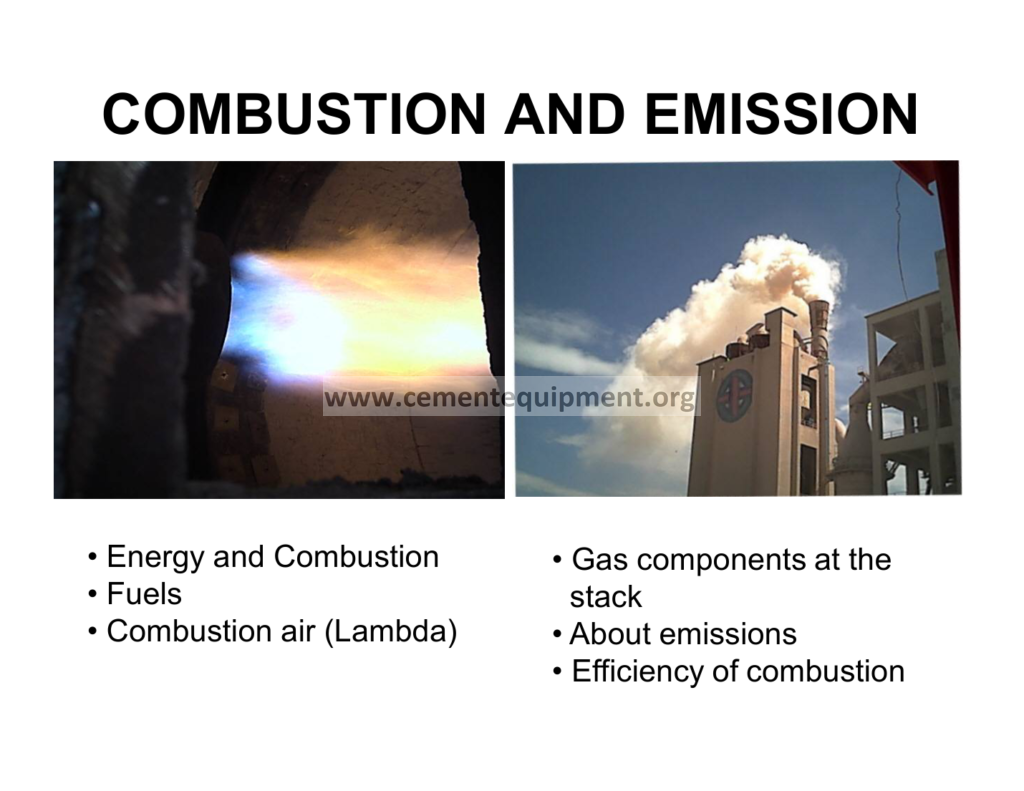
Combustion and Emissions in Cement: Guide
The combustion and emission guide is the thermal conscience of the cement plant: the file that explains how the fuel burns in the kiln and the calciner, how the flame is shaped, how the nitrogen oxides, the sulfur dioxide, the carbon monoxide and the dust are formed, and how the line measures and controls them: the module between the fuel preparation and the stack, the knowledge that decides the heat consumption on one side and the emission permit on the other: for the kiln operator, the process engineer and the environmental officer, this is the reference of the burning.
The Complete Cement Technical Package (931 files including the books, the courses, the Excel tools and the presentations: $249.99 one-time: instant download via the PayPal payment) includes this combustion and emission guide with its combustion calculations, the gas analysis chapters, the emission tables and the control recommendations: this article walks the file: the combustion chemistry, the flame practice, the calciner staging, the pollutant formation mechanisms and the abatement equipment: the reader finishes with the mental map of the whole gas side of the kiln line: from the fuel nozzle to the clean stack.
Combustion in the cement process is unlike any other industrial flame: the fuel burns in the presence of the raw meal dust, at gas temperatures above 1800°C in the flame core, with the tertiary air and the secondary air joining from different directions, and the products of combustion carry the heat that calcines the limestone and sinters the clinker: the same products must then be cleaned to the emission limits of the permit: the guide treats the two faces of the same system, and so does this article: first how the heat is made, then how the gas is cleaned.
1. The Combustion System of the Cement Line: The Air Roads and the Fuel Roads
A cement kiln line is first a gas circuit with a chemical reaction in the middle: the combustion air enters through three gates, the fuel enters through the burner pipes, and the gas leaves through the preheater tower:
- The primary air: the conveying and the shaping air of the burner: typically 5-12% of the total combustion air in the modern multichannel burners: it carries the fuel from the burner tip and lends the initial momentum to the jet;
- The secondary air: the hot air from the cooler through the kiln hood: typically 55-65% of the total air at 900-1100°C: the preheated air that keeps the flame economy of the clinker sintering;
- The tertiary air: the branch from the cooler to the calciner through the tertiary air duct: typically 25-40% of the air: the oxidant of the calciner flame, at 800-1050°C depending on the duct position and the insulation;
- The kiln exit gas: the products of the kiln combustion plus the calcination gases leaving at 850-1100°C toward the preheater riser duct and the cyclones;
- The tower exit gas: the cooled gas at 290-330°C from the five-stage tower, carrying the raw meal dust to the dedusting filter;
The distribution of the air between the three gates is the first tuning variable of the line: too little primary air cools the nose, too much secondary air is impossible by design, and the tertiary air flow must balance the calciner demand with the kiln demand: the guide dedicates a full chapter to the air balance and the pressure control of the three gates: the plant that does not know its air splits cannot control its combustion, and the guide says exactly that.
2. The Combustion Chemistry: The Reactions, the Stoichiometry and the Excess
The chemistry of the fuel burning in the kiln is the classical oxidation chain, but the cement engineer reads it with the stoichiometric numbers in mind:
The principal reactions. The carbon oxidizes to carbon dioxide: C + O2 → CO2, releasing 33,800 kJ per kilogram of carbon; the hydrogen oxidizes to water vapor: 2H2 + O2 → 2H2O, releasing 120,000 kJ per kilogram of hydrogen; the sulfur oxidizes to sulfur dioxide: S + O2 → SO2: the combustion of a typical coal with a lower heating value of 25,000 kJ/kg requires about 7.6 Nm3 of theoretical dry air per kilogram of fuel: the practical operation runs at 1.10-1.25 times the theoretical air, which the kiln man reads as the oxygen content at the kiln exit of 1.5-3.0% oxygen by volume, dry basis.
- The stoichiometric air: the air that supplies exactly the oxygen for the complete oxidation: the reference of the operation: the theoretical air for fuel oil of 40,200 kJ/kg is about 10.3 Nm3/kg, for petcoke of 33,000 kJ/kg about 9.3 Nm3/kg: the tables of the guide give the stoichiometric air for the whole fuel slate;
- The excess air: the air above the stoichiometric: the guarantee of the complete combustion: in the kiln system the excess shows as the O2 in the exit gas: 1.5-2.0% for the kiln side, 2.5-3.5% at the tower exit, and the calciner operates with its own excess of 1.5-3.0%: the excess is the insurance against the CO, and its price is the heated nitrogen that leaves the tower;
- The air factor and the exit gas volume: with the excess air, the wet gas volume of the modern dry process line runs 1.35-1.60 Nm3 per kilogram of clinker: the gas volume decides the fan power, the cyclone sizing and the filter load: the Kapitel of the guide calculates the gas volumes from the fuel analysis and the air factor;
- The unavoidable products: the combustion of the coal brings the ash to the clinker, about 8-15% of the clinker ash content in the modern precalciner operation: the fuel nitrogen and the thermal fixation produce the NOx: the sulfur partitions between the clinker, the SO2 and the circulating sulfates: the combustion chemistry is closed by the material balance of the kiln;
| Fuel | Typical LHV kJ/kg | Theoretical air Nm3/kg fuel | Combustion notes |
|---|---|---|---|
| Coal (as received) | 22,000-30,000 | 6.7-8.9 | 25-40% volatile matter, flame-stable |
| Petroleum coke | 31,000-35,000 | 9.3-10.5 | 8-12% volatile, high sulfur, fine grinding |
| Fuel oil | 40,200 | 10.3 | Clean firing, burner atomization |
| Natural gas | ~50,000 | 9.5 | Highest flame temperature, no grinding |
| Typical alternative fuels | 10,000-25,000 | 3.5-7.5 | Moisture and volatile spread, feeding specific |
The air requirement table of the file is the quick reference of the fuel changes: the engineer multiplies the fuel rate by the theoretical air and the excess factor to reach the combustion air demand: the guide’s chemistry chapter builds the complete combustion balance: the fuel flow, the air flows, the gas composition, the excess and the gas temperature at every point of the line: the engineer who masters the balance can predict the effect of every fuel change and every excess air change before touching the plant: the balance tables of the guide are the daily tools of the optimizer.
3. The Flame in the Rotary Kiln: The Shape, the Length and the Burner
The rotary kiln flame is the heart of the clinker sintering: the flame core reaches 1800-2000°C while the clinker bed in the burning zone holds the required 1350-1450°C: the flame must be short enough to concentrate the heat in the burning zone and long enough not to overheat the kiln nose, and its management is the daily art of the kiln burner:
- The flame length and the shape: the modern standard flame in a precalciner kiln is 8-15 diameters long in the aim configuration: a flame that is too long pushes the heat into the transition zone and cools the burning zone: a short fat flame overheats the refractory and the coating: the multichannel burner shapes the jet with the swirl air and the axial air;
- The momentum: the jet momentum of the modern burner is typically 12-18 N/MW: the momentum pulls the secondary air and controls the recirculation inside the flame: the high momentum gives the short stiff flame of the alternative fuels, the low momentum the lazy flame of the easy coal;
- The primary air rate: 5-12% of the total with the multichannel burners: split between the fuel conveying air, the swirl air and the axial air: each channel has its nozzle pressure, typically 0.6-2.5 bar, and its velocity: the flame dictionary of the burner is written in these numbers;
- The burner tip placement: the tip is set relative to the nose ring and the raw meal feed: typically 10-30 cm inside or at the nose ring level from the hood, and the vertical position is centered on the kiln axis: the guide covers the alignment discipline;
- The heat release intensity: the burning zone heat release density of the modern kilns is in the range of 1.5-2.5 MW per square meter of the shell area in the zone: the flame must deliver the intensity without melting the coating: the stability of the coating is the flame quality measure of the shift;
The flame practice chapter of the guide includes the burner types from the single-channel pipes of the wet kilns to the multichannel kiln burners with the simultaneous gas, coal and alternative fuel feeding: the adjustments are described with the observable symptoms: the free lime rising, the burning zone temperature falling, the thermal load of the nose: the flame is not seen, it is inferred, and the guide teaches the inference chain: flame, coating, clinker, gas.
4. The Calciner Combustion: The Staged Burning and the Fuel Split
The precalciner is the second combustion chamber of the line: in the modern process, 55-65% of the total fuel burns in the calciner at 840-900°C, and the kiln burns the remainder: the calciner combustion is gentle, staged and dust-rich, and it is the tool that cut the kiln length and multiplied the line output:
- The fuel split: 55-65% to the calciner, 35-45% to the kiln, in the standard precalciner line: the split balances the heat duty between the two chambers and keeps the kiln exit gas temperature at 850-1050°C;
- The combustion temperature: the calciner flame burns at 840-900°C in the meal-laden gas: the raw meal absorbs the heat by the endothermic calcination CaCO3 → CaO + CO2 with 1780 kJ consumed per kilogram of CaCO3: the result is the calcination degree of 85-95% at the kiln inlet;
- The staged combustion for NOx: the calciner is the NOx reduction stage of the modern lines: the fuel is injected into the reducing zone with the substoichiometric air, the NOx from the kiln is partly reduced by the CO and the NH3 fragments, then the tertiary air completes the burnout: the staged calciner cuts the overall NOx by 30-50% compared to the non-staged operation;
- The catch-fire risk: the meal accumulation in the calciner corners and the rising CO from the overfueled zones: the CO setpoint at the riser duct and the pressure profile of the calciner are the safety instruments: the guide covers the emergency procedures of the calciner trip;
- The inline and the offline calciners: the inline calciner sits in the riser duct between the kiln exit and the lowest cyclone, the offline calciner has its own air supply and its own cyclone pair: the two architectures have different responses to the fuel chemistry, documented with the design numbers in the guide;
The calciner chapter closes with the design parameters: the gas velocity in the riser duct of 12-18 m/s, the residence time of the gas of 1-3 seconds, the meal distribution of 60-70% of the total meal into the calciner: the numbers that the operator holds when the calcination degree drifts.
5. The Fuels of the Burning Line: The Coal, the Petcoke and the Alternative Fuels
The fuels chapter of the guide maps the energy sources of the line with their combustion characteristics, because the combustion quality follows the fuel quality:
- The coal: the classic kiln fuel: lower heating value 22,000-30,000 kJ/kg on the as-received basis, volatile matter 25-40% for the flame stability, ash 8-25%, moisture 5-15%: the coal of the kiln must grind to 1-3% residue on the 90 micron sieve with a moisture below 1% for the pneumatic conveying;
- The petroleum coke: the high-sulfur, low-volatile fuel: LHV 31,000-35,000 kJ/kg, volatile matter 8-12%, sulfur 3-7%: the low volatile demands the high kiln inlet temperature and the dedicated calciner conditions: the petcoke is ground finer, typically 1-2% residue on the 90 micron sieve;
- The alternative fuels: the tires, the refuse-derived fuel, the solvents, the meat and bone meal, the plastics: the thermal substitution rates of 30-80% are common in the European and the Southeast Asian lines: each fuel has its feeding point: the whole tires to the kiln inlet, the fluff to the calciner, the liquids through the burner lance;
- The total moisture and the calorific dispatch: the alternative fuels bring 2-8% moisture into the system that must evaporate at the cost of the heat: the guide teaches the moisture penalty calculation: each 1% moisture in the fuel costs roughly 7-10 kJ/kg of clinker in the sensible and the latent heat terms;
- The sulfur burden: the fuel sulfur plus the raw material sulfur form the SO2 and the circulating alkali-sulfur cycles: the sulfur to alkali ratio must stay below about 1.0 for the stable operation without the ring formations: the fuels are selected with the sulfur balance of the line in mind;
The fuel tables of the guide list the composition, the stoichiometric air, the flame temperature and the combustion notes for a dozen industrial fuels: the reader evaluates any fuel offer against the numbers of his own line: the fuel change is planned, not discovered, and this chapter is the planning instrument.
6. The Emission Inventory of the Kiln Line: What Leaves the Stack
The emission chapter opens with the inventory: the pollutants the line sends to the stack, their units and their typical ranges in the modern dry process operation:
| Pollutant | Typical range, modern precalciner line | Main formation source |
|---|---|---|
| Dust | 5-30 mg/Nm3 after the bag filter | Raw meal, clinker dust, fuel ash |
| NOx as NO2 | 300-800 mg/Nm3, kiln exit; 150-400 with the staging and the SNCR | Thermal fixation and fuel nitrogen |
| SO2 | 10-100 mg/Nm3 with the limestone scrubbing in the tower; 100-500 when the sulfur exceeds the alkali | Fuel sulfur and the pyrite of the raw material |
| CO | 100-800 ppm, transient peaks to 2000 ppm | Incomplete combustion, the reducing pockets |
| HCl | 1-15 mg/Nm3 with the alternative fuels | Chlorides in the fuel and the raw material |
| Organic carbon TOC | 1-20 mg/Nm3 | Incomplete burnout of the fuels |
| Dioxins and furans PCDD/F | 0.01-0.10 ng TEQ/Nm3 | Reformation in the low-temperature gas path |
The inventory is the bridge between the combustion and the permit: each pollutant has its formation window in the line, and the abatement of each is a technology: the guide organizes the line by pollutant, so the environmental engineer reads the file the way the plant must react: by species and by measurement point.
7. The Nitrogen Oxides: The Formation and the Control
NOx is the combustion pollutant that shapes the modern kiln operation, because its control changed the burner design and the calciner architecture:
- The thermal NOx: the nitrogen of the combustion air fixes at the flame temperatures above 1400-1500°C by the Zeldovich mechanism: the kiln flame core at 1800-2000°C is the factory of the thermal NOx: the cement kiln forms 60-90% of its NOx in the flame;
- The fuel NOx: the nitrogen chemically bound in the coal, the petcoke and the alternative fuels oxidizes at the moderate temperatures: the fuel nitrogen contributes 10-40% of the total, more with the high-nitrogen fuels like the meat and bone meal;
- The prompt NOx: the fast fixation in the fuel-rich zones of the flame: a minor share in the kiln, more visible in the calciner staging;
- The primary measures: the staged combustion in the calciner, the low-NOx burner with the internal recirculation, the lower excess air, the flame shaping: the primary measures bring the NOx from 800-1200 mg/Nm3 of the earlier lines down to 400-700 mg/Nm3;
- The SNCR: the selective non-catalytic reduction: the urea or the ammonia solution injected into the gas at 850-1000°C: in the modern five-stage line the injection window is narrow and sits in the riser duct or the calciner: the efficiency of 40-70% under the good temperature control: the reagent must not slip as the NH3 emissions;
- The SCR: the selective catalytic reduction on the tail gas at 280-350°C with the catalyst: the emerging technology of the cement lines, inhibited by the dust and the sulfur content of the kiln gas: the reference plants of the package document 70-90% reduction rates;
The control strategy of the guide is pragmatic: the primary measures first, the SNCR second, the SCR as the reserve for the strict permits: each stage has its cost per kilogram of NOx removed, and the guide tabulates the comparison so the plant can choose the investment grade of its own target.
8. The Sulfur Dioxide: The Cycles and the Abatement
The SO2 of the cement kiln is a paradox the guide explains carefully: the fuel sulfur largely combines with the alkalis into the clinker and the dust, and the emitted SO2 is mostly the oxidizable sulfur of the raw material:
- The sulfur forms in the feed: the pyrite and the organic sulfur of the limestone oxidize to SO2 in the preheater stages at 400-700°C: this SO2 appears at the tower exit unless it is captured by the reactive lime in the upper stages: the SO2 of the raw material is the dominant source when the pyrite sulfur exceeds about 0.1-0.2% of the raw meal;
- The fuel sulfur path: the fuel SO2 forms in the flame at 1800°C: in the oxidizing kiln atmosphere it reacts with the alkali sulfates and the lime to be partly absorbed in the clinker: the absorption depends on the local reducing conditions, the alkali supply and the temperature;
- The circulating sulfates: the SO2 and the SO3 travel with the gas, condense with the alkalis in the preheater, return with the dust to the kiln: the internal cycle concentrates the sulfates until the system achieves the steady state: the alkali-sulfur ratio below 1.0 keeps the cycle stable and the emission low;
- The reducing conditions: the local reducing zones in the kiln release the sulfur as the H2S and the elemental sulfur that re-oxidize to SO2 at the kiln exit: the stable excess air distribution is itself the first SO2 abatement measure;
- The desulfurization measures: the lime slurry or the hydrated lime injection into the upper preheater stages: removal of 60-90%; the wet scrubber at the tail for the strictest permits: the raw material selection remains the cheapest measure: the guide compares the methods with the investment and the reagents costs;
The SO2 chapter closes with the diagnosis tables: the SO2 spike at the feed change, the SO2 drift with the kiln exhaust conditions, the SO2 mirroring the CO peaks: the signatures that tell the operator whether his sulfur problem is the quarry, the fuel or the flame.
9. The Dust and the Carbon Monoxide: The Filter Protection and the Reducing Operation
Dust is the oldest emission of the cement industry and the one with the most visible equipment: the kiln gas carries 30-100 grams of raw meal dust per normal cubic meter at the tower exit, and the filter must take it down to the single digits of milligrams:
- The dust load: the tower exit typically carries 30-100 g/Nm3: after the raw mill the filter usually treats the combined kiln and mill gas with its own profile: the quantities make the filter the largest single process unit of the gas train;
- The dust resistivity and the ESP: the electrostatic precipitator collects by the charge: the raw meal resistivity of 10^9-10^11 ohm-cm at the normal operating temperature makes the ESP efficient at 99.0-99.9%: the ESP performance collapses under the high resistivity conditions, especially with the low-moisture feed and the high alkali dust;
- The bag filter: the filter bags of the new lines: the pulse-jet filter with the polyester or the P84 bags at the gas temperature below 200-220°C: the outlet dust of 5-20 mg/Nm3: the bag filter is insensitive to the resistivity and the chemistry of the dust: the guide compares the two technologies on the availability, the pressure drop and the operating cost;
- The dust circulation: the collected dust returns to the kiln feed system: the recirculation of the alkalis and the chlorides with the dust: the bypass of the kiln exit gas at 3-8% of the total or more when the chlorides demand it: the dust handling is the material balance partner of the gas cleaning;
- The emissions of the other points: the clinker cooler, the raw mill, the cement mills and the silos each have their dedusting systems: the guide inventories the whole plant and the typical limits: the 20-30 mg/Nm3 of the national permits with the tightening trend toward 10 mg/Nm3 in the stricter jurisdictions;
The dust chapter of the guide contains the filter sizing calculations, the pressure drop models and the bag life statistics: the plant engineer sizes the new filter and troubleshoots the old one with the same tables.
The CO formation. The carbon monoxide appears when the oxygen runs low: the incomplete combustion in the locally reducing pockets of the kiln, the calciner overfueling, the fuel rich zones near the nose: the CO at the kiln exit above 300-500 ppm signals the reducing conditions that also destroy the coating and raise the SO2: the prolonged reducing conditions reduce the iron to the ferrous state, discolor the clinker, disturb the alite formation and weaken the cement: the reducing operation is not only an emission issue: it is a product quality issue.
- The CO and the ESP: the electrostatic precipitator operates with the CO interlock: the accumulated CO above 1.0-1.5% with the sparks inside the ESP is an explosion hazard: the CO trip at 0.5-1.0% is standard practice on the ESP lines; the bag filters raised the tolerances but the CO alarms remain;
- The transient CO peaks: the feed breaks, the fuel spikes, the calciner trips: the CO excursions of seconds to minutes: the continuous CO analyzer at the tower exit and the filter inlet guards the installation: the guide covers the alarm strategy and the interlock logic of the dedusting equipment;
The dust and the CO of the line share their guardian, the dedusting filter, and the guide treats them as the pair the operator lives with: the operating windows of the O2, the CO and the NOx at the kiln exit and the tower outlet, the alarm levels and the corrective sequences are mapped completely: the operator of the modern lines lives in the triangle of the O2, the CO and the NOx, and the guide maps that triangle completely.
10. The Measurement of the Combustion: The Gas Analysis of the Line
No combustion control exists without the measurement, and the measurement chapter of the guide is shared with the gas analyzer file of the package: the points, the instruments and the interpretation:
- The kiln exit gas: the O2, the CO and the NOx measured at the kiln inlet riser: the sample gas at 850-1100°C with the heavy dust load: the extractive sampling system with the heated probe, the cyclone and the automatic blowback: the kiln exit O2 is the single most important combustion number of the line;
- The tower exit gas: the O2, the CO, the NOx and the SO2 measured after the last stage at 290-330°C: the same extraction systems in the friendlier conditions: the point of the filter protection and the afterburning control;
- The calciner gas: the O2 and the CO in the riser duct and the calciner: the CO monitoring guards against the afterburning in the cyclones and the unburnt fuel carryover;
- The continuous emission monitoring (CEMS): the stack measurement for the permit compliance: the dust by the opacity or the light-scattering monitors, the NOx and the SO2 by the extractive analyzers, the flows and the temperatures registered for the emission report: the quality assurance of the CEMS (the calibration gases, the zero and the span checks) is a chapter of its own;
- The portable measurements: the traverses of the ducts with the pilot tubes and the gas meters for the balance campaigns: the combustion survey that recalibrates the fixed instruments: the guide gives the traverse planning and the evaluation worksheets;
The measurement chapter connects the combustion theory to the control room: the O2 readings drift with the probe plugging, the NOx readings with the sample conditioning, and the guide teaches the discipline of the instrument trust: the numbers are only as good as the probes.
11. The Emission Limits and the Compliance: The Permit Arithmetic
The compliance chapter translates the process knowledge into the permit arithmetic:
- The limit frameworks: the plants operate under the national permits that converge on the reference values of the regional best-available-technique documents: the typical daily average limits for the dust 10-30 mg/Nm3, for the NOx 200-500 mg/Nm3, for the SO2 50-300 mg/Nm3, the CO limit of 500-1000 mg/Nm3: the guide states the ranges without pretending to replace the local legislation;
- The measurement basis: the mg/Nm3 at the reference conditions: the dry gas, the normalized to the standard temperature and pressure, the oxygen reference of 10% for the cement kilns: the conversion of the measured values to the reference oxygen is arithmetic the guide drills with the examples;
- The compliance margin: the plant should hold 75-85% of the limit to survive the peaks and the analyzer tolerances: the guide teaches the margin management: the daily averages, the half-hourly averages, the drop-out handling;
- The carbon dioxide context: the CO2 of the cement kiln is 60-70% from the calcination and 30-40% from the fuel: the total emission of about 0.85-0.95 tons of CO2 per ton of cement produced: the guide closes the emission story with the energy and the clinker factor levers: the thermal substitution, the clinker factor reduction, the efficiency: the CO2 reduction plan of the plant is the combustion plan revisited;
The emission arithmetic is the language of the permit negotiation, and the guide makes the reader fluent: the same tables serve the technical manager in the permit dialogue and the operator on the shift report: the numbers of the stack are the numbers of the business.
12. The Optimization of the Whole Line and Its Audit: The One Burner Concept
The final technical chapter of the guide puts the combustion and the emission together: the modern line is operated as one combustion device, not as a kiln plus a calciner:
- The integrated tuning: the kiln exit O2 at 1.5-2.5%, the calciner O2 at its setpoint, the tower exit CO below 100-300 ppm, the NOx at the target of the day: every adjustment of the fuel split moves all the numbers, and the guide teaches the multivariate tuning sequence of the line, step by step;
- The thermal substitution and the emission: the alternative fuels change the flame, the volatile content and the NOx: the tires and the plastics raise the CO risk, the sewage sludge raises the NOx and the heavy metals: the substitution ramps are planned with the gas measurements as the lead indicators;
- The combustion KPIs: the specific heat consumption, the kiln exit O2, the CO peaks per day, the NOx per ton of clinker, the SO2 hours above the limit: the guide proposes the KPI dashboard of the burning line with the target ranges and the review cadence;
- The troubleshooting cases: the guide closes with the compiled cases: the flame red and the free lime high, the SO2 climbing with the feed change, the NOx rising after the petcoke increase, the CO peaks after the calciner trip: each case walks the symptoms, the measurements and the corrective actions;
The line is one burner in the sense the guide teaches: the air, the fuel and the gas form one connected system, and the operators who see it whole see the cheapest heat consumption and the cleanest stack of their region: the optimization chapter is the toolbox of that vision.
The optimization chapter is supported in the guide by the audit practice: the periodic combustion campaign that measures the line and recalibrates its control: the audit is the professional ritual of the burning lines, and the guide gives its complete protocol:
- The audit inventory: the measurement points of the campaign: the gas analysis traverses of the kiln exit, the calciner, the tower exit and the cooler ducts; the fuel sampling and the analysis; the gas temperatures and the pressures at every stage; the clinker free lime and the temperature profiles: the campaign data set that fills the balance worksheets of the guide;
- The reference instruments: the portable analyzers and the calibrated probes serve as the audit reference against the fixed instruments: the deviations found are the calibration actions: the audit corrects the control room numbers to the truth of the traverses;
- The balances of the audit: the air balance of the line reconstructed from the measured flows and the gas compositions: the false air of each stage computed from the O2 and the CO2 profiles; the fuel balance from the fired rates and the calorific values: the balance closure of 98-102% is the audit acceptance criterion, and the guide drills the closure calculation with the worked examples;
- The audit report: the findings, the deviations, the recommended setpoint changes and the economic quantifications: the report format of the guide includes the summary tables that the management reads: the fuel savings of the corrected excess air and the NOx savings of the tuned staging, both in the annual currency of the plant;
The audit closes the combustion loop of the guide: theory, operation, optimization and verification: the line that audits itself twice per year holds its numbers honest, and the honest numbers are the foundation of every further saving: the audit habit is the cheapest investment of the burning line, and the guide makes it a routine, not an event.
13. The Frequently Asked Questions
What oxygen content should the kiln exit hold?
The typical operating window is 1.5-3.0% oxygen at the kiln exit, dry basis, with 1.5-2.5% as the economical target: the level must keep the CO below about 300 ppm while avoiding the excess air that heats the nitrogen: the calciner side and the tower exit run slightly higher, typically 2.5-3.5% O2 at the tower outlet.
Why does NOx rise when the flame gets longer?
The longer flame pulls the high-temperature zone toward the feed end and raises the gas temperature over a longer stretch of the vessel, increasing the thermal fixation of the nitrogen: the shorter, stiffer flame with the internal recirculation reduces the high-temperature residence time and the NOx: every NOx campaign on a kiln starts with the flame shape review.
Can the plant burn the whole tires without exceeding the emission limits?
The whole tires are burned with the well-controlled combustion in the dedicated feeding systems, often at the kiln inlet or through the specialist pre-combustion chambers: the tire steel adds the fuel ash and the zinc, and the combustion must be complete to avoid the CO and the organic emissions: the substitution rates of 10-30% of the kiln fuel are the proven practice with the gas monitoring in place.
What is the difference between the primary and the secondary measures of emission control?
The primary measures prevent the pollutant formation in the first place: the staged combustion, the low-NOx burner, the excess air control; the secondary measures abate the formed pollutant: the SNCR and the SCR for the NOx, the lime injection and the scrubbers for the SO2, the filters for the dust: the economics always favor the primary measures first, with the secondary as the final instruments.
Does the bag filter tolerate the CO?
The bag filters tolerate higher CO levels than the electrostatic precipitators, because the filter has no sparks, but the dust deposits of the bags are still combustible and the CO alarms are retained: the operating practice keeps the tower exit CO below the alarm setpoints and the trip logics of the raw mill interconnections active: the CO discipline is the safety discipline.
14. Conclusion
The combustion and emission guide is the complete map of the gas side of the burning line: the air gates, the flame, the calciner staging, the fuels, the pollutants and the abatement equipment: the engineer who works through the file can balance the air, shape the flame, diagnose the NOx and tune the excess: the same engineer speaks fluently with the burner supplier, the filter vendor and the environmental authority, because all three speak the same numbers: the oxygen, the temperature and the milligrams per normal cubic meter.
The line that burns well and emits little is the line that costs little: the combustion discipline is the first line of the energy budget and the emission permit of the plant: the guide of the package puts the discipline in the hands of the operators and the engineers: the Complete Cement Technical Package includes this file with the combustion calculation tables, the emission reference values and the gas analysis practice: the one-time $249.99 purchase, the instant download via PayPal, the 931 files of the cement library: the burning line, understood and controlled.
Get this Combustion and Emission guide + the full 931-file package
$249.99 — one-time purchase, instant download, lifetime access
This file is part of the Complete Cement Technical Package (931 files) available from cementequipment.org. Respective rights holders; library copy for the licensed single user.