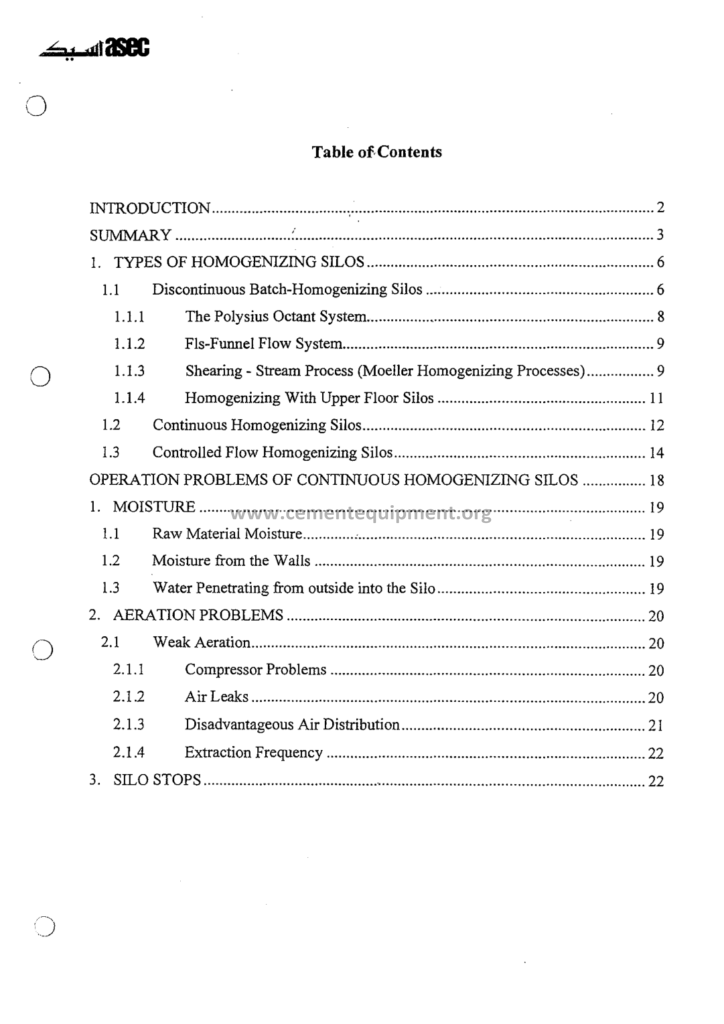
Homogenizing Silos: Complete Technical Guide
The homogenizing silo is the quiet quality engine of the cement plant: the tall concrete tower that receives the fluctuating raw meal from the raw mill and delivers the stable kiln feed to the preheater: the kiln burns the best when the feed chemistry stays constant, and the homogenizing silo is the buffer that absorbs the variations of the quarry, the crusher and the mill: the standard deviation of the lime saturation factor is squeezed from the raw meal to the kiln feed by the air, the time and the design: the file of the package documents the complete science of this mixing machine.
The Complete Cement Technical Package (931 files including the books, the courses, the Excel tools and the presentations: $249.99 one-time: instant download via the PayPal payment) includes this homogenizing silo file with the design calculations, the aeration layouts, the operational procedures and the troubleshooting tables: the article follows the file from the mixing theory to the maintenance calendar: the process engineers, the operators and the mechanical teams each find their chapters.
The silo looks like a simple storage vessel, and it is in fact the chemical reactor of the plant’s quality chain: the compressed air lifts and rolls the meal in the programmed zones, the conical flow patterns mix the layers, and the extraction at the center or the periphery completes the mixing: this guide explains the physics of the air-fluidized meal, the design of the aeration patterns, the statistics of the blending and the operating discipline that keeps the kiln feed on the target.
1. The Mission of the Silo: The Chemistry of the Kiln Feed
The homogenizing silo exists for the stability of the kiln feed chemistry, and the targets are precise:
- The kiln feed parameters: the lime saturation factor LSF at 95 to 100, the silica ratio SM at 2.2 to 2.8, the alumina ratio AM at 1.3 to 1.7 for the ordinary Portland cement: the variations of the raw materials move the parameters and the kiln responds:
- The consequences of the variation: the burnability fluctuates with the chemistry: the underlime clinker loses the strength, the overlime burns hard with the free lime and the refractory stress: the kiln operator chases the instability with the fuel and the speed, and the production and the emissions suffer:
- The targets of the mixing: the homogenized kiln feed with the standard deviation of the raw meal LSF 1.5 to 2.5 at the silo inlet reduced to 0.3 to 0.8 at the outlet: the mixing efficiency of the good plants reduces the variation by the factor of 5 to 10: the numbers of the contract guarantees:
- The chain of the stability: the quarry planning, the prehomogenization beds, the raw mill proportioning and the homogenizing silo form the chain: the silo is the final filter of the system, and its effectiveness is measured at the kiln feed sampler of the file’s quality chain:
The mission statement of the silo: the kiln feed that leaves the silo must stay within the tolerance band of the control system: the plants measure the standard deviation of the kiln feed weekly and hold the reviews: the silo is the instrument of that discipline: the file opens the guide with the chain of the chemistry and the measurements of the mixing task.
2. The Statistics of the Mixing: The Standard Deviation and the Mixing Factor
The mixing is quantified by the statistics, and the file builds the vocabulary of the quality numbers:
- The standard deviation: the square root of the average squared deviation of the parameter from its mean: the sigma of the LSF of the raw meal stream, computed from the hourly samples: the sigma is the language of the silo contract and the kiln feed reports:
- The mixing factor n: the ratio of the inlet variation to the outlet variation: n = sigma-in / sigma-out: the mixing factor of the continuous silos in the range 5 to 12, of the batch silos 10 to 30: the factor measures the silo’s total effect on the variations at the storage-related time scales:
- The time scales of the variation: the silo mixes the variations with the periods comparable to the silo residence time: the half-hour and the hour-scale fluctuations are the domain of the mixing; the daily drifts of the quarry beds exceed the mixing capacity and reach the kiln as the slow trends the control compensates: the file’s spectral view of the variations explains which disturbances the silo can and cannot cure:
- The test methodology: the inlet and the outlet samplers with the hourly increments over the three to seven days, the chemical analysis, the sigma computation: the mixing test of the file with the acceptance criteria: the plant runs the documented test at the commissioning and the annual audits:
The statistics of the file turn the silo into a measurable machine: the sigma reduction is the KPI of the mixing department, and the trends of the quarterly tests show the health of the aeration system: the silo that fails its mixing factor is diagnosed with the tomography of the flow patterns, and the file’s chapters trace the failure to the aeration or the extraction: the numbers govern, the tests verify.
3. The Prehomogenization Upstream: The Blending Beds of the Quarry
The silo works best with the prepared feed, and the upstream prehomogenization is the first stage of the quality chain:
- The pile principle: the chevron and the windrow beds: the material stacked in the layers and reclaimed across the face: the stacking builds the statistical mixture of the horizontal layers and the reclaiming mixes the vertical profile: the mixing factor of the blending beds 3 to 10:
- The quarry variations: the limestone seams vary in the calcium and the magnesium: the quarry plan blends the faces, and the beds even out the variations of the days: the bed capacity of the raw plants 30,000 to 100,000 tonnes, the residence of the belt and the stacker economy:
- The homogenizing effect: the good prehomogenization cuts the raw mix variation by half before the mill: the silo then finishes the job: the two-stage philosophy of the file: the coarse mixing in the piles, the fine mixing in the silo: the plants that skip the beds depend on the silo alone and pay in the mixing margin:
- The bed operation: the stacking quality (the layer thickness and the reclaiming face angle) decides the bed’s mixing: the travelling stacker leveling and the shifting reclaimers of the modern beds: the bed management of the file integrates the quarry plan and the mill demand:
The prehomogenization chapter of the file connects the quarry and the silo: the standard deviation of the chemistry entering the silo is the product of the whole chain above, and the mixing factor requirements of the silo are sized on that basis: the quality engineering of the plant is the one system from the blasting to the preheater, and the file documents the responsibility of each link: the bed smooths the days, the silo smooths the hours.
4. The Principles of the Silo Mixing: The Air, the Cones and the Layers
The homogenizing silo mixes by the air-fluidization and the gravitational flow, and the physics of the mixing are the heart of the file:
- The fluidization: the air is blown through the porous bottom of the silo, and the meal bed expands into the fluid state: the fluidized meal flows almost like the liquid: the air requirement 0.3 to 1.5 cubic meters per minute per square meter of the bottom, at the pressures 300 to 800 millibars:
- The active cones: the aeration is zoned: one sector of the bottom aerates while the others rest: the fluidized meal flows down the active cone toward the extraction point, forming the cone-shaped flow channel: the concurrent sectors create the multiple cones in sequence:
- The layer mixing: the meal fed to the silo settles in the horizontal layers: the extraction at the bottom draws the columns: the layer with the high lime arrives at the extraction at different times than the layers around it: the mixing is the averaging of the many vertical columns of the different residence: the classic principle of the blending silos:
- The mixing by the recirculation: the continuous silos pump the air in the programmed rotation across the sectors: the meal rolls from the high cone to the low, mixing the layers actively: the rolling of the cones is the active mixing of the continuous system, documented in the design models of the file:
The physical picture of the mixing: the silo is the arena of the fluidized meal: the air atmosphereizes the powder and the cones roll the chemistry: the file’s diagrams of the flow cones and the layer deformation explain the principles that the design chapters then quantify: the mixing of the silo is not the stirring of a liquid but the programmed collapse of the powder bed, and the design of the aeration geometry is the design of the mixing.
5. The Batch Homogenizing Silos: The Cycles of the Air and the Reabsorption
The batch silo is the classical high-mixing machine, operating in the fill, the mix and the discharge cycles:
- The fill phase: the raw meal accumulates in the silo over the filling period of 4 to 12 hours: the meal enters with its variation: the silo stores the material of the complete cycle:
- The mixing phase: the compressed air aerates the whole bottom in the programmed sequence: the meal rolls and mixes in the fluid state, and the aeration continues until the charge reaches the homogeneous composition: the mixing phase of 1 to 4 hours circulates the meal and levels the chemistry of the entire batch:
- The discharge phase: the mixed meal leaves for the kiln feed: the kiln feed tank below the silo buffers the transition: the discharge empties the silo to the residual cone and the new cycle begins: the cyclicity of the plant between the filling and the discharge is the rhythm the operators manage:
- The mixing factor: the batch silos achieve the mixing factors of 10 to 30 because the entire charge participates: the operational cost: the compressed air of the mixing phase 10 to 30 percent of the plant’s air consumption and the silo capacity utilization 50 to 80 percent of the geometric:
The batch philosophy of the file: the maximum mixing at the price of the capacity and the air: the plants with the very variable raw materials favor the batch systems for the kiln feed perfection: the operational sequence of the batch silo (the level controls, the mix timers, the discharge interlock with the kiln feed tank) is the chapter of the operator’s manual: the batch machine is the discipline of the cycle.
6. The Continuous Homogenizing Silos: The Fuller Principle in the Operation
The continuous silo is the workhorse of the modern plants, operating the simultaneous feed and discharge:
- The principle: the air sectors under the bottom rotate on the timer: the meal flows continuously from the feed to the central extraction, crossing the rolling cones that mix the layers: the continuous mixing at the full capacity of the silo:
- The components: the raw meal feed to the roof, the conical bottom with the porous aeration tiles, the sector air valves and the blowers, the central extraction with the fluidized chute to the elevator, the kiln feed tank after the silo:
- The air program: the sectors aerate in the sequence: the semicircular or the quadrant zones, with the dwell times 30 seconds to 5 minutes per zone: the rotation speed of the air program sets the mixing intensity: the file’s air program tables give the starting points per the silo diameter and the meal flow:
- The cone control: the level of the meal in the silo is kept high (60 to 90 percent) to maintain the mixing depth: the level drops and the mixing shortens: the kiln feed tank absorbs the silo’s low levels during the mill stops: the level management of the continuous silo is the operator’s central duty:
The continuous operation of the file: the mill feeds, the silo mixes and the kiln draws, all at the steady flow: the silo is the hydraulic system of the quality: the feed fluctuation averaged over the residence time of 4 to 12 hours, with the rolling cones actively mixing: the continuous silo of the modern plants is the preferred balance of the capacity, the air and the mixing: the philosophy of the steady state at the service of the kiln.
7. The Design of the Silo and the Aeration: The Sizes, the Pressures and the Air
The sizing of the homogenizing silo follows the rules of the mixing depth and the air, and the file presents the design method:
- The capacity: the silo volume holds 6 to 12 hours of the kiln feed (the raw meal flow of the 5,000 tonnes per day plant is 350 to 380 tonnes per hour and the silo holds the 2,500 to 6,000 tonnes): the usable capacity after the dead cones 65 to 80 percent:
- The geometry: the diameter to height ratio of the continuous silos typically 1:1 to 1:1.5: the conical bottom of 50 to 70 degrees with the central extraction: the flat-bottom with the multiple extraction points for the large diameters:
- The air quantities: the continuous silo air 0.3 to 0.6 cubic meters per minute per square meter of the aeration area at the 500 to 800 millibars: the blower capacity for the 12-meter silo at 8 to 15 cubic meters per minute: the batch silos at the higher rates of the mixing phase:
- The porous tiles: the cement-bound or the polymer-bound porous plates of the permeability 20 to 40 in the standard units: the tiles carry the air evenly across the bottom: the tile maintenance and the replacement are the main items of the silo chapter:
- The extraction: the central extraction of the conical bottom with the fluidizing air, or the bottom extraction ring of the flat designs: the extraction rate regulation by the rotary valve or the flow gate: the extraction draw keeps the flow pattern of the mixing: the design of the file sizes every element of the system:
The design chapter is the engineer’s workbook: the capacity from the kiln demand, the air from the area, the blowers from the pressure, and the aeration program from the mixing model: the worked example of the file sizes the silo for the 5,000 tonnes per day line: the engineer of the new plants follows the design method, and the operators of the existing plants use the tables to check their systems against the design intent:
8. The Aeration Equipment: The Blowers, the Valves and the Tiles
The aeration system is the muscle of the silo, and its equipment is the daily maintenance reality:
- The blowers: the roots-type and the screw compressors of the silo: the discharge pressure 400 to 900 millibars, the capacity per the silo: the blower rooms filter the intake air and the discharge lines carry the safety valves: the blower duty cycles of the continuous silos run the machines 50 to 90 percent of the time:
- The air valves: the solenoid and the pneumatic sector valves open the air to the zones: the valve seat wear of the dusty service is the classic failure: the valve inspection at the scheduled stops and the diaphragm replacement per the file’s calendar: the leaking valve wastes the air and the pressure, and the zone without the air loses its mixing:
- The porous tiles: the tiles distribute the air across the bottom: the tile blinding by the fine meal and the moisture cements the pores: the tile steam cleaning and the periodic replacement: the tile life 5 to 15 years with the care: the tile pressure drop grows with the blinding and signals the need:
- The dust control: the aeration air returns from the silo through the roof bag filter or the vent filter: the filter keeps the silo pressure within +/- 50 millibars and recovers the dust: the filter maintenance and the pressure monitoring belong to the silo’s daily log:
The equipment chapter of the file is the mechanic’s map: the blower room layout, the valve positions, the tile numbering and the filter details: the silo availabilities above 99 percent are achieved with the planned maintenance of the file: the aeration system and the silo are the one machine: the air that mixes and the equipment that delivers it are inseparable in the operation and the maintenance of the plant.
9. The Raw Meal Quality Control: The Samples, the Lab and the Loop
The silo works within the quality control loop of the plant, and the loop closes with the laboratory:
- The sampling: the automatic samplers on the raw mill feed, the silo inlet, the silo outlet and the kiln feed: the hourly samples of the streams: the sample representativeness is the quality of the loop: the sampler design and the division discipline of the file:
- The analysis: the X-ray fluorescence of the hourly samples: the major oxides: CaO, SiO2, Al2O3, Fe2O3, MgO, SO3, the LOI correlation: the XRF calibration of the file against the wet chemistry and the inter-laboratory rounds: the analysis uncertainty of 0.1 to 0.3 percent of the oxide:
- The calculations: the LSF, the SM and the AM computed from the oxides: the C3S and the C2S potentials for the quality assessment: the kiln feed quality report of the hour: the target windows and the alarms of the file:
- The loop: the laboratory results flow to the raw mill proportioning: the CUSUM and the EWMA control charts of the file detect the drifts early and the corrections of the limestone, the clay, the sand and the iron corrective follow: the loop of the correction cycles with the silo as the buffer: the response time of the loop 2 to 8 hours with the silo in the middle:
The quality loop and the silo share the mission: the loop corrects the slow drifts, the silo cancels the fast fluctuations: the file integrates the two into the one control strategy: the plant’s quality manual of the file defines the sampling schedule, the analysis procedures and the control charts: the laboratory and the silo are the two halves of the quality brain of the raw department.
10. The Control Strategies of the Kiln Feed: The Statistics in the Automation
The modern plants run the kiln feed control on the statistics, and the file documents the automation layers:
- The setting of the targets: the target LSF and the ratios set by the quality department for the clinker product: the kiln feed control maintains the targets at the silo outlet: the target optimization balances the burnability and the fuel:
- The control charts: the EWMA charts of the silo outlet chemistry with the control limits at the 2 to 3 sigma: the out-of-control signals trigger the investigations: the CUSUM charts of the cumulative deviations catch the small persistent drifts the charts of the single points miss:
- The feedforward of the mill: the raw mill proportioning anticipates the silo level and the chemistry: the mill feed ratios adjusted from the inlet samples: the combination of the feedforward and the feedback of the file’s control architecture:
- The simulation of the mixing: the plant models of the resistance-time distributions of the silo: the convolution of the inlet chemistry series with the silo mixing function predicts the outlet: the model of the file (the residence time distribution measured by the tracer tests) tunes the control anticipations:
The automation of the file moves the plant from the reactive corrections to the predicted chemistry: the control room displays the measured and the predicted kiln feed alongside: the operators trust the numbers because the samplers and the models are disciplined: the control strategy of the kiln feed is the silent layer under the smooth kiln: the stability of the chemistry becomes the stability of the burning.
11. The Cement Silos and the Fluidized Storage: The Same Science at the Finish Side
The mixing science of the raw silos carries over to the cement storage, where the requirements soften:
- The cement silos: the product silos of the finished cement: the storage of the 5,000 to 50,000 tonnes: the cement discharges through the fluidized bottoms and the aeration slides to the packing and the dispatch: the cement silos mix less aggressively: the cement is already homogenized by its grinding circuit, and the silo level management serves the dispatch, not the chemistry:
- The fluidized discharge: the air slides of the silo bottoms fluidize the cement at 300 to 700 millibars: the flow of the cement follows the aeration zones in the same cones: the discharge rates of the packing silos and the bulk loading towers:
- The segregation risk: the cement separates by the size in the filling cones of the silos: the coarse and the fine layers alternate at the outlet, disturbing the packing uniformity: the aeration recirculation of the modern silos reduces the segregation: the file’s silo filling and discharge arrangements balance the flows:
- The storage quality: the cement silo storage degrades the product slowly by the moisture and the temperature: the silo ventilation, the aeration dehumidification and the FIFO rotation of the silos: the quality chapter of the cement storage of the file:
The finish side of the file completes the silo family: the raw silo for the chemistry, the cement silos for the logistics and the quality: the same air, the same cones, the same enthusiasm of the fluidized powder: the engineer of the plant carries the one physical understanding to both ends of the line: the silos of the raw and the silos of the finish, operated with the same science.
12. The Operational Problems of the Silos: The Bridges, the Walls and the Dead Zones
The silos of the plant face the family of the flow problems, and the file maps the symptoms and the remedies:
| Symptom | Cause | Remedy |
|---|---|---|
| Discharge stops with the full level | Bridging at the outlet, dead zone collapse | Re-aerate the bottom, restart with the high air |
| Mixing factor falling | Blinded tiles, failed valves, low level | Repair the air system, restore the level |
| Kiln feed spikes | Reference cone collapse after the mill stops | Maintain the level, restart the extraction slowly |
| Pressure pulses at the roof | Filter blocked, air system surge | Clean the filter, balance the valves |
| Air consumption rising | Tile leaks, valve seats, duct leaks | Pressure test, renew the seals |
| Raw meal hardened in the silo | Moisture ingress after the prolonged stop | Air-dry the bed, manual breakage plan |
The bridged silo is the drama of the plant: the meal sets into the wall structure and the extraction starves the kiln: the remedies of the file combine the aeration bursts, the roof access for the rodding and the safe clearing procedures: the dead zones of the flat bottoms accumulate the stale meal that hardens and contaminates: the flow audits of the file (the level sensors and the differential pressures) find the dead zones early: the silo problems of the file are prevented by the level discipline, the air maintenance and the planned emptying.
13. The Maintenance and the Inspection of the Silos: The Calendar and the Entries
The maintenance of the homogenizing silo is the long-cycle discipline of the air system and the structure:
- The daily checks: the blower pressures, the air valve operations, the silo levels, the roof filter differential, the kiln feed chemistry: the daily log of the file:
- The monthly maintenance: the valve inspections and the seal replacements, the blower oil checks, the tile pressure tests by the zone: the monthly entries of the file’s calendar:
- The annual inspection: the internal entry with the confined space protocol: the tile condition survey, the concrete inspection of the walls and the bottom, the aeration channels, the extraction system: the entry procedure of the file (the gas tests, the ventilation, the rescue plan) protects the crews: the annual report of the silo condition:
- The structural care: the concrete silos: the moisture ingress and the corrosion of the reinforcement, the epoxy crack repair and the coating cycles: the silo structure life beyond the plant life with the maintenance of the file: the thermography and the sound tests of the walls:
The maintenance calendar of the file turns the silo into the predictably available machine: the aeration, the valves and the structure on their due dates: the confined space entries follow the safety permits of the file strictly: the silo of the plant, inspected and repaired on the plan, serves the decades: the maintenance discipline of the silo is the quiet foundation of the kiln feed stability.
14. The Safety of the Silo Handling: The Dust, the Confined Spaces and the Explosions
The powder handling of the silos carries the dust hazards, and the file documents the safety doctrine:
- The dust explosion risk: the cement raw meal is not explosible under the usual conditions but the coal dust and the alternative material silos are: the explosion vents of the roofs, the inerting systems of the fuel storages and the electrical classification of the areas: the file’s hazard assessment of the silo types:
- The confined space entry: the silo entry is the permit-required confined space: the gas testing (the oxygen, the CO, the dust), the continuous ventilation, the standby rescue teams and the full-body harnesses: the entry rules of the file are the non-negotiable of the maintenance chapters:
- The dust control: the silo roofs and the filter housings keep the dust leak-free: the housekeeping of the silo platforms, the respiratory protection of the crews and the dust monitoring of the workplace: the silo operates the dusty material and the discipline of the file keeps the exposure low:
- The electrical safety: the silo area zoning for the dust and the explosion protection: the motor classifications, the grounding of the aeration equipment and the electrostatic risks of the dry powder handling: the earthing and the bonding rules of the file:
The safety chapter closes the operating guide with the absolutes: the silo never opens without the permit, the entries never happen without the gas test, and the explosion vents never blocked: the file’s safety checklists of the silo operations are the daily companions of the crews: the homogenization of the raw meal proceeds the years only when the safety of the powder handling is the first priority of the plant: the knowledge and the discipline together complete the silo manual.
15. The Instrumentation of the Silo: The Level, the Pressure and the Flow
The silo runs on its instruments, and the file devotes its instrumentation chapter to the measurements of the powder tower:
- The level measurement: the silo level by the radar, the guided wave, the weight-and-cable, the differential pressure or the ultrasonic instruments: the radar the modern standard for the dusty burial-risky service: the level signal of the file drives the mill feed control and the kiln draw interlock: the level accuracy 1 to 2 percent of the range with the correct mounting at the cone reflection zones: the multiple level instruments of the large silos cross-check the dead zones:
- The differential pressures: the aeration zone pressures, the roof pressure and the bottom pressure of the fluidized bed: the bottom pressure rises with the bed weight and falls when the air channels open: the zone pressure monitoring of the file detects the blocked tiles and the failed valves: the pressure trend chart of the silo is the early warning of the air system health:
- The flow measurement: the inlet belt scales of the raw meal, the extraction flow by the impact meters or the weight feeders at the kiln feed: the mass balance of the silo (the inflow minus the outflow equals the level change) closes the daily log: the balance check of the file catches the sampling and the weighing errors:
- The chemistry on-line: the on-line analyzers (the prompt gamma neutron activation and the X-ray fluorescence cross-belt systems) at the raw mill feed measure the chemistry continuously: the analyzer data shorten the correction loop from the hours to the minutes, and the silo keeps the short-term stability while the loop corrects the trends: the calibration of the on-line instruments against the laboratory XRF of the file weekly:
- The data architecture: the silo data into the process control system and the quality data to the laboratory information system: the historian data of the file: the inlet and the outlet chemistry, the levels, the air pressures and the flows, archived for the quarterly mixing reports and the audits: the data are the memory of the mixing machine:
The instrumentation of the file gives the silo its senses: the level, the pressure, the flow and the chemistry measured with the discipline: the instruments of the dusty service demand the purging, the calibration and the redundancy that the file’s maintenance sections specify: the silo without its instruments is the blind buffer, and the file’s instrument list (the tag numbers, the ranges, the intervals) standardizes the installation: the measured silo is the controlled silo: the quality of the kiln feed rests on the quality of the measurement chain that surrounds the tower.
The calibration program of the file schedules the routine checks: the level instruments versus the measured bunches at the annual inspection, the pressure transmitters with the reference manometers quarterly, and the chemistry analyzers against the certified laboratory standards monthly: the calibration records follow the instruments by the tag numbers and the deviations are trended: the drift of a level transmitter of two percent swings the inferred silo hold-up by some thousands of tonnes, and the drift of the chemistry analyzer moves the kiln feed corrections by the percentages: the calibration discipline of the file is the truth of the loop: the instruments of the silo, calibrated on the schedule, are the trusted senses of the mixing tower: the plant reviews the calibration histories at the quality audits, and the records of the file keep the measurement chain defensible in the yearly reviews: the unhurried calibration time of the planned stops protects the shift from the false readings that always arrive at the worst moments.
The Frequently Asked Questions
What is the typical mixing factor of the continuous homogenizing silo?
The continuous silos of the modern plants achieve the mixing factors of 5 to 12, measured by the ratio of the inlet to the outlet standard deviations at the hourly scale: the batch silos reach 10 to 30: the required factor is sized by the inlet variation and the kiln tolerance: the file’s sizing method computes the contract value.
How much air does the continuous silo consume?
The continuous silo aerates at 0.3 to 0.6 cubic meters per minute per square meter of the bottom at 400 to 800 millibars: the 12-meter silo consumes 8 to 15 cubic meters per minute continuously: the blower power is 50 to 150 kilowatts, notable in the plant’s compressed-air bills but justified by the mixing at the kiln feed.
The kiln feed chemistry spikes after every mill stop: why?
The mill stop leaves the silo with the partially mixed bed and the reference cone of the fresh meal: at the restart the extraction draws the stagnant layers and the chemistry spikes: the remedy of the file: maintain the silo level high, restart the extraction slowly and let the silo run a full residence before judging the kiln feed: the buffer works with the patience.
Can the batch silo be operated in the continuous mode?
The batch silo can run the continuous mode with the reduced mixing (the fill and the discharge overlap), but the aeration of the batch mixing phase is lost: the plant then operates the hybrid with the periodic mixing cycles between the continuous runs: the file’s operating modes table compares the flows and the mixing for the decisions.
How is the silo mixing performance tested at the commissioning?
The tracer test: the pulse of the chemically distinct meal (or the inert tracer) at the inlet and the continuous sampling at the outlet reconstructs the residence time distribution: the mixing test with the salt or the collected chemistry series computes the mixing factor: the acceptance test of the file follows the documented procedure of the three to seven days.
Does the package include the silo design and the mixing tools?
The Complete Cement Technical Package includes the silo sizing calculator, the air system spreadsheets, the mixing model and the maintenance trackers: the 931 files of the package: the engineer runs the silo numbers with the tools of the file: the homogenization of the raw meal, designed, operated and measured by the book.
Conclusion
The homogenizing silo is the chemical stabilizer of the cement plant: the fluidized air, the rolling cones and the layered extraction average the raw meal into the kiln feed the preheater loves: the statistics of the mixing, the design of the aeration and the discipline of the levels are the three levels of the silo mastery: the operators, the process engineers and the maintenance crews of the file run the silo as the one machine of the quality: the stability of the kiln feed is the foundation of the whole burning line.
The Complete Cement Technical Package includes this homogenizing silo guide with the design methods, the air tables, the operating procedures and the Excel tools: the 931 files, the $249.99 one-time purchase, the instant download: the mixing science of the raw meal in the hands of the plant: the kiln feed, stable: the kiln, calm: the quality, assured.
Get this Homogenizing Silos file + the full 931-file package
$249.99 — one-time purchase, instant download, lifetime access
This file is part of the Complete Cement Technical Package (931 files) available from cementequipment.org. Respective rights holders; library copy for the licensed single user.