Grinding Theory & Chromium Steel Metallurgy
The grinding theory and the chromium steel metallurgy are the two halves of the same professional question: how does the mill break the material, and what does the steel of the balls really do inside the mill: the process engineer calculates the energy and the mechanical engineer orders the media: the two disciplines meet in the steel of the second chamber: the article brings them together: the comminution laws that predict the power, the breakage mechanisms that grind the clinker, and the metallurgy of the chromium steels that survives the work: the file of the package covers the theory and the practice in the one document.
The Complete Cement Technical Package (931 files including the books, the courses, the Excel tools and the presentations: $249.99 one-time: instant download via the PayPal payment) includes this grinding theory file with its equations, the wear tables, the ball selection charts and the worked examples: the engineer of the plant follows the article with the file: the theory chapters give the numbers, the metallurgy chapters give the materials, and the wear economics chapters give the decisions: the three levels of the professional.
The grinding theory is one of the oldest engineering sciences, and the metallurgy of the chrome steels one of the newest: the combination of the two is the practical education of the mill man: this guide opens with the energy laws, moves through the breakage mechanics and the population balance models, then crosses into the steel: the alloying, the heat treatment, the microstructure and the quality control: the final chapters connect the theory to the wear costs of the plant: the honest numbers of the mill floor.
1. The Comminution Laws: Rittinger, Kick and Bond
The modern theory of the grinding begins with the three classical laws of the energy-size reduction:
- The Rittinger law (1867): the work required is proportional to the new surface area created: dE = KR d(1/x): the theory fits the fine grinding where the surface dominates: the finish grinding of the cement is closer to the Rittinger behavior;
- The Kick law (1885): the work required is proportional to the reduction ratio of the sizes: dE = KK d(ln x): the theory fits the coarse crushing where the volume dominates: the crushers of the quarry behave like the Kick bodies;
- The Bond law (1952): the compromise: the work is proportional to the square root of the sizes: dE = KB d(1/√x): the empirical law that the industry adopted for the mill power: the famous W = 10 Wi (1/√P – 1/√F):
The historical debate of the three laws ended practically: the Bond equation with its work index Wi became the universal design tool because it fits the middle range of the industrial grinding: the cement plant crushes millions of tons per year on the Bond arithmetic: the file derives the three laws from the energy balance and shows the ranges of the application: the crushing of the quarry to 20 millimeters is the Kick zone, the tube mill grinding to 90 microns is the Bond zone, and the ultrafine grinding of the last chamber approaches the Rittinger zone: the engineer who knows the zones knows where the design formulas are valid.
2. The Bond Work Index and the Power of the Mill
The practical outcome of the Bond theory is the prediction of the mill power:
- The Wi measurement: the laboratory Bond mill test: the standard 12 x 12 inch mill with the 285 balls, the feed at 80 percent passing F, the grinding cycles to the steady state at the 250 percent circulating load: the result: the work index in kilowatt-hours per short ton;
- The power formula: the specific energy W = 10 Wi (1/√P80 – 1/√F80): multiplied by the tonnage the plant obtains the net power of the grinding: the corrections of the efficiency, the circuit type and the feed conditions apply per the standard method;
- The typical indices of the cement materials: the limestone 8 to 12, the raw mix 10 to 13, the clinker 12.7 to 16, the slag 15 to 20, the quartz sand 16.5 to 19 kWh/t: the table of the file is the daily reference of the estimator;
- The limits: below the product of about 40 microns the Bond law underestimates the energy, and above the feed of 100 millimeters it overestimates: the method belongs to the tube mill range, and the file says so honestly;
The power calculation example of the file: the finish mill grinding the clinker of Wi 13.5 from the feed F80 of 4,000 micrometers to the product P80 of 90 micrometers: W = 10 x 13.5 x (1/√90 – 1/√4000) = 10 x 13.5 x (0.1054 – 0.0158) = 12.1 kWh per ton: for the 100 tons per hour the net grinding power is 1,210 kilowatts, and the installed power with the 92 percent drive efficiency and the safety margin reaches 1,400 to 1,500 kilowatts: the entire exercise of the design runs on the one equation and the one measured number: the file walks the calculation with the correction tables of the standard.
3. The Breakage Mechanisms Inside the Mill: The Impact, the Attrition and the Abrasion
The theory of the comminution classifies the ways the particles break in the grinding chamber:
- The impact: the direct collision of the ball with the particle: the rapid loading, the crack propagation through the particle, the crushing of the coarse feed in the first chamber: the dominant mechanism of the coarse grinding;
- The attrition: the rubbing of the particles between the balls and the liners: the slow shearing of the surface layers: the fine grinding of the last chamber and the rounding of the grains;
- The abrasion: the surface scratching by the harder particle: the two-body and the three-body abrasion: the wear of the balls and the liners as the unwanted twin of the grinding: the energy of the abrasion goes into the metal wear instead of the breakage;
- The crushing in the bed: in the planetary mills and the high-pressure rolls the inter-particle compression breaks the layer: in the tube mill the particles are nipped between the two colliding balls: the intermediate mechanism of the chamber;
The partition of the mechanisms changes along the mill axis: the first chamber with the large balls breaks by the impact, the second chamber with the small balls grinds by the attrition and the bed crushing: the practical consequence is the wear profile: the impact wears the balls by the spalling and the deformation, the abrasion wears them by the cutting and the scratching: the steel selection of the chambers follows the mechanism: the tough steel of the first chamber, the harder steel of the second: the file maps the mechanisms to the media selection and to the liner design of the mill.
4. The Population Balance Model: The Selection and the Breakage Functions
The modern quantitative theory of the grinding describes the mill as the population of the size classes:
- The selection function S: the probability per unit time that a particle of the size class i is selected for the breakage: the property of the mill and the media: the S values increase with the ball size and the mill speed up to the limits;
- The breakage function B: the distribution of the fragments produced when the particle of the class i breaks: the property of the material: the B matrix of the cement raw mix is measured in the laboratory;
- The balance equation: the rate of the change of the mass in each class equals the inflow from the feed and the breakage of the coarser classes minus the loss by its own breakage: the set of the differential equations solved numerically for the residence time distribution;
- The application: the model predicts the product size distribution of the mill from the feed, the media charge and the residence time: the calibrations of the plant data fit the S and B parameters and the model becomes the simulator of the mill: the trials of the ball size and the charge volume run in the minutes instead of the weeks of the plant tests;
The population balance is the bridge between the theory and the modern optimization: the plants that calibrate their mills with the model answer the design questions with the numbers: the ball size distribution optimum, the compartment lengths, the effect of the liner profile: the file introduces the method with the worked matrix of the four size classes and the spreadsheet of the package solves the balance for the engineer: the theory that the industry uses silently every day.
5. The Media Charge: The Balls, the Volumes and the Motion
The grinding media is the energy carrier of the mill, and its configuration sets the performance:
- The charge volume: the ball charge of the tube mill is 28 to 35 percent of the mill volume: the classic design at 32 to 33 percent: the higher charge raises the power until the saturation, then the cataracting and the liner stress dominate;
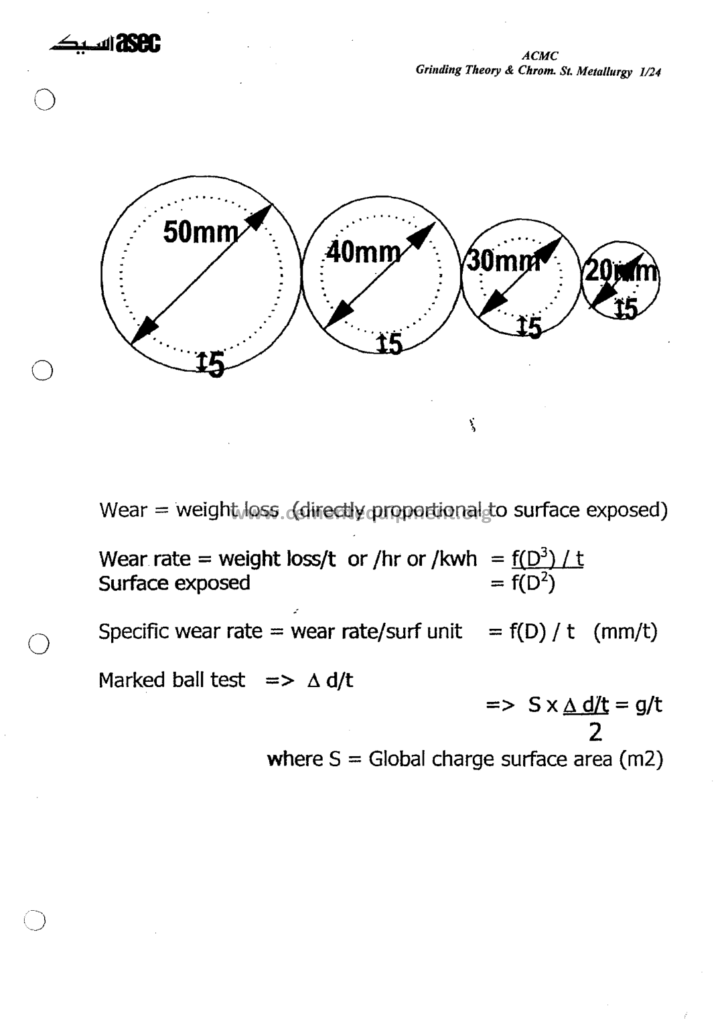
- The ball size distribution: the first chamber with the 60 to 90 millimeters (or 4-inch to 3-inch), the second chamber with the 17 to 30 millimeters: the classic distributions of the three-chamber mills follow the 50/30/20 patterns of the compartments;
- The mill speed: the critical speed of the mill Nc = 42.3/√D revolutions per minute: the tube mills run at 70 to 75 percent of the critical in the cascade mode: the cataracting at the higher speeds wastes the energy in the liner impacts;
- The media shape: the balls dominate, with the cylpebs and the slugs as the alternatives of the last chamber: the cylpebs increase the surface area per volume and improve the fine grinding at the equal charge weight;
- The media density: the steel 7.8 tonnes per cubic meter, the chromium steel with the higher density and the hardness: the charge weight of the 4,000 kilowatt mill is 120 to 180 tons: the investment and the operating cost of the circuit;
The motion of the charge follows the mill speed and the liner profile: the cascade of the balls rolling down the charge surface grinds the material; the cataracting of the top layer impacts the toe of the charge: the theory of the charge motion, documented since the 1910s, is the basis of the liner design: the file includes the classic diagrams of the charge motion at the speeds and the load profile of the mill: the operator of the mill hears the motion in the noise of the shell, and the engineer of the plant calculates it.
6. The Steel for the Grinding Media: The Carbon and the Alloy Elements
The steel of the grinding media belongs to the family of the wear-resistant steels, and its base is the carbon and the alloys:
- The carbon: the principal hardening element: the carbon content of the high-carbon steels 0.7 to 1.2 percent: the carbon forms the martensite after the quenching and the carbides at the tempering: the hardness rises with the carbon, and the toughness falls;
- The chromium: the alloying element of the name: the chromium forms the chromium carbides (Cr7C3, Cr23C6) of the extreme hardness, increases the hardenability so the large balls harden through, and improves the corrosion resistance: the chromium steels of the media contain 1 to 30 percent chromium;
- The manganese: the deoxidizer and the strengthening element: the manganese 0.5 to 1.5 percent increases the hardenability and the toughness: the Hadfield manganese steels of the extreme work-hardening serve the impact zones;
- The silicon and the molybdenum: the traces control the deoxidation and the temper resistance: the molybdenum up to 0.5 percent prevents the temper brittleness of the large balls;
- The nickel and the copper: the residual elements of the scrap cycle: the limits are specified in the quality steel, and the plant of the media controls the tramp elements to keep the heat treatment repeatable;
The steel of the media is a micro-alloyed engineering material, not a commodity: the file gives the typical compositions of the media steels: the low-alloy forged ball of 0.7 to 0.9 percent carbon with the 0.8 to 1.2 chromium; the cast ball of 1.0 to 3.5 percent chromium in the classic low-chromium family; the high-chromium cast ball of 11 to 18 percent with the white iron carbide structure: the composition table of the file is the purchase specification of the plant and the language of the media supplier.
7. The Chromium in the Steel: The Carbides and the Hardenability
The metallurgy of the chromium is the science of the alloys, and three effects define the role of the element:
- The carbide formation: the chromium is the strong carbide former: in the high-chromium white irons the chromium combines with the carbon into the hard hexagonal carbides of the 1,800 to 2,200 VPN hardness: the carbides are the cutting teeth of the grinding ball against the abrasive clinker;
- The hardenability: the chromium pushes the time-temperature-transformation curves to the right: the critical cooling rate for the martensite drops, and the large ball of 80 millimeters hardens through its body on the air cooling or the slow quench: the low-alloy carbon ball of the same size would need the water quench and would crack;
- The matrix strengthening: the chromium dissolves in the austenite and the ferrite, strengthening the matrix that holds the carbides: the matrix hardness after the tempering 45 to 62 HRC in the hardened condition;
- The corrosion resistance: the chromium reduces the corrosive wear in the wet grinding and the chloride environments: the wet mills of the minerals industry select the higher chromium grades for the corrosion domain: in the dry cement grinding the effect is secondary but the trend persists;
The practical classification of the media by the chromium: the low chromium up to 2 percent (the forged and the cast plain steels), the medium chromium 2 to 8 percent, and the high chromium 8 to 30 percent: the file explains the metallurgy behind the classes: the low chromium hardens by the martensite alone, the medium adds the moderate carbide volumes, and the high chromium brings the large carbide volumes at the cost of the toughness: the selection table maps the mill and the material to the chromium class.
8. The Heat Treatment of the Balls: The Quenching, the Tempering and the Microstructure
The performance of the grinding ball is decided in the heat treatment furnace, and the file documents the steps:
- The austenitizing: the balls heat to 850 to 950 degrees Celsius for the forged and the cast steels so the structure becomes the homogeneous austenite: the soak time depends on the ball diameter, and the overheat coarsens the grain and reduces the toughness;
- The quenching: the transformation of the austenite into the martensite: the water spray or the oil quench for the small balls, the air hardening for the large chromium balls: the cooling rate controls the hardness and the residual stresses: the too-fast quench cracks the ball, the too-slow leaves the soft pearlite;
- The tempering: the reheating to 150 to 250 degrees Celsius relieves the quenching stresses and adjusts the hardness-toughness balance: the tempered martensite of the good media shows 58 to 64 HRC on the surface and 50 to 60 in the core of the large balls;
- The microstructure: the desirable structure: the tempered martensite matrix with the fine carbides: the undesirable: the pearlite (soft), the bainite at the higher temper levels (acceptable in the impact applications), the retained austenite (unstable and soft under the repeated impact);
- The quality control of the heat treatment: the hardness survey across the ball diameter, the macro-etching of the cross-section for the uniformity, the microstructure examination at 100x to 500x magnification: the disciplined supplier tests one ball per batch of the production;
The heat treatment is the hidden value of the media: two balls of the identical composition can differ by 15 points of the hardness and the factor of three of the wear life, purely by the thermal history: the file teaches the plant to read the certificate of the supplier: the quench type, the temper temperature, the hardness traverse: the quality purchase is the technical conversation, and the technical conversation is the file.
9. The Hardness and the Toughness: The Balanced Design of the Ball
The grinding ball fights the material and the mill at once: it must be hard to resist the abrasive wear, and tough to survive the impacts without the breaking:
- The hardness: measured by the Rockwell HRC or the Brinell HBW: the surface hardness of the media 55 to 65 HRC: the hardness of the abrasive clinker grains is 800 to 1,200 HV, and the general rule of the wear: the hardness of the steel above two-thirds of the abrasive hardness gives the exponential wear reduction;
- The toughness: the energy the ball absorbs before the fracture: the drop test of the standards drops the ball from the defined heights onto the hardened anvil: the impact test of the production: the good chromium ball survives the drops of 3.5 to 4.5 meters without the fracture;
- The trade: the hardness and the toughness are the enemies of the one ball: the carbon and the carbide raise the hardness and lower the toughness: the design point of the quality ball balances the two at 58 to 62 HRC with the acceptable drop survival;
- The failure modes: the fracture, the spalling, the exfoliation of the surface layers, the pitting of the corrosion: the fracture is the failure of the toughness (the voids of the casting, the microstructure defects), the spalling the failure of the fatigue (the retained austenite transforming under the impacts);
| Property | Low Cr forged | Low Cr cast | High Cr cast |
|---|---|---|---|
| Hardness, HRC | 50 – 58 | 50 – 62 | 58 – 64 |
| Density, t/m3 | 7.8 | 7.6 – 7.7 | 7.6 – 7.8 |
| Impact toughness | High | Medium | Low – medium |
| Abrasion resistance | Medium | Medium – high | High |
| Typical use | Large balls, impact zones | General raw and finish | Second chamber, fine grinding |
| Relative price | Base | 1.1 – 1.3 x | 1.4 – 1.8 x |
The table of the file is the selection map of the plant: the ball that breaks in the first chamber costs the plant the stops and the downtime; the ball that wears fast in the second chamber costs the media budget: the steel grade follows the duty, and the duty is defined by the mechanism map of the earlier chapter: the balanced ball, like the balanced cement, is the product of the specifications, not of the guesses.
10. The Manufacturing Routes: The Forged and the Cast Balls
The grinding media reach the plant through the two routes of the production, and the file compares them honestly:
- The forged balls: the steel billet is heated and upset-forged to the spherical shape: the closed die forging (the highest density and the grain flow), the rotary forging (the cost-efficient mass production), or the roll forging: the forged ball has the wrought structure without the casting voids, the higher toughness per the same composition;
- The cast balls: the molten steel is poured into the molds, the sand or the metal molds: the casting allows the higher chromium compositions whose carbides make the forging impractical: the defects of the casting (the shrinkage, the gas porosity, the segregation) are the risk, controlled by the foundry practice and the quality testing;
- The grinding media of the specific duties: the high-chromium cast balls of the second chamber, the forged low-alloy balls of the feed end of the first chamber, the forged martensitic balls of the grate discharge mills, the special media of the autogenous and the semi-autogenous plants;
- The quality control of the production: the hardness traverse test on the sectioned ball, the drop test on the sample of every 2 to 5 tons, the macro-etching for the defects, the chemical spectrograph per heat: the certificate of the quality accompanies the delivery: the file includes the sample certificate format of the purchase;
The choice between the forged and the cast is the economics of the specific mill: the cast high-chromium ball outwears the forged low-alloy ball by two to three times in the fine grinding, but costs more per ton and tolerates less impact: the comprehensive models of the media economics (the purchase price, the wear rate, the downtime for the topping-up, the breakage rate) are the decision tools of the file: the Excel model of the package computes the media cost per ton of the cement for the alternative offers and prints the recommendation.
11. The Wear of the Media: The Mechanisms, the Measurement and the Rates
The wear of the grinding balls is the steel consumed by the process, and the plant measures it in the kilograms per ton of the product:
- The wear mechanisms: the abrasive wear by the hard clinker grains (the dominant in the dry mills), the impact deformation and the spalling, the corrosive wear of the wet circuits, the adhesive wear of the ball-to-ball contact: the mechanisms act together, and the steel and the circuit decide the split;
- The measurement: the wear rate is measured by the media accounting: the charge weight at the stop, the added media over the period, the product tonnage: the formula of the file: the wear = (initial + added – final + removed)/product tons: the monthly media accounting of the plant is the mirror of the media health;
- The typical rates: the raw mills 100 to 300 grams per ton, the finish mills 150 to 400 grams per ton of the cement, the high-chromium media at the lower bound, the low-alloy at the upper: the slag grinding at the highest 400 to 800 grams per ton;
- The wear distribution: the media wears from the surface and the balls shrink: the balls leaving the mill at the wear limit exit through the mill diaphragm at the ball size below the slot: the competent mill keeps the charge distribution by the periodic sorting out of the worn balls;
The wear rate per unit of the energy is the derived KPI: the grams of the steel per kilowatt-hour of the grinding: the plants compare the KPI of the shifts and the campaigns: the worn media of the second chamber is the silent thief of the fineness: the file teaches the media audit: the sampling of the charge at the stop, the size distribution analysis, the hardness test of the pulled balls: the audit finds the ball of the wrong hardness or the oversized charge, and the correction saves the media budget of the year.
12. The Liner Interaction: The Steel Interface of the Mill Shell
The liners and the media are the steel couple of the mill, and the theory of the one is incomplete without the other:
- The liner function: the liners protect the shell and control the charge motion: the Lifter bars of the first chamber lift the charge for the impact (the classic wave and the step liners), the smooth liners of the second chamber promote the sliding and the attrition;
- The liner materials: the high-chromium cast iron of the first chamber for the impact, the Ni-hard and the chromium-molybdenum steels of the second: the rubber liners (up to 40 percent lighter, 3 to 8 decibels quieter, longer life at the small media) for the fine grinding chambers:
- The wear coupling: the liner profile wears and the charge motion changes: the worn lifter at 50 percent of the height loses the lifting power, and the mill power drops 5 to 10 percent: the liner and the media wear together, and the planned replacements of the two coincide at the overhaul;
- The liner economy: the liner steel is 30 to 80 grams per ton of the cement, one-quarter to one-half of the media wear: the optimization of the liner profile against the media charge is the joint project of the theory chapters: the file includes the liner selection matrix of the mills and the materials;
The steel of the mill is the closed system: the media beats the material against the liner, and the liner lifts the media: the correct pairing of the two materials and the two profiles is the mechanical foundation of the grinding theory: the file closes the loop of the design with the liner chapter, and the plant applies the pairings of the matrix.
13. The Chromium Steel in the Vertical Roller Mills: The Tires and the Tables
The chromium steel metallurgy serves the vertical roller mill as well, in the larger wearing parts:
- The roller tires: the high-chromium cast iron tires of the vertical mills with the 18 to 30 percent chromium, the hardness 55 to 62 HRC, the carbide volumes above 30 percent: the tires of the known suppliers with the embedded tungsten carbide composites for the extreme wear zones;
- The table segments: the cast segments of the same white iron family, the field welding of the wear patches between the stops: the hardfacing of the roller with the chromium carbide rods restores the profile in place;
- The wear difference: the vertical mill wears by the abrasive rolling of the bed, without the impact of the tumbling charge: the steel selection moves toward the hardest carbides and away from the impact toughness: the chromium content of the vertical mill parts is systematically higher than the ball media;
- The economics: the roller and the table wear of the vertical mill 5 to 15 grams per ton of the product, an order of magnitude below the ball mill of the same duty: the steel consumption argument of the vertical mill selection: the file brings both mills into the one wear model;
The metallurgy of the chromium, introduced for the balls, closes its circle on the rollers of the raw mills: the same carbides, the same heat treatment logic, the same quality control: the engineer of the plant who masters the chromium steels masters the wear of the entire grinding department: the file connects the chapters and gives the unified wear language of the two mill families.
14. The Practical Campaign: The Media Optimization of the Finish Mill
The theory and the metallurgy meet in the optimization campaign, and the file walks the plant through the typical year:
- The audit: the mill stops, the charge is sampled: the size distribution, the hardness traverse of the samples, the wear rate of the last six months from the media accounting, the power draw at the known charge: the baseline of the file;
- The analysis: the population balance model computes the product of the current charge; the gaps of the fineness and the specific power appear: the over-loading of the coarse balls in the first chamber or the worn top-up in the second:
- The change: the planned charge correction: the relining of the worn lifters, the top-up with the high-chromium 20-millimeter balls of the second chamber, the charge volume adjusted to the 32 percent: the change executed at the scheduled stop, the risk limited by the staging;
- The verification: the mill restarts, the product fineness and the power monitored daily: the first samples after the 24 hours, the full Blaine and the PSD tests within the week: the target: the 5 to 12 percent lower specific power at the equal fineness, the media saving of the year;
- The continuous loop: the media accounting monthly, the wear trend quarterly, the annual audit: the optimization is not the project but the routine: the file includes the monthly media log of the plant and the KPI dashboard of the ware;
The campaign of the file is the complete proof of the theory: the breakage functions predict, the chromium steel delivers, and the accounting verifies: the three chapters of the document close the circle: the engineer leaves the file with the method, the tables and the tools: the mill of the plant runs the next year on the chromium steel of the right grade, at the wear rate the file promised.
15. The Media Logistics: The Storage, the Charging and the Handling of the Balls
The finest metallurgy is wasted by the careless logistics, and the file closes the practical loop of the media with the handling discipline:
- The storage: the balls arrive in the steel drums of 500 kilograms to 1 tonne, or in the big bags, or loose in the containers: the store keeps the drums covered and elevated: the surface rust of the humid storage does not harm the martensitic core but the corrosion pitting creates the stress raisers, and the rust layers of the long storage should be brushed before the charging: the oldest stock is used first;
- The handling: the charging of the new mill or the top-up is done with the magnetic ball lifters, the ball chutes, the rotating drum chargers or the pneumatic conveyors: the lifting magnets must not feed the balls through the diaphragm slots: the mill manufacturers provide the charging hatch positions of the shell:
- The charging into the running mill: the regular top-up proceeds while the mill turns, with the interlocked chute and the counted quantities: the balls enter at the feed end and migrate with the material: the plant records every addition in the media log: the addition discipline is the basis of the wear accounting of the earlier chapter:
- The sorting and the removal: at the overhaul the charge is sorted on the screens by the size classes: the worn balls below the useful size are removed, the deformed and the broken balls rejected, the good fractions returned: the sorting of a 150-tonne charge takes the shifts and the planning of the file allocates the time:
- The safety: the media charging is the manual-heavy work of the plant: the personal protective equipment, the machine guarding of the chutes, the lockout of the mill drive during the internal work: the safety chapter of the file repeats the rules of the media handling: the balls of 90 millimeters weigh the kilograms that break the feet and the fingers:
The media logistics is the quiet cost center of the grinding department: the counting, the store and the charging organized well save the percent of the media budget in the shrinkage and the mistakes, and the traceability of the batches keeps the quality conversation with the supplier alive: the file treats the logistics as the equal of the metallurgy: the chromium steel performs only when the discipline delivers it whole to the mill chamber: the complete media management, from the foundry to the sorting floor.
The Frequently Asked Questions
Why is the Bond work index quoted per short ton and not per metric ton?
The Bond method was built in the American mineral industry, where the short ton (2,000 pounds) is the traditional unit: the index Ki is defined at the short ton basis: the plant converts the kWh per short ton to the metric by multiplying by 1.102: the conversion table of the file avoids the classic errors of the difference.
What hardness is the best for the second chamber of the finish mill?
The second chamber grinds by the attrition and the abrasion with the small impacts: the design point is 58 to 62 HRC for the high-chromium cast media: the hardness above 63 risks the premature fracture of the small balls; below 56 the wear rate climbs steeply: the file’s optimum is the 59 to 61 band for the typical clinker.
How often is the drop test of the media performed?
The industrial practice tests the sample balls per 2 to 5 tonnes of the production lot, and the certificate accompanies the delivery: the receiving inspection of the plant repeats the drop test on the arrival samples: the balls that fail the drop damage the mill and cost more than the test: the test is cheap and the failure is expensive.
Does the chrome content alone decide the media quality?
No: the chromium enables the carbides and the hardenability, but the heat treatment, the density and the defect control decide the final performance: the high-chromium ball with the poor austenitizing behaves like the low-chromium ball at the higher price: the plant verifies the hardness traverse and the microstructure of the certificate, not only the chemistry.
The Excel tool of the media accounting is included in the package?
Yes: the package includes the media management spreadsheet that logs the additions, computes the wear rates, forecasts the top-up calendar and compares the supplier offers at the equal basis: the 931 files of the package include the tools of the media economy and the theory books of the grinding.
Can the wear rate of the media be predicted before the purchase?
The prediction uses the hardness of the ball, the abrasiveness of the material and the mill parameters: the models of the file combine the material abrasion index (measured by the laboratory test) with the mill power and the media hardness: the prediction lands within the +/- 20 percent band: the plant then verifies with the three months of the accounting and adjusts the media plan.
Conclusion
The grinding theory and the chromium steel metallurgy are the two disciplines of the one mill: the energy laws predict the power the mill needs, the breakage mechanisms describe the work, and the chromium steels deliver the wear life that makes the work economical: the engineer of the plant, armed with the Bond equation, the population balance and the metallurgy of the carbides, reads the mill with the complete eyes: the power, the fineness and the steel are the three answers of the one machine.
The Complete Cement Technical Package includes this grinding theory and the chromium steel file with the equations, the tables, the quality forms and the Excel tools: the 931 files, the $249.99 one-time purchase, the instant download: the metallurgy and the theory of the mill in the hands of the engineer: the cement knowledge, the steel certain: the grinding of the plant, understood and mastered.
Get this Grinding Theory file + the full 931-file package
$249.99 — one-time purchase, instant download, lifetime access
This file is part of the Complete Cement Technical Package (931 files) available from cementequipment.org. Respective rights holders; library copy for the licensed single user.