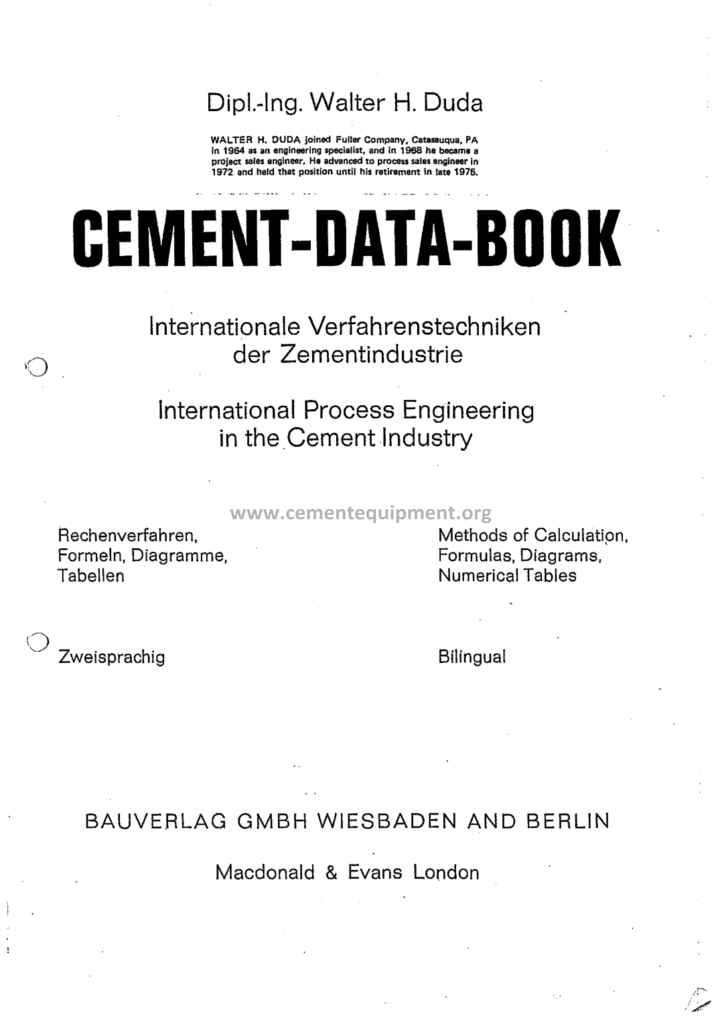
Cement Databook Duda Version: Complete Technical Guide
The Cement Data Book by Walter H. Duda is one of the most important reference titles the cement industry has ever produced. For process engineers, mechanical engineers and plant managers it was for three decades the default “encyclopedia” where design relationships, machine ratings, process steps and cement technology diagrams were looked up before any spreadsheet existed. This document, the full multi-hundred-page volume in PDF form, is part of the Complete Cement Technical Package available from the cementequipment.org library for $249.99 with instant PayPal delivery.
The value of the Duda Data Book lies in its structure: instead of presenting one theme with water (as a textbook does), it collects, tables and organizes the whole body of cement process engineering — materials, machines, flowsheets, formula relations, plant examples — in a way designed for quick professional reference. In this guide we reveal what the book contains, how it is organized, how engineers actually apply it, and how it complements the rest of the 931 files in the package.
1. Who Was Walter H. Duda and Why His Data Book Matters
Walter H. Duda is a classic name in cement engineering literature, the author of the multi-volume and international process manual “Cement Data Book”.
In the pre-internet era of engineering, engineers at cement plants, machinery suppliers and engineering offices in Germany, India, the Middle East and Africa used Duda’s tables daily: ash recipes, grindability indexes, mill power formulas, preheater design, kiln productivity relations, silo calculations, transportation systems data. The book remained famous because it combined, in one place, the process knowledge that today is fragmented across manuels, courses and vendor catalogues.
Because of its terse and tabular style, anxious trainees called it and the profession still calls it “the data book”. For the community of mill and kiln engineers in non-English-speaking countries the English edition became the bridge language.
2. The Overall Structure of the Cement Data Book
The Data Book is organized around the complete flow of cement manufacturing. Depending on the edition volume, the classic content relates to:
| Chapter block | Content family |
| Raw materials and quarrying | Limestone, marl, clay, gypsum; deposit assessment; quarry layout; explosives usage; excavator/feeder. |
| Blending and homogenizing | Storage, dosing plant, homogenizing silos, mixing beds, machinery. |
| Size reduction | Crushers (jaw, gyratory, impact), mills (ball, vertical, separate), comminution theory. |
| Drying and heat exchange | Heat supply, rotary dryers, kiln systems with preheater / precalciner stage circuits. |
| Burning | Rotary kiln, the flame, calcinator, residence time, coating, clinker burning chemistry. |
| Cooling | Cooler types (grate, planetary, rotary), clinker cooling efficiency, heat recovery. |
| Grinding | Ball mill design, charge weighing, degree of filling, drive, media lifetime. |
| Storage & transport | Silos, conveyors, cement dispatch, packing & palletizing. |
| Lab & quality | Sampling, analysis, control of the process. |
This organization — from raw material to dispatch — mirrors the physical plant, which is exactly why the book is so easy to consult during plant design and audit.
3. The Process Engineering Core at the Heart of the Book
The unflinching goal of Duda’s Data Book is the quantification of process design. Well-known chapters give for example:
- Raw meal design: calculation of the composition and the LSF, silica and alumina ratio from a given analysis.
- Burnability/kiln load: the relations of input, retention time, temperature, output; kiln diameter tables with ratios.
- Ball mill: the “32:1” filling relations, grindability constants, output per kW and per volume, media wear relations.
- Air flow: the preheater gas flows, working points, separator circulation ratio and classification of the material.
- Thermal balance principles: the energy inputs/outputs for the kiln section in numbers.
These formulas are of the family of “engineering rules that work on site”: the numerical coefficients were validated in industrial plants over decades, so they remain useful day-to-day even if a modern plant uses an Excel copy of the same relations.
4. How Modern Engineers Use the Data Book (Even in 2026)
It would be a mistake to believe that a material from the “pre-digital” era has no place in the modern engineering office. In practice:
- Audits & technical due diligence: consultants compare the book’s formula-based performance of a plant (kiln volume, cooler area, separator circulation) with the actual KPIs from the DCS, to find energy potential.
- Design checks: when a vendor proposes a mill or cooler, the design engineer verifies the geometric and process dimensions against the Data book rules before signing.
- Training and recruitment exams: many internal “cement school” courses reuse the Data Book exercises as exam models.
- Sizing spreadsheets: the numerous relations live encoded into Excel tools, including under the same package.
For the modern engineer the book is, in other words, the “source text” that produces of the plant devices and the Excel sheets: it is the reference environment of the whole discipline.
5. The Kiln Section: Burning Lines and Practical Realities
The burning section of the Data Book is famous among practitioners. It describes the rotary kiln itself:
- The geometry relations that give stable coating, the L/D ratios.
- The residence time of the material, and its base on the inclined and rotating lines.
- The flame geometry, the temperature distribution, the region of the reaction zone.
- The calciners and preheater stages with their gas flows and separators.
- Coating and ring formation, and its relation to raw-meal design.
In a modern context the same sections give the base to understand alternative fuel plants: a burn as replacement, a lower flame temperature with the same quality – because the data relations of the function of the kiln do not change.
6. The Grinding Chapters: From Ball Mill Rules to Vertical Rollers
Grinding occupies a huge share of the Data Book, mirroring its share of cement plant electricity:
- Comminution basics: Bond, Kick and Rittinger laws, work index, tailor-made classification.
- Ball mill sizing relations: critical speed, ball degree of filling, ratio of ball charge, output per unit capacity, drive & gear data.
- Separator technology: circulating load, efficiency, the Blaine/90μm indicators.
- Vertical/roller mills: the geometry of the table – runner, pressing force, the NV of the mill.
- Auxiliaries: mill ventilation, grinding aid use, cooling cements.
These chapters remain the best-ever “single-trip” description of the mass-balance of the ball mill in the literature: with the Data-book formulas an engineer can design the number of chambers, the liner arrangement and the annual charge quickly.
7. Quality Control and Plant Operation Tables
The book also dedicates chapter blocks to quality control:
- The sampling regimes (instant and cumulative), the laboratory characterization, the data-based control charts.
- The chemical limits of the raw mix and clinker with the ratios LSF/SR/AR and their numerical limits.
- The setting of strength development relation to grinding» and to the SO3 addition.
All is presented in the tabular school phrase, ideal for use at the shift meeting.
8. The environment, energy and modernization pages
The later editions of the Data Book also integrate efficiency and environmental material: the heat an balance of the cement plant, energy saving options, dust collection, assessment of emission data and modern process control. This gives the volume the rare property of being both “retro classics” text and “still up to the tool” field books.
9. How the Data Book Works with the Rest of the Library
Within the Complete Cement Technical Package, the Data Book serves as the systematic “reference spine” while other files provide:
- The Holderbank course files — teaching the same material with modern slides and case exercises.
- The Excel tools — knockout calculations of what the Data Book describes in tables.
- The plant documents — real KPI sheets of preheater, kiln and mill sections.
- Lea’s Chemistry — the micro and chemical layer beneath the Data Book formulas.
The stack “Duda + Brooks — Excel — Lea” gives the plant engineer the entire : the data book speeds the calculations, the tools give numbers quickly, and the chemistry explains the underlying mechanisms. That is why the package of all files (931) is sold under one roof and not file by file.
10. Who Should Use the Data Book
| Role | Use of the Data Book |
| Process engineer | Formulas to check capacities, heat balances, kiln geometry, preheater flows. |
| Mechanical engineer | Mill charge calculation, chain systems, elevator and conveyor data. |
| Project & contracts | Design specification validation, scope of proposals, engineering memos. |
| Training manager | Exercise stems for process school exams and filling the “engineering common knowledge”. |
| Consultant / auditor | Performance benchmarking of plants: data look-ups and expected ranges. |
| QC / laboratory | Chemistry ratios, sieve list, control charts in the manual. |
10.1 A Practical Demonstration: Sizing a Ball Mill with Data-Book Relations
To illustrate how the Data Book is used in real design work, consider a typical assignment from a plant engineering office: defining the first approximation of a new finish grinding department for 3,000 tpd of OPC. The steps a young engineer takes with the Data Book are the following:
- Grindability first. The work index of the clinker is taken from the tables for ordinary clinker with a given Blaine target, by interpolation between the book’s standard curves (28, 30, 32 cm²/g on the scale of inputs).
- Mill dimensions. From the ratio tables, the diameter/length and the number of chambers are chosen so that the calculated output matches the requested throughput with the circulating load typical of OPC (with the book ranges 150–250%).
- Charge definition. The ball charge distribution (% of each ball diameter by compartment) is read in the charge-panel chapter, then adapted to the feed size d95 of the clinker.
- Drive sizing. The absorbed power is computed by the Data-Book formula family (power per ton, critical speed relation), then compared with the vendor quote; a deviation above ~5% triggers a design review.
- Ventilation and separators. The separator is dimensioned by circulation & temperature of the air, and the filter size from the gas volume tables.
This workflow alone demonstrates why the book has remained in daily use: it gives the “first-size” that professional FMEA and detail design then refine. The same mental route is used today, only faster, by the hybrid of the book formulas re-implemented into the package’s Excel sheets.
10.2 The Data Book in Turnkey Project Documents
In many engineering procurements of the 1980s;2000s years the Data Book was referenced in the technical specification itself: “Design in accordance with the data and relations of the Cement Data Book (Duda)”. Why? Because it played the role of a neutral, universally accepted design baseline. Two suppliers could both claim their kiln was “big enough”, but only one bakery the calculated capacity and retention time of the book. The consequence is that today almost every experienced engineering director and junior process engineer from the old school has gone to school, in his explanation, with Duda: it created a shared professional vocabulary. For a young engineer joining a middle plant, the recoron “Duda data” during his first days is the professional gatekeeping to the industry.
10.3 Reading Plan for a New Engineer
For a newcomer to the industry, reading the Data Book from cover to cover is not the recommended path. The practical reading plan is:
- First month: the raw-mix and chemistry chapters, plus the process table of the whole flow.
- First year: the kiln chapters (geometry, retention, flame) and the cooler tables — during the first kiln project.
- Second year: the mill sizing chapters, mastered in parallel with the Excel grinding tools.
- Five years: the energy-efficiency, environmental and control blocks, if the “green cement” era assignment has begun.
This staged reading is the same for the 931-file package: the books give the stages, the tools practice the numbers, the courses glue the knowledge.
10.4 Materials Handling and Storage: The Chapters They Skip Too Often
Every experienced engineer admits the cement plant is 60% materials handling and 40% process. The Data Book gives these unglamorous chapters their full place:
- Storage and blending beds: the geometry and arrival/withdrawal stacking so that the raw material quality is homogenized; chute and bin angles, hopper discharge, the theory of the “live storage”.
- Mechanical conveying: bucket elevators (capacity, chain speed, filling of buckets), drag chain conveyors, belt conveyor slant tables, screw conveyors (the famous “K-coefficients” for capacity = k * D2 * n), air slide systems for dry bulk powder.
- Pneumatic conveying: the dense-phase and lean-phase calculations, air quantities, pressure aids (blowers/pumps) and the mill filter interplay.
- Clinker and cement storage: silo design basics, discharge aids (fluidization panels), cement moisture protection, root bin levels and the transport to packing.
- Packing and loading: bag packing machine types, palletizer data, despatch organization — the section the plant manager always wants to see.
The economic weight of handling is huge: each ton of raw material spends energy in at least three transfers before it enters the kiln. The book’s advice to compare inclines, distance, angle tablets before choosing a system is still valuable design acumen, and with the raw material changes of the “green era” (more additives, more moisture) this material regains new relevance.
10.5 Quality Control Data and the Laboratory Inside the Book
The laboratory block of the manual is remarkable for being practical:
- Sampling trees in the complete automatic stations: sampling of raw meal, clinker, cement, with the statistical quantities of the sampling interval.
- Chemical analysis practice: the classic XRF/XRD work, the free lime titration, the sulphate determination, the retained-in-filter residues.
- Interpretation: the strength of the standard cement mortar, the setting characteristics, the soundness test, the “relationship” in which grindability and SO3 affect strength curve.
The famous “shift decision” process from the lab is presented in table: if A, then B. For example the operator’s grid of raw-meal LSF movements (feed correction), the clinker free lime movements (burning temperature or flame), the cement strength deviations (mill parameters) — all the closed-loop actions that the whole plant does hundreds of times each shift. A young QC engineer will in the first months reproduce these exact flows with an improvement manual.
10.6 The Ten Data-Book Relations Engineers Actually Remember
Old cement engineers treasure a handful of rules from these tables that still serve as rule-of-thumb sanity checks at every plant. Here are the classic ten, presented as the profession remembers them:
- LSF ~ 0.92–0.98 for ordinary raw mixes (with the classic 100 CAO / (2.8 SIO2 + 1.18 A2O3 + 0.65 F2O3) definition).
- Silica ratio 2.0–3.2 and alumina ratio 1.0–2.5 as the classic design window that burns well and grinds acceptably.
- Free lime below ~2% for acceptable burning-zone output in the evening samples.
- The Blaine 90μm residue relation: for every unit of Blaine the 45μm residue tells more than surface alone — hence the 32μ sieve culture in the plant.
- Ball mill critical speed relation: charging percentage and mill speed define the trajectory of the load: the operational point (fmt) is typically 70–80% of critical.
- Degree of filling ~28–32% in the classical ball charge design, adjusted by compartment task.
- Mill output ~ 30–35 kWh/t as the specific energy reference for OPC to 3500–3800 Blaine (pre-pregrinder circuits vary).
- Circulation ratio of separator normally ]150–250% for 3rd-generation close circuits; low ratio means coarse return, high ratio a too loaded separator.
- Kiln retention: the classic geometrical relation based on inclination & rotation, giving 20–40 minutes at the given kiln speed.
- Cooler efficiency data in the book’s panels (secondary air temperature, clinker exit temperature) that are used as acceptance criteria in the no-manufacturer guarantee tests.
Each of these ten is a matter of thirty seconds of consultation in the book and hours of software verification in modern projects — this is exactly what we expect from a “data book”.
10.7 Why This Volume Still Sells as a Course Companion
Ask any trainer who runs the classic “cement process training weeks” (the old-fashioned 3-week schools of the industry) which exhibit is still on the table during the plant design exercise: certainly the Data Book. The reason is the pedagogical quality of its chapter-end problem sets: the reader is led to calculate the raw-mix, the mill combination, the heat balance and the separator circuit in the same order as the plant. During formal training, the typical week plan looks like this:
- Monday: raw materials and batch chemistry exercises (LSF/SR/AR and the raw mix dosages).
- Tuesday: grinding: Blaine, PSD, charge, energy per ton exercises.
- Wednesday: kiln system: geometry, retention, temperatures, gas analysis.
- Thursday: cooler and heat recovery exercises.
- Friday: complete “mini-design” of a line with the Data tables — the famous closing exercise.
This is why so many Technical university courses in emerging cement countries (where these books were the local technical source for decades) still recommend the reading list “Duda first”. It is also the segment the package directly addresses with the Holderbank and FLS course files: slide + exercise + book = complete formation loop.
15.2 Positioning Inside the Digital Age: the “Paperless” of the Modern Plant
The modern plant runs with a CMMS (maintenance software), an LIMS (laboratory), Excel macros for process and PDF drawers of vendor manuals. The Data Book in PDF integrates into this environment as it never did as paper: it can be referenced in documents, quoted in e-mails, printed chapter-by-chapter, or copied into the technical library of a server. The technical community often uses the “digital Duda” as the agreement point: when the Arabic/Indian/African colleagues refer to a “formula or a table” they all mean the same pages — a rare universally shared base. The package includes the full set of formats: books, courses, tools and presentations, so every digital need of the professional library is served from one checkout.
15.3 Keeping The Data Tree Up-to-date
One legitimate question of a modern buyer: “Do I need additional volumes or later editions on top of this?” Our answer is clear: the package is a complete reference by scope (all 931 files) and this particular item is the complete integral edition of the classic work, the same that generated the generation of engineers and, in all its successors, has never been replaced: later specialized titles (like the courses of Kneis, like the modern process training) complement rather than replace the Data Book. That complementarity is exactly what the library offers: together with the Data Book you receive the courses, the tools and the modern documentation, giving your bookshelf both the classic spine and the modern arms.
11. Thermal Balance Work with the Data Book: A Kiln Engineer’s Standard Exercise
One of the most practical uses of the Data Book in daily engineering life is the thermal balance of the kiln section. The classic heat-in/heat-out matrix taught by this volume includes the following items, still written by hand in plant audit reports today:
- Heat in: sensible heat of raw meal, chemically bound heat of the feed, sensible heat of fuel (plus the latent heat of fuel moisture), heat of combustion.
- Heat out: sensible heat of clinker at the cooler exit, heat of the cooler air, heat of kiln exhaust gases, heat losses by radiation, heat loss in casing, heat in dust, heat of the chemical reactions (endothermic calcination, exothermic component formation).
- Reporting index: the energy per ton of clinker (GJ/t or kcal/kg clinker), the “heat consumption of the burning since” the preheater-phase efficiency, the cooler efficiency, and the fans consumption.
In a modern audit the balance is typically performed with the site Excel matrix, but the industry convention still quotes “the Duda range”: the typical kilns sections with a moderate preheater consume 3,100–3,600 MJ/t or less with precalciner lines, while the Data Book helps verification of retained heat streams and expected losses. Using the book’s default values as a reference makes the site-specific balance credible in front of management: “our excess air is 12% against the book’s 8–10%, hence our exhaust heat loss grows by ~X GJ” — an exact argument and not an opinion.
12. Energy Efficiency: The Data Book on the Decarbonization Agenda
The modern “green cement” era has not diminished the Data Book; it has changed the way its sections are quoted:
- The alternative fuel chapter (where present in the edition) and the burning sections now form the basis of co-processing calculations: the flame temperature, the residence time and the gas flow that the legacy fuels will host.
- The mill power formulas are now used to design electricity-saving circuits, pregrinders and optimizer separators (“Feeding the Data Book relations to power curves”).
- The exhaust gas data serve to size boiler feedover instead of dust filters, because the waste heat is no longer rejected in an energy-optimized plant.
- The raw-material tables support the evaluation of alternative raw materials (limestone pones, slags, ashes) with their grindability and moisture, which is exactly the assessment needed for scope-2 and scope-3 reduction.
Engineers planning the 2030 transformation of an old line will therefore open this book again, not as museum, but as the base design instrument of the colder base case an simulated with heat and mass data.
13. The Data Book Compared to Other Library Titles
Let us position Duda relative to the other pillars of the package, so that choosing where to start is easy:
| Title family | Character | Use together with |
| Cement Data Book (Duda) | Tabular design data, formulas, machinery survey | Excel tools of the package (the same relations in calculators) |
| Lea’s Chemistry of Cement and Concrete (5th ed.) | Fundamental chemistry and microstructure | Theoretical depth where the process “why” |
| Holderbank courses / process training | Modern slides and case studies, operator-level | Induction training using the Data Book as reference |
| FLS training and PPT library | Vendor-level specifics: equipment types, maintenance | vendor-technical chapters referencing Data formulas |
The purpose of this positioning is never to say one book “beats” the other; on the contrary, the two of them force the strongest circle of engineering knowledge growth: Duda for the numbers, Lea for the chemistry, courses for the operating reality, tools for the speed.
14. Digitization Experience: PDF with Search, Tables and Figures intact
Digital copies of dataset-quality scans can be bad: cut tables, blurred figures, broken indices. The library copy is a complete PDF in usable page formation; the tables and curves essential to the reader remain legible, the page numbers of the printed edition match up so that chapter calls in older plant documents (for example “see Duda, Table 3-19”) can still be found. The transfer of the book to the digital library keeps its reference role intact, while adding the official convenience of the electronic copy.
15. Frequently Asked Questions
Is this the complete book?
The file is a complete full-run volume in digital form, faithful to the print pagination, ready to read and print. If you are looking for a specific chapter it remains fully search-friendly.
I only wanted “the mill chapter” of the Data Book; do I need the package?
The package sale is the complete library at once ($249.99), all 931 files: books, courses, tools and presentations. You will use the mill chapter, and then you will likely also use the associated formulas and course slides — still at the same single price.
Is the relationship with the German industries edition?
The original is a German-language industry work (Bauverlag editions) which was distributed internationally in the English translation. This library copy is the standard professionally recognized reference edition and is used for over a generation of the community.
Is everything in the package licensed?
The package is a single-end-user purchase collection of materials. You pay once, download and use your own library; redistribution is prohibited by the terms and should be respectful of the authors’ works.
How do I receive the files?
Immediately after the PayPal payment, the download access of the full library (books, courses, tools) is delivered to your e-mail; the package is meant for one user/team-approved license. For larger teams, dedicated multi-seat orders can be discussed via Contact of the site.
Does the Data Book need other programs to be used?
No. It is a standard PDF file, readable in every reader on Windows, macOS, Linux and mobile devices. Because the process relations in the volume are tabulated, many engineers transcribe them into their own Excel delivers — a workflow the package supports directly with its ready-made calculation tools.
Can I print a chapter for the plant meeting?
Yes; printing for your own professional use is fine. The copy is delivered digitally and the buyer obtains a single-user license of the library. Redistribution of files to third parties is not permitted; for plant-wide training across dozens of staff the multi-seat option applies.
I am a student; is the Data Book too advanced for me?
It is actually the best “second book” a cement-processing student can own: the formulas and tables give numbers to the theory of the courses, and the many check calculations serve as self-assessment practice. The recommended path: read your university material, then verify with Duda’s numbers.
Are there unknown errors in digital copies?
The copy in the library is seduquevily verified across several editions of the scan available in the community: page identity, table legibility, cover-to-cover completeness were controlled before inclusion. Any report concerning the file quality is investigated by our support.
16. Conclusion: The Cement Data Book Remains the “Number One” of the Industry
Few industrial texts have kept daily usefulness for six decades. The Duda Data Book is one of them: the design formulas, panels of checks and process tables are still the “reference” for engineering thinking in the cement sector. Take the chance to get it today in the complete library with its Excel and courses, and build the full engineering desk of the plant with one payment.
The package is one library: books + courses + tools + slides, instantly downloadable. The professionals of the industry have used this volume since decades; now the digital copy is at your fingertips.
Add it to your cart now: click the button below, complete the payment with PayPal and the download link will be in your e-mail the same minute. Your next project, the next mill sizing, the next thermal audit will sit on the ground of six decades of professional data — the true “cement data book”.
Get this book + the full 931-file package
$249.99 — one-time purchase, instant download, lifetime access