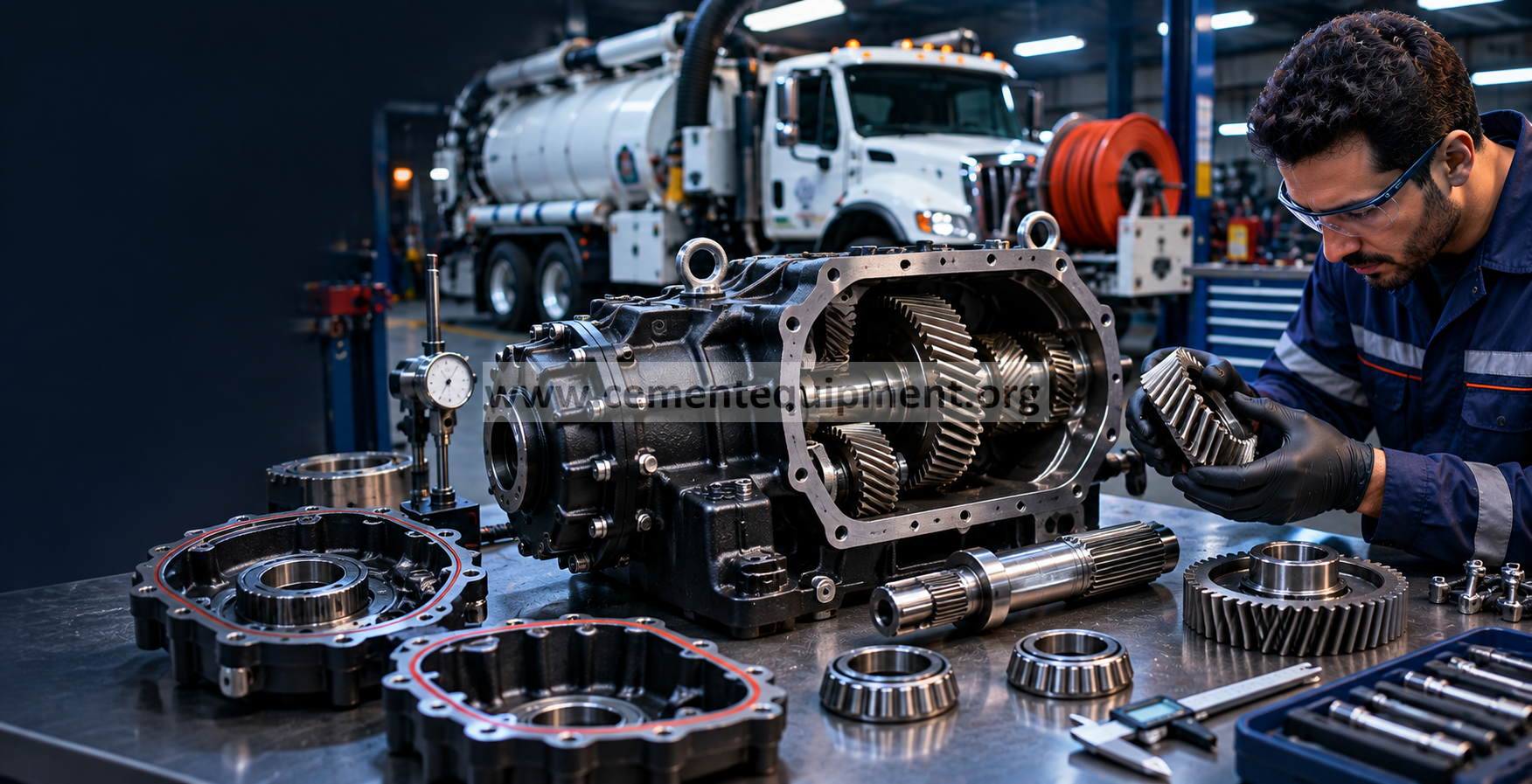
Repair instead of replacing an entire expensive transfer case. We assess failed Vactor-equipped sewage and vacuum-service trucks individually, including Vactor 2100-series, 2100 Plus, 2100i, 2115 and compatible heavy-duty transfer-case arrangements where fitted. Transfer-case designs vary by chassis, serial number and OEM supplier, so we confirm the actual assembly before promising compatibility.
Tell us which Vactor is down. Start with pictures, not an expensive parts order.
Send the unit’s model and serial, transfer-case data plate, visible damage, fault symptoms and any inspection notes. We will determine the appropriate inspection scope and whether a controlled repair or rebuild is feasible.
Engineering RFQs: [email protected]
Problems we can investigate
- Transfer case cracked or housing damaged: evaluate casting condition, shaft bearing bores, alignment, replacement housing or engineered recovery options. Not every cracked housing is repairable.
- Gear tooth, shaft or spline damage: identify damage mechanism, metallurgy, gear geometry, fit and suitable approved replacement or manufacturing route.
- Bearing failure, noise, heat or oil contamination: analyze lubrication, bearing preload, sealing, alignment and related drivetrain causes.
- Vacuum blower does not engage: distinguish internal mechanical failure from PTO, drive coupling, air-shift, hydraulic and electrical control/interlock faults.
- Transfer case will not shift between road and work mode: assess air pressure, actuation, control input and the actual shift mechanism under appropriate service procedures.
- Obsolete or difficult-to-find transfer-case parts: explore dimensional inspection, reverse engineering, machining and material testing where permitted and technically justified.
- Recurring transfer-case failure: investigate driveline angle, misalignment, lubrication errors, abnormal torsional loads or operating-condition problems.
Our repair process
- Initial evidence review: Vactor model and year, Vactor unit serial, chassis VIN only if needed for fitment, transfer-case manufacturer and nameplate, current symptoms and fault history.
- Failure isolation: separate a defective mechanical case from driveline, control module, shift actuator, PTO or blower-drive problems. Do not bypass interlocks.
- Inspection & engineering scope: agree authorized disassembly, photographs, defect map, dimensional and metallurgical checks where relevant.
- Repair or replacement decision: quote parts, rebuild labor, engineering NRE, tests, return shipping and estimated lead time separately after technical confirmation.
- Verification: appropriate mechanical bench checks, leak/oil checks, controlled fitment and OEM-specified return-to-service procedures by qualified technicians.
Which assemblies are eligible?
We review Vactor, sewer cleaner and hydrovac transfer-case problems based on the exact data plate and service configuration. Older OMSI, split-shaft and other OEM or chassis-supplied gearcases can differ substantially. We do not assume that all Vactor models use the same case or that every part can be economically or safely repaired. Where a case is too severely damaged, we can assess engineered replacement options.
Useful pictures and documents
- Transfer-case ID/data-plate picture and serial number
- Close-up photos of cracked housing or broken gearing (if safely accessible)
- Chassis manufacturer, engine, transmission, Vactor model and production year
- Symptom: truck drives/no vacuum, no PTO engagement, gear noise, overheating, leak or no shift
- Existing dealer diagnosis, parts quotation or overhaul report if available
- Location/country of the truck and whether the case can be shipped for workshop inspection
Questions fleet managers ask
Can you fix every Vactor transfer case?
Our engineering network accepts enquiries across Vactor configurations, including unusual and obsolete gearcases. Actual repairability must be determined after reviewing the assembly, extent of damage, safety requirements and access to suitable materials or parts. No universal repair guarantee is made.
Can you repair a transfer case that is cracked?
We can evaluate the housing, including casting and bearing-seat integrity. Repair, remanufacture or complete replacement may be required depending on loading, defect depth and material. Critical repairs require validated inspection and testing.
What if the truck runs but vacuum does not work?
That symptom can involve a cracked gearcase, but it can also originate in the PTO, shaft coupling, interlocks, blower or shift-control system. We investigate the cause instead of treating a symptom as proof of a failed case.
Do you ship internationally and accept one unit?
A one-unit technical assessment is welcome. The proposed workshop location, transport, import/export and any temporary-import/re-export procedures must be agreed before shipment. Repair cost and scheduling depend on inspection and case configuration.