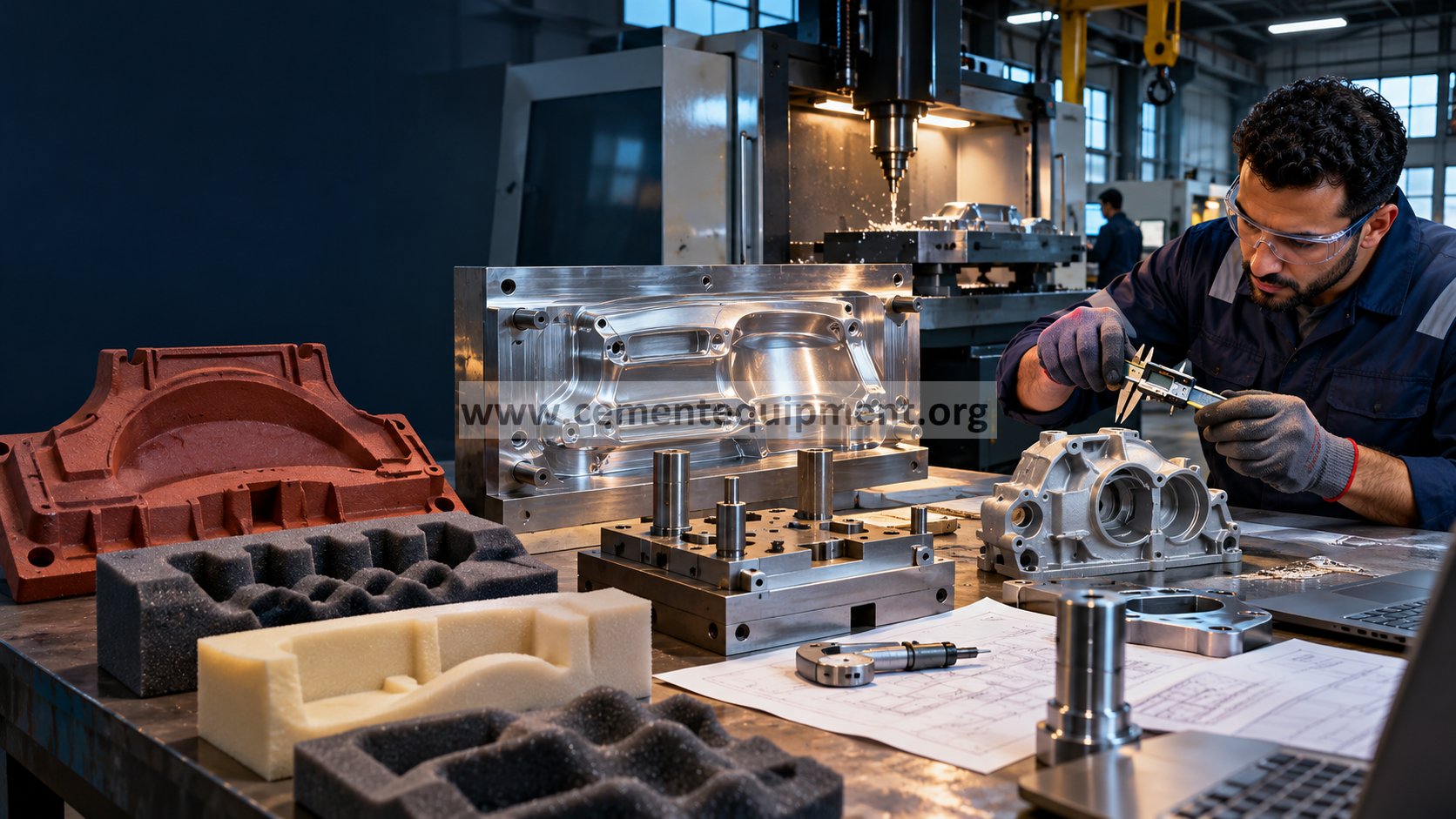
When conventional mold suppliers refuse your project
A complex foam insert or obsolete iron casting may be economically impossible to make with conventional high-volume tooling. We investigate alternative production routes and the true cost of a first article. Our independent engineering network in Egypt can assess technical possibilities for customer-owned designs and irregular low-volume projects without requiring a standard production MOQ as a precondition to review.
Specialized engineering scope
- Foam / sponge parts: custom industrial foam inserts, shaped pads, cushioning, protective packing cavities and controlled-density prototypes.
- Foam cutting molds and fixtures: CNC-cut tools, reusable patterns, compression tooling and inspection templates to match complex profiles.
- Cast-iron tooling and casting patterns: sample-driven reproduction, foundry pattern feasibility, casting allowance and machining datums where suited to the target iron grade.
- Aluminum molds: prototype and bridge tools, low-volume precision cavities, inserts and repair feasibility.
- Complex shape reconstruction: reverse engineering from samples or approved CAD, defining critical dimensions and acceptance tests.
Technical information needed for a real quotation
- Drawing or sample photo with dimensions, CAD files if available, and any intellectual-property ownership evidence required.
- Material family, hardness/density or iron/alloy grade, required temperature/chemical exposure, dimensional tolerance and application.
- Quantity now, possible repeat demand, expected lifetime and accepted first-article inspection requirements.
- Destination country, time constraint and target delivered cost.
One part is enough to begin a feasibility review
Email: [email protected]
Frequently asked questions
Can you start with one prototype?
Feasibility review has no fixed MOQ, although an individual prototype may require dedicated CAD time, patterns or fixtures whose cost is stated separately. Acceptance and production depend on technical and commercial assessment.
Can you replace a worn mold without the drawing?
Often a sample and sufficient reference dimensions allow a reverse-engineering assessment, but defects or missing critical geometry must be resolved before tooling is made.
Are molds guaranteed suitable for food, medical or load-bearing use?
No general certification is implied. Applications requiring certification, structural validation or special material compatibility will need those requirements documented and independently confirmed before contract acceptance.
Images illustrate possible engineering processes, not a completed customer project. Proprietary designs, casting grades, environmental and safety constraints are reviewed before accepting work.