Cement Plant Spare Parts Inventory Management: We Plan. We Supply. We Replenish.
Stop relying on emergency purchasing to protect your kiln, mills and production lines. Share your inventory and consumption data with Infinity. We manage agreed minimum and maximum stock policies, anticipate requirements, coordinate sourcing and execute replenishment for your contracted cement plant wear parts and MRO spares.
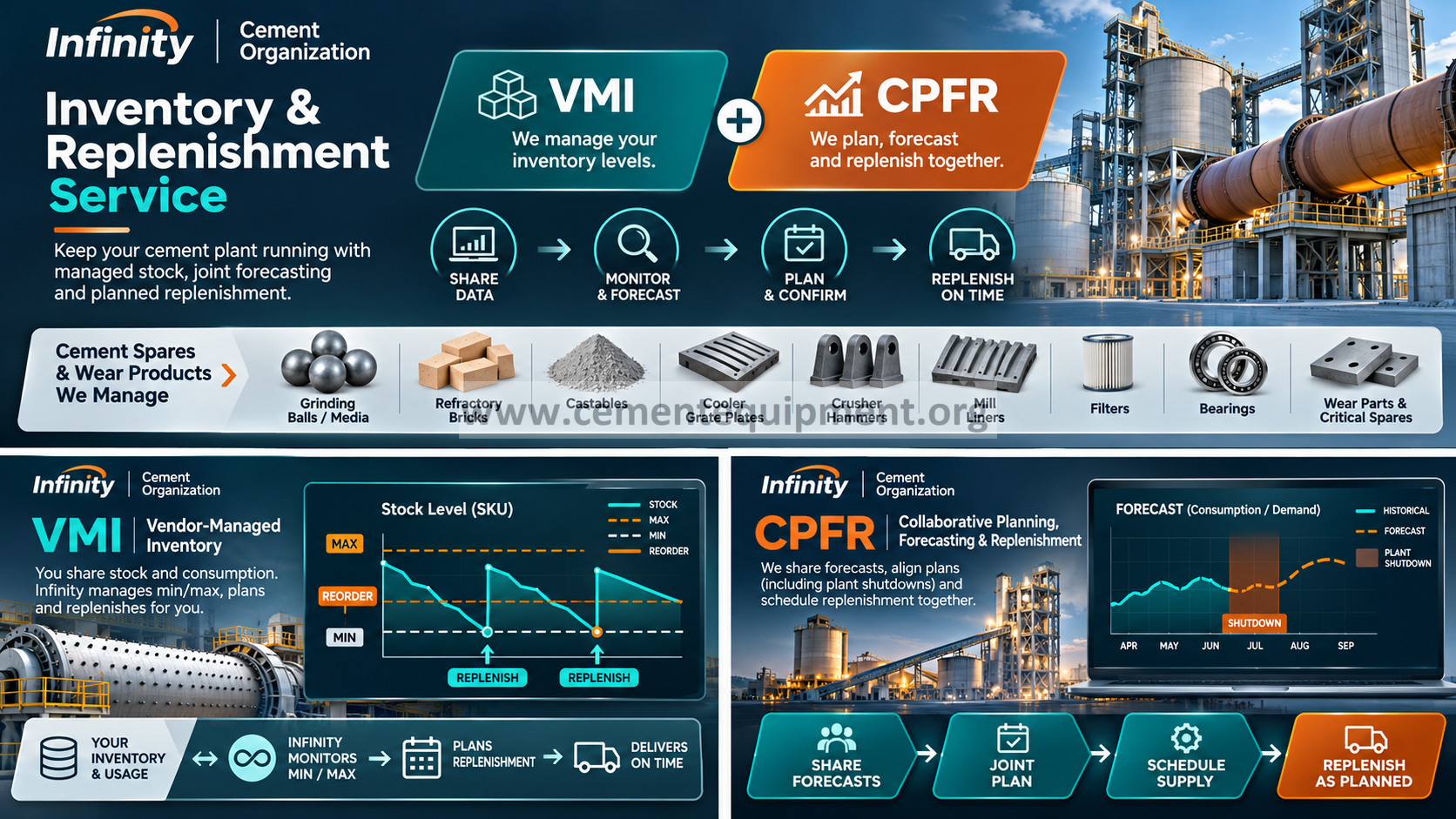
Vendor-Managed Inventory (VMI) + Collaborative Planning, Forecasting & Replenishment (CPFR)
VMI places day-to-day replenishment responsibility with Infinity for agreed items. CPFR extends the partnership to shared demand forecasting, shutdown planning and procurement coordination.
Infinity Vendor-Managed Inventory
We control replenishment of the parts you authorize. Your plant shares stock balances and actual consumption; Infinity calculates and manages the agreed order triggers, follows up supply, and keeps the covered items within their approved inventory policy.
- SKU mapping, equipment references and ABC/criticality review
- Minimum/maximum stock levels, safety stock, and reorder points
- Supplier follow-up, shipment schedules and expediting
- Shortage-risk alerts, exception escalation and periodic reporting
Collaborative Forecasting & Replenishment
We plan demand and supply together before materials are needed. Production and maintenance teams share demand drivers. Infinity translates them into procurement plans, supplier commitments and planned replenishment.
- Joint forecast from production tonnage, wear rates and maintenance history
- Demand planning for kiln campaigns and plant shutdowns
- Long-lead-time procurement and supply-risk scenarios
- Periodic forecast reviews, supply planning and call-off orders
Which spare parts and wear products can we manage?
The contracted portfolio is designed for your plant’s approved item master, drawings, OEM specifications and operating conditions. Candidate categories include:
Grinding balls & cylpebs
High-chrome and forged grinding balls, cylpebs and mill media ordered according to consumption per tonne and the grinding plan.
Refractory bricks & castables
Kiln lining bricks, precast shapes, monolithics, castables and insulation materials aligned with kiln campaigns and shutdown schedules.
Mill liners & grinding parts
Mill liners, diaphragms, grinding roller parts, table segments, wear plates and associated fixing systems.
Heat-resistant and cooler parts
Cooler grate plates, castings, kiln sealing parts, dip tubes, clinker handling wear items and other technically approved components.
Crusher & conveying spares
Crusher hammers, blow bars, impact plates, conveyor-related spare parts, liners and wear-resistant materials.
Critical MRO items
Bearings, filters, belts, seals, instrumentation and other equipment-specific mechanical or electrical parts.
Other materials, including kiln-feed pellets where technically relevant, can be assessed by request. Product sourcing and actual availability are confirmed case by case; no blanket OEM authorization is claimed.
How the Infinity managed inventory service works
Illustrative min–max replenishment control
Infinity monitors the agreed inventory thresholds and coordinates restocking before available stock reaches a shortage-risk level.
Reorder point = expected demand over replenishment lead time + approved safety stock. The graph is conceptual, not a claim of achieved performance. For intermittent demand, critical spares require a different stock policy from regular consumables.
We manage the agreed replenishment. Your plant retains technical and operational approval.
Infinity takes responsibility for
- Demand analysis and forecast preparation for the covered product range
- Proposed min/max levels, periodic policy recalculation and reorder decisions
- Supplier sourcing, approved procurement coordination and delivery tracking
- Critical-shortage and delay exception reporting
- Planning reviews, inventory reports and KPI follow-up
The cement plant provides
- Approved technical specifications, part numbers and asset mapping
- Accurate and timely stock balances and actual consumption records
- Maintenance shutdown plan, production outlook and demand changes
- Technical acceptance of substitutes and receipt inspection
- Ordering authority, storage access and payment under agreed terms
Performance dashboard — KPIs we agree and monitor
Choose a service structure that fits your operation
| Commercial model | Best application | Scope of responsibility |
|---|---|---|
| Vendor-Managed Inventory | Frequent-use grinding media, refractory consumables, wear items and standard MRO | Infinity manages approved min/max policy, reorder planning and procurement coordination. |
| CPFR Planning Partnership | Production-driven demand, shutdown projects and long-lead-time spares | Infinity and the plant agree forecasts, procurement milestones, supplier commitments and reviews. |
| Integrated VMI + CPFR | Multi-category, complex or multi-plant operations | Joint forecasting combined with delegated replenishment for the covered SKUs. |
| Optional supplier-held buffer / consignment | Selected items where physical or financial stockholding is feasible | Stock ownership, storage, risk, withdrawal, billing and eligibility require a separate agreement. |
Start with your inventory list — not a software purchase
An initial pilot can run from existing Excel exports or ERP reports. We review a defined SKU portfolio, establish baseline risks and agree targets before scaling the arrangement.
What to share for an initial assessment
- Plant location and site contacts
- Approved SKU / part-number list and current balances
- 12–24 months of stock issues, if available
- Open purchase orders and normal supplier lead times
- Kiln and mill maintenance schedules
- Production plan and technical item specifications
What Infinity will scope with you
- Eligible items and exclusions
- Proposed forecasting and stock-control methods
- Lead times, alternate sourcing and order commitments
- Information-sharing cadence and escalation contacts
- Commercial terms and agreed SLA / KPI definitions
- Pilot timetable and review checkpoints
FAQs about VMI and CPFR for cement plants
Will Infinity manage our minimum and maximum inventory levels?
Yes, for the exact SKUs, stock policy, agreed data-sharing cadence and replenishment commitments defined in your signed service agreement. Infinity will propose and manage min/max policy and procurement coordination for that scope.
Do we need a new ERP system?
No. A pilot can begin using consistent Excel exports or scheduled ERP reports. API integration can be evaluated later if useful.
How does CPFR differ from VMI?
VMI focuses on delegated replenishment execution and inventory targets. CPFR adds joint, forward-looking planning around production, maintenance, forecast changes and long-lead-time material readiness.
Can a single agreement include grinding balls, refractory bricks and mill liners?
Yes, if product specifications, supplier capabilities, delivery horizons and individual inventory policies are verified and agreed. Shutdown-critical and regular-consumption items typically need different policies.
Are the goods held on consignment?
Not automatically. Supplier-held buffers, customer site stock and consignment are possible commercial variants, subject to separate ownership, handling, insurance and payment arrangements.
Do you guarantee zero stockouts or specific percentage savings?
Any availability commitment or savings target must be defined in an agreed SLA after the demand, lead times and supply feasibility are assessed. This page does not claim historical performance results.
Let Infinity take over replenishment planning for your agreed cement plant spares.
Send your intended spare-parts categories, estimated SKU count and plant location. We will evaluate the VMI / CPFR model, the required data and the commercially feasible scope.
This service is offered subject to technical review and a mutually executed agreement defining covered parts, prices, lead times, service levels, stock ownership and customer information obligations.