Connected, Verifiable Cement Operations—From Quarry to Customer.
Enterprise blockchain and digital-traceability consulting for cement procurement, supplier trust, equipment provenance, laboratory evidence, carbon data and dispatch.
We start with your operating problem—not with cryptocurrency.
Make important factory records easier to verify across organizational boundaries
Cement operations generate trustworthy data only when real-world measurements, human approvals, document versions and business transactions can be tied to a responsible source. A supplier may send one shipment certificate; the plant records a different weight, the laboratory rejects one sample and finance receives an invoice referencing an earlier quotation. The cost of reconciling evidence can be more important than the technology itself.
Our approach first maps the documents, participants and existing ERP, MES, CMMS and LIMS interfaces. We then compare conventional shared databases, signed audit logs and permissioned distributed ledgers. Only pursue a blockchain when multi-party verification, governance and measurable economic value justify its additional infrastructure and coordination.
Procurement and supplier trust
Purchase order approvals, signed shipment evidence, accepted goods receipts and invoice exception history.
Raw material provenance
Limestone, gypsum, supplementary materials, weighbridge evidence and controlled mass-balance lineage.
Quality and dispatch records
Approved laboratory certificates, cement batches, transport documents and customer acknowledgement.
Low-carbon cement evidence
Versioned clinker, fuel, electricity, Scope 3 and environmental product-declaration source data.
Equipment identity
OEM-issued part identities, inventory receipt, commissioning, warranty and maintenance events.
ERP integration and governance
Identity controls, off-chain documents, shared event policies, key custody and system resilience.
Begin with a scoped assessment. Scale only on evidence.
Three entry points serve plant management, procurement, IT, finance and sustainability decision-makers.
Readiness assessment
Stakeholder workshop; ERP and document process map; data trust requirements; blockchain-versus-database fit; business-case model; phased roadmap.
Proof of concept & pilot
One operational workflow; sample data and signed events; permissioned architecture; controlled integration; exception tests; measurable go/no-go criteria.
Enterprise architecture & integration
Multi-plant requirements; vendor selection; permissions and network governance; ERP interfaces; deployment plan; handover and support model.
All prices and schedules require quotation. Software development, technical specialists and third-party implementation partnerships will be confirmed in each engagement. No unverified client implementation results or certifications are claimed.
How verification fits a real cement plant
Identify the transaction, its original owning application, counterparties who need evidence, the approved event, exception path and measurable outcome. For procurement, the relevant chain is requisition → RFQ → evaluation → commercial comparison → approval → purchase order → shipment → receipt → quality acceptance → invoice matching → authorized payment. Not every activity belongs on-chain: source documents stay in secure off-chain storage, high-frequency kiln and instrument readings remain in plant systems, and only selected signed event references may be shared.
Choosing a ledger is a business-case decision
When one organization owns the complete workflow, signed conventional audit logs and a well-configured ERP may be cheaper. A permissioned ledger becomes a candidate where suppliers, logistics firms, customers, auditors and several factory entities need shared verification without surrendering all data to a single participant.
Detailed industrial blockchain implementation guide
The following technical chapters address process engineering, system boundaries, commercial controls and implementation risk. Process examples are illustrative designs, not claimed completed client projects.
CHAPTER 01 / 24
Business case: why cement manufacturers need trustworthy cross-party records
Open the complete technical chapter
A cement factory has many systems that are individually useful but collectively incomplete. Procurement owns purchase requisitions, technical evaluation and purchase orders; production owns process records; the quality laboratory approves material and product tests; the stores department records receipt and issue; finance performs invoice checks; dispatch issues transport evidence; sustainability teams assemble emissions and product-environmental data. A buyer may have no single view that connects these records across suppliers, transport contractors, customers and the factory’s own legal entities. The commercial question is how much time, money and risk this fragmentation creates.
Consider a clinker cooler fan replacement ordered from an overseas supplier. The technical department specifies duty point, motor characteristics, metallurgy, balancing requirement and acceptance tests. Procurement negotiates delivery and warranty conditions. Shipping agents produce documents, customs records arrive separately, incoming inspection records the serial number, maintenance signs commissioning and finance authorizes payment. If the fan fails, a warranty dispute can depend on whether the installed part is the same part that left the manufacturer and whether a specific inspection or contractual acceptance occurred. The objective of a shared audit trail would be to reduce the time required to reconstruct that chain, not to replace any of the specialist records.
A distributed ledger can add value when independent organizations need a common, tamper-evident version of selected events but do not wish to give one party unilateral editing control. Participants can verify signed assertions such as “purchase order version 3 was accepted,” “vehicle ABC delivered load 427,” or “laboratory report version 2 was approved.” The underlying specifications, testing data and invoices can remain in protected repositories. What is made common is the event identifier, issuer, reference, version, time and validation rule. This limited approach is usually better suited to industrial confidentiality and system performance than putting everything on a chain.
But many factory problems do not need distributed architecture. If every record is owned by one cement company and the actual weakness is poor master-data discipline, missing ERP workflow, undocumented approvals or weak backups, the responsible remedy may be ordinary software configuration, digital signatures or access control. An objective readiness assessment should explicitly permit a recommendation against blockchain. The goal is better evidence and lower total process cost. An unnecessarily complex ledger that operators avoid would be a failure even if its cryptography is sound.
Define the problem before the solution
A useful discovery session establishes four boundaries. Business boundary: which transaction and decision matter? Organizational boundary: which parties can provide or contest evidence? System boundary: which application is authoritative for each fact? Evidence boundary: which event must be independently verifiable, and what stays confidential? The team then prepares a process map, a RACI ownership matrix, a data dictionary and an exception register. These artifacts turn a vague request for “blockchain transformation” into an auditable engineering problem.
Baseline metrics might include approved purchase orders per month; percentage with missing supporting quotations; median age of open receipt discrepancies; supplier qualification renewals overdue; engineering hours spent reconstructing warranty claims; dispatch quantity disputes per thousand deliveries; and hours spent collecting source data for an annual EPD update. Each metric needs a defined numerator, denominator, time window and responsible owner. Without this discipline, a vendor can present a plausible productivity percentage that cannot be linked to the cement plant’s actual work.
Illustrative decision
Suppose a manufacturer operates three grinding plants, buys gypsum from six suppliers and routinely compares supplier dispatch figures with independent weighbridge receipts and quality tests. Suppliers cannot access the plant ERP, while transporters want acknowledgement of delivery and the purchasing office wants a reconciled invoice state. A shared event-verification design may be worthwhile. By contrast, a single plant struggling with paper leave approvals and departmental stock requisitions should first evaluate an internal workflow and document-management improvement. The number of stakeholders, not the marketing name of the technology, influences the architectural choice.
A good executive proposal translates this into outcomes: shorter settlement time, lower manual verification effort, faster access to legally relevant evidence, fewer unsupported claims and a controlled history of revisions. It also acknowledges costs: network governance, identity verification, software integration, cybersecurity testing, supplier onboarding, support staff, data retention and resilience. Decision-makers should approve a pilot only after seeing a plausible route from the baseline problem to a measurable net benefit or a documented risk-reduction objective.
CHAPTER 02 / 24
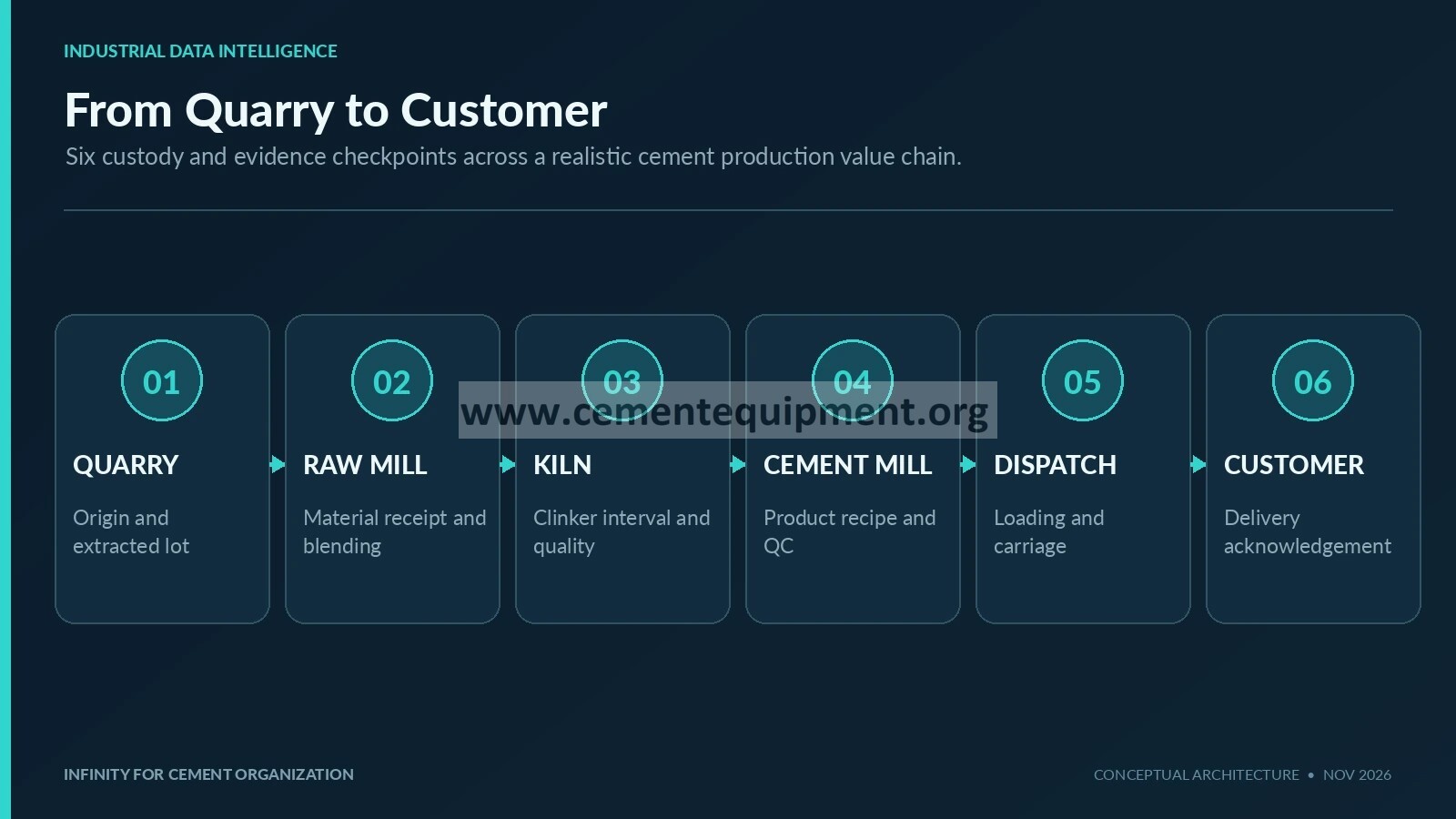
How a cement factory generates traceability data from quarry to customer
Open the complete technical chapter
The cement value chain begins well before clinker leaves the kiln. Limestone extraction, drilling and blasting, crushing, corrective-material receipt, preblending, raw-meal milling and homogenization create identifiable operational events. The preheater, calciner and kiln transform the meal chemically, while the cooler and clinker storage connect successive production periods. Cement grinding then combines clinker with gypsum and, where specified, additional constituents; product is stored, packed and dispatched. A supply-chain evidence model must respect these physical transformations, particularly mixing and the loss of discrete material identity within stockpiles and silos.
Quarry and raw materials. Create a source reference for quarry bench, approved extraction zone or contracted supplier. At the point of movement, generate a load identifier tied to the material category, quantity and dispatch record. On receipt, associate it with a weighbridge ticket, scale calibration status, vehicle identity and any sample ID. Distinguish a supplier’s declaration from a measurement made by the factory. If a source field was copied from a manual invoice rather than independently measured, mark its origin accordingly.
Crushing and preblending. The crusher produces throughput and maintenance records; the preblending system may combine multiple inbound loads. An automated stockpile movement should reference the relevant feed events without pretending to identify every mineral particle. Inventory management may rely on measured or modeled quantities, and uncertain source allocation should be documented. Traceability is meaningful only if the granularity remains appropriate to the way material is handled and stored.
Raw meal and kiln operation. Laboratory values for lime saturation factor, silica modulus, alumina modulus and major oxides are commonly connected to sampling points and production periods. Kiln temperatures, differential pressure, oxygen, heat consumption, fan speeds and many other values may be sampled at high frequency. These time series belong in process historians, DCS or MES infrastructure. A ledger might reference an approved production summary or quality release by hash and identifier, but writing every sensor reading to the chain would increase complexity without establishing that the instrumentation was calibrated correctly.
Clinker cooling and storage. A production interval can carry plant ID, kiln ID, time range, approved clinker quality results and the destination silo or storage zone. It is important to handle rework, reclaimed dust, bypass dust or material transfers using the real material-balance rules. If clinker from multiple periods is mixed, a valid provenance statement should disclose the approach to allocation. Exact batch tracing may be impossible without dedicated segregation.
Grinding, cement silos and finished product. Product identity depends on cement type, applicable standard, formulation, test schedule and approved quality certificates. A digital passport or customer-facing certificate should reference the approved product or production batch, not merely a PDF filename. Any substitution of raw material or clinker grade should be captured in the source system that authorizes the change. The ledger may preserve the event and document version but cannot determine chemical conformance independently.
Packing and dispatch. Bulk trucks and bagged deliveries require different identification levels. A bulk loading event can include sale order, silo, product type, vehicle, tare weight, loading weight, net weight, timestamp and gate pass. Bagged product may need packaging line, bagging date, lot and shipment identifiers. Dispatch evidence should travel with a controlled delivery reference that the customer can use without receiving unrelated production or commercial data.
Practical data dictionary
| Stage | Authoritative source | Candidate shared proof | Common failure |
|---|---|---|---|
| Raw material receipt | Weighbridge / ERP | Accepted load, quantity and document version | Mismatch between supplier and plant scale |
| Quality testing | LIMS | Approved test certificate reference | Wrong sample linked to material lot |
| Clinker manufacture | MES / historian | Approved production interval summary | Untraceable mixed clinker storage |
| Dispatch | ERP / dispatch | Signed shipment and receipt milestones | Disputed net quantity or delivery time |
Before connecting systems, factory and IT teams should agree on a canonical plant identifier, legal entity code, supplier ID, product ID, load ID, stockpile or silo ID, document revision, unit of measure, timezone and event status. Time must be consistently recorded, with allowance for corrected and late-arriving data. A traceability platform that uses the same text string to mean both an invoice line and a goods-receipt line will produce misleading reports regardless of architecture.
CHAPTER 03 / 24
Blockchain fundamentals and the decision to use a conventional database instead
Open the complete technical chapter
A blockchain is an append-oriented ledger in which participants validate transactions according to a network protocol and preserve a sequence of cryptographically linked records. A hash is a compact fingerprint of data; if the original content changes, a newly computed hash should generally differ. A digital signature binds a transaction to a private key under a particular identity framework. Consensus determines how accepted events are ordered and validated. These mechanisms increase the difficulty of unnoticed record alteration after acceptance, but they neither prove the honesty of an initial submission nor replace physical inspection.
In a permissionless public network, participation and validation are generally open under its protocol. An enterprise permissioned network has identified participants, admission controls and agreed rights to transact or endorse. Industrial users may require selective visibility of pricing, product recipes, supplier performance, personal data and quality exceptions. A permissioned platform such as Hyperledger Fabric provides concepts for participant identities, endorsement policies and configurable deployment architecture. It does not remove the need for a legal agreement about governance, disputes, liability and exit conditions.
Some sales material describes a blockchain as an “immutable database.” This is incomplete. The recorded sequence can be designed to preserve prior assertions, but authorized corrections must still be possible by adding new events. For example, if a receipt was entered as 12,500 kg and subsequently corrected to 12,050 kg, the system should preserve the original measurement, the corrective evidence, the authorized reviewer and the current accepted state. The ability to reconstruct what happened matters more than banning correction.
By contrast, a relational database can provide strong transactions, backups, logical replication, role-based permissions, auditing and immutable write-once storage. If a single enterprise owns the application, such controls are often sufficient and less expensive. The business justification for a distributed ledger is not that ordinary databases cannot keep history; it is that multiple parties may need to share a governed verification process without depending on one party to rewrite the common evidence.
Technology-fit decision table
| Question | Conventional database favoured when | Ledger merits evaluation when |
|---|---|---|
| Who controls data? | One accountable organization | Several independent organizations |
| What is disputed? | Internal approvals and missing fields | Common event history or document versions |
| Can parties trust an operator? | Yes, by existing contract | No common operator accepted |
| How sensitive are records? | Central role controls suffice | Participants need private, selective evidence |
| What is transaction volume? | Large telemetry or routine operations | Selected business milestones |
Another distinction is between the integrity of a record and the validity of its content. A hash can establish whether a downloaded certificate matches a previously approved version. The certificate can still contain a wrong pressure value because the instrument was improperly calibrated, the sample was mislabeled or the technician made a mistake before approval. A useful architecture combines cryptographic evidence with trusted instruments, competence, inspection controls, human review and independent audit.
A ledger also needs operational discipline. Who maintains peer nodes? How are certificate authorities protected? What happens when a supplier’s key is compromised? Can a plant accept deliveries during loss of connectivity? Who can modify a smart contract? Will historical data remain exportable if the platform is retired? These are not later IT details; they are essential parts of the business case. A system that cannot recover a lost identity or handle a network partition may create more factory risk than it removes.
A practical workshop should finish with a scored architectural decision: requirements met by simple ERP configuration, shared document portal, signed audit service, database replication or a distributed verification network. Include lifecycle costs and supplier readiness in the scoring. If the first candidate problem can be solved by adding a mandatory PO number and electronic goods-receipt approval, implement that simpler fix. Reserve a permissioned ledger for circumstances where its unique multi-party governance properties change the outcome.
CHAPTER 04 / 24
Cement procurement transformation from requisition through supplier settlement
Open the complete technical chapter
Industrial purchasing begins with clear technical demand. A purchase requisition should specify the requesting department, plant and cost center, item description, equipment reference, quantity, unit, required date, technical standards and authorization. In a cement factory, requests for a kiln refractory lining, a separator rotor, a high-voltage motor or a fuel delivery may have fundamentally different acceptance conditions. A digitization project must preserve technical completeness rather than forcing all categories into the same generic form.
The RFQ stage creates version-sensitive records. Suppliers may submit technical proposals, commercial offers, validity periods, incoterms, delivery schedules and alternative part numbers. Technical reviewers assess compliance; procurement compares commercial terms only after understanding deviations. Competing suppliers must not see each other’s bid details. A shared ledger could anchor the moment an offer version was received and the fact of a controlled decision, but storing full quotation contents in a broadly replicated network would create confidentiality and commercial risk.
Approvals should map to the organization’s delegated authority. A purchase order is not valid merely because a ledger accepted a transaction. Budget controls, exception approvals, legal terms, supplier master data and segregation of duties must be applied by the appropriate corporate systems. In the proposed architecture, ERP approval creates an event carrying order ID, revision, approver, timestamp and document hash. Authorized counterparties receive only the view needed to validate their own obligations.
Shipment requires its own evidence rules. An imported spare part may be linked to the manufacturer certificate, packing list, bill of lading, shipping invoice, certificate of origin, delivery note and customs documents. A domestic bulk material purchase may depend instead on a weighbridge scale ticket, vehicle registration, sealed sample and lab acceptance. The design should not assume that scanning a barcode confirms the material actually arrived or met the specification.
At receipt, quantity and quality are distinct. Warehouse personnel may record the physical quantity, while quality or engineering staff determines acceptance. Partial delivery, over-shipment, visible damage and late arrival require separate dispositions. A typical exception includes an initial receipt event, supplier discrepancy notice, reinspection, authorized adjustment and final accepted quantity. Deleting the rejected event would conceal the decision path. The chain should instead record the history and the current business state.
Invoice matching needs explicit tolerances and tax treatment. A three-way match can compare approved PO, accepted goods receipt and invoice quantity/price, but it must account for freight charges, taxes, currency, contract revisions, quantity variance, discounts, retention and debit notes. The finance system remains the source for vouchers, bank instructions and ledger postings. A smart contract can recommend eligibility according to approved rules; it cannot compel a bank payment unless a separately authorized financial integration exists.
Illustrative imported equipment procurement
A cement plant orders a hydraulic lubrication unit for the kiln drive. Engineering approves the design duty, filter rating and drawing revision. Procurement issues a PO with delivery and warranty milestones. The supplier signs the acceptance and shipment reference; the carrier supplies dispatch milestones; incoming inspection logs the serial number; commissioning confirms pressure and flow testing. A shared verification service could link these events for buyer, supplier and independent inspector. If the unit fails during warranty, the approved version of the equipment specification and commissioning report can be retrieved without relying solely on email archives.
Which record belongs where?
| Business event | System of record | Verification layer |
|---|---|---|
| Purchase requisition and funds availability | ERP / budget system | Approved status reference if required |
| Supplier commercial offer | Private procurement repository | Restricted hash and receipt timestamp |
| Purchase order approval | ERP | Signed PO version |
| Delivery and incoming acceptance | Warehouse / QA | Quantity and status event reference |
| Invoice decision | Finance ERP | Controlled eligible / disputed milestone |
Pilot success should be judged by transaction-level metrics: time to reconstruct an approved offer, percentage of goods receipts matched without manual intervention, average days to resolve supplier disputes, number of missing acceptance documents and audit sampling effort. A pilot must also test bad scenarios—duplicate invoices, rejected materials, incorrect unit conversion, broken shipment reference, wrong serial number and a supplier trying to read another vendor’s quote. These tests are more valuable than demonstrating a simple transaction on a test network.
CHAPTER 05 / 24
Supplier verification, qualification, auditing and certificate lifecycle
Open the complete technical chapter
A company master-data record is not equivalent to approval for every critical cement application. A vendor authorized to supply office consumables may not be technically qualified to overhaul an electrostatic precipitator, supply kiln refractory or transport regulated alternative fuel. A robust vendor lifecycle includes legal-entity verification, tax registration, physical address, relevant industrial capabilities, approved supply categories, certifications, insurance, sanctions screening where applicable, contract terms, quality incidents and periodic performance review. Separate verified facts from statements that are merely declared by the supplier.
Each credential needs a data owner, issuer, issue date, expiry date, scope and source document. An ISO certificate may refer to a specific manufacturing facility rather than the group headquarters. A product approval may be valid for a named plant, engine model or material specification. If the system simply displays a green “verified supplier” label without the approval scope, it can produce dangerously misleading purchasing decisions. The recommended model distinguishes legal verification, technical evaluation, quality approval, financial evaluation and category authorization.
Cross-party verification is attractive where several sites or buyers use the same manufacturer credentials. With the issuer’s agreement, authorized participants can confirm that a certificate version corresponds to the issued record and remains valid at the review date. This should not expose the bidder’s private banking information or a competitor’s pricing. An integrity record can carry a certificate hash, issuer identifier, scope, expiry and revocation reference while the actual document remains in a restricted repository. The system should explain who attests authenticity and what checks were performed.
Avoid false assurance from expired documents
A certification that was valid when a purchase order was approved may expire before the next contract. Historical transactions should preserve that earlier status while the live approved-vendor list reflects the new one. Status transitions should include pending evidence, verified, conditionally approved, suspended, expired and rejected. Reviews need clear deadlines and escalation rules. Automatic reminders can reduce administrative work, but supplier suspension should follow approved company policy and appropriate human oversight.
Vendor performance should connect objective events: on-time delivery calculated against the contractual date, accepted quantity, nonconformity frequency, corrective-action closure, warranty incident and responsiveness to technical clarifications. Score definitions must be stable and documented. If the delivery date changes through an authorized PO amendment, the system should disclose whether punctuality was measured against the original or amended obligation. Blockchain cannot resolve an ambiguous scoring policy; that ambiguity belongs to procurement governance.
Consider two plants purchasing industrial bearings from the same supplier. One plant records repeated certificate mismatches, while the other maintains an approved classification. A multi-plant qualification network could share the existence of a verified quality incident and the current category authorization, but it should not automatically blacklist the supplier without company-approved procedures and verified source evidence. The business owns the decision; the shared record makes approved evidence easier to reconstruct.
Pilot design and controls
For a limited trial, select one high-risk material group, perhaps refractory or electrical switchgear, and five willing suppliers. Define every mandatory document, validation owner, event state and access role. Import only current credential metadata; avoid copying historical personal details that have no current business purpose. Test revoked certificates, duplicate company names, group-versus-branch confusion, altered PDFs, late renewals and approval for a different product category. Measure supplier onboarding days, repeated document requests and percentage of expired approvals detected before PO release.
Deliverables should include a supplier identity model, evidence checklist, approval-state diagram, private data policy, permission matrix and exception workflow. The procurement director should be able to ask: Who approved this vendor for this component? Which certificate was in force when the order was placed? What changed after a quality incident? If the system cannot answer those questions with precise references, a visually impressive dashboard provides little commercial value.
CHAPTER 06 / 24
Genuine spare-parts verification and equipment lifecycle traceability
Open the complete technical chapter
Industrial spare parts are unusually well suited to provenance analysis because the identity of a component can matter long after its initial purchase. A large VRM gearbox, kiln thrust roller assembly, high-voltage motor, kiln burner component or precision bearing can affect plant availability and warranty exposure. The plant may buy through an agent, distributor, aftermarket workshop or subcontractor. Records are dispersed between procurement, goods receipt, technical inspection and the maintenance-management system. The value proposition is an attributable chain from declared manufacturer identity to installed equipment history.
Start with the identification problem. A manufacturer part number identifies a product design or item type; a serial number may identify a specific unit; a lot or batch code identifies a production batch. These identifiers are not interchangeable. Commodity bearings may lack unique serial numbers, while rebuilt gearboxes can retain a housing serial number despite replacement internals. A trustworthy design must record identifier type, issuing authority, product family and physical-marking method rather than treating every scanned code as definitive evidence.
Manufacturers and authorized distributors should control authenticity claims. A printable QR code can be copied and attached to counterfeit material, so it is at best a lookup mechanism. Genuine verification may require authenticated manufacturer data, tamper-evident packaging, physical inspection, dimension checking, material documentation, supplier accreditation and matching reference records. A ledger can help preserve who made each assertion and which version of the certificate was inspected; it cannot prove the steel composition of a gear or the bearing’s metallurgy.
Receiving inspection should distinguish document completeness from technical acceptance. A motors shipment may have an OEM certificate but still suffer shaft damage, inadequate preservation or missing accessories. A bearing may match a printed part number yet have incorrect internal clearance or seals. The goods-receipt event should capture actual quantity and condition; an engineering inspection event should capture conformity against the purchase specification; the stores event should capture location and reservation. These steps may have separate approvers and different timestamps.
From warehouse to equipment hierarchy
When a component is issued to maintenance, the work order should link its inventory ID to the installed functional location. For example, “clinker cooler fan 2 drive-end bearing” is more informative than a generic inventory deduction. The maintenance record may include commissioning readings, balancing report, alignment, oil cleanliness, lubrication schedule and warranty conditions. Detailed vibration and temperature signals belong in the CMMS or historian. A shared ledger needs only controlled proof of installation and major lifecycle milestones if cross-party verification is justified.
Failure investigation is another use case. A rebuilt gearbox fails after six months; the buyer, rebuilder, OEM and insurer disagree about maintenance conditions. An agreed record can link accepted overhaul scope, replacement-parts list, test-bench report, transport damage exceptions, commissioning certificate and subsequent major service events. It should never expose unrelated maintenance records to a supplier or assume that every failure was caused by a counterfeit part.
Illustrative data model
| Field | Meaning | Owner |
|---|---|---|
| manufacturer_id | Claimed OEM and issuing identity | OEM / approved agent |
| part_number | Design or catalog reference | Procurement / technical master |
| serial_or_lot | Unit or batch identifier, type specified | Manufacturer / warehouse |
| grn_reference | Physical received quantity and condition | Stores |
| inspection_status | Approved, rejected or conditional | Quality / engineering |
| functional_location | Actual installed plant asset | Maintenance |
For a first pilot, use one category with expensive failures and identifiable supplier data, not every inexpensive fastener. Audit ten sample transactions end to end, compare the time to assemble warranty evidence before and after, and document where source-data reliability breaks. If the supplier cannot provide independently verifiable identity, call the result “traceable commercial documentation” rather than “authenticated genuine equipment.” Precision in such language protects the credibility of the whole initiative.
CHAPTER 07 / 24
Raw-material provenance: limestone, gypsum, clay, slag, fly ash and blended stocks
Open the complete technical chapter
Raw-material traceability begins with understanding how cement materials move physically. Limestone may be excavated within the plant’s own quarry; clay, iron corrective, gypsum, limestone additive, slag or fly ash may be purchased from third parties. The receiving team works with vehicles, weighbridge receipts and stockpile assignments; the chemistry team works with samples and assays; the ERP works with received quantities and valuation. A traceability model needs cross-references between these perspectives but must not assume that every input can be followed as an isolated batch through mixing and grinding.
Source declarations should identify quarry, supplier facility or relevant generating process. A truckload record may include unique loading reference, supplier ID, product designation, date, driver or vehicle identifier where proportionate, gross and tare weights, seal where applicable and dispatch timestamp. The plant receipt can independently record its own scale measurements and acceptance, with calibration records accessible as needed. Difference between declared and measured weight should be retained as an exception, not silently overwritten by whichever organization has the most powerful database.
Quality data requires careful sampling logic. A truckload might be accepted provisionally and later rejected after laboratory analysis. Some materials are sampled by vehicle, lot, shift, stockpile or periodic composite; a single chemical result may therefore apply to a defined sampling group rather than each truck. The sample must be associated with an explicit rule and approved test method. If a lab result is revised, previous versions, responsible reviewers and material disposition should remain available.
Stockpiles, silos and feed hoppers introduce dilution and mixing. A blockchain cannot recover material origin information that was never measured. For a continuous raw-mill feed, practical provenance may be expressed as a time-bounded input mix or documented mass balance instead of an exact particle genealogy. Inventory tolerances, conveyor belt scale accuracy, moisture adjustments, reclaim geometry and process returns should be included in the methodology.
Illustrative limestone receipt dispute
A supplier issues an invoice for 1,000 tonnes delivered over 40 vehicles. The plant weighbridge indicates 981 tonnes, with several loads showing high moisture and two rejected quality samples. A shared event trail could show each supplier dispatch reference, plant received quantity, applicable sampling outcome, approved commercial deductions and final payable amount. This does not automatically determine which scale is legally authoritative or how the contract handles moisture. Those rules must already exist in the supply agreement and be applied consistently.
Origin evidence becomes important where low-carbon cement claims rely on supplementary material sources, recycled content or chain-of-custody assertions. Fly ash supply may involve a power station, intermediary trader, storage terminal and cement plant. Slag may change custody before grinding. If materials from multiple originators are pooled, an approved accounting approach is necessary before marketing a specific provenance statement. The evidence platform should make uncertainties explicit and should not create stronger environmental claims than the available measurements support.
Recommended receiving controls
Create separate statuses for arrived, weighed, sampled, provisional receipt, accepted, partly accepted, rejected, returned and financially settled. Ensure every status includes an authorized role and event reference. Acceptances must reconcile to inventory and valuation; a laboratory hold should prevent inappropriate consumption where the plant procedure requires it. Define whether the supplier can see all inspection reasons or only the accepted disposition and supporting certificate. Restrict personal and vehicle information to the retention period needed for the business purpose.
A well-scoped pilot might select one gypsum supplier, one weighbridge and one laboratory sampling regime. Instrument a single month of deliveries; preserve discrepancies; reconcile the ledger evidence against signed physical records; compare invoice-resolution effort and outstanding adjustments. The most valuable deliverable may be a corrected master-data and receiving workflow rather than a blockchain network. That conclusion should be considered a valid improvement.
CHAPTER 08 / 24
Coal, petroleum coke, biomass and alternative-fuel traceability
Open the complete technical chapter
Fuel purchasing is more complex than ordering a fixed quantity at a fixed quality. Coal, petroleum coke, biomass and refuse-derived fuel can vary by moisture, ash, calorific value, sulfur, chlorine and other contaminants relevant to kiln process stability and emissions management. Contractual price may depend on dry tonnage or measured energy content. A delivery can be physically accepted before its quality is fully characterized. Any traceability design must reflect the commercial sampling agreement and laboratory control, rather than treating a single truck weight as the whole transaction.
Incoming fuel records should identify the supplier, fuel specification, shipment or load, quantity, sampled condition, relevant test report and authorized disposition. Sampling protocol matters: a composite sample collected under a defined method can produce a different commercial result from an isolated grab sample. Chain of custody for retained samples may include sample collection, sealing, laboratory receipt, storage and retest approval. Digitally signing a test certificate is useful only if the sample identity and laboratory process are trustworthy.
Alternative fuels can involve more organizations than fossil fuels. A waste generator, pre-processor, licensed transporter, terminal and cement plant may each maintain distinct environmental and transport records. A shared evidence layer could connect approved custody transitions, waste classification, delivery acceptance and relevant laboratory data. However, legal permits, physical inspections, transportation controls and applicable waste legislation cannot be replaced by blockchain timestamps. Local regulation and contract provisions need specialist validation.
Heating-value settlement example
Assume a contract price is based on a reference net calorific value, with a defined adjustment curve and moisture correction. The supplier declares one shipment average; the plant’s accredited laboratory records a different result. A digital workflow should link the actual contractual formula, agreed sampling methodology, test version and approved adjustment. An automated rule can calculate a draft settlement only after the correct acceptance event is present. Finance must still approve the voucher and tax treatment under the purchaser’s authority framework.
Process information from fuel feeders, dosing equipment and kiln energy meters should be handled at appropriate granularity. Hourly fuel consumption and sampled calorific value may contribute to a production or emissions calculation. High-frequency feeder signals should remain in the historian; an approved daily or monthly reconciliation can be referenced as an evidence object with a controlled version. The data owner should explain how corrections to density, moisture and inventory movements are treated.
Fuel provenance also intersects with sustainability reporting. Assertions about biomass fraction, avoided emissions, waste origin or renewable content require relevant methodologies, source documentation and verification boundaries. A ledger can preserve the submission history and detect unapproved changes to evidence, but it cannot establish the true biogenic fraction of mixed waste. When the evidence is uncertain, the system should expose the uncertainty and prevent a more precise public claim than the calculation supports.
Operational exceptions should include rejected truckloads, contaminated shipments, inaccurate manifests, permit expiry, moisture claims, laboratory disagreement and contract amendments. Each exception needs a responsible department, resolution deadline, correction protocol and supporting records. Supplier access should be limited to its own shipments and contractual outcomes; competitors should not view fuel prices or procurement forecasts merely because they share a verification platform.
The recommended pilot is one fuel type with stable contractual acceptance rules and willing counterparties. Begin by measuring invoice adjustment time, missing source-document rate, time to compile environmental evidence and rejected-delivery handling. Test at least one deliberately incorrect sampling reference and one revoked supplier credential. If traceability depends entirely on self-reported declarations that cannot be audited, fix the measurement and control design before commissioning a distributed network.
CHAPTER 09 / 24
Production, laboratory quality assurance and technical record integrity
Open the complete technical chapter
Quality assurance in a cement plant combines laboratory science, process control and product conformity. The same organization may measure oxide composition, free lime, fineness, soundness, setting time, strength and other characteristics at different sampling frequencies. A sampling result may represent one truck, a clinker shift composite, a cement silo, a product lot or a dispatch certificate. Any shared verification design must first define what population each result actually represents; otherwise, attaching a signed certificate to a product label can imply a level of traceability that the sampling system cannot support.
A quality data chain begins with a unique sample identity and the authorized sampling location. It should capture the sample type, collection method, time and responsible role; preparation and analytical method; instrument and calibration context where relevant; initial test outcome; review status; and approved report version. The laboratory information management system should remain responsible for scientific work and calculation. A ledger would normally store only the approval event and an integrity reference to the signed output, not raw chromatograms, XRF spectra or every individual strength measurement.
Clinker quality illustrates why process interval and sample identity cannot be conflated. A clinker sample may cover a shift or composite period, while clinker from that period may enter storage that also contains material from other times. Subsequent cement manufacture draws mixed clinker and additional constituents. A well-designed genealogy may identify contributing intervals and approved mass-balance logic, but it should not automatically claim a perfect one-to-one link from one kiln sample to every cement bag.
Report revisions are inevitable in an operating laboratory. A sample may be reanalyzed, a transcription error corrected or a calibration investigation opened. Rather than overwrite the original version and pretend the earlier certificate never existed, create a controlled amendment with reason, authority and relation to the previous record. Business systems should display the current approved state and preserve historical states for audit. The difference between superseded, withdrawn, provisional, quarantined and fully accepted should be visible to authorized users.
Scenario: cement strength certificate dispute
A customer challenges the 28-day strength shown in a delivered product certificate. The plant traces the certificate to its sample, casting date, curing conditions, testing machine, laboratory review and dispatched product lot. A shared evidence record can help verify whether the certificate presented to the customer matches the approved version and when a correction was issued. It cannot by itself confirm that specimens were stored properly or that the testing machine was calibrated. Those facts require independent laboratory controls and documented physical procedures.
Quality managers should define a clear approval boundary. Before release, a report may be draft and accessible only internally. After review, an approved version can be shared with a named customer or inspector. If a nonconformity is detected, the system should support suspension, product hold, rework evaluation, incident tracking and appropriately limited disclosure. Commercial sensitivity matters because laboratory and recipe details can reveal plant performance or product formulation.
A pilot metric can be the time needed to retrieve complete supporting evidence for five randomly chosen dispatch certificates. Other useful measures include mismatched lot references, certificate revision errors and time between completion of a test and authorized release. Before crediting blockchain, measure whether improvements came from unique identifiers, stronger laboratory controls, automated reporting or multi-party cryptographic verification. A credible technical report should attribute each result to its actual cause.
Where quality documents underpin international trade, adopt a stable product and certificate identity scheme before deploying any ledger. Define plant code, product standard, grade, manufacturing period, batch or silo relation, lab report ID, version number, authorized signature and publication timestamp. Data dictionaries and source-system integrity are the foundation. Blockchain verification is optional infrastructure layered above that foundation.
CHAPTER 10 / 24
Logistics, bagged cement, bulk dispatch and proof of delivery
Open the complete technical chapter
Cement dispatch is a practical candidate for cross-organizational verification because manufacturer, haulier, driver, customs broker, distributor and customer may each maintain different records. The physical movement may be a bulk tanker from a silo, palletized bags, bagged cement in covered trucks or clinker shipped in bulk. Each model has different traceability granularity. A design that tracks one shipment ID may be sufficient for delivery disputes but inadequate for product-recall analysis or bag-level warranty claims.
At loading, the authoritative dispatch system should identify sales order, cement type, source silo or inventory batch, loaded quantity, vehicle or container, transport company, dispatch gate and timestamp. A weighbridge record should distinguish tare, gross and net values and any approved weighing exception. Where legally relevant, record the weighing instrument reference and calibration status. Signed references to the loading ticket can then be made available to the transporter and recipient without exposing the entire order book.
Transport milestones should be defined operationally rather than based on decorative GPS traces. Departure, handover to another carrier, customs release, arrival at customer site, discharge start, accepted receipt and claim initiation are possible events. Not every trip needs every milestone. GPS locations can be imprecise, and a driver phone can report a location without proving a cement load was physically delivered. Combining trusted gate records, weighed receipts and customer acknowledgement is generally stronger than relying on a single tracking signal.
Bulk cement quantity dispute
Suppose a truck leaves the plant with an accepted net mass of 30,200 kg and the customer reports 29,850 kg received. The first task is not to accuse either party of altering records but to identify scale tolerances, residual material, unloading conditions, tare differences, moisture and contractual acceptance methodology. A shared event chain can preserve both measurements, associated evidence, time and authorized resolution. It does not determine liability without the contract and physical investigation.
For bagged cement, product identification can follow pallet or dispatch-lot levels rather than each individual bag. The system should link production and packaging records to shipment and customer documentation, including relabeling, damaged sacks and returns where relevant. Avoid claiming precise provenance if bags from several packaging shifts are mixed in a truck without segregated identifiers. The customer-facing verification page should disclose the intended level of traceability.
Digital proof of delivery should identify who accepted the consignment and under what authority. A mobile signature is useful but may not be sufficient to establish weight or product condition. Photograph evidence may contain personal or site-security details and should be retained with appropriate permissions. The acceptance workflow must allow short delivery, damaged product, refused load, partially discharged truck and subsequent adjustment rather than collapsing everything into a binary “delivered” status.
Useful KPIs include disputed deliveries per thousand shipments, average time to assemble complete proof, number of missing customer acknowledgements, percentage of transport documents reconciled automatically, average age of open claims and time spent resolving incorrect invoice references. A pilot should sample both normal and abnormal journeys, including offline network conditions and late synchronisation. Users should not be required to retype a document number that is already available from the dispatch system.
The broader architecture should respect ERP revenue recognition, tax documents, contracted carrier access, retention periods and cross-border paperwork. A shared verification service can improve evidentiary consistency but must never unilaterally change sales ledger balances or customer credit terms. Finance and legal owners retain responsibility for the rules that convert physical evidence into commercial rights and obligations.
CHAPTER 11 / 24
Smart contracts for purchasing milestones, approvals and supplier payments
Open the complete technical chapter
In industrial operations, a smart contract is software that evaluates defined conditions and records permitted actions. It is not automatically a legally complete supply agreement, an intelligent negotiator or a bank settlement mechanism. A smart contract for a cement factory might check whether a purchase order is in an approved state, whether the supplier acknowledged the correct revision, whether quantity was received, whether technical inspection released the material and whether an invoice falls inside contractual tolerances.
The first design task is to translate policy into unambiguous states. “Received” may mean arrived at the gate, physically offloaded, counted in stores, accepted by quality or posted as available inventory. A poorly designed contract treats these states as equivalent and may release payment eligibility too early. Define one authoritative event for each state, and specify the system and role that is allowed to assert it. If the company policy requires two technical approvals above a value threshold, the software must reflect that and log the approved policy version.
Contractual exceptions are not edge cases; they are the normal complexity of procurement. Some orders have advance payment, letters of credit, milestone retention, warranty holdbacks, customs charges, freight reconciliation, penalty clauses or staged acceptance. Others allow partial receipt or substitution with approved equivalent parts. Each of these may require a human judgement or a negotiated amendment. Smart contracts should automate stable objective checks while sending uncertain issues to controlled review.
Illustrative three-way-matching rule
An example rule can require: PO status approved; supplier active for the ordered material category; receipt physically posted; quality status accepted; invoice line tied to the current PO revision; quantity not exceeding accepted units outside a permitted tolerance; unit price and currency matching the approved commercial version; and tax classification validated by finance. The output might be “eligible for finance review,” “manual exception required” or “blocked.” It should not be “money transferred” unless a separately authorized banking process really executed and confirmed that action.
Version control is essential. If the purchasing policy changes after contract award, the system should preserve which rules applied to the original transaction and how any migration was authorized. A future code deployment should not silently reinterpret old commercial events. Endorsement policies also need governance: who can approve a new smart contract version, whether independent consortium members must agree, how urgent security patches are handled and how audit evidence for policy amendments is retained.
Consider a kiln refractory installation project where payment milestones are linked to delivery, installation acceptance and subsequent performance observation. The contract includes technical inspection, construction completion and retention release. The system can record that the project’s authorized engineer signed the milestone certificate, but it cannot determine whether the refractory installation met design requirements without the inspection evidence and competent professional assessment. The business remains responsible for deciding whether the contractual condition has been satisfied.
Security testing should cover forged identities, replayed events, repeated invoice submission, stale purchase orders, unauthorized amendments, role escalation, insufficient separation of duties, duplicated transport tickets and partial failure between ERP and ledger. A transaction may succeed in one system and fail in another; idempotent integration logic and reconciliation queues must resolve that uncertainty before it becomes a commercial dispute.
The return on smart-contract automation should be judged by reduced manual exception handling, faster legitimate approvals, fewer duplicate payments or better auditability, measured with appropriate controls. A complex contract engine that requires staff to manually correct every document has not automated procurement. The ideal result is fewer unnecessary steps for good transactions and clearer escalation paths for genuine exceptions.
CHAPTER 12 / 24
Carbon accounting, environmental declarations and auditable emissions source data
Open the complete technical chapter
Carbon accounting for cement requires special attention because process emissions from limestone calcination are fundamental to clinker manufacture, while kiln fuels, electricity and value-chain activities add other components. Any data-traceability proposal must distinguish direct process and combustion emissions, purchased-energy emissions and relevant upstream or downstream Scope 3 activity, then apply the appropriate reporting organization, product boundary and accounting standard. A blockchain does not calculate emissions correctly by virtue of storing a number; validity depends on source measurements, emission factors, allocation rules and methodological review.
The data sources can include clinker production, alternative fuel deliveries, coal or petcoke consumption, biomass fraction determination, electricity bills, fuel analyses, carbonate chemistry, cement additive quantities, transport distances and purchased raw materials. Some of these are measured, some estimated and some derived. The record should carry a source identifier, responsible data owner, unit, period, status, factor-library version and calculation reference. Results should not lose their underlying uncertainty or become artificially precise after digitization.
Product carbon footprints and environmental product declarations require appropriate life-cycle assessment methodology and product-category rules. For cement, clinker and concrete, the Global Cement and Concrete Association EPD Tool is a sector-specific reference. Its Version 6 release in September 2026 includes a new calculation foundation and supports digital output workflows. The point of a traceability layer would be to connect approved input records and calculation versions to an EPD review; it would not replace LCA methodology or independent verification.
Data lineage helps investigate a value months later. If a published carbon factor for a cement product changes after a fuel inventory correction, an auditor should be able to identify the original report, the factor dataset, production period, approved calculation version, reason for revision and affected output records. This can be implemented through signed document governance or, when several organizations must agree on shared evidence, through a permissioned ledger. Accuracy and legal assurance remain separate responsibilities.
Illustrative kiln fuel evidence workflow
Start with the approved fuel inventory and calorific-value methodology. Link a reporting period to received quantities, opening and closing inventory, usage records, moisture and laboratory energy data. Capture the approved factor set, relevant biomass allocation and reviewer signature. A downstream product-carbon calculation can reference that version while maintaining access to detailed working papers. If a later reconciliation reveals a weight error, issue a controlled correction rather than modifying the historical assertion without a trace.
Environmental claims about alternative fuels, low-clinker products, clinker substitution or carbon capture must be tested for double counting, allocation assumptions, system boundaries and the specific commercial claim. A plant cannot claim a particular carbon reduction merely because a supplier digitally attested that a fuel originated from a preferred source. Material provenance, emissions methodology and third-party assurance each answer a different question. A credible project should keep those roles distinct in its data model and marketing.
For customers, the interface should serve a limited set of verified product facts, declaration status and approved documents. Sensitive fuel mix, manufacturing costs, individual supplier contracts and proprietary calculation details should not become public simply because the company wants a traceable EPD. A disclosure policy can grant auditors deeper access than distributors or retail customers. Access to original source data should be logged and governed by contractual and regulatory requirements.
Pilot KPIs include hours required to assemble evidence for one verified product declaration, percentage of source records with an identified owner, number of manual reconciliation steps, frequency of calculation-version ambiguity and time to trace an environmental figure back to the original material or energy data. These measures support an investment case. Any claimed reduction in actual CO₂ emissions requires separate physical evidence and must not be conflated with a reduction in reporting effort.
CHAPTER 13 / 24
Construction digital product passports, cement EPDs and market readiness
Open the complete technical chapter
A digital product passport is best understood as a structured way to connect a product identity with relevant technical, sustainability and compliance information. For cement products, useful fields may include manufacturer and manufacturing site, product designation, applicable standard, intended use, declaration of performance or conformity where required, quality evidence, environmental product declaration, traceability identifiers and durable links to authorized documents. The system needs access rules, version history, a persistent identifier and a practical way for distributors, construction clients and regulators to retrieve the information they are entitled to see.
The EU regulatory landscape requires careful interpretation. Regulation (EU) 2024/3110 establishes a framework for a construction digital product passport system, with implementing detail and particular obligations subject to delegated acts and relevant timelines. The European Commission also describes broader digital product passport development under the Ecodesign for Sustainable Products Regulation. Neither framework should be summarized as an immediate universal requirement for every cement manufacturer to deploy blockchain. A market-entry review must determine product scope, effective dates, applicable harmonized requirements and permitted technical approaches.
The product identity model needs to fit actual cement supply. A batch of packed cement, a bulk shipment, a product type and an EPD declaration are different objects. A certificate may cover product produced during a given interval, and a declaration of performance may relate to a product family rather than one truck. A digital passport must distinguish those levels instead of presenting all records as if they identify the same unit. A stable identifier should remain usable after a company changes software vendors or reporting systems.
Proposed passport content blocks
| Block | Candidate content | Control consideration |
|---|---|---|
| Identity | Product code, producer, plant, declared product type | Persistent issuer identity |
| Technical | Specifications, intended use, standard references | Approved revision and language |
| Quality | Certificate references and conformity statements | Scope and review authority |
| Environmental | EPD identifier, methodology, valid period | Independent verification and versions |
| Logistics | Product or shipment traceability when appropriate | Granularity and privacy |
Blockchain can provide verifiable issuer credentials or signed document-version references when several organizations need to share product evidence. It is not an obligatory identity database. A conventional managed passport portal with reliable access controls, digital signatures, export standards and durable URLs may satisfy the requirement more simply. A technical assessment should compare solutions on interoperability, data portability, identity governance, ongoing access, cybersecurity and lifecycle cost.
International cement sales involve additional considerations such as language, regional standards, trade documentation, quality declarations and customer contractual requirements. The passport should not replace a legally prescribed document with a platform page unless applicable law and the customer agreement allow it. Documents may also have different disclosure scopes: one set for public product information, another for an approved construction customer and a more detailed set for a notified body or independent verifier.
An exporter preparing for future product information obligations can begin today without selecting a ledger. Consolidate consistent product identifiers across plants; map declarations to producing sites; archive approved EPD versions and reports; standardize document ownership; establish machine-readable records; and test customer access. These foundation tasks reduce future integration risk regardless of which passport technology is ultimately adopted.
The success of a pilot should be measured by time to produce complete product documentation, fraction of required fields reliably populated, number of missing or outdated declarations, ease of third-party verification and ability to retrieve historical product versions. Avoid ranking the system by number of QR codes issued; an identifier with incomplete or unreliable data does not create real compliance or customer value.
CHAPTER 14 / 24
Decarbonization use cases, carbon capture and lower-clinker cement traceability
Open the complete technical chapter
Cement decarbonization initiatives can involve clinker-factor reduction, alternative fuels, supplementary cementitious materials, process optimization, renewable electricity, carbon capture and product-level environmental reporting. Each pathway has a different evidence problem. A digital ledger does not physically reduce emissions, but it may improve the traceability of approved inputs, lifecycle statements and transfer of environmental attributes across suppliers and buyers. Any claim of avoided or captured CO₂ should follow recognized accounting rules, not generic blockchain transaction counts.
Lower-clinker cement depends on the actual mixture and applicable product standard. The traceability system should preserve formulation authority, constituent provenance, production period, laboratory acceptance and product declaration version. If an SCM such as ground granulated blast-furnace slag is purchased through several intermediaries, the factory may want evidence of source and approved specification; blending and mass-balance methods still determine the confidence that can be assigned to a specific product lot.
Alternative-fuel initiatives bring custody and composition challenges. Refuse-derived fuel may comprise variable streams requiring careful control of material acceptance, moisture, calorific value and contaminant limits. Sustainability reporting may require evidence of origin and an approved methodology for biogenic fraction. A token or signed event alone cannot prove those values. Where an independently verified material certificate is available, digital version anchoring may make subsequent audits more efficient.
Carbon capture introduces measurement, reporting and verification processes for captured quantities, storage or utilization pathways and the fate of the CO₂ after leaving the cement plant. A chain-of-custody design could record custody transfers or meter-report versions, but physical monitoring, permitting, accounting boundaries and the prevention of double counting remain essential. If a captured tonne has been allocated to a particular environmental product claim, the organization needs explicit rules preventing that same environmental benefit from being sold or declared twice.
Product-level environmental attribute claims
Environmental attributes are not always interchangeable. A product marketed as low carbon under one methodology may not satisfy another procurement standard; a captured-carbon claim may have different evidence than a lower-clinker-factor claim. The information system should identify the exact product, calculation boundary, verification statement, factor set and reporting period. Claims should never be framed as third-party certified solely because their underlying documents are hashed on a distributed ledger.
Commercial examples such as Heidelberg Materials’ evoZero illustrate a market in which customers ask for robust descriptions of low-carbon cement attributes. Such examples should be cited to official product disclosures and compared on their specific accounting approach; they are not evidence that Infinity has delivered a comparable platform. The service opportunity for Infinity lies in assisting cement producers to document and evaluate their own data flows, not in appropriating the credibility of another manufacturer’s projects.
A multi-site group could consider an environmental data-governance program linking approved clinker production, fuel consumption, alternate raw materials, grid factors, transport and site-specific declarations. Begin with a small dataset and test whether a centralized controlled repository suffices. A distributed verification layer becomes relevant where external suppliers, auditors, customers or a separate carbon-capture partner must independently validate specific signed events.
Measure the business outcome through document retrieval effort, audit exceptions, completeness of approved source data and turnaround for product declarations. Actual carbon-reduction performance should be measured separately through accepted environmental methodologies. Separating those KPIs avoids misleading executive dashboards where an improvement in record traceability appears as though it were an improvement in physical kiln emissions.
CHAPTER 15 / 24
Enterprise ledger architecture, Hyperledger Fabric and governance alternatives
Open the complete technical chapter
A credible enterprise architecture separates presentation, business transactions, integration, verification and original-document storage. Cement employees should continue to work primarily through their familiar procurement, dispatch, maintenance or quality interface. A middleware service validates selected business events, maps source identifiers, applies access control and signs an approved reference. A permissioned ledger, where justified, records the verifiable event and its governance context; the original files remain in protected storage. The architecture is deliberately not a blockchain node attached to every kiln sensor.
Hyperledger Fabric is one candidate for this design. It supports identified participants, membership services, peer-ledger copies, ordering services, chaincode and configurable endorsement policies. These concepts must be implemented according to actual platform version and deployment requirements. Some events may be public to consortium members while commercial information remains private through application design or controlled data mechanisms. Technical product marketing that promises complete confidentiality without explaining visibility, key custody and endorsement boundaries is insufficient.
Define a transaction schema before choosing infrastructure: event UUID, organization identity, source system, record type, source document ID, revision, event time, submission time, signature, status and correction reference. A unique idempotency key prevents an interrupted API call from duplicating a goods receipt. Status models must allow approved revisions and reversals. The ledger’s ability to maintain a common event order does not mean every participant sees every source document.
Governance is central. Establish membership criteria, onboarding and exit procedures, node hosting obligations, costs, decision rights, software-update votes, incident reporting, key replacement, backup and recovery responsibilities, retention policy, dispute handling and the legal effect of signatures. For an internal two-plant pilot under one owner, network governance is relatively simple; for buyers, competing suppliers, carriers and financial institutions, it becomes a commercial negotiation that can dominate the technical work.
Option comparison
| Architecture | Strength | Potential limitation | Typical fit |
|---|---|---|---|
| Centralized ERP database | Simple authoritative transactions | Other entities depend on one owner | Internal purchasing and stores |
| Shared document portal | Low-friction cross-party evidence | Audit integrity depends on operator controls | Supplier documents and dispatch |
| Signed audit service | Verifiable history with limited infrastructure | Usually centralized policy governance | Certificates and document versions |
| Permissioned ledger | Multi-party validation and replicated event proofs | Consortium governance and ongoing operations | Shared custody and settlement evidence |
Availability matters for plants that operate around the clock. Determine what the ERP does if the verification network is offline. A sensible arrangement can queue signed events and reconcile when service resumes, while preserving safety-critical and production-critical control locally. This requires replay protection, duplicate detection and explicit reconciliation status. A design that blocks essential material receipt solely because an external network is temporarily unavailable may be operationally unacceptable.
Cybersecurity should be incorporated into architecture drawings: certificate issuance, privileged-account controls, separation between organizational tenants, private data lifecycle, cryptographic key storage, audit logging, network segmentation, vulnerability management and the ability to revoke a participant. A security review should examine smart-contract upgrade procedures and trust assumptions as carefully as server firewalls.
A prototype should prove not merely that a ledger transaction can be written, but that two parties can see the intended common evidence without seeing protected information; that invalid or duplicate transactions are refused; that authorized corrections work; and that an original document hash can be verified against a retrieved file. These tests convert an architecture picture into practical engineering assurance.
CHAPTER 16 / 24
Connecting blockchain with SAP, Oracle, Dynamics, Odoo, MES, LIMS and SCADA
Open the complete technical chapter
The integration strategy starts by identifying the existing system of record for each important business fact. SAP, Oracle, Microsoft Dynamics, Odoo and specialized procurement platforms may control purchasing and finance; warehouse applications control stock; CMMS platforms handle maintenance; LIMS platforms approve test results; MES and plant historians retain process context; and SCADA/DCS systems control and monitor production. A blockchain must not become a second source of truth that requires duplicated manual entry and creates conflicting inventory states.
A recommended pattern is event extraction through approved APIs or middleware. The ERP completes a purchase-order approval under its normal controls, after which an integration adapter receives a published event. The adapter checks mandatory fields, normalizes timestamps and units, validates identity and submits a minimal signed reference. The system records a confirmation or exception back to a monitored queue. It should not delay every ERP operation until an external ledger agrees, unless the organization has explicitly approved such dependency and failure behavior.
Identity mapping needs particular attention. A vendor may have one legal entity number in ERP, another portal login in the supplier system and separate branches for tax and delivery. A material number can differ between plants. A unique canonical identity, cross-reference table and data stewardship process are necessary. A cryptographically secure record with the wrong supplier or product identifier can worsen disputes because it appears more authoritative than the flawed source mapping deserves.
Example integration event contract
| Property | Illustrative purpose | Validation |
|---|---|---|
| event_id | Unique event and retry key | No duplicate acceptance |
| source_record | ERP PO or GRN reference | Exists in designated source |
| issuer | Authorized submitting organization | Validated enterprise identity |
| occurred_at | Business event timestamp | Timezone and plausibility |
| document_hash | Approved version fingerprint | Recomputable from original file |
| status | Accepted, rejected, amended | Allowed state transition |
For laboratory integrations, use an approved-report event rather than streaming every raw measurement to a distributed system. The source report should identify the product or material scope and approval authority. A later correction should produce a new approved version with a link to the original. In maintenance, service events may be relevant where OEM and plant share warranty responsibilities; routine lubrication observations normally remain in the CMMS without shared validation.
Industrial control safety boundaries should be strict. Do not place blockchain peers on PLC networks or introduce uncontrolled write routes into production systems. If process data is needed for an environmental evidence report, obtain it from an approved historian or data platform through read-only interfaces and appropriate network segmentation. The project must follow plant management-of-change procedures and information-security review, including assessment of any new cloud egress path.
Legacy systems may lack reliable APIs. Options include scheduled file exchange, secure database views, message brokers, document repositories or a controlled human approval interface. Each has different freshness, auditability and operational risk. The project should define reconciliation windows and a support process for failed interfaces rather than promising “real-time integration” that the source applications cannot deliver.
Integration acceptance tests should include malformed dates, missing units, out-of-order events, invalid credentials, temporary ERP downtime, resumed connectivity, duplicate delivery notes, conflicting status updates and vendor-record changes. Measure event completeness and reconciliation lag as well as throughput. A technically correct blockchain integration that generates unexplained exceptions for operators will not be adopted by the plant.
CHAPTER 17 / 24
Cybersecurity, confidentiality, industrial resilience and digital identity
Open the complete technical chapter
Industrial blockchain projects introduce identity and infrastructure beyond the factory’s existing applications. The security review should therefore begin with a threat model rather than a product brochure. Who can forge supplier events? Can one participant read another bidder’s price? What happens when an integration account is compromised? Could sensitive plant volumes or production schedules be inferred from otherwise harmless transaction timestamps? A ledger may make some alterations detectable, but it is not a substitute for authentication, access control, patching and secure systems engineering.
Roles should follow the minimum information needed. Procurement can review competing quotations, while a supplier should see only its own commercial records and designated accepted milestones. A transporter may need loading references and delivery obligations but not plant cost data. An auditor may need controlled access to historical evidence and its original issuer. The ability to view a document, submit an event, approve a status and modify network policy are distinct permissions that should not be granted together merely for administrative convenience.
Identity infrastructure needs lifecycle management. A supplier representative may leave employment, a contractor may lose authorization, a plant may change ERP identity provider, or a certificate may become compromised. Credential issuance, identity proofing, delegated authority, expiry, rotation and revocation should be designed before the first live transaction. An invalidated credential should not be able to endorse future events even though its earlier authorized actions remain visible in historical audit records.
Private records and sensitive metadata
Bid values, product formulations, quality incidents, raw-material prices, production output and commercial contracts can be confidential. Storing full records or unprotected metadata on multiple participant nodes may conflict with company policy and applicable data protection requirements. Hashes are not automatically anonymous: their context may still reveal sensitive relationships. A conservative model keeps source documents in controlled repositories and publishes only references needed for shared verification. Private channels, collection strategies and application-layer access rules require platform-specific review.
Cryptographic key custody is a critical operating responsibility. A lost or stolen private key can compromise signature integrity or disrupt operations. Define whether keys reside in managed secrets services, approved hardware modules or other protected storage; who can rotate keys; how emergency revocation works; and how cryptographic material is recovered after a disaster. In a multi-organization consortium, a key rotation can require coordination across legal entities, not only a local password reset.
Availability is equally important. A cement plant operates continuously, so loss of WAN connectivity should not interrupt safe kiln operation, environmental controls or essential local receiving without an approved business requirement. The architecture must specify which evidence actions can queue offline, how events are retried, which source time is preserved, how duplicate submissions are prevented and what happens when two parties submit conflicting states. Test server failures, identity-provider outages, incorrect clocks and corrupted documents before production.
Security assurance should include code review, dependency management, vulnerability scanning, penetration testing appropriate to the deployment, change control, monitored logs and incident response. Smart contracts should be tested for authorization errors, unsafe state transitions, unexpected inputs, transaction replays and insecure upgrade paths. A network consensus protocol does not correct application bugs or an insecure API endpoint that exposes private documents to the wrong requester.
Finally, plan for the end of the system. A supplier may withdraw, a consortium may dissolve or the cement group may replace the platform. Retained records should remain readable with documented formats and suitable verification tools. Legal retention and personal-data obligations should be addressed by controlling original information, minimizing replication and designing a legitimate export and deletion strategy. A trustworthy service remains auditable during migration and retirement as well as during normal operation.
CHAPTER 18 / 24
Implementation methodology: readiness, architecture, pilot, rollout and adoption
Open the complete technical chapter
An implementation program should be managed as an industrial change initiative rather than an isolated software demonstration. Begin with a named executive sponsor and process owner. Define business boundaries, target sites, supplier or customer participants, source applications and measurable baseline problems. For cement procurement, the sponsor may be a procurement director; for EPD evidence, the sustainability and quality functions may share ownership; for dispatch, sales logistics and finance must be involved. Without a process owner, there is no authority to resolve the exceptions that a pilot uncovers.
Stage 1: discovery. Interview stakeholders and observe live transactions. Collect sanitized samples of requisitions, approved supplier lists, RFQs, purchase orders, delivery notes, goods receipts, quality releases and payment approvals. Document identifiers, approval hierarchy, document storage, actual workarounds, exception paths and how evidence moves across external parties. The output is an as-is process map and an initial defect register. Do not begin by committing to a technology platform.
Stage 2: technology and value assessment. Compare a centralized workflow, shared portal, signed document archive and permissioned distributed ledger. Estimate implementation complexity, data reliability, consortium willingness and the value of multi-party verification. Select one case where success can be measured within a defined pilot window. A convincing business case includes not only gross time savings but also new costs for software, integration, security, support and stakeholder training.
Stage 3: target architecture. Create a future-state workflow, event schema, data dictionary, system ownership map, privacy matrix, credential model, correction process and network governance. Choose a candidate platform only after evaluating these requirements. Prepare interface specifications for the ERP and other systems; identify whether the source application exposes an API or requires safer file-based integration. Agree on the operational behavior during network failure and confirm that production control networks remain segregated.
Stage 4: prototype and exception testing. Build a narrow prototype using approved synthetic or sanitized data. Demonstrate a normal purchase order, successful receipt and confirmation. Then test a rejected shipment, partial delivery, incorrect invoice, altered document, expired supplier certificate and unauthorized access attempt. Record each finding and the associated design correction. A prototype should not be declared production-ready merely because a user can see a transaction in a blockchain explorer.
Stage 5: controlled pilot. Select participating users and suppliers, establish a test acceptance plan, train receiving or procurement staff and define day-to-day support. Reconcile the verification layer with source systems at regular intervals and log all discrepancies. Collect user feedback on extra work, response time and exception clarity. Report actual baseline-versus-pilot results with sample sizes and uncertainty. A pilot may reveal that the right solution is a better master-data workflow rather than a distributed network.
Stage 6: scale decision. The sponsor reviews verified benefits, operational risks, security posture, supplier participation and total ownership cost. If the case is positive, plan the next supplier, plant or process. If not, document the reason and retain usable process improvements. Scaling should include governance and service-support capacity, incident response, training, contractual agreements, data-retention requirements and a strategy for decommissioning outdated interfaces.
Suggested decision gate register
| Gate | Evidence required | Decision owner |
|---|---|---|
| Discovery complete | Process map, source systems, baseline exceptions | Process owner |
| Technology approved | Alternatives comparison and feasibility | IT + sponsor |
| Pilot authorization | Scope, security plan, supplier participation | Steering group |
| Production acceptance | Test evidence, recovery plan, support model | IT security + operations |
| Scale authorization | Measured benefits and lifecycle cost | Executive sponsor |
Change management should be tangible. Train procurement on offer revisions and confidentiality; stores staff on receipt exceptions; quality teams on approved certificate references; finance on automated eligibility versus actual bank authorization; and IT on identities, alerts and recovery. Avoid building another data-entry screen when the existing source can publish the necessary event. The best evidence platform disappears into the operator’s normal workflow instead of becoming a separate administrative burden.
CHAPTER 19 / 24
Business case, risk-adjusted ROI and total cost of ownership
Open the complete technical chapter
Return on investment should be calculated from the factory’s measured workload rather than generic claims about blockchain efficiency. A procurement director can count annual purchase orders, average reconciliation time, exception frequency and time to resolve mismatched delivery documents. A dispatch manager can count disputed deliveries and hours to prepare proof. A sustainability team can count days spent retrieving approved EPD evidence. These process baselines allow a precise discussion of what digital verification may change.
Begin with direct activity cost: annual events multiplied by avoidable minutes per event divided by 60, multiplied by loaded labor cost per hour. For illustration, 8,000 purchase orders per year requiring 12 minutes of unnecessary reconciliation at $25 per hour represent $40,000 in annual activity cost. If a pilot measures a 30% reduction in that particular work, the modeled gross saving is $12,000. This number is not a guaranteed benefit, nor a completed Infinity client result, and it excludes implementation and ongoing costs.
Other measurable categories include receipt disputes, supplier requalification effort, document rework, audit evidence retrieval, payment exception review and warranty investigation. Each category needs its own baseline and should avoid double counting. For example, if a disputed invoice already appears in the per-order reconciliation estimate, adding its entire labor cost again will inflate the benefits. Separate labor cost, external fees, prevented losses and hard-to-quantify compliance value with clear assumptions.
Full cost model
Upfront cost may include discovery workshops, process engineering, data cleansing, technical architecture, software build, ERP connector development, testing, supplier onboarding, cybersecurity review, change management and deployment. Recurring cost may include hosting, node operations, monitoring, credential issuance, periodic security assessments, support coverage, integration maintenance and consortium administration. Where external vendors or specialist partners are needed, obtain actual quotations before treating an estimate as an approved budget.
Net annual benefit equals validated recurring savings minus incremental annual operating expense. Simple payback is upfront investment divided by net annual benefit, but only when that benefit is positive. A fuller evaluation may use discounted cash flow across a defined useful life, with realistic adoption rates, technology replacement risk and supplier-participation assumptions. Do not silently assume 100% adoption or that a manual task disappears in every exception scenario.
Scenario sensitivity
| Illustrative condition | Conservative | Base case | Optimistic |
|---|---|---|---|
| Reduction in identified avoidable work | 10% | 30% | 50% |
| Annual gross saving on $40,000 baseline | $4,000 | $12,000 | $20,000 |
| Interpretation | Likely insufficient for a complex ledger | Assess integration and support cost | Validate with production evidence |
Quantified savings should be audited after the pilot. Record staff sample size, time-study method, transaction mix, exceptions, additional activities introduced by the new system and whether the process itself changed during the comparison. Improvements caused by cleaner supplier master data or automated email handling are still valuable but should not be attributed incorrectly to blockchain. The objective is a valid investment decision, not an inflated technology success story.
Some benefits are primarily risk-related. Better evidence may reduce contractual disagreement or accelerate an environmental audit, even if direct labor savings are modest. Those benefits should be described with probability and consequence, not inserted as invented annual savings. For a multinational cement group, governance and regulatory preparedness may justify a shared data program; for a single small plant, a conventional portal may offer faster payback. The assessment should be willing to reach either conclusion.
CHAPTER 20 / 24
Commercial packages, statement of work and procurement-ready deliverables
Open the complete technical chapter
Infinity for Cement Organization positions this service around the realities of cement manufacturing and industrial purchasing. The initial offer is a structured business discussion leading to one of three quotation-based scopes: a readiness assessment, a defined proof of concept or pilot, or a wider enterprise architecture and integration engagement. These are proposed service packages, not pre-priced off-the-shelf software licenses. Specialist blockchain development, cybersecurity, hosting and production deployment should be confirmed through named qualified resources and project-specific agreements.
Package A — Readiness Assessment
Suitable for an organization with a process concern but no selected architecture. Scope can include stakeholder interviews, process mapping, application inventory, evidence taxonomy, pain-point quantification, supplier-participation assessment, alternatives comparison, initial privacy review and a prioritized implementation roadmap. The useful output is a decision on whether blockchain is appropriate. A recommendation to strengthen the ERP or document-management process without a ledger is a legitimate and commercially responsible result.
The client should provide an approved point of contact, current workflow overview, available example documents and named stakeholders. Sample data may be anonymized or redacted. The final assessment can include an opportunity matrix ranking business value, cross-party complexity, source-data readiness and execution risk. No fixed project duration or price should be promised before reviewing the scope, participant availability and site requirements.
Package B — Proof of Concept or Pilot
Suitable where one measurable workflow has been defined, such as supplier certificate renewal, imported-equipment receipt, bulk raw-material quantity reconciliation or cement delivery acknowledgement. Deliverables may include event schema, permission and identity model, architectural decision record, prototype interface, integration assumptions, acceptance-test script, exception demonstrations, security findings, pilot measurement plan and a scale-up recommendation. Live integrations and external supplier participation depend on explicit written approvals and technical feasibility.
Before moving from a controlled prototype to a live plant, require security testing, access-control verification, backup and recovery procedures, data-protection review, source-system reconciliation and agreed support ownership. Do not classify a simulation as an operating production system or use synthetic test transactions as evidence of delivered customer savings.
Package C — Enterprise Architecture and Integration
Suitable for industrial groups planning cross-plant governance or extended supplier and customer integration. Workstreams can include organizational policy, supplier identity, enterprise architecture, ERP and LIMS interfaces, private evidence management, security design, network governance, phased rollout, training and an operating support model. Any delivered software, intellectual property, data-processing obligations, integration hosting and maintenance commitment must be described in the contract.
What an RFQ for this service should include
A plant should communicate the number and location of sites; main process scope; source applications and ERP versions; supplier or third-party participants; approximate annual transaction volumes; documents to verify; required languages; confidentiality and residency requirements; target success criteria; available integration interfaces; expected internal resources; and intended decision timeline. Sensitive financial information should be shared only after a suitable confidentiality and access arrangement is agreed.
The proposal should include assumptions, exclusions, acceptance criteria, named responsibilities, data ownership, dependencies, third-party licensing, training and support terms. This is particularly important when a consultancy coordinates development partners rather than providing every engineering role in-house. Commercial credibility comes from a transparent delivery model and measurable scope, not from promising a turnkey blockchain network before technical discovery.
12 cement-industry process diagrams and technical illustrations
All visuals are original and optimized for responsive display. Dashboard numbers and conceptual data are illustrative only.
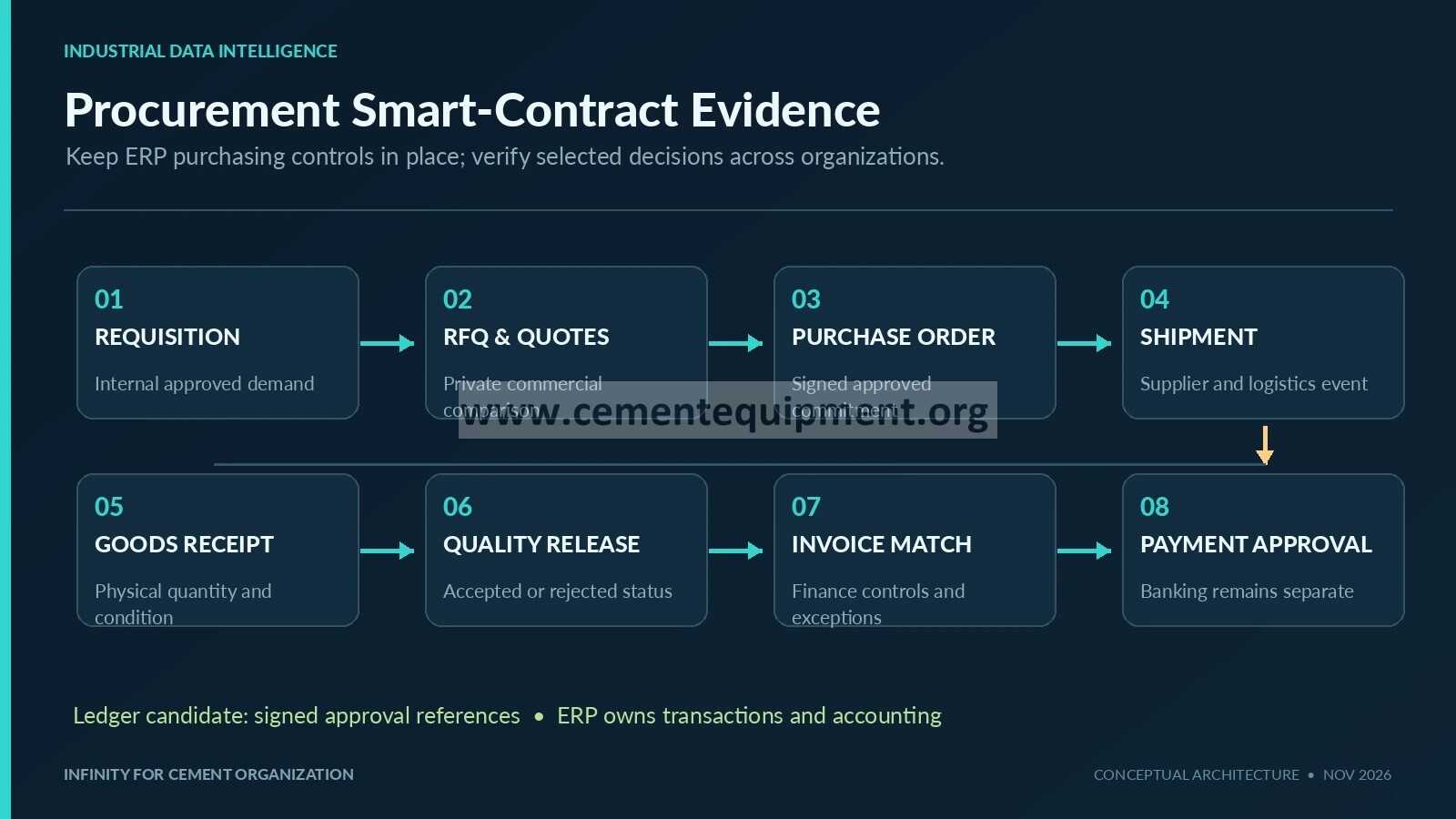
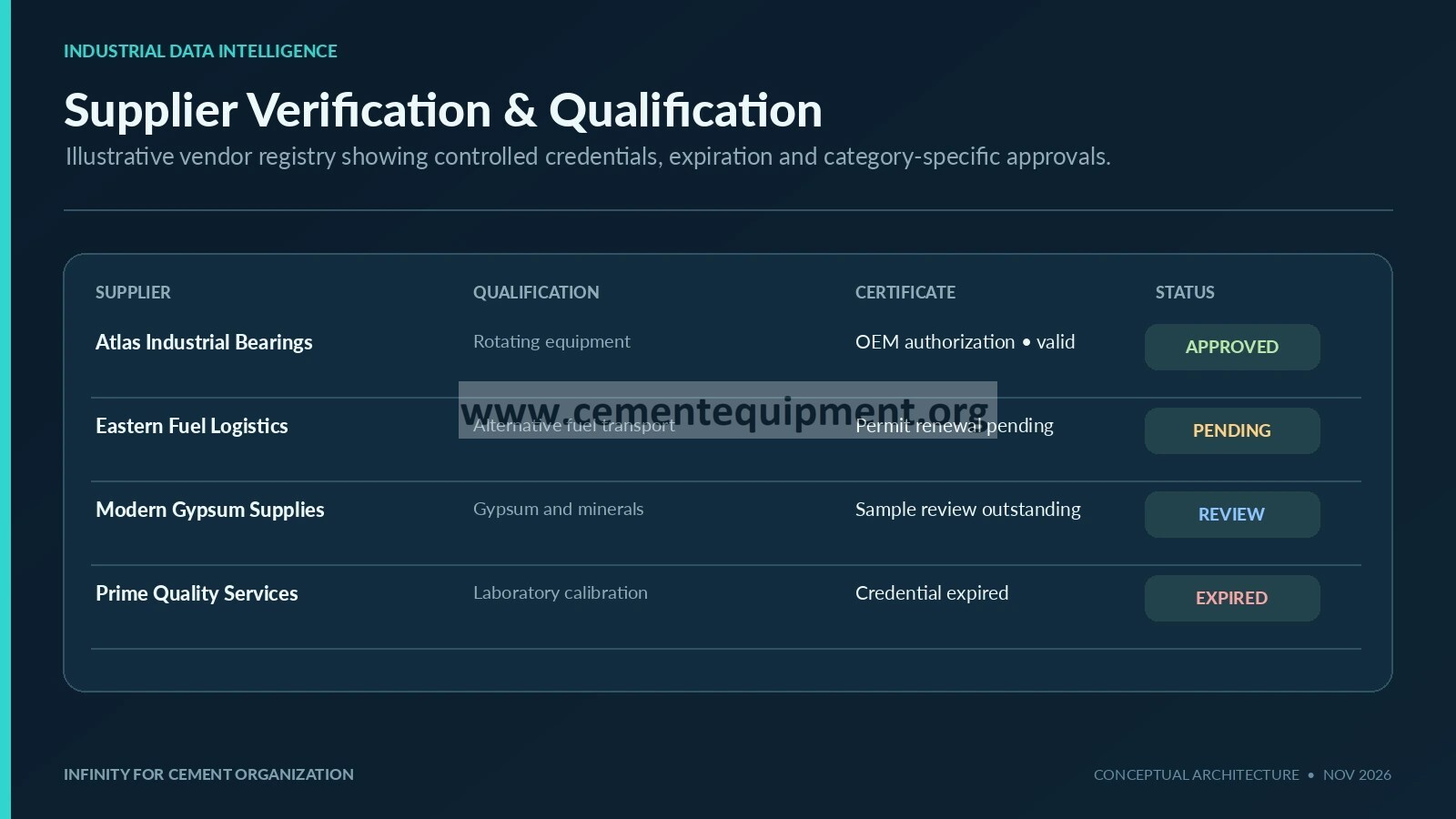
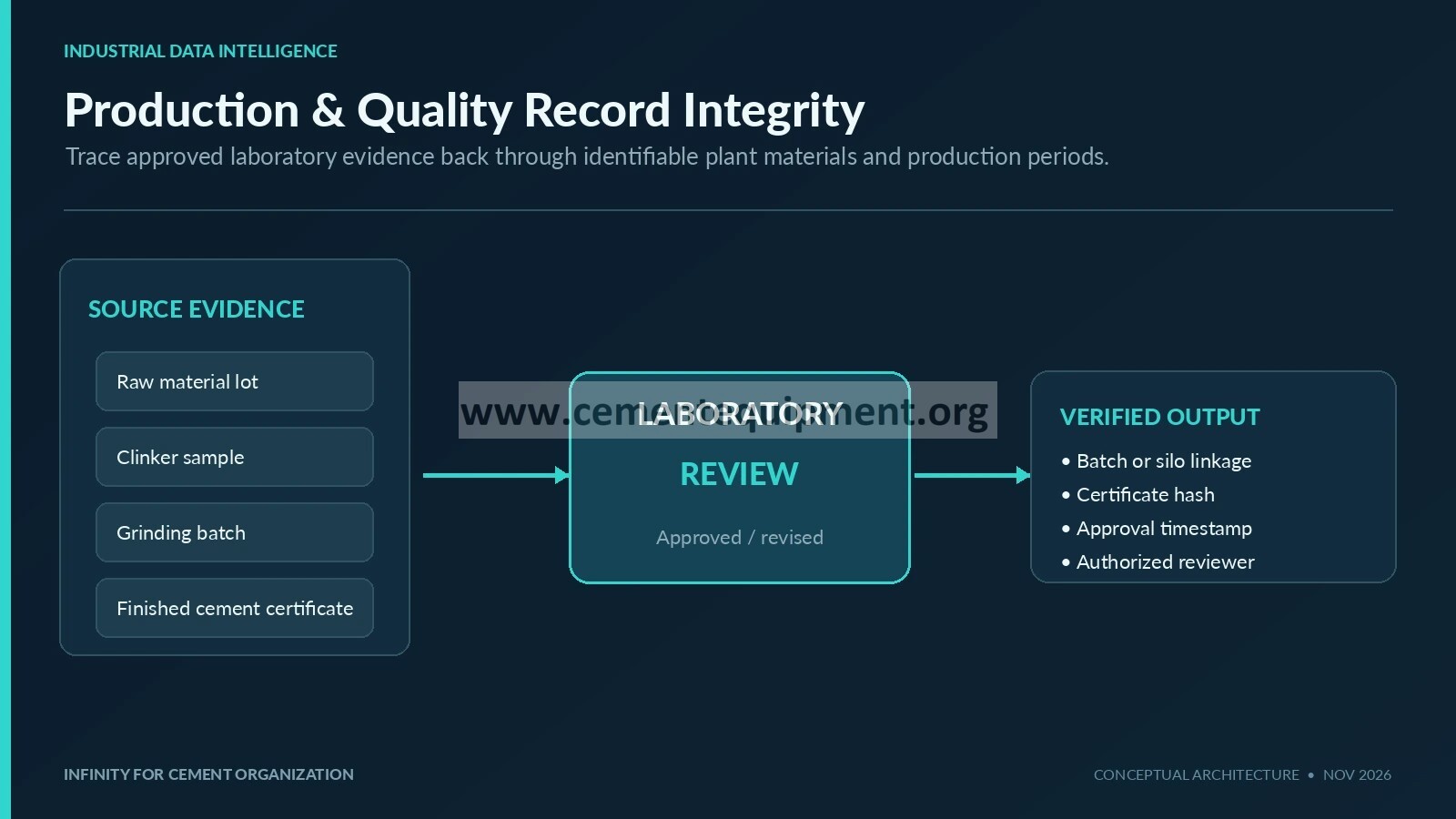
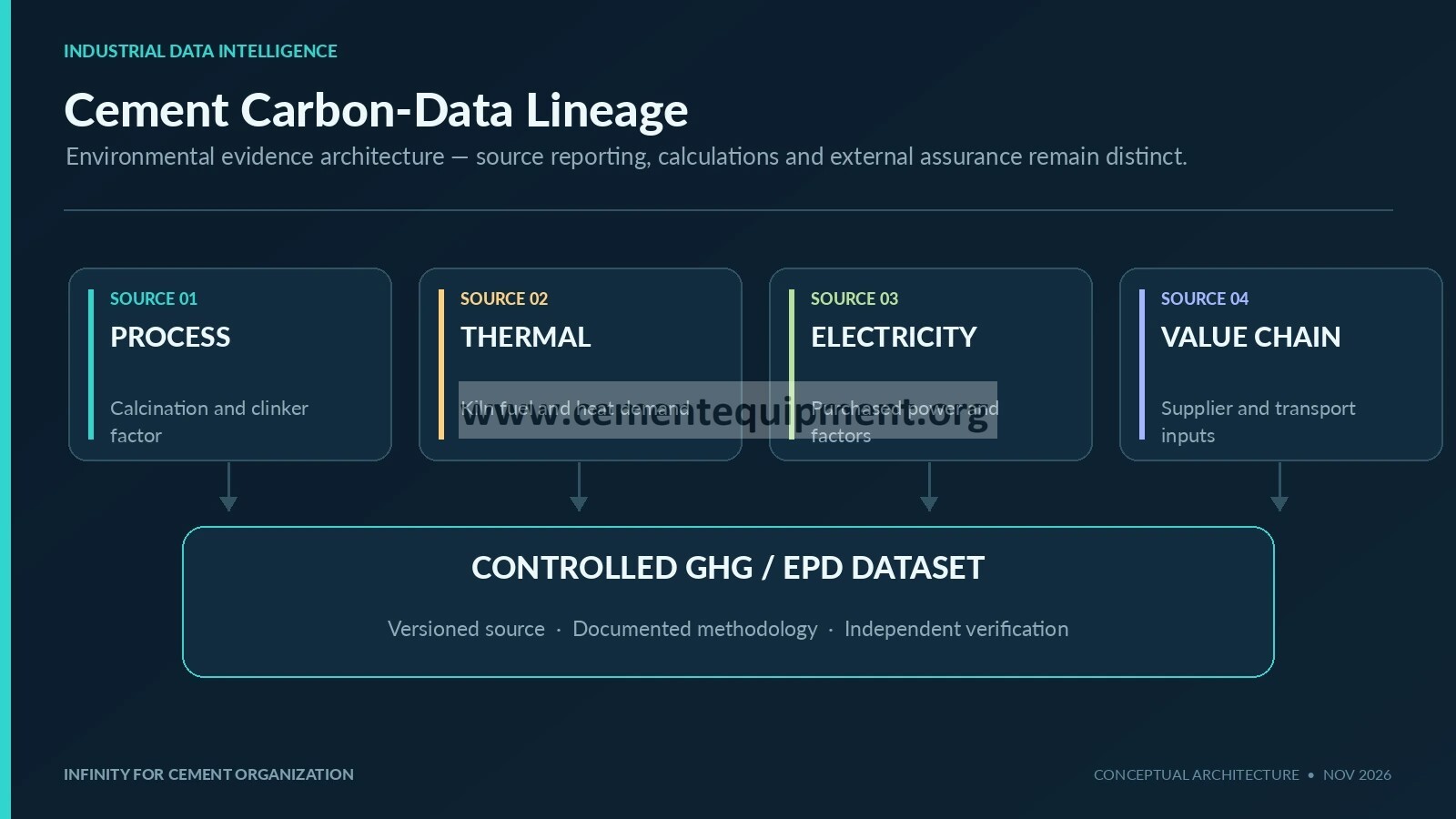
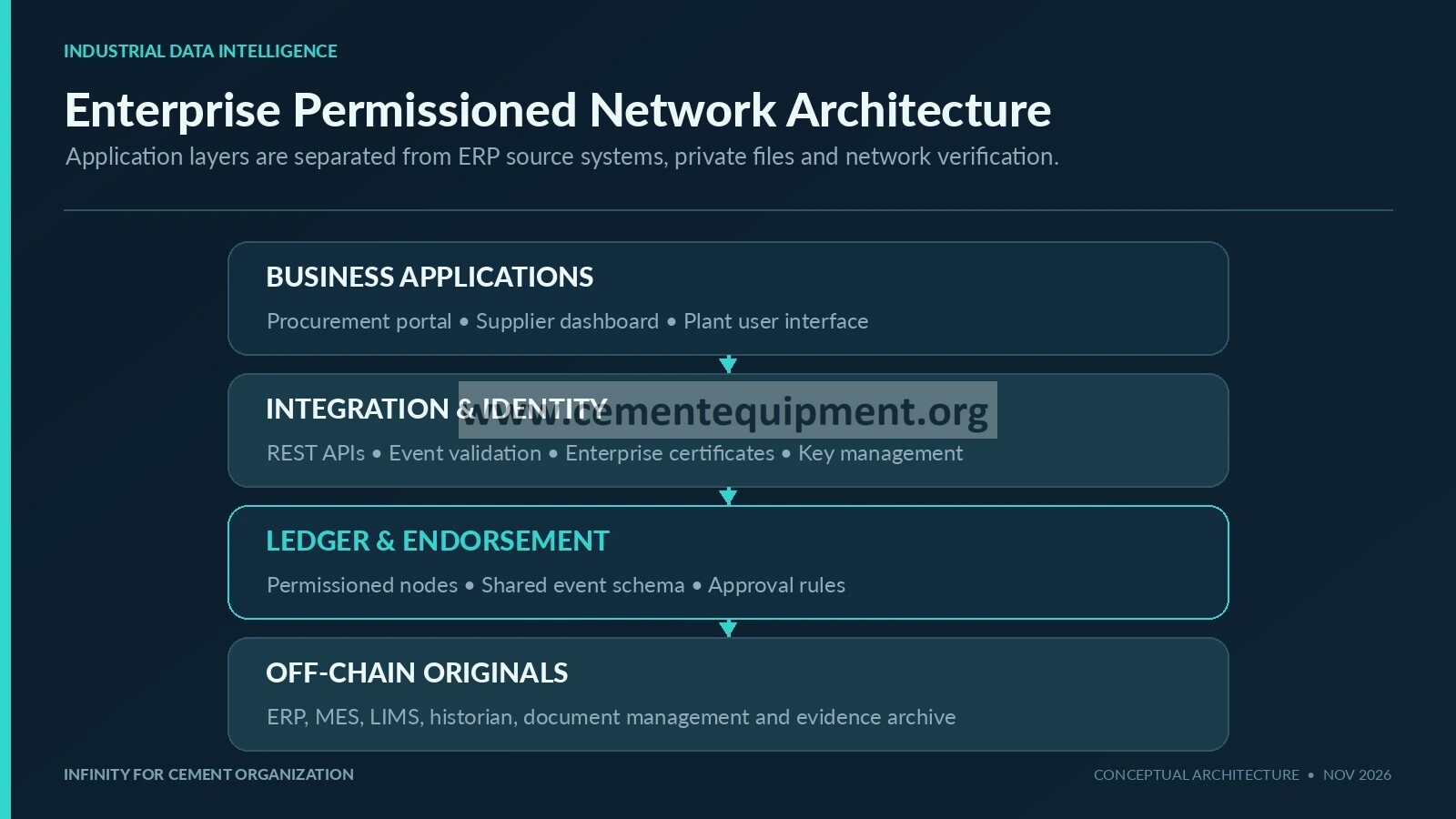
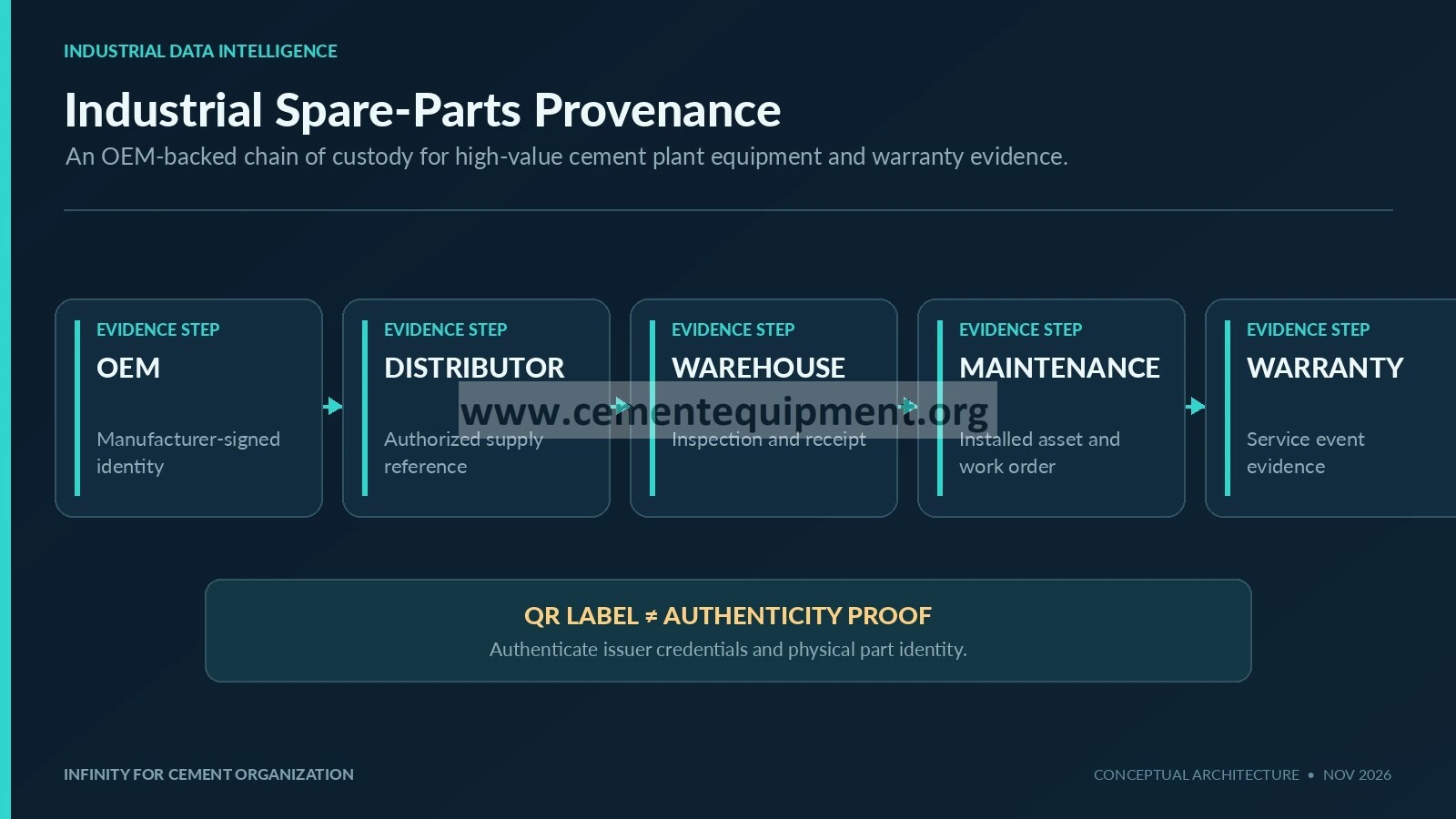
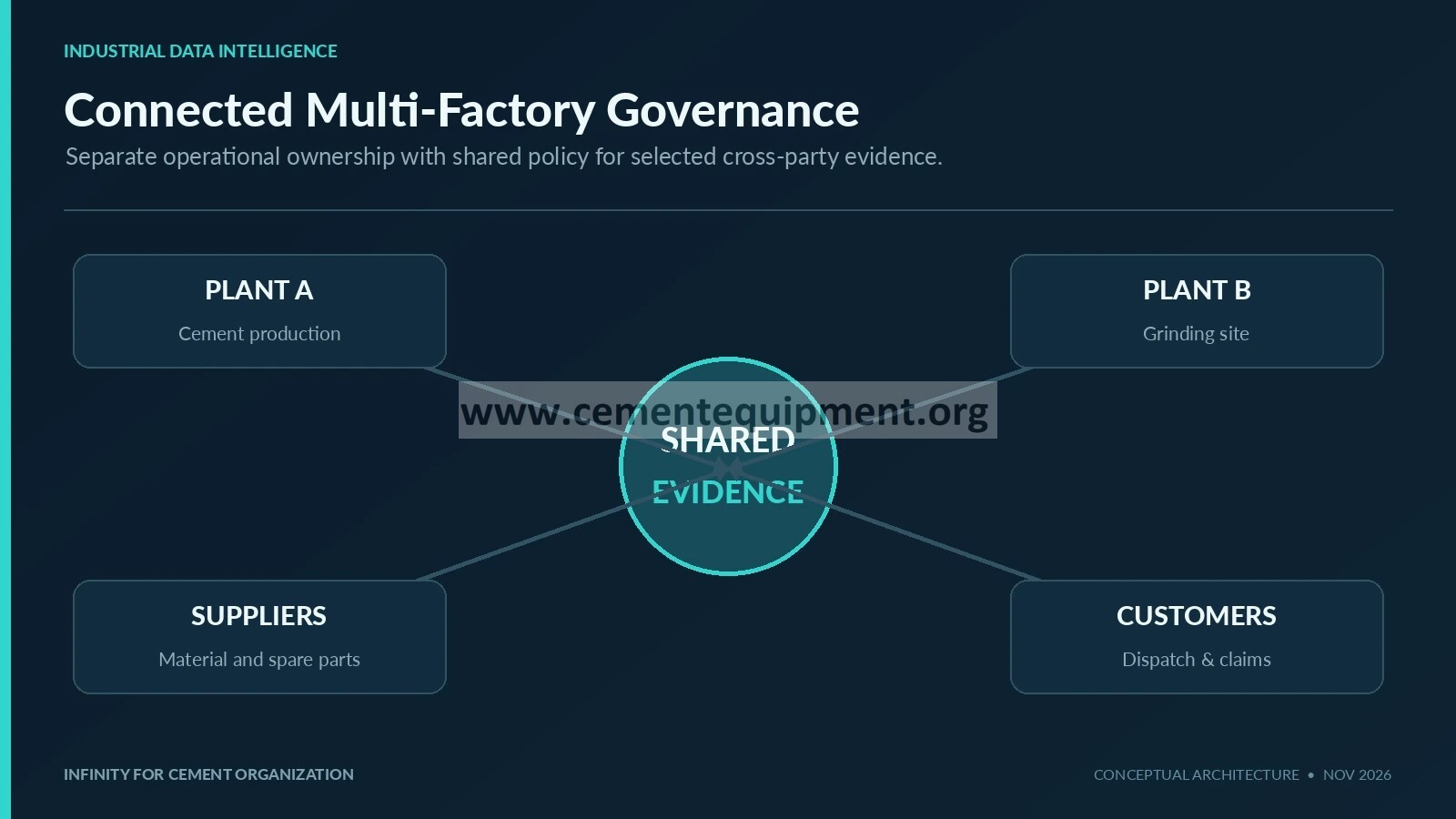
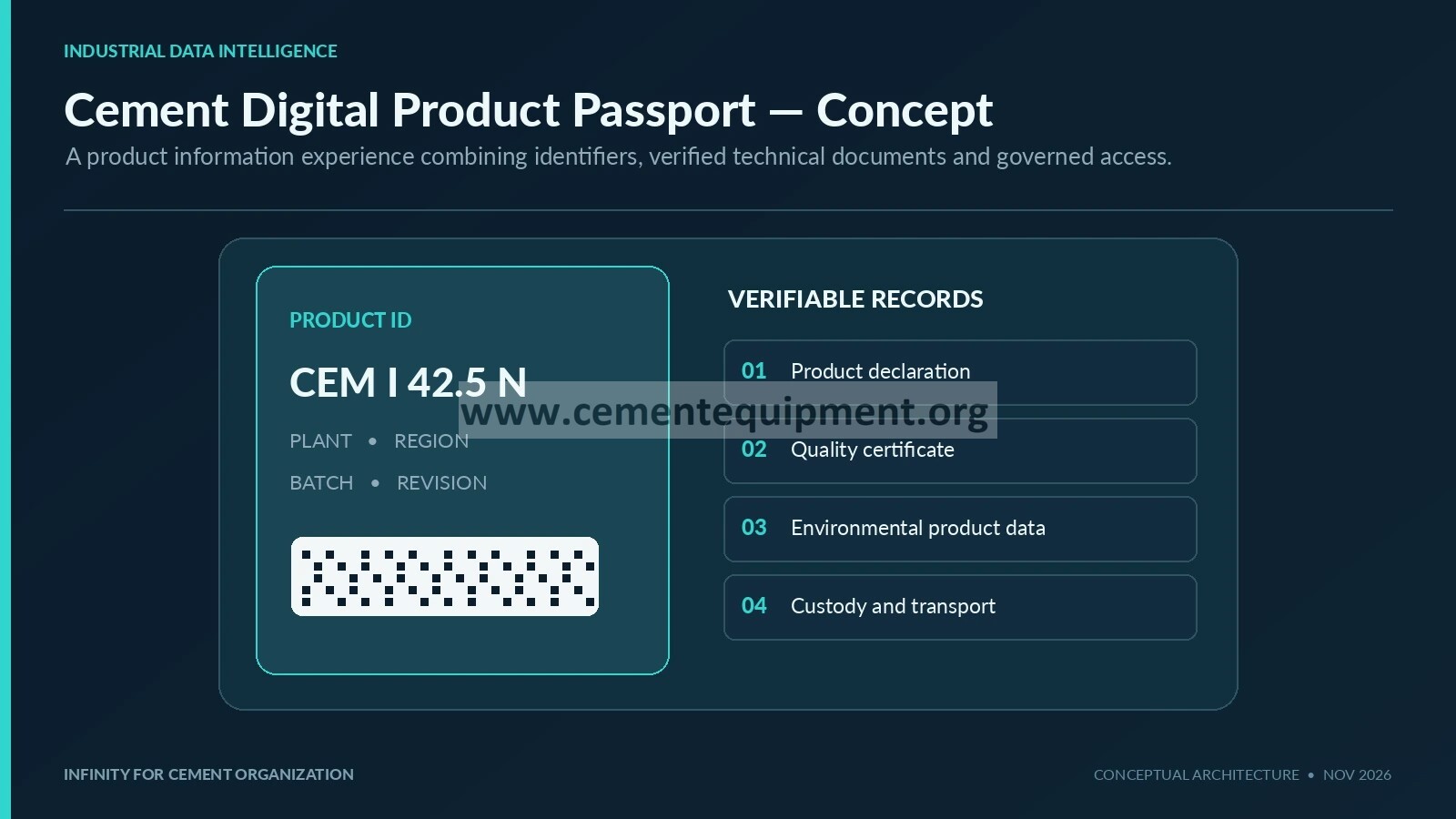
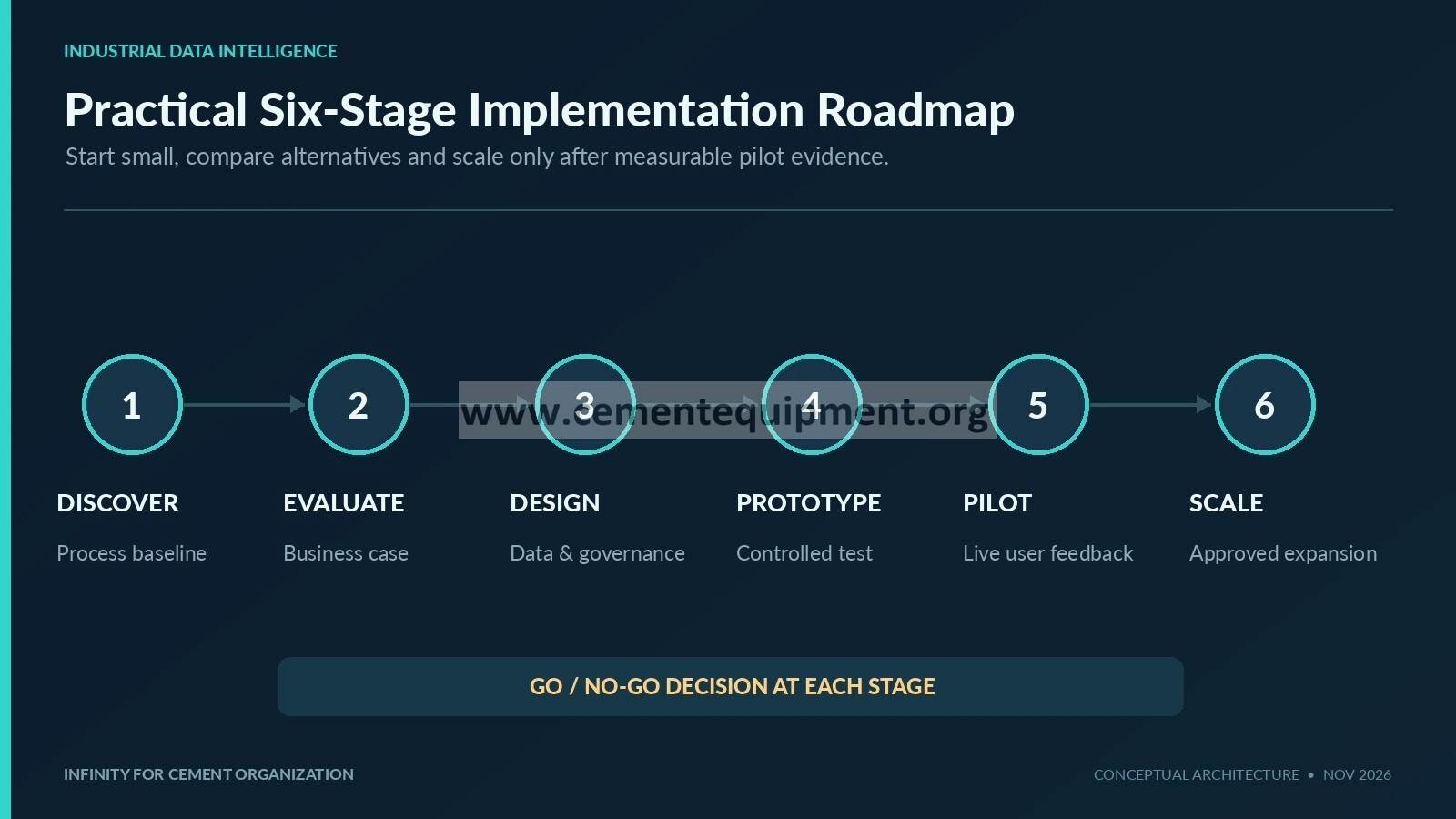
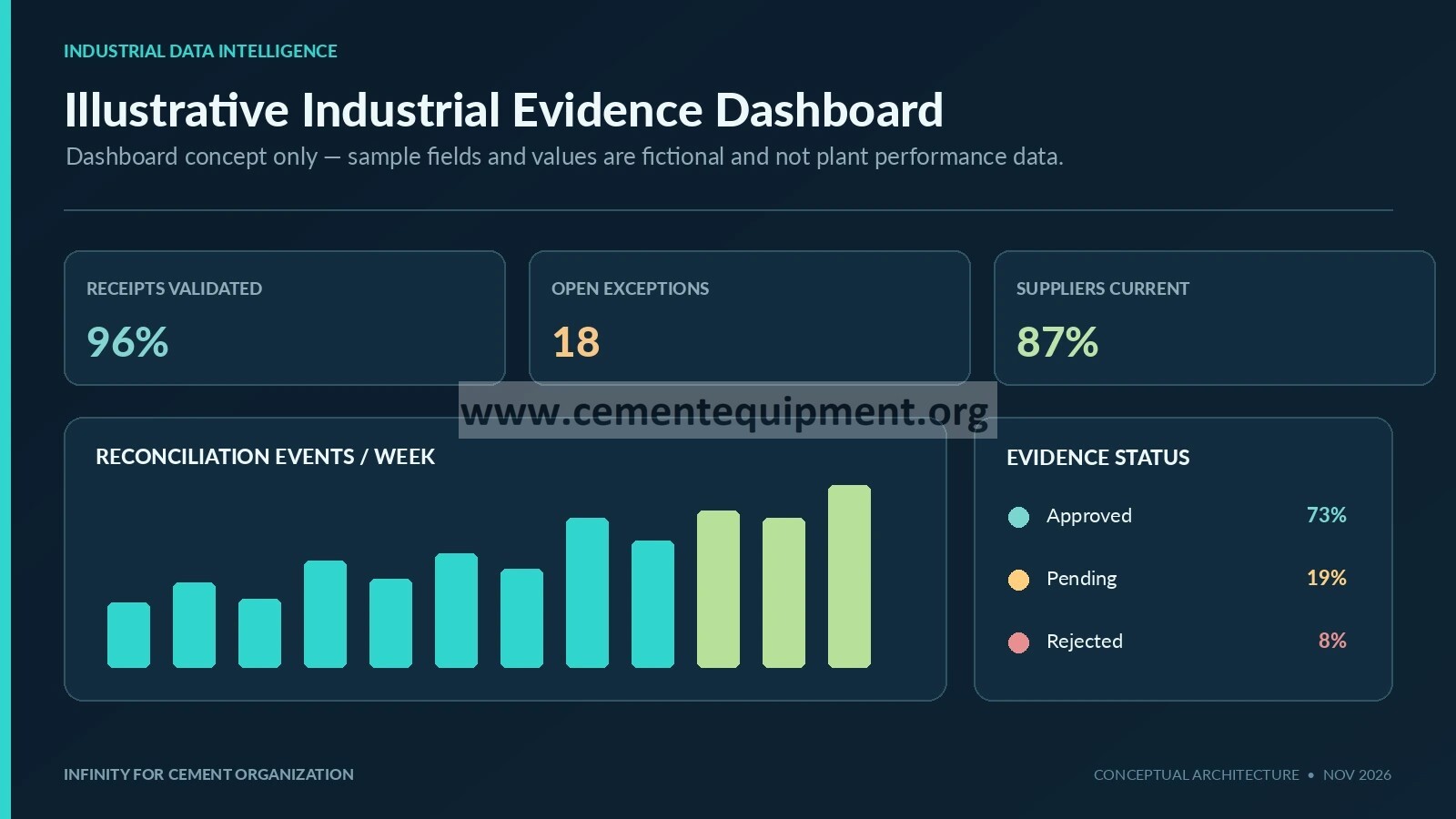
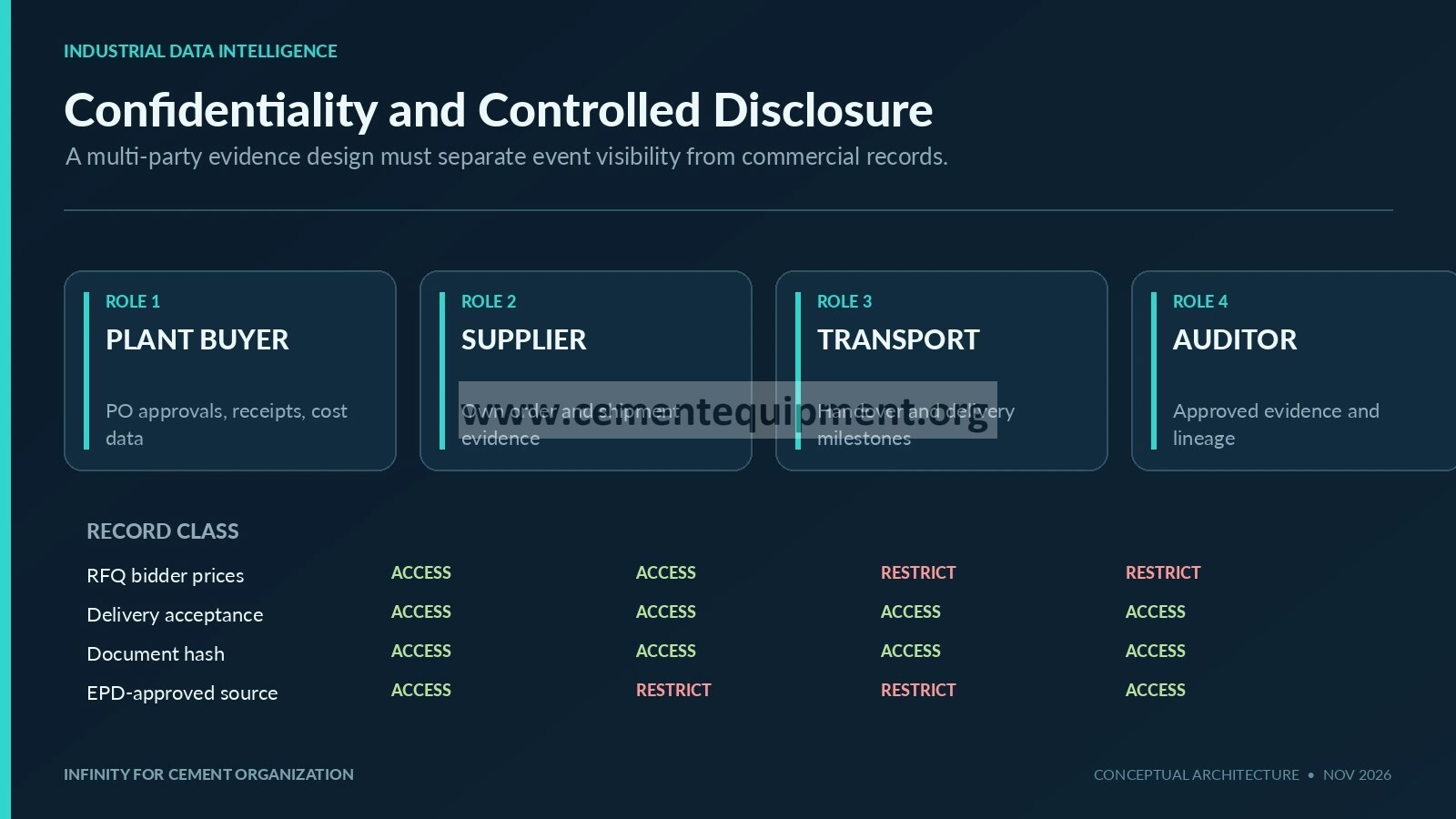
What cement-industry decision-makers need to know
Is blockchain mandatory to modernize a cement factory?
No. An existing ERP, strong audit logging and a conventional database can be better where a process has one accountable owner.
Does this mean cryptocurrency trading?
No. It concerns industrial transaction evidence and permissioned data exchange, not speculative cryptocurrency.
Can blockchain replace SAP, Oracle or Odoo?
No. Those business systems typically continue to own inventory, commitments, supplier master data and financial postings.
Can this remove all procurement fraud?
No. Evidence controls can expose unauthorized changes but cannot prevent false initial data or collusion without supporting governance.
Will competitors see confidential quotations?
A properly designed network must segregate competing bidder information with access control and private records.
Can smart contracts trigger real bank payments?
Not by themselves. Banking integration, controlled approval and applicable regulations remain essential.
Is Hyperledger Fabric the only possible technology?
No. It is one permissioned-ledger option. The assessment should compare platforms and conventional architecture.
Does a cryptographic hash certify a lab result?
No. It helps check that the approved version has not changed; it does not establish laboratory competence or sampling truth.
What about cement product passports and EU regulation?
The construction-products passport framework is developing through delegated acts and staged applicability; it does not establish a universal blockchain mandate.
Can an EPD be generated from blockchain alone?
No. An EPD requires appropriate LCA methodology, product rules, verified inventory and applicable independent review.
Who should own the network?
Governance, participating entities, admission, maintenance, dispute resolution and exit provisions must be agreed before deployment.
How is a delivery correction handled?
Use a governed amendment event; preserve original goods receipt and attach the approved correction.
Is a pilot expensive?
Cost depends on participants, systems, scope, integration complexity and support requirements; no fixed price can responsibly be assumed.
Will this affect the kiln control network?
It should not. Industrial control networks must remain appropriately segregated; use reviewed, approved data interfaces.
How are project savings calculated?
Use measured reconciliation hours and exception costs, then subtract technical development, security, governance and operating expenses.
Can suppliers without ERP participate?
Potentially through a secure portal or approved signed document exchange, depending on their requirements.
How does Infinity start an engagement?
A process and data discovery meeting identifies the workflow, parties, current costs and an appropriate technology assessment.
Is Infinity presenting an already deployed blockchain platform?
No completed proprietary customer blockchain deployment is claimed on this service page.
Primary technical and regulatory references
Hyperledger Fabric official technical documentation; EU Construction Products Regulation 2024/3110; European Commission Digital Product Passport; GCCA Cement and Concrete EPD Tool. Product and legal applicability requires review against current applicable requirements.
Request your Cement Blockchain Consultation
Tell us your name, business email, cement factory, country, department, preferred service, operational challenge, current ERP and project description. Additional details such as plant count, project timeline and decision authority help us scope the appropriate assessment.
This uses the established commercial email destination and opens the visitor’s email client. A dedicated form and independently verified backend receipt will be marked operational only after tested.
Detailed cement factory scenarios, evidence controls and pilot acceptance tests
The following are illustrative engineering design examples, not completed Infinity implementations. They demonstrate how to specify responsibilities, records and measurable outcomes before developing or procuring technology.
Scenario 1 — Imported clinker-cooler drive package
Define the asset identity before placing the purchase order: the equipment manufacturer’s legal identity, type designation, serial-number scheme, drive rating, reducer ratio, bearings, lubrication requirements, specified drawings and any approved exceptions. The technical approval record must refer to a fixed revision of the specification. If procurement compares three offers, the shared traceability system should not expose the competitors’ prices; instead, it can record the buyer’s approved selection event and the final contract reference. The ERP retains the commercial commitments, currency, taxes and payment terms.
Shipment evidence should link an OEM inspection certificate, packing list, export document, container or truck reference and carrier milestones. The buyer must define which signatures are authoritative: an OEM quality certificate is not interchangeable with a distributor declaration, and a freight forwarder cannot attest internal product performance. During receiving, the warehouse identifies each crate and serial number; quality records visible damage, shortages and certificates; engineering confirms whether preservation and storage meet the manufacturer’s conditions. Partial receipt and rejected components require separate, traceable status events.
Commissioning evidence should reference the installation work order, lubrication record, alignment measurements, vibration baseline, electrical tests and the first operating date. Raw vibration waveforms, commissioning videos and instrument plots belong in the CMMS or engineering repository. A signed hash of an approved report can provide a change-detection anchor without filling the ledger with documents. A later failure investigation can reconstruct the serial-number history across seller, carrier, receiving department, contractor and maintenance teams.
Pilot acceptance should be expressed as tests: can an authorized engineer retrieve the exact delivered specification within two minutes? Can finance determine whether a rejected seal was invoiced? Can the supplier see the accepted component list but not competing bid values? Can a corrected inspection status be added without erasing the rejected original? Can the process continue with a defined manual fallback during network downtime? The software should fail the pilot if it cannot meet agreed operational tolerances, even when ledger transactions succeed.
Scenario 2 — Limestone and gypsum transport with disputed weights
Start with measurement jurisdiction. A supplier’s loading scale and the plant’s entry scale may differ because of accuracy class, calibration, moisture, truck configuration or transit losses. Record both quantities as separate attestations, never as one overwritten number. Every ticket needs a unique dispatch reference, supplier, quarry or warehouse source, vehicle identifier, material description, departure time, receiving time, scale identity and unit of measure. Validation should reject impossible negative quantities, duplicate ticket identifiers and inconsistent units before the event becomes part of the approved workflow.
Sampling creates a second chain of custody. The sample label must connect to the correct truckload or defined composite batch; chain-of-custody fields include sampling point, collector, collection time, seal, destination laboratory, preparation method and sample condition. A gypsum shipment’s purity, moisture or other contract criteria may determine whether it is accepted, rejected, conditionally accepted or subject to a price adjustment. A calculation of dry-tonne value should reference the agreed formula and approved lab result, not an ad hoc spreadsheet cell.
Blend points require special care. When limestone from several benches is placed in one stockpile, the material after blending is not a pristine lot from one source. A system should explicitly represent intake, blending, transfer and consumption events and select a mass-balance method consistent with how the plant operates. Data-model fields must disclose uncertainty and reconciliation adjustments. Supplier-facing output might show accepted tonnes and relevant lab criteria while the plant retains confidential recipe and production information.
Acceptance tests can compare the platform against current receiving reports for a representative month. Reconcile every truck ID, accepted quantity, lab sample and supplier invoice. Deliberately introduce a duplicate ticket, a corrected weighbridge value, a failed sample and a late quality result; verify that exceptions route to qualified staff and preserve the original record. Evaluate resolution time, number of manual telephone calls, percentage of receipts linked to quality evidence, and monthly disputed-value exposure.
Scenario 3 — RDF and alternative-fuel delivery accountability
Alternative-fuel procurement combines commercial, quality, environmental and operational information. Supplier onboarding may involve waste licenses, treatment-facility documentation, acceptable feedstock categories, permitted transport, moisture and calorific-value specifications, and prohibited contaminants. The digital workflow must reflect the plant’s actual permit obligations and contract terms, which vary by country and source material. A blockchain record is not a substitute for a government-issued movement document or laboratory surveillance.
An RDF arrival can carry a delivery manifest, batch or vehicle ID, measured mass, visible contamination result, moisture or NCV sample reference, chlorine and other relevant quality measurements, disposition and invoice settlement event. The data model should support provisional receipt while lab results are pending. Where the contract prices material by net energy delivered, the pricing logic should use the agreed quantity basis, method and factor version. The executed commercial adjustment remains controlled by the finance application.
The movement of accepted fuel to storage and consumption generates records about handling and inventory, not direct proof of total emissions performance. Environmental calculations require validated consumption, fuel composition, factor selection, system boundary and allocation treatment. Biogenic and fossil carbon fractions must not be silently combined or represented as automatically certified renewable content. The data lineage can assist an auditor only if retained source datasets and methodologies remain available.
One practical pilot objective is to prove that rejected batches cannot be marked approved simply by a transporter and that each invoice adjustment can be traced to a valid sampled result. Test inadequate documents, a misidentified truck, disputed sampling, delayed laboratory release and an authorized retest. Protect waste-supplier commercial terms and any personal driver information using differentiated access.
Scenario 4 — Cement bulk-dispatch and customer acknowledgement
Dispatch begins with the seller’s order and specified cement product, not with a GPS device. The order identifies a buyer, delivery site, requested product type, agreed quantity, truck or tanker plan and commercial reference. The loading terminal records a batch or silo, loading start and end, gross and tare weights, seal identifiers if applicable, issued documents and dispatch authorization. These are factual assertions from the seller’s systems; they do not become independently verified simply because their hashes are copied to a ledger.
The carrier may attest handover, departure, arrival, delay or exceptional incident. The recipient can acknowledge a delivered quantity, record rejected material or request investigation. These events must identify the responsible organization. A delivery can be partly acknowledged without forcing all sides to agree immediately. Disputed weight, trailer contamination, seal damage and delayed unloading should generate evidence trails and controlled exceptions.
The system should use product references at the level the plant can actually support. Some factories can relate dispatch to a well-controlled production lot; others can only relate to a storage silo and loading window. Marketing claims such as ‘trace every cement particle’ would be scientifically unsupported. The design should preserve batch confidence, certificate version and relevant production time interval, with clearly stated limits.
Success criteria include fewer disputed proof-of-delivery records, faster invoice release, improved completeness of truck documentation and reliable customer access to authorized quality evidence. Include a test for cancellation, change of delivery site, partial receipt, two vehicles on one sales order and a customer unable to access the web service. No unverified payment release should be permitted merely because a transporter submitted a GPS arrival point.
Scenario 5 — Cement EPD and product passport evidence
Product carbon data needs a hierarchy: site-level process data, production-period or product-specific allocation, emission factors, activity datasets, calculation files, approved declarations and publication versions. Establish which business entity owns each source and which assurance organization, if any, has reviewed it. A blockchain may preserve a tamper-evident receipt for an approved dataset but cannot validate the underlying clinker factor, fuel balance or process-emission calculation.
A usable digital product passport should allow an authorized buyer to find the declared product, manufacturing plant, relevant technical specifications, performance declaration and EPD reference. Its data should be accessible through durable identifiers and machine-readable formats, with availability, data minimization and phased regulatory applicability managed under a documented compliance assessment. A QR label can be one access mechanism, but not the product’s only source of truth.
When clinker from different periods feeds one finished product, the applicable carbon calculation must follow the approved accounting method and allocation rules. It should not infer exact physical origin from a shipment number alone. Records should identify which emissions-factor version, time boundary and allocation method underlie a published claim. Corrections and superseded EPDs need machine-readable status so buyers do not rely on an outdated declaration.
Test a simulated third-party review: provide a declared product number and ask the reviewer to retrieve its supporting report version, calculation inputs and responsible approvals without disclosing unrelated supplier prices. Test a revised factor, rejected source dataset, new declaration revision and expired certificate. The workflow is satisfactory only when the evidence trail is both technically inspectable and consistent with the applicable declaration program.
Detailed responses to procurement, CFO, IT and plant-management questions
These answers address the operational and contractual decisions that typically determine whether an enterprise digital-trust project can be justified, deployed and maintained.
How do we know whether blockchain is necessary?
Run a neutral architecture decision rather than asking whether a ledger can be installed. Document the transaction, participating legal entities, source systems and the specific disputed claims. A centralized store with immutable logs, role-based access and electronic signatures should be the first comparator. If independent companies need durable shared event evidence without accepting a single organization’s editable history, a permissioned ledger may create value. Quantify that value against hosting, governance, integrations and support. The final recommendation may legitimately be not to deploy blockchain.
What belongs in the ERP and what belongs in the ledger?
The ERP remains authoritative for purchase orders, vendor accounts, inventory balances, tax treatment, invoice matching and financial postings. The ledger should record only selected approved events, actors, document fingerprints, references and shared confirmations whose cross-party integrity matters. Original proposals, drawings, certificates, invoices, lab reports and maintenance files should normally stay in conventional controlled storage. Maintaining a clean reference between the event and original document is more important than placing large files on-chain.
What happens if someone supplies incorrect weighbridge data?
A cryptographic signature identifies who submitted data with a particular credential, not whether a measurement was accurate. The plant needs scale calibration, sample checking, separation of duties, an exception-handling process and periodic reconciliation against physical transactions. A correction should be a signed, reason-coded adjustment with a reference to the original, not a hidden edit. If a truck receipt is disputed, both counterparty assertions can remain visible while the responsible quality or commercial officer resolves the approved position.
Can the solution protect supplier quotation confidentiality?
Yes only with a suitable access architecture, not by default. Rival bidders must not read each other’s commercial terms or see a shared encrypted blob from which sensitive facts can be inferred. Segment records by party and purpose, use application-layer authorization and platform-supported confidential data controls. Do not anchor sensitive information in a public chain without a formal threat assessment. Record evidence that a quotation was approved without publishing its value or attachments to every member of the network.
Who governs a network used by several cement companies?
The participants need a signed governance agreement identifying node operators, admissions, withdrawal, endorsements, key custodians, upgrade decisions, dispute resolution, incident procedures, operating hours, fees and record-retention responsibilities. One organization may run the application on behalf of others, but then a conventional shared portal might offer comparable utility. Governance must explain what happens if a participant refuses a software update or loses the authority to sign new transactions.
Can smart contracts accelerate invoice payment?
A smart contract can confirm that machine-readable conditions have been satisfied: for example a valid PO, accepted goods receipt and invoice within tolerance. It can then emit a recommendation, exception or approval-ready event to the ERP. Actual release of money remains subject to finance delegations, segregation of duties, banking integrations, currency and tax rules, and local regulations. Never automate a transfer solely because an unverified logistics event exists. Reconcile payment states with bank responses rather than treating the ledger as a bank statement.
How can the design support product recalls or quality complaints?
Each dispatch should link to the product identifiers and quality documentation actually available from the factory. If a product is linked only to a silo and loading interval, the traceability resolution must be stated rather than pretending a physical batch can be uniquely separated after blending. A complaint workflow can identify potentially affected deliveries, the most recent approved lab results and corrective actions. Authorization to issue a recall or conformity declaration belongs to qualified quality-management personnel and relevant legal requirements.
How do we assess ROI for the finance director?
Specify measurable transaction populations and use activity-based costing: purchase orders per year, average minutes spent searching for documents, receipt exceptions, dispute duration, audit preparation hours and loaded staff cost. Baseline each metric before the pilot, then compare against the same metric after implementation, adjusting for differences in transaction complexity and sample sizes. Include one-time build and training, annual operations, key management, partner participation and security maintenance. Avoid double counting a saved reconciliation task as both a labor saving and a separate ‘audit saving’.
Can carbon reporting become audit-ready automatically?
No. Digital evidence can improve traceability of approved datasets, timestamps, document versions and responsible sign-offs, but the measurement and calculations still require appropriate instruments, sampling, factor selection, product category rules and assurance. Distinguish Scope 1 process emissions from direct fuel use, Scope 2 purchased energy and applicable Scope 3 supply-chain activities. Make calculation assumptions and allocation rules retrievable. A verifier should be able to reproduce the declared number from stored source evidence, not only see a blockchain hash.
Can a cement digital product passport be implemented now?
A manufacturer can develop data readiness now: consistent product IDs, reliable technical files, relevant declarations, quality report archives, approved EPDs and machine-readable access. The applicable legislation and delegated acts must be verified for the product and export destination before promising a required passport format or deadline. Blockchain is optional technology, not a general legislative requirement. Prefer standards-based identifiers and interoperability so the same source records can support future obligations.
What are the cybersecurity and recovery requirements?
Document identity assurance, authentication, permissions, data encryption, audit logging, credential recovery, patch management and incident response. Separate enterprise IT from industrial control networks; avoid accepting a ledger node as justification to expose SCADA equipment to the internet. Test backup restoration, unauthorized document requests, compromised credentials and network partition conditions. A usable fallback is essential if the receiving gate cannot validate a transaction while a remote service is unavailable.
What should be included in the supplier contract?
Define data accuracy obligations, approved statement types, certificate issuer responsibility, permitted event corrections, key custody, data retention, confidentiality, export rights, participation costs and exit procedures. Ensure that a transporter only attests the custody events it can genuinely know, rather than declaring equipment conformity. Provide a dispute-resolution procedure for conflicting receipt and dispatch records. If a proof is legally relevant, obtain advice on the required local formalities and contractual evidence status.
How should a pilot select participants?
Select a process owner at the plant, one credible external counterparty, an IT security representative and a person responsible for measuring business outcomes. Their authority and availability matter more than the number of blockchain nodes. Do not recruit five suppliers only to show a large diagram; start with a transaction population with enough normal, late, rejected and disputed cases to demonstrate business rules. Obtain permission to use sanitized source data and identify how pilot events will be distinguished from live business approvals.
How can an implementation avoid vendor lock-in?
Demand a documented event schema, interoperable identifiers, API contracts, exportable audit history, standard cryptographic signing where feasible, and clear ownership of source code or licenses. Avoid proprietary logic that the plant cannot independently operate or migrate. Export tests should produce a readable history, associated documents and verification instructions. Evaluate the ability to continue business if a consortium platform is retired, a hosting vendor changes or a system integrator becomes unavailable.
What does Infinity deliver itself versus through partners?
The available service is described as industry-specific assessment, requirements discovery, feasibility, architecture and project scoping. A proposal for software engineering, secure hosting, integrations, penetration testing, EPD calculations or independently regulated assurance must identify the responsible qualified delivery resources and confirm partner arrangements before making a binding implementation commitment. No completed customer deployment, certification or implementation result should be inferred from the technical design examples on this page.
Why a cement-industry operational perspective changes the consulting approach
A technical proposal is useful only if it protects the procurement, production, quality and environmental decisions that cement organizations actually need to make. The following describes the proposed delivery philosophy and its boundaries.
Operational knowledge before technology selection
Infinity for Cement Organization is positioned around cement engineering content, specialist reference materials and industrial commercial support. That industry orientation matters because the most expensive software mistakes begin when a systems team models a production process without understanding the operational context. A cement plant purchases highly specified equipment, handles bulk materials with varying composition, operates continuous thermal processing assets, uses extensive inspection and testing, and delivers a product whose declared quality has technical and commercial consequences. A generic ‘blockchain for every transaction’ pitch does not resolve these complications. The correct discovery process identifies the practical evidence required for an actual procurement, laboratory or dispatch decision.
A credible plant interview needs participants from procurement, accounts payable, warehouse, quality, plant operations and IT—not just the executive sponsor. An engineer may define a component’s specification, procurement may issue the purchase order, warehouse may physically receive the part, and quality may reject it before inventory can be used. Each step has a different legal and operational meaning. A reliable verification architecture must preserve that meaning, permit controlled exceptions and integrate with the existing systems that remain accountable for it.
A disciplined boundary between consulting and implementation
A request to ‘implement blockchain’ is not yet an engineering specification. The first output should be a defined problem statement, process boundary, candidate transaction population, counterparty map, data model, integration inventory, privacy classification, preliminary risk register and decision criteria. Only after that work can a technical team justify permissioned distributed ledgers, conventional shared databases, digital signatures or existing ERP enhancements. Where the simpler solution satisfies the objective, Infinity should recommend it explicitly.
The scope of professional delivery must also be transparent. Industrial requirements assessment and pilot design are distinct from secure production hosting, custom cryptographic development, bank integrations, independent carbon assurance or legal advice. A proposal for those activities should identify the actual qualified delivery team, necessary partners, responsibilities, support coverage and acceptance criteria. Until those commitments are confirmed, the website presents a service capability for consultation and project scoping rather than an already deployed proprietary blockchain product.
Procurement and commercial accountability
The technical chain of events should never obscure basic procurement controls. Supplier selection depends on approved specifications, fair comparison, qualification, commercial authority and documented approvals. A digital ledger may preserve a signed statement that a selection occurred, but it does not establish that the evaluation was unbiased or the price competitive. Real governance requires access controls, delegation of authority, separation between buyers and approvers, conflict-of-interest procedures and a reliable way to investigate discrepancies.
The finance director must remain able to reconcile PO commitments, receipted quantities, invoice liabilities, credit notes and bank payments in the normal financial accounts. New technology should reduce manual reconciliation or improve evidence quality rather than create a parallel accounting truth. A useful acceptance test is whether finance can investigate a disputed invoice more quickly without learning a separate cryptographic user interface. The shared proof should point back to the correct ERP and source documents.
Factory process and material science
Clinker formation, fuel substitution, grinding, storage and batch blending are physical processes governed by chemistry, equipment condition and operational controls. An information system does not turn a blended cement silo into a chain of perfectly separable product lots. The plant must describe which attributes can be traced with confidence, how mixing events are recorded and how quality certificates apply to a shipment or production interval. This is especially important for low-carbon claims that depend on approved calculation boundaries, allocation approaches and reliable process measurements.
Recognizing these limits supports credible marketing. The website should promise an assessment of traceability feasibility, not guaranteed end-to-end physical certainty. If the receiving records or product genealogy are incomplete, the initial project may need to improve weighing, sample identification, master-data management or laboratory interfaces before a distributed verification layer can add meaningful trust. This is a legitimate outcome of discovery, not a failure of the consulting engagement.
A practical commercial engagement model
For an initial discussion, the customer can provide a non-confidential overview of one process, the ERP or operating system used, approximate transaction volume, number of counterparties and major reconciliation difficulties. A readiness assessment can then produce a workshop record, prioritized problem list, data and governance gaps, technology alternatives, initial risk assessment and proposed pilot. The pilot should involve enough exceptions to prove that corrected, disputed or rejected events can be handled safely. A successful pilot is judged by the buyer’s agreed operational metrics, not by whether a demonstration screen displays blocks connected by lines.
If a plant wishes to scale, the business case should include recurring license, infrastructure, node operation, identity management, cyber monitoring, integrations, training, supplier participation and long-term document retention. Multi-plant governance introduces additional costs and responsibilities. These must be presented before a rollout commitment is made. Where the result is negative, executives should be shown the facts so they can redirect their technology budget to higher-value plant improvements.
Evidence, transparency and technical credibility
External references on this page are deliberately distinguished from customer references. Hyperledger Fabric documentation establishes technical behavior of one candidate platform. European Commission material provides context for digital product passports and construction-products regulation. GCCA resources provide context for EPD-related data workflows. None of those third-party publications establishes that Infinity has delivered a blockchain system or achieved a specific reduction in plant costs. Likewise, hypothetical savings calculations are clearly labeled as scenarios requiring validation.
Prospects should request a written proposal with actual personnel, deliverables, assumptions, exclusions, intellectual property terms, support and verification criteria. They should not be encouraged to rely on an unconfirmed installation timeline or a claim of regulatory certification solely because a web page contains detailed technical explanations. The objective is to make the buyer better informed and better equipped to commission a useful and auditable solution.
The first meeting and the next decision
A qualified inquiry should describe the relevant factory process in language that staff already use: supplier qualification, spare-parts receiving, gypsum weighbridge, RDF testing, cement-batch quality certificate, truck dispatch or carbon evidence collection. State the plant’s country, the software environment, which other organizations are involved and what goes wrong today. Sensitive bid prices and personal records should be withheld until a secure exchange route has been agreed.
The outcome of that first discussion should be specific: either a short list of missing information, a proposed readiness assessment with deliverables, a well-bounded pilot brief, or a recommendation to solve the problem with an existing software system. Maintaining this clarity is more valuable than promising that every cement company needs an expensive blockchain transformation.
How to begin: a twelve-step procurement and engineering requirements process
The fastest useful engagement is an evidence-based discovery exercise around a specific factory workflow. Use the steps below to prepare information for a proposal without disclosing unnecessary confidential material.
1. Define the factory and the business owner
Identify the exact plant, legal entity, operating country, responsible department and person authorized to sponsor an assessment. A procurement problem should have a procurement owner; a laboratory integrity problem needs quality leadership; a multi-plant carbon-data project needs a sustainability and finance governance interface. The first session should establish whether the goal is operational efficiency, accountability, compliance preparation, customer visibility or a combination. Choose no more than two principal success measures for the initial project.
2. Identify all organizations that produce or verify evidence
List the factory, subsidiary or group headquarters, suppliers, transporters, calibration provider, external laboratory, OEM, customer, insurer, banks or regulators involved in the target workflow. For each participant record the data it generates, whether it is authorized to correct that data, whether it can participate in a shared technical system, and what it should be allowed to read. Separate a participant’s legal entity identity from its system users and device identities.
3. Describe the current process without drawing a blockchain first
Use the actual business documents: purchase requisition, approved RFQ, offer comparison, purchase order, acknowledgement, commercial invoice, packing list, receipt, delivery note, inspection certificate, batch release or customer receipt. Mark which documents represent requests, which are approvals, which establish physical quantities and which generate accounting entries. Observe the exception paths. A solution designed only for an ideal successful transaction will fail when the first damaged shipment arrives.
4. Identify the source systems and responsible administrators
Record ERP product/version, available APIs, document storage, CMMS, warehouse system, laboratory interface and relevant industrial data repositories. For each event choose an authoritative application. Define whether a system publishes an event automatically after an approved status or whether a human initiates a signed assertion. Avoid manual retyping of master data that already exists. Identify system administrators, expected change approvals, network restrictions and data availability requirements.
5. Build an evidence dictionary before prototyping
Define stable identifiers for plant, organization, user role, vendor, PO, material, item, lot, batch, shipment, vehicle, scale, instrument, lab sample, certificate, acceptance status and invoice reference. Specify uniqueness, field formats, required values, controlled vocabularies, valid units and maximum acceptable delay between a physical event and its electronic record. If two participants use different item numbers or quantities, develop an explicit translation and exception process rather than silently merging records.
6. Define privacy and permitted verification claims
Classify records into public, consortium-visible, bilateral confidential and internal-only. Mark commercial bid values, personal identities, bank details, production recipes and security-sensitive asset data as restricted where required. Define which information appears directly in the ledger, which appears only as a fingerprint and which is never transmitted beyond the originator. A hash may still reveal information through correlation, so the security design should account for context and metadata, not just cleartext.
7. Design normal and exceptional transaction journeys
Prepare test journeys for correct delivery, partial delivery, overdelivery, wrong part, rejected quality sample, corrected certificate, supplier withdrawal, cancelled invoice and network outage. For each journey define who may advance status, what documents support it, what constitutes a valid counterparty signature, and how the earlier history remains recoverable. Specify how the ERP posting and ledger event are reconciled if one system acknowledges a transaction and the other times out.
8. Compare plausible technical alternatives
Build a simple decision matrix for improved ERP workflow, shared supplier portal, central document-verification service, cryptographically signed archive and permissioned distributed ledger. Score each option on transparency, confidentiality, cross-company trust, licensing, speed of integration, availability, cybersecurity exposure, maintenance and cost. Define weighting with the business owner. The chosen alternative should be the one that meets requirements at an acceptable total lifetime cost, not necessarily the newest technology.
9. Agree on a pilot scope and evidence population
A useful initial boundary could be one imported spares supplier and one purchase-order category, one gypsum material stream, one bulk-cement dispatch route or one EPD source-evidence workflow. Identify enough transactions to include rejected and disputed cases, not only demonstrations. Protect personal and confidential data with test-environment controls. Record baseline processing times and rework before implementation so post-pilot performance can be measured meaningfully.
10. Set acceptance criteria with numeric definitions
Examples include percentage of deliveries with matching PO and receipt references, time to retrieve an approved certificate, proportion of invoice exceptions resolved within the contracted workflow, number of unauthorized changes detected, recovery time after an integration outage and supplier onboarding completion rate. Do not assume an arbitrary percent reduction. Define thresholds based on actual process economics and the plant’s tolerance for risk. An independent stakeholder should be able to repeat the test and arrive at the same result.
11. Prepare the financial model and governance agreement
Include discovery effort, build, system integrations, user training, hosting, monitoring, support, key recovery, disaster recovery, partner onboarding and potential licensing. Define who pays for external participants, who owns the application, which organization operates nodes and how a supplier exits. Evaluate payback using measured benefits and an agreed time horizon. Where carbon or compliance value is important but hard to monetize, report that separately instead of converting it into an unverified dollar saving.
12. Agree on the proposal and handover
A commercial proposal should identify deliverables, personnel and partner roles, assumptions, exclusions, milestones, change-control procedure, security design, acceptance tests, ownership of resulting artifacts and post-project support. The implementation should deliver documents that an independent team can use: event dictionaries, architecture diagrams, interface specifications, test results, governance rules and export procedures. This prevents a prototype from becoming an unsupported operating dependency.
Begin with a precise cement factory inquiry
Send a brief stating the company and plant, country, job title, preferred service, ERP platform, target supplier or cross-company workflow, existing document types, approximate annual transaction volume and the business problem to be solved. Sensitive data can be handled through an agreed secure exchange after scope is established.
Recommended minimum event dictionary for procurement and traceability platforms
The data dictionary below illustrates the information an integration design should consider. It is not a mandatory universal blockchain schema. Each field needs a responsible data steward, validation rule, confidentiality decision, error-handling procedure and provenance.
Network transaction ID
A stable opaque identifier for the shared event. It must not encode a supplier’s confidential price or a personal identifier. It should remain globally unique within the defined network and link to a documented schema version.
Source-system event reference
The immutable or version-controlled event ID from the authoritative application. Examples include an ERP goods-receipt movement reference or an approved laboratory report version. If an application can recycle IDs, include a source namespace and effective date.
Legal entity and plant
Identify both the legal organization responsible for the assertion and the physical plant or logistics site. A multi-plant group may operate one ERP but require distinct legal and regulatory responsibilities for purchases and quality declarations.
Counterparty organization
The supplier, transporter, OEM, testing body or customer contributing to the event. Its verified network identity and the scope of its authority should be independent of the displayed trade name.
Signer credential and role
Reference the signing identity or enterprise certificate plus the authorized business role. A dispatcher can attest truck departure, but should not possess the same permissions as a quality manager approving a laboratory certificate.
Business event type
Use a controlled vocabulary such as PO_APPROVED, SUPPLIER_ACKNOWLEDGED, DISPATCH_RECORDED, RECEIPT_RECORDED, QC_ACCEPTED, QC_REJECTED, INVOICE_MATCHED or DOCUMENT_SUPERSEDED. Publish definitions and valid status transitions.
Object identifiers
Relate the event to the appropriate item number, equipment serial number, material lot, shipment, sample or cement product. Objects should have namespace-aware identifiers so the supplier and plant can reconcile different codes without accidental collisions.
Document type and version
Record the meaning of an attached document: technical specification, packing list, certificate of analysis, delivery note, inspection finding or EPD report. A document version must not be represented as current after it has been superseded.
Cryptographic document fingerprint
Compute a digest of the precise approved file bytes using a documented cryptographic algorithm. Store only the minimum necessary proof. If the document is scanned again, normalization and revision handling must be specified to avoid false mismatches.
Event timestamp and time zone
Preserve the original event occurrence time and the time the information was submitted to the verification service. Include time zones, synchronization quality and clock source where material. A retrospective upload should not appear to have been signed on the physical event date.
Quantity and unit basis
Store quantity when essential for shared verification, with explicit unit, gross/net basis and permitted tolerance. A tonne, wet tonne, dry tonne, cubic meter and megajoule are not interchangeable. Keep sensitive prices and contractual conversion factors restricted.
Quality and acceptance state
Record the responsible approving function, whether the result is provisional or final, and the quality specification revision. An acceptance decision should reference the evidence that supports it, including any hold or permitted retest process.
Confidentiality classification
Label the event public, consortium-shared, bilateral, internal or restricted. This classification must drive actual enforcement in storage, APIs and node data distribution. A UI that hides a record is not security if the same data can be queried directly.
Link to preceding and corrective events
Retain explicit causality: invoice matched to receipt, receipt to dispatch, inspection to sample and correction to original finding. A mistake should result in an auditable authorized new event, not deletion of the original history.
Source evidence location
Keep a durable authenticated pointer to the system that maintains the original file or record. The pointer should be usable by approved investigators and should not grant indefinite anonymous access. Document what happens when the storage system changes.
Schema and validation version
State which schema, rule set and endorsement policy validated the event. A policy update should not silently reinterpret historical approvals. Old transactions should remain auditable according to the business rule effective at the time.
Retention and deletion category
Differentiate legal retention requirements from convenience. Personal identifiers, sensitive supplier documents and environmental claims have differing retention rules. The off-chain storage must support permitted deletion while preserving a nonmisleading verification history.
Export and independent verification
Make the record interpretable through documented JSON or another stable format, with evidence links and signature verification instructions. The plant should not need the original application vendor to read its historical procurement decisions after a contract ends.
Risk register and acceptance controls for an industrial blockchain pilot
Use the following risks during feasibility review and project procurement. Each should have a named owner, severity rating, test case and documented treatment before production approval.
False measurements entered by trusted users
Threat: a valid signer submits an inaccurate weighbridge quantity or laboratory result. Mitigation: calibration records, separation of duties, sampling protocol, independent reconciliation, exception logging and periodic audits. Residual risk: the system cannot prove physical truth from signatures alone.
Sensitive quotations exposed to suppliers
Threat: a shared network gives a participant unauthorized visibility of a competitor’s bid. Mitigation: bilateral data segments, private records, role-scoped APIs and adversarial access testing. Residual risk: metadata or traffic patterns may still permit inference and require review.
A ledger used as a parallel ERP
Threat: duplicate master data and mismatched financial states create more reconciliation work. Mitigation: source-of-truth matrix, approved event publishing and end-to-end consistency testing. Residual risk: asynchronous interfaces can temporarily disagree and need a documented recovery process.
Incorrect carbon or product claim
Threat: an immutable record gives false confidence in a poorly calculated EPD or product carbon figure. Mitigation: documented boundaries, factor versions, source validation, quality approval and external verification. Residual risk: evolving methods or regulations can make past claims obsolete.
Compromised signing keys
Threat: a stolen device or service credential issues apparently valid events. Mitigation: hardened key custody, revocation, least privilege, monitored anomalies and recovery procedures. Residual risk: some fraudulent events may require a formal correction and external investigation.
Uncontrolled supplier participation
Threat: a subcontractor incorrectly attests that an OEM-certified part is genuine. Mitigation: distinguish issuer types and restrict claim-specific signing authority. Residual risk: parties may misrepresent evidence outside their actual knowledge if business controls are weak.
Failure of external hosting or network nodes
Threat: a warehouse cannot process receiving while ledger services are unavailable. Mitigation: queues, idempotent retries, offline workflow, service-level objectives, backups and recovery drills. Residual risk: delivery reconciliation can be delayed until authorized services resume.
Unapproved changes to process-control systems
Threat: integration work introduces a vulnerability or operational disruption into SCADA or PLC networks. Mitigation: segmentation, read-only historian access, approved OT change control and explicit boundaries. Residual risk: incorrect interfaces or privileged service accounts still need independent security review.
Conflicting regulatory duties
Threat: multinational deployments mishandle privacy, data residency, tax evidence or document retention. Mitigation: jurisdiction-specific reviews, data minimization and region-aware architecture. Residual risk: future legal changes may require technical and contractual updates.
Cost escalation and inadequate ROI
Threat: infrastructure, customization and supplier onboarding exceed measurable process benefits. Mitigation: limited pilots, alternatives analysis, total-cost modeling, stage gates and change-control review. Residual risk: value depends on sustained process adoption and partner participation.
Integration and master-data errors
Threat: different supplier and plant IDs reference different items or deliveries, leading to false matches. Mitigation: canonical identifiers, translation tables, duplicate detection, data stewardship and reconciliation reports. Residual risk: legacy data quality may require a substantial cleanup project.
Loss of portability at contract end
Threat: the plant cannot retrieve readable historical evidence after terminating a vendor or network agreement. Mitigation: documented formats, regular exports, ownership clauses, verification tooling and tested exit procedures. Residual risk: cryptographic or identity dependencies must also remain recoverable.
The risk assessment should be revisited when additional plants, suppliers, banks or verification organizations join, because trust boundaries, business value and liabilities change with network participation. A clean demonstration does not replace penetration testing, recovery testing, financial-control approval or operational acceptance.
Practical acceptance-test matrix for procurement, quality and carbon workflows
These tests translate architecture concepts into specific behaviors that a cement plant can require of a supplier or systems integrator. They are proposed acceptance examples rather than executed factory test results.
TC-01 Approved purchase order and correct supplier
Create an authorized order in the ERP, verify its approval delegation and capture the immutable source reference. Confirm the external supplier can acknowledge only its own order and does not see other suppliers’ orders or prices. Verify that the platform records the approval, source ID and exact specification revision without duplicating financial balances.
TC-02 Supplier with an expired qualification
Attempt to acknowledge or submit a controlled transaction with a credential or category approval that has expired. Confirm the configured policy either blocks the transaction or routes it to an authorized exception. Ensure the rejection can be explained to an auditor with the applicable rule and timestamp.
TC-03 Duplicate delivery note
Submit a delivery event twice, once through the normal interface and again after simulating a timeout. The integration should identify the same business event through stable idempotency keys and avoid double-counting received quantity. The system should preserve a clear retry history without creating two inventory receipts.
TC-04 Partial goods receipt
Deliver fewer units than ordered and accept only inspected quantities. Verify that the ledger event can reference a partial receipt, quality status and remaining outstanding PO amount, while the ERP remains authoritative for commitment, inventory quantity and valuation. Confirm the supplier can view the correct approved disposition.
TC-05 Rejected equipment serial number
Use an incoming part whose serial number conflicts with the OEM certificate or PO specification. Confirm the status is rejected or held, not installed or financially accepted by default. Require an authorized technical waiver or supplier replacement with a documented link to the original rejected event.
TC-06 Amended quality certificate
Publish an approved laboratory certificate and then issue a corrected version after a documented retest. Verify that both versions remain identifiable and that the new version is marked current only when approved. A customer retrieving the old reference should see an appropriate superseded status rather than receive silent, misleading content.
TC-07 Conflicting dispatch and receipt weights
Record a seller’s dispatch weight and a buyer’s different receiving weight. Do not overwrite either assertion. Route the variance to agreed rules for scale tolerance, moisture basis, investigation and contractual settlement. Confirm finance cannot mark a disputed amount fully accepted without the corresponding authorized decision.
TC-08 Private supplier bid access
Sign in as an unrelated bidding supplier and attempt to access commercial comparison data through visible links and direct API queries. The expected result is denied access for the unauthorized participant. Record logs sufficient to investigate an attempted disclosure; test metadata exposure as well as the document’s main body.
TC-09 Revoked user credential
After a person leaves the procurement organization, revoke the identity used to sign events and attempt a new approval. Confirm that historic authorized events remain verifiable while the departed user cannot issue new approvals. Test replacement of the responsible business role and retention of proper segregation of duties.
TC-10 Network outage during gate receiving
Disconnect the verification network while the ERP or receiving system continues its normal approved contingency process. Confirm goods are neither silently rejected nor counted twice. When service returns, queued events should replay safely, reconcile against the authoritative records and distinguish original event time from later transmission time.
TC-11 Carbon-factor revision
Produce an illustrative product carbon record with one approved factor version, then replace it through controlled approval. Confirm the earlier calculation remains identifiable and the declared output is recalculated only under the approved method. Any already issued EPD or customer declaration should have a defined version-management and notification process.
TC-12 Independent export verification
Export a sample event history, document references, signing credentials and verification instructions into a documented format. An independent engineer should be able to distinguish original, disputed and corrected events without using the proprietary website. This is an essential test of data portability and long-term auditability.
TC-13 Permissioned access from a mobile device
Test a field user’s tablet or phone using a narrow role. Confirm forms remain readable, all required fields have accessible labels, upload errors have actionable messages, and the user cannot accidentally approve a commercial milestone outside the role’s authority. Mobile responsiveness does not replace authentication and permission checks.
TC-14 High-frequency sensor data exclusion
Verify that the solution ingests controlled business summaries or approved quality events rather than sending every PLC tag or historian sample to the ledger. Test failure of a source feed, unexpectedly high message volume and duplicate sensor aggregation; the integration should preserve operational network boundaries and clear data-quality flags.
TC-15 Project business-case reconciliation
Compare the pilot’s measured reconciliation time, exception count, document retrieval time and audit effort with the approved baseline. Use the same definitions and normalize for transaction complexity. Separately report implementation expense and recurring maintenance costs. A pilot should not be considered commercially successful solely because test blockchain transactions were accepted.
TC-16 Lead-inquiry delivery and custody
For the public commercial website, submit a non-confidential test inquiry and verify that the receiving mailbox or lead database records the correct contact name, company, country, service selection and submitted problem statement. Confirm an appropriate visitor acknowledgement and durable backup if email fails. Until this test is completed, an email link is only a contact route—not a verified automated lead-capture form.
Calculate the potential value of reducing manual procurement reconciliation
Change the assumptions to see a transparent scenario. This estimates administrative time only; it does not calculate carbon savings, fraud prevention or guaranteed project results. All costs are in illustrative USD equivalents.
From a factory problem to an auditable digital solution
Does your procurement team spend too long reconciling supplier documents? Are clinker, limestone, gypsum or alternative-fuel records difficult to verify across different organizations? Would your quality, logistics or sustainability department benefit from a controlled and traceable evidence chain? An effective next step is a concise project-scoping conversation grounded in actual plant transactions—not a generic software demonstration.
To obtain a useful assessment proposal, describe your factory and country, existing ERP or process software, the business event you want to verify, participating suppliers or customers, annual volume of transactions, normal and exceptional workflows, and one measurable improvement you expect. Do not transmit confidential supplier prices, personal identifiers or unpublished technical drawings before agreeing a secure information-transfer channel.
Infinity for Cement Organization can discuss readiness assessment, pilot architecture and implementation planning. Specialized development, hosting, security and integration delivery will be proposed only after the relevant resources and responsibilities have been confirmed. Project fees, milestones and acceptance conditions are determined individually.
The email link uses your local mail application. It is not represented as a tested online submission form with independent storage.