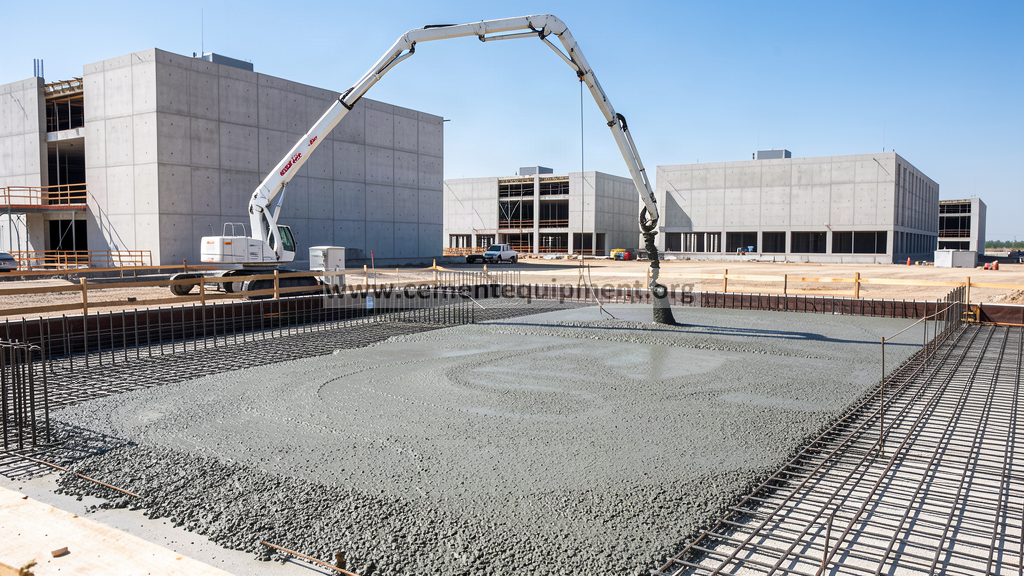
Data Center Construction, HPC Concrete & Precast: The Cement Opportunity in Hyperscale Capex
Behind every hyperscale data center goes up a large amount of concrete. Foundations, slabs, pedestals, shear-wall cores, pre-cast elements, and the high-performance concrete mixes that hold those structures together — the construction of a modern data center is, in concrete terms, a large and demanding project, and the cement and concrete industry is only beginning to understand the demand tailwind that the data-center boom represents. This article explains the scale of the demand, the specific concrete and cement products that the data-center market calls for, the performance requirements that separate data-center concrete from ordinary structural concrete, the precast opportunity that sits alongside the in-situ concrete, the sustainability angle that hyperscalers are beginning to demand, and the commercial opportunity for cement and concrete suppliers who move to serve this market. It is written for concrete technologists, cement producers, precast manufacturers, specification engineers, and anyone who wants to understand how the AI infrastructure build-out translates into tonnes of cement and concrete and where the margin in that translation sits.
If you work in cement or concrete and you have felt that the data-center boom is happening somewhere else — in the technology press, in the hyperscaler earnings calls, in the power and cooling story — this article is for you. The concrete and cement demand is real, it is large, and it is coming faster than most cement and concrete businesses have planned for.
The scale of the data-center concrete demand
The headline numbers are striking, and they are worth stating plainly because they frame everything else in the article. The American Cement Association, drawing on data from Concrete Logic, has estimated that AI infrastructure in the United States will need roughly 625,000 to 725,000 metric tons of cement per year across 2026 and 2027, and its June 2025 analysis put the figure for AI infrastructure cement demand by 2028 at about 1 million metric tons. Those are not small numbers in the context of a single end-use sector; they represent a meaningful incremental demand on top of the ordinary building-construction and infrastructure demand that the cement and concrete industry is used to serving.
To put that in context, the data-center share of U.S. office construction spending reached about 55 percent in 2026, up from around 40 percent in 2025, according to the American Cement Association’s summer forecast. That shift — from a diversified office-construction market to a market where more than half the spending is going to data centers — is a structural change in the demand mix, and it has concrete implications. Data centers are not normal office buildings; they are large, heavy, highly loaded, highly available, and highly specified structures, and the concrete that goes into them reflects that.
The demand is global in direction even if the numbers above are U.S.-focused, because the hyperscale build-out is global. Microsoft, as one widely cited example, has publicly reported concrete and cement-associated demand for its data-center builds, and the broader hyperscale market — AWS, Google, Microsoft, Meta, and the colocation and edge providers — is building at a rate that is driving incremental cement and concrete demand across the markets where the builds are happening. The exact tonne figures vary by market and by source, but the direction is unambiguous: more data centers mean more concrete, and the concrete demand is growing faster than the ordinary construction market.
What kind of concrete a data center actually needs
Data centers are not concrete-homogeneous. Different parts of the structure call for different concrete performance, and the performance requirements are often more demanding than those of a standard commercial building. Understanding the mix of requirements is the first step to understanding the opportunity.
Foundations and slabs-on-grade are the largest volume of concrete in a typical data center, and they need to be flat, stable, and durable. The slab-on-grade under a data hall carries equipment loads, floor-cooling infrastructure, and the traffic of maintenance and installation. The performance requirements include flatness and levelness, compressive strength sufficient for the equipment and the live loads, durability against moisture and exposure, and often a finish that supports the flooring and the cooling infrastructure. High early strength is valuable here because it allows faster construction sequencing — the slab can be placed and finished and the next trade can come in sooner, which matters on a project where schedule is expensive.
The pedestals and isolated footings that support heavy equipment — the UPS blocks, the generator bases, the transformer pads, the large air-handling equipment — call for high-strength concrete and often high early strength as well, because these elements need to carry concentrated loads and need to be ready for the next phase of construction on a tight schedule. The concrete here is often specified at strengths well above the ordinary structural range, and the mix design is driven by the load, the geometry, and the schedule.
The shear-wall cores and the vertical structural elements in a data center — the cores that carry the lateral loads, the transfer elements, the tower walls — call for high-strength concrete with good workability for placing and pumping, good durability, and often a controlled temperature rise in mass placements to avoid thermal cracking. Mass concrete is a real consideration in data-center cores, and the mix design has to manage the heat of hydration and the resulting temperature differential. High-performance concrete that combines high strength with good workability and good thermal behaviour is the product here, and it is a product that rewards a concrete supplier who can design and deliver it reliably.
The pavements and the yard and the logistics areas around a data center are also concrete, and they carry heavy delivery traffic, crane loads, and the wear of construction and ongoing operations. These are durable, often higher-strength pavements, and the concrete has to stand up to the loading and the exposure. The demand is not as high-profile as the structural slabs, but it is concrete demand nonetheless, and it is demand that is often specified with performance in mind.
And underpinning all of the above is the reliability requirement. A data center is a facility where downtime is expensive, and the construction quality of the concrete — the placeability, the finish, the durability, the consistency — matters to the owner because the owner’s business depends on the facility performing. That reliability requirement pushes the specification toward established suppliers and proven mixes, which is an opening for suppliers who can demonstrate consistency and performance.
The data-center concrete specification: what the projects actually call for
The data-center market does not buy concrete by the abstract category; it buys specific products against specific specifications, and those specifications are the practical starting point for any supplier that wants to serve the market. The first is the slab specification. Data-center slabs — particularly the data-hall slabs that carry the raised-floor loads and the equipment loads above them — are specified for flatness and levelness at tolerances that are tighter than most general-construction slabs. The flatness and levelness requirements are often expressed in terms of FF (flatness) and FL (levelness) numbers, and the data-hall slabs routinely call for FF/FL values of 25/20 at the loose tolerance end and 50/50 or higher on the stricter raised-floor specifications — values that require careful concrete placement, finishing, and curing, and that reward a concrete producer who understands how to deliver a slab to that tolerance. A slab that comes out of the truck and is finished to a general-construction tolerance is not a data-hall slab; the spec is the spec, and the margin is in delivering to it consistently.
The second specification is the high-strength and high-early-strength mix for the pedestals, the transfer slabs, theColumns, and the other heavily loaded elements. These elements are specified for strength at early ages — 3, 7, and 28 days — and for compressive strength levels that are higher than the standard structural concrete. A high-strength mix for a data-center pedestal might be specified at 40, 50, or 60 MPa or higher, and the high-early-strength requirement means the mix has to develop that strength on the schedule the project needs, not just eventually. That drives the mix design toward w/c ratios in the 0.35 to 0.40 range, higher cement content or high-performance binder systems, and the admixture strategy — water reducers, high-range water reducers, accelerators where appropriate — that delivers the strength and the placeability at the same time.
The third specification is the mass concrete for the cores, the foundations, and the larger structural elements. Mass concrete in a data-center context means large volumes of concrete placed in a single pour, where the heat of hydration is a real concern and where the specification typically includes temperature control limits and sometimes a maximum temperature rise or a maximum internal temperature. The mass-concrete mix is designed for lower heat of hydration — lower cement content, larger aggregate, often a blended or supplementary cementitious material to moderate the heat — and for the durability and strength that the structural element needs, without the thermal cracking that a more reactive mix would produce in a large placement. The supplier who can design and deliver a mass-concrete mix that hits the structural spec without the thermal problems is solving a real problem for the project.
The fourth specification is the architectural and exposed concrete, where the finish and the appearance are part of the spec. Some data centers have exposed concrete surfaces — columns, walls, facades — where the look of the concrete matters, and the spec calls for a particular colour, texture, or finish consistency. That spec drives the mix design toward consistency of aggregate, colour, and surface, and it drives the placement and finishing toward the quality that produces the specified appearance. The margin here is in the consistency and the appearance quality, and in the relationship with the architect or the owner who specified the look.
Case studies and project patterns: what the builds actually look like
The data-center builds are not abstract; they are physical projects with concrete pours, schedules, and specifications, and understanding the pattern of those projects is useful for a supplier who wants to serve the market. The hyperscale data center — the 5, 10, or 20 megawatt facility that a hyperscaler builds as a phased campus — is the dominant pattern, and it is a pattern that generates large, concentrated concrete demand. A single hyperscale facility can call for tens of thousands of tonnes of concrete across the foundations, the slabs, the cores, the columns, and the precast elements, and the build is often phased so that there are multiple facilities on the same campus, each generating its own concrete demand. The contractor and the concrete supplier on that project are dealing with a large, multi-phase, schedule-sensitive concrete program, and the supplier who can deliver consistently across the phases is the supplier who wins the program.
The colocation and enterprise data center is a different pattern — smaller facilities, often built by colocation providers or enterprise IT departments, with less concentrated but still significant concrete demand, and with a different buying pattern. The colocation and enterprise builds are often faster, smaller, and less specification-intensive than the hyperscale builds, but they still call for structural concrete, slabs, and precast elements, and they are part of the total data-center concrete demand. The supplier who serves the hyperscale market may also find opportunity in the colocation and enterprise segment, particularly where the same regional concrete producers serve both markets.
The edge data center is the smallest and most distributed pattern — smaller facilities closer to the end user, often built by the hyperscalers as they extend their networks to the edge. The edge facilities are smaller, but there are more of them, and they are being built in more geographies than the large hyperscale campuses, which means the concrete demand is spread across more sites and more local concrete suppliers. The edge pattern is a distribution challenge for the supplier who wants to serve the data-center market nationally or regionally — the demand is real but it is spread out, and the supplier has to be present in more local markets to capture it.
The project patterns also include the civil and infrastructure work that surrounds the data center — the roads, the stormwater, the utilities, the retaining structures, the perimeter — and that civil work is part of the concrete demand on the project even if it is not the data-hall slab or the pedestal. A concrete supplier who is on the project for the structural concrete is often also in position for the civil concrete, and the civil concrete can be a meaningful addition to the volume on the project.
high-performance concrete — concrete that delivers higher strength, better durability, better workability, or a combination of these at a given cement content — is the natural product for the demanding parts of a data-center build. Concrete technology has moved well beyond the single-cement-content mix: binary blends that replace a portion of the Portland cement with a supplementary cementitious material such as slag or fly ash, and ternary blends that combine two supplementary materials — for example slag and silica fume, or fly ash and slag, or calcined clay and limestone — are now standard tools for hitting the performance and sustainability targets that data-center specs increasingly carry. A ternary blend with silica fume at 5 to 8 percent of the binder, slag at 30 to 50 percent, and Portland cement making up the balance can deliver 60 to 80 MPa at 28 days with improved durability and lower permeability, while also cutting the embodied carbon per cubic metre of concrete. The mix design for a data-center core or pedestal is now more likely to be a tuned blended system than a straightforward CEM I mix, and the supplier who can design and control those blends — the slag reactivity, the silica fume dispersion, the water demand, the setting time, the early strength trajectory — is solving the real problem.
The ultra-high-performance concrete segment in particular has been growing: market data from Dataintelo places the UHPC market at roughly $1.58 billion in 2025, growing to about $3.49 billion by 2034 at a compound annual growth rate around 9.2 percent, though other sources give different figures — Allied Market Research, for example, has reported a smaller base and a lower CAGR. That variation is normal across market reports with different scope definitions, but the direction — a fast-growing multi-billion-dollar segment advancing at a high-single-digit rate — is consistent. That growth is not only about data centers, but data centers are a significant driver of the kind of demanding applications that UHPC and high-performance concrete serve — thin, high-strength elements, durable exposed surfaces, elements that carry high loads in a limited geometry.
The commercial case for high-performance concrete in data centers is not just about strength; it is about the outcomes that higher performance enables. Higher strength in a slab or a pedestal can reduce the section size, which can reduce the volume of concrete and the reinforcement and the overall weight, which can matter in a structure where every element is designed against load and cost. Better durability means longer service life and less maintenance, which matters to a facility that is expected to operate for decades. Better workability means easier placement and finishing, which matters to schedule and to quality. And high early strength means faster sequencing, which matters on a project where time is money.
The supplier opportunity here is in mix design expertise and in reliable delivery of demanding mixes. A data-center general contractor or concrete contractor who has to place a high-strength slab or a mass core is looking for a concrete supplier who can design the mix to hit the specification, deliver it consistently, and support the placement. The margin in that relationship is in the expertise and the reliability, not just in the volume of concrete sold. A supplier who can demonstrate that it can hit a demanding specification batch after batch is capturing value that a commodity supplier cannot.
The precast angle: elements made off site, installed on site
Precast concrete is a significant part of the concrete story in data centers, and it is a part that is often under-appreciated in the cement-and-concrete market analysis because it sits in a different segment than ready-mix. Precast elements — hollow-core slabs, double-tees, wall panels, stairs, sculptural and architectural elements — are made in a factory, cured, and delivered to site for installation. The data-center construction market has a significant precast component, and the precast market itself is sizable: the global precast concrete market is well above $100 billion — industry compilations put it in the range of $115 to $150 billion across 2024 to 2026, with the United States segment around $20 billion — and data-center construction is contributing to that growth.
The case for precast in data centers is partly about speed and quality. Elements made in a controlled factory environment can achieve higher quality and more consistent dimensions than the same elements cast in situ, and they can be produced in parallel with the site work, which speeds the overall construction. For a data center where schedule is expensive, that speed and quality matter. The case is also about the specific elements that data centers use: the precast hollow-core and double-tee floor elements for the data halls, the precast wall panels, the precast stairs and ramps, and the architectural precast elements that show on the exterior.
The cement and concrete opportunity in precast is partly in the concrete that goes into the precast elements — the mix design, the cement content, the strength, the durability — and partly in the relationship with the precast manufacturer. A cement supplier who can supply the right cement to a precast manufacturer who is serving the data-center market, and who can support the mix design and the performance, is capturing value in the precast supply chain. A precast manufacturer who serves the data-center market well is capturing the value of the factory-quality, speed, and specification that data-center construction demands.
The sustainability and low-carbon angle that hyperscalers are beginning to demand
One of the most important commercial developments in the data-center concrete market is the rise of sustainability requirements. Hyperscale data-center owners are among the most visible corporate buyers of renewable energy and among the most active in setting Scope 3 supply-chain emissions targets, and concrete and cement — as significant carbon-intensive materials — fall within that supply-chain picture. A hyperscaler that is serious about the carbon footprint of its data center is going to ask its concrete and cement suppliers about the carbon intensity of the concrete and the cement that goes into the build, and that question is becoming a commercial requirement, not just a courtesy.
This is creating demand for lower-carbon concrete mixes and for cement with a lower carbon footprint — whether that is blended cement, supplementary cementitious materials, optimised mixes that use less cement per unit of performance, or, over time, novel low-carbon cements. The demand is real, it is coming from the largest and most influential buyers in the data-center market, and it is a demand that rewards suppliers who can offer verifiable lower-carbon options. The sustainability angle is not a substitute for performance — the concrete still has to meet the structural and durability specification — but it is an additional dimension on which the supplier can win, and it is a dimension that is increasingly part of the specification.
The sustainability demand also creates an opening for the kind of high-value advisory work that the wear-parts niche rewards: a concrete or cement supplier who can help the data-center owner and the general contractor understand and reduce the carbon footprint of the concrete on the project, while meeting the performance and schedule requirements, is offering a service that goes well beyond selling concrete by the cubic metre. That is a value-added relationship, and it is the kind of relationship that carries margin and retention.
The timing and the geography of the opportunity
The data-center build-out is not uniform across time or geography, and a supplier who wants to serve this market needs to understand where and when the demand is coming. In the United States, the demand is concentrated in the regions where the hyperscale builds are happening — the traditional data-center corridors and the new ones that are opening up as power availability drives the build-out. The American Cement Association’s numbers are U.S.-focused, and they reflect the U.S. build-out, but the global build-out is similar in direction: data centers are being built wherever there is power and connectivity and demand, and the concrete demand follows.
The timing is such that the demand is here now and accelerating. The 2026 and 2027 numbers are not far-horizon projections; they are near-term demand that is being placed on the ground today. For a cement or concrete supplier who is building a data-center market offering, the time to move is now, because the projects are in the pipeline and the specification decisions are being made now. The supplier who establishes the relationship, the qualification, and the track record early on the current wave of projects is positioned to capture the recurring demand as the wave continues.
The mixing and transport logistics that data-center concrete demands
The logistics of supplying concrete to a data-center build are a real part of the commercial and operational challenge, and they are a part that rewards the supplier who understands them. Data-center builds are often large, concentrated, and schedule-sensitive, which means the concrete demand is large in volume, concentrated in space and time, and unforgiving of delivery failures. A hyperscale facility that is being built in phases can call for hundreds of deliveries per day across the site, and the pour sequence — the slabs, the cores, the pedestals, the precast installation — has to be sequenced so that the concrete arrives when the crew is ready, the pump is in place, and the specification requires it.
The supplier who serves this market well has to manage the logistics to that level. That means the dispatch and routing that gets the right mix to the right place at the right time; the fleet and the plant capacity that can meet the concentrated demand without starving other customers or overloading the operation; the quality control that delivers the same mix to spec on the 200th truck as on the first; and the contingency planning for the weather, the pump breakdowns, the site access, and the other things that can disrupt a large pour. The logistics are not glamorous, but they are where the reliability requirement meets the operational reality, and they are where a supplier who cannot manage the logistics will fail the specification.
The admixture and temperature management are other logistical and technical details that matter. A high-strength, high-early-strength mix that is specified at 50 or 60 MPa and that has to hit a 3-day or 7-day strength schedule is sensitive to the temperature — too hot and the set is too fast and the finishing is compromised; too cold and the early strength development is too slow. The supplier who is delivering to a data-center pour has to manage the admixture dosage, the mix temperature, the delivery time, and the slump retention so that the concrete arrives in the right condition and stays placeable through the pour. That is a technical and logistical capability that is worth money on a data-center project, because a pour that goes wrong on a data hall is expensive in both schedule and quality.
The admixture strategy itself is a mix-design and application detail. Modern demanding concrete mixes rely heavily on the admixture suite — polycarboxylate superplasticisers for workability at low w/c, accelerators where early strength is required, viscosity-modifying agents where the mix needs to hold its shape or resist segregation in a large placement, and the set-control agents that tune the setting time to the project schedule. The admixture dosage, the compatibility between admixtures, the effect of the admixtures on the long-term properties, and the tolerance to variations in the materials and the temperature are all technical details that the supplier needs to manage. The margin in the admixture and the mix design is in the expertise that gets the right performance reliably, not just in the chemicals themselves.
The precast logistics are a separate but related challenge. Precast elements are made off site and delivered to the site on a schedule that has to match the site pour sequence and the installation sequence. A data-center build that uses precast hollow-core slabs, double-tees, wall panels, and other elements has to coordinate the precast production, the curing, the delivery, the crane availability, and the installation — and a mismatch in any of those creates a delay. The precast manufacturer who serves the data-center market well is managing that coordination as part of the value, and the cement supplier who supplies the precast manufacturer is part of that chain.
The admixture and temperature management that the demanding mixes require
The concrete that data centers call for is not only demanding in strength and durability; it is demanding in the placement and finishing behaviour that the mix has to deliver on the day of the pour. That places real demands on the admixture strategy and the temperature management, and those are the details that separate the mix that hits the spec on paper from the mix that hits the spec in the truck and on the slab.
The demanding mixes — the high-strength pedestal mixes at 50, 60, or higher MPa, the high-early-strength mixes that have to develop that strength on a tight schedule, the mass-concrete mixes that have to manage the heat of hydration — all rely on a carefully balanced admixture suite. The polycarboxylate superplasticisers that deliver workability at the low water-cement ratios these mixes need are sensitive to the materials, the temperature, the mixing time, and the time on site, and the dosage has to be right for the specific mix and the specific conditions of the pour. The accelerators that drive the early strength development have to be dosed to hit the strength schedule without compromising the workability or the finishability, and without setting the concrete too fast for the placement. The viscosity-modifying agents that help the mix hold its shape in a large placement or resist segregation in a pumped placement have to be dosed for the specific risk in the specific placement. These are not generic admixture calls; they are application-specific decisions that depend on the materials, the mix, the pour, and the conditions.
The temperature management is the other set of details that matter. A high-early-strength mix delivered on a hot day is a different problem from the same mix delivered on a cool day, because the temperature affects the set time, the finishing window, and the early strength development. A mix that is specified at a 3-day strength that is needed for the next construction sequence has to be managed so that the concrete arrives and is placed and finished within the window that the temperature and the admixtures allow. The supplier who serves this market well is managing the water temperature, the aggregate temperature, the admixture temperature, the delivery time, and the site temperature so that the concrete arrives in the right condition — placeable, finishable, and on the schedule that the project needs.
The slump retention and the set control are the practical details that the field crews feel. A mix that loses its slump on the way to the site or during a long pour is a mix that is hard to place and finish, and a mix that sets too fast is a mix that the finishing crew cannot keep up with. The admixture strategy has to deliver slump retention and set control that match the pour — the time from the plant to the site, the time on site, the pour duration, and the finishing crew’s pace — and that is a capability that is worth money on a data-center project where the pour is large and the schedule is expensive.
The commercial model: how to make money in this niche
The commercial model for serving the data-center concrete market is not a single thing; it varies by where the supplier sits in the value chain. A cement supplier who supplies cement to concrete producers who serve data-center projects captures value in the cement volume and in the relationship with the concrete producer. A concrete supplier who delivers ready-mix to data-center projects captures value in the concrete volume, the mix-design expertise, and the reliability of delivery. A precast manufacturer who supplies precast elements to data-center projects captures value in the factory-quality, the speed, and the specification. And a supplier who can offer lower-carbon options and advisory support captures a value-added premium on top.
The common thread across these models is that the value is in the performance, the reliability, and the specification, not just in the commodity volume. A data-center project is not the place where the general contractor is looking for the cheapest possible concrete regardless of performance; the stakes are too high, the schedule is too expensive, and the reliability requirement is too strong. That tilts the market toward suppliers who can demonstrate performance and reliability, and away from pure price competition. The margin is in the value, not in the volume alone, and that is the commercial opportunity.
The competitive dynamics and the opening
The competitive dynamics in the data-center concrete market are shaped by the same factors that shape the wear-parts market: the importance of specification, the cost of downtime and schedule delay, and the trend toward value-based procurement. The incumbents in the ready-mix and precast market in a given region have the local presence, the local qualification, and the local track record, and they have a natural advantage. But the data-center market is large enough and growing fast enough that there is room for suppliers who can differentiate on performance, on sustainability, and on the specific demands of the data-center application.
The opening is for the supplier who understands the data-center application — the slab flatness and levelness requirements, the high-strength pedestal mixes, the mass concrete thermal management, the precast elements, the sustainability requirements — and who can bring that understanding to the table as a value proposition. A supplier who shows up with a generic concrete offering and a price is competing with every other generic concrete supplier; a supplier who shows up with the right mix designs, the right delivery capability, the right sustainability credentials, and the right understanding of the application is competing on value, and that is where the margin is.
What could go wrong
As with any market, there are risks. The data-center build-out is capable of shifting with the hyperscalers’ capex cycles, and a slowdown in the build-out would slow the concrete demand. The demand is strong and the direction is clear, but it is not immune to macro cycles. The sustainability requirements are real but still evolving, and a supplier who over-invests in a particular low-carbon solution before the specification settles could find itself carrying inventory or capability that does not match the market. And the market is competitive in the sense that established local concrete and precast suppliers have a natural advantage in their own regions; a new entrant has to earn the qualification and the track record.
The mitigation is to serve the market with a value-based offering that does not depend on the assumption of uninterrupted hyper-growth, to keep the sustainability offering flexible and aligned with the evolving specification, and to earn the local qualification and track record through performance and reliability. The demand is strong enough and the value-based differentiation is strong enough that the business can be built on solid foundations rather than on a hyper-growth bet.
Closing the case
The data-center construction boom is one of the most significant new demand drivers for cement and concrete, and it is one that rewards suppliers who move to serve it with a value-based offering. The demand is large — hundreds of thousands of tonnes of cement per year in the U.S. alone, growing toward a million tonnes — and it is demanding in performance, schedule, and sustainability. The products that the market calls for — high-performance concrete, high early strength, mass-concrete mixes, precast elements, and lower-carbon options — are products that reward expertise, reliability, and specification. The commercial opportunity is in the value, not just the volume, and the opening is for the supplier who understands the data-center application and brings the right mix of products, services, and credentials to the table. If you are in cement or concrete and you have not yet oriented your business toward the data-center market, the time to do it is now, because the projects are being specified and built today, and the supplier who establishes the relationship early captures the demand as it grows.
Frequently Asked Questions
I work in a cement plant; will this be useful to me as an engineer?
Basic cement chemistry is useful but not required: the article relates to the complete library in the package. As a cement plant engineer, the article is useful because it describes a real, large, and growing end-use market for cement and concrete — the data-center construction market — and it explains the performance requirements and the commercial dynamics of that market, which helps you understand where the demand is coming from and what kind of cement and concrete the market is asking for.
Is the COMPLETE Technical Package going to be worth the price for the team?
It is worth it because the data-center concrete opportunity is part of the broader market and application knowledge that the Complete Cement Technical Package is built to support. The package is not a single book; it is a technical desk for the real engineer on the shift, covering the process, the products, the performance, and the applications that connect to the data-center and high-performance concrete market described in this article. At $249.99 for the pack, it is the reference library that lets a team go deeper on exactly the topics this article raises.
Will this help me get my project approved?
Yes. Understanding the scale and the performance requirements of the data-center concrete market helps justify investments in the mix designs, the delivery capability, and the sustainability credentials that serve that market — and that justification is what is needed to get a market-development or capability project approved on a value rather than a speculative basis. The Complete Cement Technical Package, available from the cementequipment.org library, covers the concrete technology, mix design, and performance knowledge that provides the technical foundation for any data-center concrete offering — and it is a practical complement to the market analysis in this article.