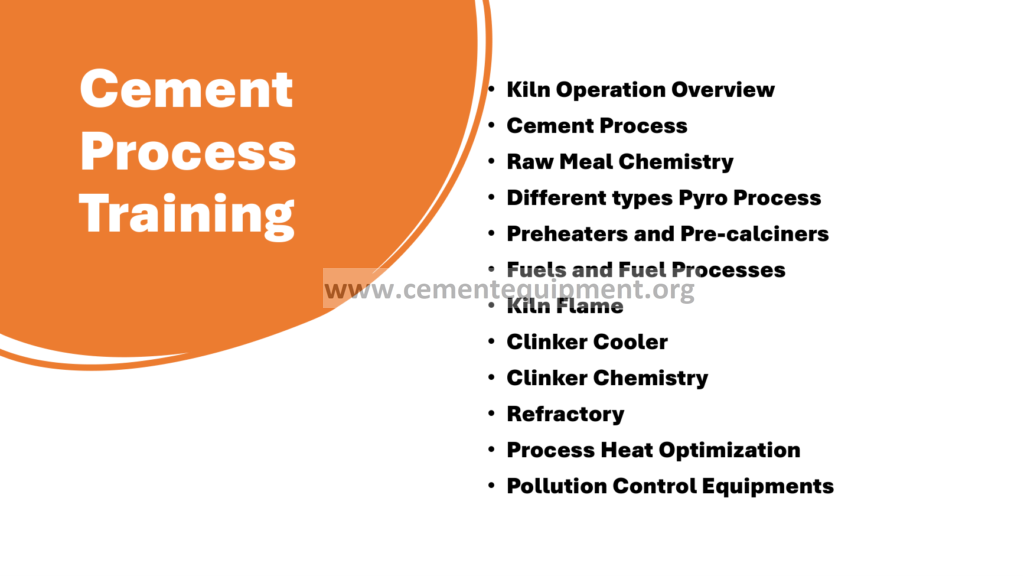
Cement Process Training: Complete Modules
Cement process training is the foundation of competence in the industry: the cement plant is a chain of interlocked processes — the quarry, the raw material preparation, the pyroprocessing, the grinding and the dispatch — and the people who run it must understand the chain as a whole, not only their own section. The process view is what makes the difference between an operator who reacts to alarms and an engineer who anticipates them: the process-trained operator knows why the kiln reacts to the raw mill stop, why the cooler behavior shows in the mill performance and why the quality of the clinker decides the grinding cost. This article is a complete cement process training package: the curriculum, the modules, the methods and the management of a process training program for operators, foremen, junior engineers and plant management. It covers the process chain from the quarry to the dispatch, the chemistry and the physics at each step, the equipment and its operating principles, the control and the instrumentation, the quality system, the energy and the environment, and the way to organize the training so that the knowledge becomes competence.
1. Why Process Training Is the Foundation
The cement plant is a continuous process with a residence time of hours: the raw meal that enters the preheater in the morning is the clinker that reaches the cooler in the afternoon, and the decisions of the morning are measured in the quality of the afternoon. The process view is the operator’s mental model of that chain: what the raw material carries, what the kiln does to it, what the mill does to the clinker, and how each section’s variables propagate to the next. The process-trained workforce has the model, and the model is the foundation of the troubleshooting, the optimization and the coordination that the modern plant demands. The untrained workforce runs the plant section by section, and the plant runs as a set of local optima that fight each other: the kiln runs at its own optimum, the mills at theirs, and the quality and the cost suffer where they meet.
The business case follows the same logic as the grinding training article: the process decisions are worth measurable percentages of the production, the energy and the quality, and the coordination between the sections is worth the largest share of all. The plant that trains its people on the whole process gets the whole-process behavior: the operators understand the kiln’s reaction to the raw mill, the quality staff understand the process behind their samples, and the management understands the trade-offs behind the KPIs. The process training is therefore not a luxury course for the engineers; it is the basic formation of every person who touches the plant.
2. The Process Chain and the Training Map
The training map follows the material from the quarry to the dispatch, and every module is located on the map. Module one is the quarry and the raw material: the limestone, the clay, the corrective materials, their chemistry and their preparation. Module two is the raw material proportioning and the raw grinding: the raw mix design, the mills, the homogenization and the raw meal quality. Module three is the pyroprocessing: the preheater, the calciner, the kiln and the cooler, with the chemistry and the physics of the clinker formation. Module four is the fuels and the combustion: the coal and the alternative fuels, their preparation and their combustion. Module five is the cement grinding: the mills, the separators and the quality. Module six is the storage and the dispatch: the silos, the packing, the bulk loading and the logistics. Module seven is the cross-cutting systems: the instrumentation and the control, the electrical systems, the water and the compressed air, the environment and the safety. And module eight is the process integration: the mass and the energy balance, the plant KPI system and the coordination between the sections.
The map is also the KPI map: each module teaches the section’s key figures — the raw mix factors, the kiln heat consumption, the mill specific power — and the integration module teaches how they combine into the plant’s production and cost figures. The trainee who completes the map can trace a tonne of limestone from the quarry face to the concrete mixer, naming every process step, every measurement and every KPI on the way.
3. The Chemistry and the Physics Across the Chain
The chemistry of the chain is one continuous story: the calcium carbonate decomposes in the calciner, the oxides combine in the kiln, and the phases hydrate in the concrete. The training teaches the story in its process order. The raw chemistry: the lime saturation factor, the silica ratio and the alumina modulus that define the raw mix and the clinker phases. The pyrochemistry: the decarbonation at 800 to 900 degrees, the clinkering at 1,400 to 1,450 with the formation of the alite, the belite, the aluminate and the ferrite, and the role of the liquid phase. The fuel chemistry: the combustion, the calorific value, the flame and the volatile cycles of the sulfur, the alkali and the chlorine. And the product chemistry: the gypsum, the hydration, the setting and the strength development. Each module links the chemistry to the process variable that the operator controls: the raw chemistry to the kiln feed, the pyrochemistry to the burning zone temperature, the fuel chemistry to the flame, and the product chemistry to the mill temperature.
The physics follows the same order: the heat transfer in the preheater and the kiln, the gas flows and the draft, the material movement in the rotary kiln, the size reduction in the mills, the classification in the separators, and the fluidization in the silos and the air slides. The physics is taught through the instruments: the temperatures, the pressures, the flows and the powers that the control room displays are the physics made visible, and the trained operator reads the physics in the data. The integration of the chemistry and the physics is the process model, and the training’s highest module is the one where the trainee builds the simplified mass and energy balance of the plant and sees the chain as one system.
4. The Equipment Modules
The equipment modules teach the machines of each section by their function in the process. The crushers and the raw material handling: the types, the capacities, the moisture and the size control. The raw mills — the vertical roller mills and the ball mills — with the drying, the grinding and the classification. The preheater and the calciner: the cyclones, the riser ducts, the build-up and the cleaning. The rotary kiln: the shell, the drive, the supports, the internals, the flame and the refractory. The cooler: the grate, the air distribution, the clinker transport and the heat recovery. The coal mills and the fuel systems: the grinding, the drying, the storage and the conveying. The finish mills and the separators: the internals, the charges, the ventilation and the classification. And the dispatch systems: the silos, the aeration, the packing and the loading. Each equipment module teaches the machine’s normal operation, its instruments, its alarms and its failure modes, and each is delivered with the plant walk where the trainees see the machines in operation.
The equipment modules are the interface with the maintenance training: the process trainees learn the operating condition and the wear behavior of the machines, and the maintenance trainees learn the repair, with the shared inspection exercises at the stops. The process equipment’s state is a process variable: the worn charge, the dirty filter and the leaking separator flaps all appear in the process data before they appear in the maintenance plan, and the process-trained operator is the first detector of the equipment’s deterioration.
5. The Control and the Instrumentation Modules
The control room is where the process training becomes operational, and the instrumentation and control modules are its curriculum. The instrumentation module teaches the sensors of the plant: the temperature (the thermocouples, the radiation pyrometers and the shell scanners), the pressure (the transmitters and the draft gauges), the flow (the weigh feeders, the gas flow meters and the level instruments), the composition (the gas analyzers, the X-ray fluorescence and the online quality instruments) and the equipment state (the vibration, the power and the current). Each instrument is taught by its principle, its location, its calibration and its failure modes, because the operator who understands the instrument understands its data.
The control module teaches the control loops of the plant: the kiln control (the feed, the fuel, the speed and the draft), the mill control (the load, the quality and the temperature loops), and the supporting loops (the cooler, the raw mill and the silo levels). The module teaches the control philosophy — the manipulated variables, the controlled variables and the constraints — and the alarm handling, the interlocks and the safety instrumented functions. The simulator sessions complete the module: the trainees run the kiln and the mills in simulation through the normal operation, the disturbances and the emergencies, and the simulator log is the assessment of the module.
6. The Quality Modules
The quality modules connect the process to the product. The raw quality module teaches the raw mix control: the sampling and the testing of the raw materials and the raw meal, the X-ray fluorescence, the raw mix correction and the homogenization. The clinker quality module teaches the clinker control: the free lime, the microscopy, the phase composition and the link between the kiln operation and the clinker quality. The cement quality module teaches the finished product control: the Blaine, the residue, the distribution, the setting, the soundness and the strength, with the sampling and the testing standards. And the integration module teaches the quality system: the standards, the certifications, the customer requirements and the complaint handling.
The quality modules are taught jointly with the process modules, because the quality data is the process’s feedback: the free lime is the kiln’s score, the clinker microscopy is the kiln’s diagnosis and the strength is the plant’s final score. The trained operator reads the quality data as process information, and the trained quality engineer reads the process data as quality information — the two disciplines are one in the trained plant.
7. The Energy and the Environment Modules
The energy and the environment modules teach the plant’s two modern obligations. The energy module teaches the plant’s energy system: the electricity, the thermal energy and their costs; the mass and the energy balance of the plant; the specific consumptions and their benchmarks; the energy efficiency of each section; and the energy management system and the audit. The trainees calculate the plant’s balances on its own data, and the module closes with the energy map: where the plant’s energy goes and where the losses are, which is the foundation of every energy project.
The environment module teaches the emissions and the environmental obligations: the dust, the NOx, the SO2, the CO2 and the trace substances; the abatement systems — the filters, the SNCR, the SCR, the desulfurization; the measurement and the reporting; the water and the waste; and the permits and the compliance. The module links the environment to the process: the emissions are made by the process decisions — the flame, the excess air, the fuel — and the trained operator prevents the emissions at the process level before the abatement equipment must collect them. The energy and the environment modules are the modules of the plant’s future, because the trained workforce is the instrument of the plant’s decarbonization.
8. The Integration Module: The Plant as One System
The integration module is the summit of the process training: the plant as one system, described by one balance. The module builds the simplified mass balance (the raw meal to the clinker to the cement), the gas balance (the combustion air to the stack) and the energy balance (the fuel and the electricity to the products and the losses), and it connects them to the KPI tree: the raw mix factor, the clinker factor, the heat consumption, the specific power and the production rate. The trainees run the integration exercise: a change in one section is traced through the whole chain — a raw mix change appears in the kiln, the cooler and the mill — and the trainees see the plant as the continuous system it is.
The integration module also teaches the coordination: the daily production plan, the section interfaces and the shift handover. The plant’s coordination meetings — the morning production meeting, the quality review and the energy review — are the operating expression of the integration, and the trained teams run them on data, not on impressions. The integration module’s assessment is the plant tour: the trainee walks the plant and explains every stream, every measurement and every KPI, and the tour is the certificate of the process competence.
9. The Training Methods and the Schedule
The methods of the process training follow the same principles as the grinding training: the plant’s own data, the active exercises, the simulator, the plant walks and the assessment. The classroom modules use the plant’s trends, its reports and its case history; the walks are scheduled with each module; the simulator sessions practice the control and the emergencies; and the exercises — the calculations, the identifications and the diagnoses — are marked individually. The schedule is a structured progression: the two-week foundation program for the new operators (the process chain, the chemistry and the equipment basics), the role-specific modules for the foremen and the engineers, and the annual refresher cycles for the whole team, with the integration module repeated by the management and the senior staff as the annual process review.
The schedule is anchored to the plant’s calendar: the modules that need the stopped plant — the internal inspections, the refractory views and the mill internals — are scheduled at the maintenance stops, and the modules that need the operating plant run between them. The training coordinator maintains the calendar with the maintenance department, and the training plan and the maintenance plan are one plan, because the best training ground is the plant at work and at rest.
10. The Assessment and the Certification
The assessment of the process training combines the written, the practical and the work-based components. The written tests cover each module with the pass standard of 80 percent; the practical assessments cover the procedures, the plant tours and the simulator exercises; and the work-based assessments cover the projects — the balance calculation, the process study and the improvement case. The certification levels follow the roles: the process operator certificate, the process foreman certificate, the process engineer certificate and the process manager certificate, each with its prerequisites and its validity. The certification is renewed annually with the refresher cycle, and the training matrix shows every person’s certification state at a glance.
The assessment data is the program’s feedback, as in the grinding training: the results by module and by team drive the refresher content, the module updates and the trainer development. The assessment is also the plant’s evidence of competence for the audits — the quality, the safety and the energy audits all require the documented competence of the people — and the training log is the audit trail of the competence.
11. The Program Management and the Pitfalls
The process training program is managed like the grinding one: the owner, the plan, the record and the review. The pitfalls are the same six — the one-off event, the generic content, the classroom-only delivery, the untested knowledge, the untrained trainers and the certification without competence — and the preventions are the same: the refresher cycle, the plant’s data, the walks and the simulator, the assessment, the trainer development and the work-based certification. The process training adds one pitfall of its own: the section-by-section training, where each department trains its own people on its own section and the integration is lost. The prevention is the process map: every module is located on the map, every trainee completes the whole map, and the integration module is mandatory for every role.
12. The Road to the Process-Trained Plant
The road to the process-trained plant is the staged implementation of the program. Stage one is the process map and the curriculum: the modules defined, the trainers assigned and the material assembled from the plant’s own documentation. Stage two is the foundation: the operator core modules delivered and certified, with the safety content scheduled by the risk assessment. Stage three is the depth: the engineering, the quality, the energy and the environment modules, and the integration module for the whole team. Stage four is the system: the refresher cycle, the training matrix, the review and the updates, with the assessment data driving the program. Stage five is the culture: the process language becomes the plant’s language — the meetings are run on the balances, the decisions are made on the data, and the plant’s improvement is everyone’s daily work. The completed road is the plant where the process training is not a program but the way the plant operates — and that plant is the one whose KPIs are limited by its equipment, never by its people.
Frequently Asked Questions
Why is process training different from equipment training?
Equipment training teaches the machines; process training teaches the chain — how the raw material becomes the clinker, the clinker the cement, and how each section’s variables propagate to the next. The process view is the operator’s mental model of the plant as one system, and it is the foundation of the troubleshooting and the coordination.
How long does the complete cement process training take?
The foundation program for the new operators is two weeks of classroom, plant and simulator training, followed by the role-specific modules and the annual refresher. The engineering certification adds the projects and the integration module, typically over six to twelve months of part-time delivery.
What is the integration module?
It is the summit of the program: the plant described by one mass, gas and energy balance, connected to the KPI tree, with the trainees tracing a change through the whole chain. Its assessment is the plant tour, where the trainee explains every stream, every measurement and every KPI.
Who should be trained in the process?
Every person who touches the plant: the operators, the foremen, the engineers, the quality staff, the maintenance staff and the management. The content differs by role, but the process map is the same, and the integration module is mandatory for every role.
How is the training’s value measured?
By the assessment results, the observed practice and the plant’s KPIs — the heat consumption, the specific power, the availability, the quality rejections and the safety record — compared before and after the training periods, and by the quality of the coordination meetings and the improvement projects that the trained teams run.
Summary
Cement process training is the foundation of the plant’s competence: it builds the mental model of the whole chain — the quarry, the raw preparation, the pyro, the grinding and the dispatch — that turns the operators into process thinkers and the plant into a coordinated system. The complete program is the process map of eight modules, delivered by the active methods of the plant’s data, the walks, the simulator and the exercises, with the assessment and the certification at every role and the integration module at the summit. The program is managed as a system with the owner, the plan, the record and the review, and the road is staged from the curriculum to the culture. The process-trained plant is the plant whose meetings are run on the balances, whose decisions are made on the data and whose KPIs are limited by its equipment — and that is the plant that wins in the cement market.
13. The Training Modules of the Cement Process Education
The cement process training of the plant personnel follows the complete process chain: the module of the raw materials (the limestone, the clay, the corrective materials, the quarry planning), the module of the raw material preparation (the crushing, the pre-homogenization, the grinding, the blending), the module of the kiln system (the preheater, the calciner, the rotary kiln, the cooler, the combustion), the module of the cement grinding (the mills, the separators, the quality), the module of the storage and the dispatch (the silos, the packing, the loading), and the cross-cutting modules of the quality control, the maintenance, the energy and the safety. The training is delivered by the senior engineers and the external specialists, and the modules combine the theory with the plant tours and the practical exercises: the complete process training builds the integrated understanding of the plant operations beyond the single department.
14. The Certification and the Competency Framework
The certification of the cement process knowledge follows the competency framework: the levels of the operator, the senior operator, the shift leader and the process engineer carry their defined knowledge and skill requirements, the assessments combine the theory exams with the practical evaluations, and the certifications are documented in the personnel records: the certified competencies align the job assignments with the capabilities, support the multi-skilling (the operators who cover the different sections) and provide the succession pipeline for the key positions. The competency framework of the process training is also the base of the plant quality and the safety systems: the audited documentation of the training demonstrates the organizational competence required by the ISO certifications and the customer requirements.
15. The Continuous Learning of the Process Teams
The continuous learning of the process teams keeps the plant knowledge current: the monthly technical meetings review the process performance and the optimization cases, the quarterly training sessions introduce the new technologies and the best practices, the incident investigations are converted into the learning modules, and the cross-plant exchanges share the experience of the sister plants: the professional development of the process teams is supported by the industry conferences, the courses of the equipment suppliers and the technical literature. The continuous learning culture of the plant is the competitive advantage that the capital equipment cannot replace: the trained and the knowledgeable teams operate the process safely, efficiently and at the highest quality.
16. The Simulation and the Digital Learning Tools
The simulation and the digital tools have transformed the cement process training: the process simulators reproduce the plant dynamics (the kiln temperatures, the pressures, the quality parameters) in the virtual environment, the trainees practice the start-up, the shutdown and the upset handling without the production risk, the virtual reality tours bring the confined and the hazardous areas into the classroom, and the e-learning platforms deliver the standardized modules to the distributed teams with the tracked progress and the assessments. The simulation-based training accelerates the operator development: the critical scenarios (the kiln trips, the preheater blockages, the mill overloads) are rehearsed repeatedly until the correct responses become automatic, and the digital training records integrate with the competency management systems: the modern process training of the cement plants combines the classroom theory, the plant practice and the digital simulation into the complete learning ecosystem.
17. The Process Knowledge Applications and the Plant Improvement
The process training knowledge is applied in the plant improvement activities: the trained teams participate in the process audits (the systematic reviews of the plant sections against the benchmarks), the energy saving projects (the identification and the implementation of the efficiency measures), the troubleshooting teams (the root cause analyses of the process problems) and the quality improvement programs (the Six Sigma and the lean projects of the production processes): the applied process knowledge of the trained workforce multiplies the effect of the technical improvements, because the trained teams understand, implement and sustain the changes: the plant improvement culture is built on the process understanding of the people: the plants that invest in the process training and apply the knowledge systematically achieve the sustainable performance improvements, and the training programs are evaluated not only by the certificates but by the improvement results of the plants: the process knowledge is the asset that the training builds and the improvement projects harvest.
Get this cement file + the full 931-file package
$249 — one-time purchase, instant download, lifetime access
This file is part of the Complete Cement Technical Package (931 files) available from cementequipment.org. Respective rights holders; library copy for the licensed single user.