Central & South American Cement Standards
Central and South American Standards for cement are the specifications, test methods and conformity rules that govern the manufacture, import and export of portland cement across Latin America: from Mexico and Guatemala in the north to Argentina and Chile in the south. Although the region is often treated as a single market in trade statistics, it is in fact a mosaic of national standardisation bodies, historical influences, economic development stages and product traditions, ranging from the fully industrialised cement industries of Brazil and Argentina to the small emerging producers of Paraguay, Bolivia and Suriname. Understanding these standards is essential for any cement plant operator, quality manager, equipment supplier or construction materials buyer working in the region, because each country issues its own national norm, applies its own certification and testing requirements, and accepts imported cement on its own terms.
This complete technical guide, based on the authoritative chapter “Central and South American Standards and Specifications for Cements” from the Innovations in Portland Cement Manufacturing series (the document held in the Complete Cement Technical Package), walks through the market structure of the region, the per capita consumption and production statistics that frame the demand, the story of each national standards organisation, the chemical and physical requirements typical of the region’s cement types, the role of ASTM heritage in regional specifications, the harmonisation efforts under MERCOSUR, and the practical compliance procedures for producers and traders. The reader will finish with a working map of Latin American cement standards: which organisation issues them, which cement types they define, how strongly they follow the American or the European tradition, and how to navigate conformity assessment from the quarry to the port.
1. The Regional Market: Production, Consumption and Per Capita Demand
Any discussion of Central and South American cement standards must begin with the market they serve, because the standards evolved with the industry. The region presents dramatic differences in economic development that are directly reflected in cement consumption. In 2001, for example, the per capita gross domestic product ranged from roughly US $486 in Nicaragua to US $7,266 in Argentina, and urbanisation ranged from about 36 percent in Guyana to 90 percent in Argentina. These disparities translate into very different construction cultures, housing programmes and, consequently, different volumes and qualities of cement consumed.
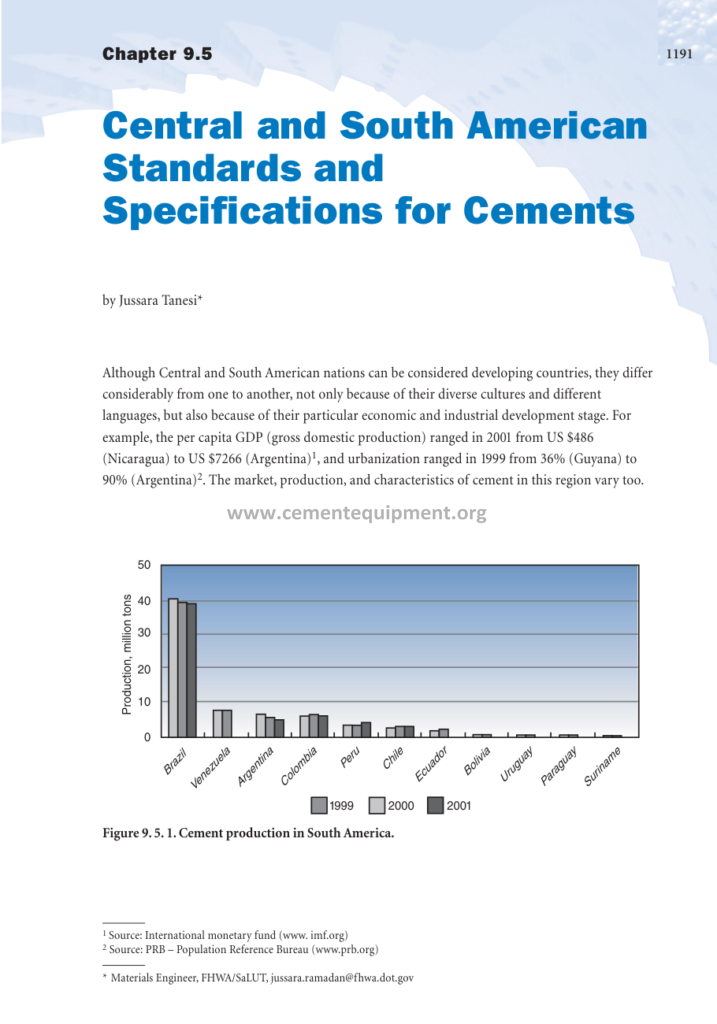
- Regional production concentration: In 2000 the region produced approximately 40 to 45 million tonnes of cement, with South America accounting for about 91 percent of the total. Brazil alone contributed about 49 percent of South American output, followed by Venezuela at roughly 10 percent, Colombia at 9 percent and Argentina at 8 percent.
- Brazilian dominance: Brazil produced on the order of 39 million tonnes of cement per year at the turn of the century, the largest single national market in the region and one of the ten largest in the world.
- Small producers: At the opposite end, Suriname produced only about 65,000 tonnes in 2000, and Paraguay and Uruguay each produced less than one million tonnes, illustrating the enormous spread of industrial scale across the region.
- Per capita consumption: Per capita cement consumption in 1999 ranged from about 321 kg per inhabitant in Panama and 312 kg in Costa Rica down to 108 kg in Paraguay and 123 kg in Colombia, with the regional leaders approaching the levels of newly industrialised Asian economies.
- Economic cycles: Economic deterioration in several countries after 1999 depressed both production and per capita consumption; Argentine production, for example, fell by more than 22 percent between 1999 and 2001, and similar contractions were recorded across the Southern Cone.
The market structure matters for standards in a direct way: countries with large industries such as Brazil developed rich, detailed national norms, while smaller markets often adopted imported specifications wholesale. The number of producers also varies: South American countries typically have an average of about five producing companies each, but Brazil operates with more than thirty producers organised in roughly eleven corporate groups, while Colombia has about ten producers. International cement groups are present in most countries of the region, although Bolivia, Paraguay, Peru and Uruguay historically operated with state participation or wholly state-owned companies. All of this shapes who writes the standards and how strictly they are enforced.
2. The Production Process Base: Dry Process and Its Quality Implications
One clear aspect unites Central and South American cement production regardless of country: the production process. The majority of the region’s plants use the dry process with a preheater and, increasingly, a precalciner, similar to modern plants in Europe and Asia. At the time the source chapter was written, only Colombia, Chile, Panama and Nicaragua still retained a considerable percentage of their installed capacity in older wet or semi-wet process plants, and those were steadily being converted or replaced.
The process base has a direct influence on quality control and therefore on standards compliance:
- Raw meal homogenisation: Dry process plants rely on continuous blending and homogenising silos to reach the tight chemical targets demanded by the national norms, typically maintaining the litre weight of kiln feed and the modulus of the mix within narrow bands.
- Kiln stability: Preheater and precalciner kilns burning at 1,400 to 1,450 degrees Celsius in the burning zone produce a consistent clinker, provided free lime, litre weight and temperature are stabilised; the national specifications then translate clinker quality into cement quality.
- Grinding systems: The finish grinding circuits of the region use ball mills with high-efficiency separators, vertical roller mills and roller presses, all of which must be tuned to hit the retained-on-90-micron and Blaine targets written into the standards.
- Quality laboratory infrastructure: Because the national norms require continuous testing, plants in the region run central laboratories equipped with X-ray fluorescence for oxide analysis, wet chemistry for free lime and SO3, Blaine air permeability apparatus and sieve analysis equipment, and mortar test laboratories for compressive strength at 3, 7 and 28 days.
The two process families meet the same specification targets by different routes, and the standards themselves are, in the prescriptive tradition, remarkably tolerant of process differences as long as the measured properties of the final cement comply. This is why the region’s standards bodies invest heavily in referee test methods and certified laboratories, rather than in process prescriptions.
3. The Architecture of Standardisation: National Bodies and Their Heritage
Cement standards in Central and South America are issued by a national standardisation organisation in each country, typically a private or semi-public institute closely linked to the national industry and the construction sector. The standardisation architecture is best understood as a layered system:
- Primary specification documents: Each country maintains a principal norm defining the types of portland cement, their chemical composition requirements and their physical performance limits, for example the NBR series in Brazil, the IRAM series in Argentina and the NCh series in Chile.
- Test method standards: Complementing the product norms are method standards covering fineness, setting time, soundness, compressive strength, chemical analysis and sampling, often adapted from ASTM C114, C151, C185, C186, C187, C191, C204 and other methods.
- Conformity and certification: Most countries require certification of cement against the national norm through accredited laboratories, sometimes with mandatory mark-of-conformity systems policed by the state, and quality surveillance of both domestic and imported product.
- Historical roots: With the exception of Brazil’s independent development, most specifications in the region were originally modeled upon the American ASTM C150 specification for portland cement, and to a lesser degree upon the British Standard BS 12, reflecting the business and technical influence of North American and British engineering in the middle decades of the twentieth century.
The result is a family of specifications that share a recognisable skeleton: types of portland cement distinguished by composition and special properties, strength classes verified by mortar cube or prism tests, chemical limits on magnesia, sulphur trioxide, loss on ignition and insoluble residue, physical limits on fineness, setting time and soundness, and a performance requirement expressed as minimum compressive strengths at three, seven and twenty-eight days.
4. Brazil: NBR 5732, NBR 5733 and the CP Type System
Brazil, as the largest producer in the region, also maintains one of the most complete national specification systems, issued by ABNT (Associação Brasileira de Normas Técnicas). The Brazilian system classifies portland cement into types identified by the abbreviation CP (cimento portland) followed by a Roman numeral and a descriptive suffix, with each type defined by composition and performance:
- CP I – Portland cement ordinary: essentially pure portland cement with a small permitted addition, corresponding in the modern harmonised version to CP I and CP I-S, and used for general construction.
- CP II – Portland composite cement: CP II-E with blast furnace slag, CP II-Z with pozzolana and CP II-F with limestone filler, each with defined addition ranges, covering the bulk of common construction cement in the country.
- CP III – Portland blast furnace slag cement: with slag contents extending to high proportions, giving low heat of hydration and good sulfate resistance, corresponding to the European CEM III concept.
- CP IV – Portland pozzolanic cement: with pozzolana additions giving improved durability in aggressive environments and lower heat, used for massive concrete and dams.
- CP V-ARI – Portland cement of high initial strength: the Brazilian high early strength cement, widely used in precast and fast-track construction, defined by its high early strength performance rather than a large addition content.
- RS – Sulfate resistant variant: the RS suffix applied to several CP types designates sulfate resistant performance, verified by criteria on C3A content or by direct expansion testing in sulfate solution.
Brazilian strength classes are designated in MPa: class 25, class 32, class 40 and class 50, referring to minimum 28-day compressive strength in the standard mortar test of about 25, 32, 40 and 50 MPa respectively. This class system, established by the NBR 5732 and NBR 5733 family and the normative updates that followed, gives Brazilian specifiers a simple strength ladder that matches the international trend toward 32.5, 42.5 and 52.5 classes. The Brazilian norms were historically among the first in the region to adopt a classification based on the addition content bands familiar to European practice, and they remain the model that several neighbouring countries reference when updating their own specifications.
5. Argentina: The IRAM Family of Standards
Argentina’s cement standards are issued by IRAM (Instituto Argentino de Normalización y Certificación), an organisation whose 1500-series standards define the country’s portland cements. The Argentine system, like the Brazilian, uses composition-based classification:
- Portland normal (PN): the ordinary portland cement of the Argentine tradition, corresponding approximately to a 42.5 class product, with defined limits on MgO, SO3, insoluble residue and loss on ignition, and compressive strength requirements measured on 3, 7 and 28 day mortar cubes.
- Portland with puzzolanic addition: typified by the CPN40 (cemento portland con puzolana) family with pozzolana additions up to defined percentages, widely used in the Rio de la Plata region due to the natural pozzolans available.
- High early strength cements: products with accelerated strength development, used in precast and repair work.
- AIR variant: air-entraining cement type defined for concretes exposed to freeze-thaw in the southern climatic zones.
- Referee testing: IRAM accredits laboratories and participates in round-robin testing programmes to keep national test results traceable and comparable, including for cement destined for export to Brazil and other MERCOSUR partners.
The strength class system historically reported values in kg/cm2: a typical Argentine ordinary portland cement was required to achieve minimum strengths of 300 to 350 kg/cm2 at 28 days (approximately 30 to 35 MPa), with middle and high strength classes reaching 400, 500 and even 600 kg/cm2, mirroring the orders of magnitude of the international 32.5, 42.5 and 52.5 classes. Sulphate-resisting and low-alkali variants are also defined for the irrigation and canal works of the interior, where sulfate-bearing soils are common. The Argentine market is notable for its strong vertical integration, and the IRAM standards are enforced through a mandatory certification regime that applies equally to domestic production and imports.
6. Chile, Colombia and the Andean Countries
Moving north through the Andes, each country maintains its own specification with distinct local features. Chile’s cement standards are issued by INN (Instituto Nacional de Normalización) under the NCh series, most importantly NCh 148 for portland cement. The Chilean market, supplied by a handful of producers, is served by a specification strongly oriented toward the ASTM tradition, with compressive strength measured on mortar cubes at 3, 7 and 28 days, limits on soundness by autoclave expansion, and a long-standing compliance culture supported by a strong laboratory infrastructure and a demanding public works procurement system.
Colombia, the region’s third producer, issues its cement norms through ICONTEC (Instituto Colombiano de Normas Técnicas y Certificación) under the NTC series, with NTC 121 as the core portland cement specification. Colombian standards follow the ASTM classification closely, defining Type I, II, III, V and their air-entraining and modified variants in parallel with ASTM C150, and the country’s certification system is among the most prescriptive in the region, requiring periodic testing and factory inspection for the ICONTEC mark. Peruvian cement is specified under the NTP (Normas Técnicas Peruanas) system, whose NTP 334.009 specification for portland cement follows ASTM C150 with locally required documentation and testing, administered through INACAL.
- Venezuela: COVENIN (Comisión Venezolana de Normas Industriales) issued the cement standards collected in COVENIN 482 and its companions, defining portland cement types in the ASTM mould; the industry, among the largest in the region at about 10 percent of South American production, was centred on the excellent limestone and cement-markets of the central and eastern states.
- Ecuador: INEN (Instituto Ecuatoriano de Normalización) maintains the cement specifications under the INEN 152 family, applied to a market served by both domestic production and imports, with testing performed in accredited laboratories.
- Uruguay: UNIT (Instituto Uruguayo de Normas Técnicas) issues the UNIT 20 series; the small Uruguayan market historically relied on a single domestic producer plus imports, and its standards closely follow the Argentine IRAM documents.
- Bolivia: IBNORCA (Instituto Boliviano de Normalización y Calidad) administers the NB series including NB 470 for portland cement, in a market fed by domestic plants and regional imports.
- Paraguay: the INTN (Instituto Nacional de Tecnología y Normalización) issues the NP series; with no significant domestic production for decades, the Paraguayan market has been supplied largely by Brazilian and Argentine exports, which must be certified against the national norm.
The Andean and Southern Cone systems therefore divide roughly into two families: those close to the ASTM tradition (Chile, Colombia, Peru, Venezuela) and those closer to the composition-based European tradition (Brazil, and increasingly Argentina and Uruguay), with the smaller markets adopting whichever model their main suppliers follow.
7. Central America, Panama and the Caribbean Edge
Central America presents a different picture again: smaller national markets, per capita consumption strongly influenced by tourism, infrastructure and remittance-driven housing, and standards that lean heavily on imported specifications. The national standardisation bodies of the isthmus, such as COGUANOR in Guatemala, ICITEL in El Salvador, COHCIT in Honduras, ICATIT in Nicaragua and INTECO in Costa Rica, each maintain a national portland cement norm, most of them direct adaptations of ASTM C150 with local adjustments for test frequency and documentation.
- Panama: the highest per capita consumption in the region at about 321 kg per inhabitant in 1999 was driven by the canal expansion, banking and commerce boom; Panama’s standards follow the ASTM tradition, and the market is supplied by a mix of local clinker production and imports from Colombia, Mexico and the United States.
- Costa Rica: with consumption near 312 kg per capita, the market is served by a single major integrated producer plus supplementary imports, with the INTECO norm specifying ASTM-style types and methods.
- Dominican Republic and Caribbean markets: although geographically closer to the isthmus in trade terms, the Caribbean islands generally follow either the ASTM specification (for cement traded with the United States) or, in the case of former British colonies, the British and later European EN 197-1 specification, giving exporters a two-track compliance reality.
- Mexico: although strictly part of North America, Mexican cement standards under NMX-C-414 are influential across the isthmus through cement exported to Central American markets; the Mexican system defines portland cements with a blend of ASTM heritage and local type classes, and Mexican producers often certify their exports against both NMX and the importing country’s national norm.
The Central American experience illustrates a general principle of the region: where domestic industry is thin, the standards function primarily as import-control documents. As a result, exporters must expect duplicate testing, mandatory certification of imported lots, and document requirements (mill certificates, test reports from accredited laboratories, certificate of origin) that exceed what is demanded of domestic producers.
8. Chemical and Physical Requirements: A Region-Wide Comparison
Despite the diversity of issuers, the chemical and physical requirements of Latin American cement specifications converge strongly because they share common ancestors. A composite picture of the typical requirement set looks like this:
| Property | Typical Regional Requirement (ordinary portland cement) | Common Test Method |
|---|---|---|
| MgO (magnesium oxide) | 5.0 percent maximum | XRF / wet chemistry |
| SO3 (sulphur trioxide) | 3.0 to 3.5 percent maximum | XRF / gravimetric |
| Insoluble residue | 1.0 to 1.5 percent maximum | ASTM C114 type procedures |
| Loss on ignition | 3.0 to 4.0 percent maximum | Ignition at 950-1000 degrees C |
| Fineness (residue on 90 micron sieve) | 8 to 15 percent maximum | Wet or air-jet sieving |
| Fineness (Blaine surface) | 280 to 370 m2/kg typical | Air permeability (ASTM C204) |
| Setting time, initial | 45 to 60 minutes minimum | Vicat (ASTM C191) |
| Setting time, final | 6 to 10 hours maximum | Vicat (ASTM C191) |
| Soundness | LeChatelier 10 mm maximum / autoclave 0.8 percent maximum | LeChatelier / autoclave |
| Compressive strength 3 days | 8.5 to 14.5 MPa minimum depending on class | Mortar cubes 1:3 sand |
| Compressive strength 7 days | 14.5 to 24 MPa minimum | Mortar cubes 1:3 sand |
| Compressive strength 28 days | 21 to 32.5 MPa minimum (ordinary classes), up to 50-60 MPa for premium classes | Mortar cubes 1:3 sand |
Two observations stand out. First, the physical test regime is nearly identical across the continent because the test methods themselves are shared ASTM-derived procedures, which makes cross-border test reports technically legible even when the product norms differ. Second, the strength reporting tradition divides the region: Brazilian norms report in MPa with class numbers (25, 32, 40, 50), many Southern Cone and Andean norms still quote kg/cm2 values (300, 350, 400, 500, 600 kg/cm2) in their product literature, and the Central American norms frequently reference the ASTM strength requirements directly. Unit conversion is therefore a practical daily task for quality engineers in the region: 1 kg/cm2 equals approximately 0.098 MPa, so 350 kg/cm2 corresponds to about 34 MPa.
9. Quality Control in Regional Practice: From Quarry to Shipment
Compliance with the national standards in Central and South America is not merely a laboratory exercise; it is embedded in plant practice built to satisfy both the national norm and the certification agencies that police it. Typical regional plant practice includes:
- Raw mix control: continuous sampling of the raw mill product with laboratory analysis by X-ray fluorescence, keeping the main oxides (CaO, SiO2, Al2O3 and Fe2O3) and the lime saturation factor within plant targets that guarantee the clinker burns well and the final cement meets the class strength.
- Clinker control: free lime determination, usually by the glycerol-ethanol or conductivity method, litre weight checks by the 5 to 7 mm sieve fraction, and chemical checks on the clinker to steer the burning and cooling against the kiln feed composition.
- Cement control: hourly or every-two-hours sampling of the finish mill product with Blaine fineness, residue on 90 and 200 micron sieves, SO3 titration and setting time checks, plus daily compressive strength testing at 3, 7 and 28 days on the standard mortar.
- Autoclave and LeChatelier soundness: routine testing of every production change and of every import acceptance sample, because soundness failures are the most common cause of norm rejection in the region.
- Certification files: maintenance of batch traceability records that link each shipment to its production silo, test results and certificate of conformity, since port authorities and buyer acceptance schemes routinely demand these documents.
The regional certification culture is dual: domestic producers are typically certified by a national mark scheme tied to their standardisation body (such as IRAM certification in Argentina or the ICONTEC mark in Colombia), while imported cement is controlled at the point of entry by the customs and standards authorities, which may hold samples and require testing in accredited national laboratories before release. This dual regime creates the practical compliance landscape that exporters must navigate: certification documents from the country of origin are useful but rarely sufficient by themselves.
10. MERCOSUR and the Harmonisation Movement
One of the most significant developments in regional standardisation was the effort, launched in the 1990s, to harmonise cement standards within the Southern Common Market (MERCOSUR), which groups Argentina, Brazil, Paraguay and Uruguay with associated members. The harmonisation work, conducted by technical committees created under the MERCOSUR standardisation framework, aimed to produce common specification requirements so that cement could circulate freely among member countries without duplicate certification.
- Common requirements table: The committees consolidated the chemical and physical requirements of the member norms into a single matrix, aligning the limits on SO3, MgO, loss on ignition, insoluble residue, fineness, setting time, soundness and compressive strength for the common cement types.
- Mutual recognition of testing: A core objective was the recognition of test reports issued by accredited laboratories of any member country, reducing the burden of duplicate testing on cross-border trade.
- Retention of national norms: The harmonisation proceeded by convergence rather than by suppression; each member retained its national document, but the documents were revised so that the principal types and requirement levels became compatible.
- Border reality: In practice, Argentine cement exports to Paraguay and Bolivia, Brazilian exports to Paraguay, and Uruguayan imports from both neighbours have circulated under harmonised test acceptance, although customs formalities and occasional dispute testing remain part of the landscape.
The harmonisation experience is instructive for the whole region because it demonstrates both the possibility and the limits of standardisation convergence: alignment of requirement tables is achievable when the economic incentive is strong, but the certification infrastructure, the laboratory accreditation systems and the national marks remain national, and the practical acceptance of foreign test certificates still depends on bilateral trust.
11. Imports, Exports and the Practical Compliance Route
For a producer or trader moving cement across the borders of Central and South America, the compliance route is a defined sequence of steps. The practical route, distilled from regional practice, is:
- Identify the destination norm: obtain the current edition of the importing country’s cement specification and its test method standards; always check amendments and annexes, because several national bodies update their norms on a cycle of three to five years.
- Map the product: determine which type and class of the destination norm the exported cement aligns with; a cement sold as Type I in the ASTM tradition may map to a class-40 or class-42.5 product in Brazil or to a 400 kg/cm2 product in the Andean norms.
- Pre-certify in the origin laboratory: run the full test suite of the destination norm on representative samples, including autoclave soundness and the standard mortar strengths, ideally in a laboratory accredited under ISO/IEC 17025.
- Arrange destination testing: engage an accredited laboratory in the importing country, or the national authority itself, to test the shipment samples taken at the port of entry, and prepare for retention samples.
- Assemble the documentary file: mill certificates, batch traceability, origin certificates, test reports and the mark of conformity from the origin country, plus the shipping documents, in the language and format required by the destination country.
- Plan for surveillance: many countries perform random draws from the market and from storage terminals, so the exporter must be able to re-issue certified documentation for any batch for at least the full shelf-life period of the product.
The lesson of the region is that the port test is the decisive control point: no matter how complete the origin documentation, the cement is accepted or rejected on the basis of the test performed at destination, and shipment-level sampling according to the destination norm is the rule rather than the exception.
12. Trends: Convergence With EN 197-1 and Performance Concepts
The direction of travel in Central and South American cement standards in recent years has been toward convergence with the European EN 197-1 composition model and, in parallel, toward the acceptance of blended cements as the mainstream product. Brazil’s adoption of addition-classified cements, Argentina’s increasing use of pozzolanic blends, and the weight of exports from countries that produce EN 197-1 compliant cement have all pushed the regional specification landscape in the same direction as the Middle East and North Africa, which moved to EN 197-1-based standards in the early 2000s.
- Composition flexibility: regional norms are progressively opening addition bands for limestone filler, fly ash, slag and natural pozzolans, mirroring the EN 197-1 philosophy that composition bands plus strength classes define the product.
- Duplicate compliance: major regional exporters increasingly certify their product against both their national norm and EN 197-1 or ASTM C595, so they can ship to any destination without re-qualification.
- Performance specification debate: following the ASTM C1157 discussion in North America, some regional bodies have examined performance-type specifications, but prescriptive composition requirements remain in force because they are simpler to police in emerging certification infrastructure.
- Sustainability push: the use of supplementary cementitious materials is being promoted by the regional concrete and cement associations and, increasingly, by national low-carbon policies, accelerating the acceptance of blended cement types across the continent.
For the cement engineer, this convergence has a practical meaning: a plant that can consistently produce a 42.5-class blended cement with tight composition control can serve most of the markets of the region with modest documentation work, whereas a plant locked into a single national type will find itself re-qualifying product for every border it crosses.
13. The Role of the Complete Cement Technical Package in Regional Compliance
The full source document on Central and South American cement standards sits inside the Complete Cement Technical Package, the library of 931 files covering the cement industry from raw materials to dispatch, including the multi-chapter treatments of cement chemistry, quality control, grinding, kiln operation and the wider world of standards and specifications. For the quality manager or laboratory chief active in the region, the package provides the neighbouring material that makes regional compliance practical: the chapters on on-line quality control instrumentation, on X-ray diffraction analysis, on microscopical quality control of clinker, and on the North American, European and Middle East standards with which the Latin American norms interact.
The working value of that combination is direct. The regional norms demand specific chemical and physical results; the companion chapters explain how those results are obtained reliably and how the influencing variables in the process are managed. A laboratory upgrading to serve export markets can use the package’s instrumentation chapters to justify investment in X-ray fluorescence, on-line analyzers and modern particle sizing, and can use the international standards chapters to prepare its documentation in the formats that foreign certification bodies expect.
14. Frequently Asked Questions
Which organisation issues cement standards in each country of the region?
The issuing bodies are ABNT in Brazil, IRAM in Argentina, INN in Chile, ICONTEC in Colombia, INACAL under the NTP system in Peru, COVENIN in Venezuela, INEN in Ecuador, UNIT in Uruguay, IBNORCA in Bolivia, INTN in Paraguay, and the national standardisation institutes of each Central American country such as INTECO in Costa Rica and COGUANOR in Guatemala. Each issues a national portland cement specification with its own identification number and update cycle.
Are Latin American cement standards based on ASTM or on European standards?
Historically, most are based on ASTM C150 and the ASTM test method family, reflecting North American influence in the region. Brazil developed a composition-based classification closer to the European model, and recent convergence driven by trade, blended cement promotion and EN 197-1 compliant regional exports is moving the whole region toward a hybrid landscape in which both ASTM-style types and composition-band classes coexist.
What does kg/cm2 strength reporting mean in practice?
Several Southern Cone and Andean norms still express compressive strengths in kg/cm2, values approximately ten times the MPa figure (1 MPa is almost exactly 10.2 kg/cm2). A 350 kg/cm2 cement corresponds to about 34 MPa at 28 days, roughly a 32.5-class product in the modern international system, while a 500 kg/cm2 cement corresponds to about 49-51 MPa and matches a 52.5-class premium product.
Is certification mandatory for imported cement in the region?
In most countries, yes in effect: imported cement is controlled at the border by customs and standards authorities that draw samples and require testing in accredited national laboratories, and some countries operate mandatory certification marks for domestic production as well. The certification documents of the country of origin facilitate but do not replace the destination-country verification.
How strict are the chemical limits compared with EN 197-1 or ASTM C150?
Substantially equivalent in the essentials: typical limits are 5.0 percent maximum MgO, 3.0 to 3.5 percent maximum SO3, 3.0 to 4.0 percent maximum loss on ignition and 1.0 to 1.5 percent maximum insoluble residue for ordinary cements, values nearly identical to the corresponding ASTM C150 optional or general limits and to EN 197-1 requirements. The distinctiveness of the regional norms lies in their type structure, testing protocols and certification practice, not in radically different threshold values.
Can a single cement be sold across several Latin American countries?
Legally, each country requires compliance with its own national norm, but in practice a plant certified against its national norm, with duplicate certification against ASTM C595 or EN 197-1, can serve multiple markets, particularly within MERCOSUR, where harmonised requirement tables and mutual recognition of testing have removed most technical barriers. The decisive work is documentary: test reports, certificates and batch traceability in the required format for each destination.
15. Conclusion and Summary
Central and South American cement standards form a complete, functional specification landscape built on a shared ASTM-derived foundation and differentiated by each country’s industrial scale, historical influences and certification infrastructure. Brazil’s ABNT system with its CP-type classes and MPa strength ladder, Argentina’s IRAM family, Chile’s NCh 148, Colombia’s NTC 121, the Peruvian NTP 334.009 and the Andean and Central American norms together cover a market of roughly 40 to 45 million tonnes per year with production concentrated in the large dry-process plants of the Southern Cone and the Andean nations.
The defining features of the regional system are the convergence of test methods, the dual certification regime for domestic and imported cement, the harmonisation achievements within MERCOSUR, and the recent drift toward composition-based classes and blended cements in line with EN 197-1. For the plant quality manager, the certification engineer or the trader, the practical route to compliance is the same everywhere in the region: know the destination norm edition, map the product to its type and class, test in accredited laboratories at origin and destination, assemble the documentary file, and be ready for point-of-entry sampling. The standards of Central and South America are demanding, but they are also stable, documented and increasingly harmonised, which makes systematic compliance both possible and commercially decisive.
Get this cement file + the full 931-file package
$249.99 — one-time purchase, instant download, lifetime access
This file is part of the Complete Cement Technical Package (931 files) available from cementequipment.org. Respective rights holders; library copy for the licensed single user.