Analytical Techniques: Complete Technical Guide
The analytical techniques of the cement laboratory are the measurement backbone of the quality: the raw material, the kiln feed, the clinker and the finished cement are sampled and analyzed around the clock, and every decision of the plant rests on the numbers of the laboratory: the oxides by the X-ray fluorescence, the phases by the X-ray diffraction, the free lime by the titration and the fineness by the Blaine and the sieve: the modern cement laboratory is the command center of the quality, and its instruments are the eyes of the process: the analysis is the language in which the plant speaks to itself about its product.
The Complete Cement Technical Package (931 files including the books, the courses, the Excel tools and the presentations: $249.99 one-time: instant download via the PayPal payment) includes the laboratory documentation: the analytical method descriptions, the sample preparation guides, the calculation tables and the quality control procedures: this article walks the reader through the analytical suite: the sampling, the XRF, the XRD, the wet chemistry, the fineness and the particle analysis: the engineer and the laboratory technician close the page with the complete map of the cement analytical techniques.
The cement laboratory is a small factory of measurements: the samples arrive from the quarry, the raw mill, the kiln and the finish mill, and the instruments convert them into the numbers the process control needs: the speed of the analysis, the accuracy of the methods and the consistency of the results decide the value of the laboratory: this page presents the techniques as the working instruments: what each one measures, how it is done, where it is strongest and where it needs the partner technique: the reader leaves with the map of the laboratory.
1. The Role of the Analysis: The Quality Control Loop of the Plant
The analytical techniques serve the plant through the closed loop of the quality control: the sample, the measurement, the decision and the correction, repeated hour after hour:
- The raw material control: the quarry samples and the pre-homogenized piles analyzed for the CaO, the SiO2, the Al2O3 and the Fe2O3: the chemistry of the deposit is the input of the raw mix design: the analysis of the raw materials is the foundation of the quality chain;
- The raw meal control: the kiln feed analyzed at the hourly intervals: the LSF, the silica ratio and the alumina ratio computed from the oxides: the raw mill is steered by the analysis to hold the mix targets: the kiln feed chemistry is the promise of the clinker quality;
- The clinker control: the free lime checked hourly and the full oxide analysis daily: the burning is steered by the free lime and its implications: the clinker analysis closes the loop of the burning operation;
- The cement control: the finished cement tested for the fineness, the SO3, the setting time and the strength: the product is released against the standard requirements: the cement analysis is the last gate before the dispatch;
- The speed of the response: the modern XRF delivers the full oxide analysis in minutes: the hour-by-hour corrections of the raw mill depend on the speed: the analytical speed is the competitive speed of the plant;
- The accuracy and the traceability: the instruments calibrated with the certified reference materials and the results verified with the control samples: the accuracy of the laboratory is the trust of the product: the traceability is the discipline of the numbers;
The analysis is the feedback of the process: the plant that measures the right things at the right frequency corrects its course before the product fails: the plant that measures too little or too slowly steers in the dark: the quality control loop of the cement industry is the loop of the laboratory: the sample on the one side and the decision on the other: the analytical techniques are the instruments of the loop, and the loop is the intelligence of the plant: the numbers of the laboratory are the dials of the factory.
2. The Sampling and the Sample Preparation: The First Discipline
Before the instruments measure, the samples must be taken and prepared: the sampling and the preparation are the step where the analytical chain is won or lost:
- The sampling points: the quarry faces, the stockpiles, the belt transfers, the mill outlets, the silos and the dispatch: each point has its sampling method: the belt sampling with the automatic samplers, the manual grabs for the spot checks: the sample must represent the stream it is taken from: the representativeness is the essence of the sampling;
- The sample reduction: the large samples (the kilograms of the belt cuts) are reduced to the laboratory portion: the coning and quartering, the riffle dividers and the rotary dividers: the reduction must not bias the composition: the reduced sample is the honest miniature of the stream;
- The drying and the crushing: the samples are dried at 105°C and crushed to the fineness required by the method: the XRF needs the pressed powder or the fused bead, the wet chemistry needs the fine powder: the crushing and the grinding of the sample are the mechanical preparation;
- The representative subsampling: the final laboratory sample of 1 to 5 grams is split from the prepared powder: the homogeneity of the split follows the grinding fineness: the well-ground sample splits evenly, the coarse one segregates: the grinding is the quality of the split;
- The sample integrity: the labels, the chain of custody and the storage: the moisture pick-up, the carbonation and the contamination of the stored samples: the sample is the evidence of the quality, and the evidence is kept clean and labeled;
- The automation of the sampling: the automatic samplers at the mill circuits and the robotic preparation lines of the modern laboratories: the automation removes the human variability: the automatic chain samples, dries, crushes and presents the specimens to the instruments: the modern laboratory is the factory of the measurements;
The sampling is the front line of the analysis: the most accurate instrument in the world is wasted on the unrepresentative sample: the kilogram that was cut at the wrong moment or the powder that was ground to the wrong fineness lies to every instrument that follows: the discipline of the sampling is the discipline of the trust: the sample chain from the belt to the spectrometer is the chain of the evidence: the plants that respect the sampling are the plants whose numbers can be believed: the first discipline of the laboratory is the last discipline of the process.
3. The XRF Analysis: The Oxide Composition of the Process
The X-ray fluorescence (XRF) spectrometer is the workhorse of the cement laboratory: it measures the elemental composition of the materials and reports the oxides that the cement chemistry uses:
- The principle: the sample is irradiated with the X-rays: the atoms of the sample fluoresce at their characteristic wavelengths, and the spectrometer measures the intensities: the intensities convert to the concentrations through the calibration: the XRF is the elemental census of the sample;
- The measurement capabilities: the major oxides (the CaO, the SiO2, the Al2O3, the Fe2O3, the MgO, the SO3, the Na2O, the K2O, the P2O5, the TiO2) and the trace elements: the full oxide analysis of the cement materials in minutes: the XRF covers the periodic table of the cement chemistry;
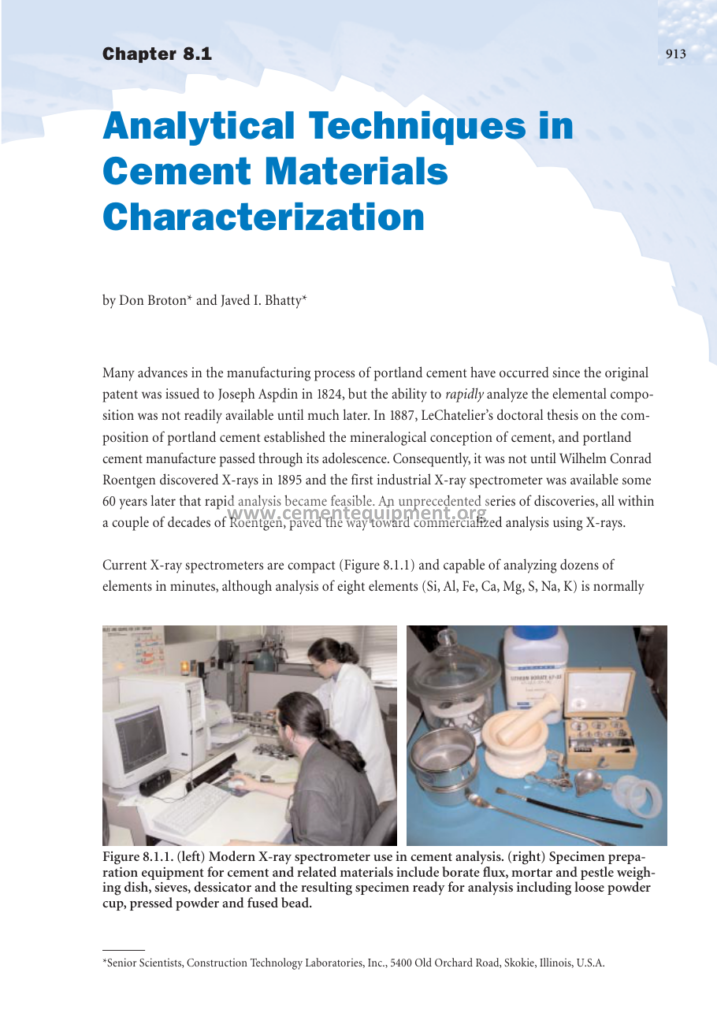
- The sample presentation: the pressed powder pellets (the binder added, the pellet pressed) or the fused beads (the sample fused with the lithium borate flux): the fused bead eliminates the mineralogical effects and gives the higher accuracy: the pressed pellet is the faster routine, the fused bead the reference;
- The calibration: the calibration with the certified reference materials and the plant standards: the correction models (the matrix effects, the inter-element interferences) are applied: the calibration is the contract of the instrument with the truth: the drift is checked daily with the control samples;
- The applications: the raw material surveying, the raw meal control, the clinker and the cement analysis, the alternative fuel ash analysis: the XRF is the instrument of the whole process: from the quarry to the dispatch, the same spectrometer speaks;
- The speed and the automation: the automatic sample feed, the 10 to 20 samples per hour, the results delivered to the process control system: the XRF is the fastest complete analysis of the laboratory: the speed of the XRF is the speed of the process corrections;
The XRF is the chemistry mirror of the plant: the oxides it reports feed the LSF and the ratio calculations, the raw mix control and the quality reports: the instrument is robust, fast and precise when it is fed the well-prepared samples and the honest calibration: the modern cement laboratory is built around the XRF, and the other techniques fill the gaps that the fluorescence cannot see: the XRF is the first instrument of the analytical suite, the daily voice of the process chemistry.
4. The XRD Analysis: The Phase Composition of the Clinker and the Cement
The X-ray diffraction (XRD) reveals what the fluorescence cannot: the phases of the clinker and the cement, the alite and the belite, the aluminate and the ferrite, the gypsum and the calcite:
- The principle: the X-rays diffract on the crystal lattice of the phases: each phase produces its characteristic diffraction pattern, and the intensities of the peaks relate to the phase quantities: the XRD is the structure camera of the minerals: the pattern is the fingerprint of the crystals;
- The qualitative analysis: the identification of the phases present in the sample: the alite, the belite, the aluminate, the ferrite, the lime, the periclase, the gypsum, the anhydrite, the calcite: the qualitative scan answers the question of what is there: the phase detection of the unusual minerals and the contaminants;
- The quantitative analysis: the Rietveld refinement: the measured pattern is fitted with the calculated pattern of the phase mixture, and the phase percentages are refined: the Rietveld gives the phase composition beyond the Bogue approximations: the alite content, the belite content and the sulfate phases measured directly;
- The Bogue comparison: the XRD phases vs the Bogue calculation from the oxides: the Bogue assumes the pure phases, the XRD measures the actual ones: the differences reveal the solid solutions and the deviations: the XRD is the reality check of the classical calculation;
- The applications: the clinker quality monitoring, the cement phase audits, the hydration studies (the calcium hydroxide and the ettringite in the hydrating paste), the alternative material characterization: the XRD serves the process and the research alike;
- The limits: the amorphous phases are invisible to the diffraction, the peak overlaps complicate the quantification, and the sample preparation (the grinding to the fine powder, the backloading, the rotation) influences the pattern: the XRD needs the careful methodology to deliver the trustworthy numbers;
The XRD is the phase truth of the clinker: the Rietveld refinement replaced the guesswork of the Bogue with the measured alite, the measured belite and the measured interstitial phases: the kiln operation benefits directly: the XRD confirms the burning, and the microscopy (of the companion article) complements it with the morphology: the diffractometer and the microscope, the two eyes of the phase analysis: the XRD is the modern partner of the XRF in the cement laboratory: the oxides on the one hand and the crystals on the other.
5. The Wet Chemical Methods: The Classical Balance of the Laboratory
Before the spectrometers, the cement laboratory worked with the wet chemistry, and the classical methods remain the reference of the accuracy and the verification:
- The gravimetric methods: the silicon (the silica) determined by the precipitation and the ignition, the sulfate by the barium sulfate precipitation: the gravimetry is slow but absolute: the gravimetric results are the classical reference for the calibration of the instrument methods: the balance and the crucible, the oldest instruments of the laboratory;
- The volumetric and the titrimetric methods: the calcium and the magnesium by the EDTA titration, the alkalis by the flame photometry, the free lime by the titration with the standard acid or the ethylene glycol extraction: the titrations are the fast and the classical determinations of the laboratory;
- The complexometric applications: the calcium oxide by the EDTA: the endpoint of the indicator, the masking of the interfering ions: the complexometry is the quantitative workhorse of the wet laboratory, still taught and still practiced in the verification of the instruments;
- The role in the modern laboratory: the wet methods serve the verification of the XRF calibration, the analysis of the unusual materials and the dispute settlement: the instrument reports and the wet check agree within the expected tolerances: the wet chemistry is the referee of the spectrometers;
- The speed and the manpower: the wet methods need the hours and the skilled hands: the modern plants run the instruments for the routine and the wet methods for the verification: the wet laboratory of the modern plant is smaller and specialized, and its role is the reference, not the routine;
- The standard methods: the procedures of the standards and the reference documents (the classical reagent books of the cement analysis): the standardized procedures guarantee the comparability of the results across the laboratories: the method discipline is the comparability of the numbers;
The wet chemistry is the classical ground of the analytical truth: the gravimetry and the titration ask nothing of the calibration curves, they ask the balance and the pipette: the modern laboratory keeps the classical methods alive as the reference of the accuracy: when the XRF drifts or the customer disputes the analysis, the wet method is the judge: the instruments are fast and the classics are true: the laboratory that masters both speaks with the confidence of the verified numbers: the analytical techniques, old and new, are the two legs of the measurement discipline.
6. The Free Lime and the SO3: The Critical Determinations
The free lime and the sulfur trioxide are the two determinations that the cement plant watches with the most attention, and each has its dedicated techniques:
- The free lime by the titration: the classic method: the free lime is extracted in the ethylene glycol or the saccharose solution and titrated with the acid: the extraction dissolves the free CaO while the combined lime stays: the hourly free lime of the kiln control is the titration result: the simple and the fast determination of the burning;
- The free lime by the conduction or the radiation: the automated variants with the conductometric or the calorimetric detection: the automation of the free lime analysis for the online control: the automated free lime follows the same chemistry with the machine precision: the modern laboratories run both the manual and the automated versions;
- The significance of the free lime: the burning intensity of the kiln: the free lime of 0.5 to 2% in the clinker signals the balanced burning: the excursions steer the kiln temperature: the free lime is the hourly compass of the burning control: the most operationally active number of the laboratory;
- The sulfate (SO3) determination: the total sulfate by the XRF, the barium precipitation gravimetry and the infrared combustion methods: the SO3 of the cement is the setting moderator: the SO3 control of the finish mill keeps the optimum sulfate: the gypsum addition is steered by the SO3 analysis;
- The soluble sulfate and the forms: the water-soluble sulfate vs the total: the available sulfate decides the early hydration and the false set: the special determinations separate the gypsum, the hemihydrate and the anhydrite: the forms of the sulfate matter more than the total in the cement behavior;
- The frequency and the integration: the free lime hourly at the kiln and the SO3 hourly at the finish mill: the results feed the process control in real time: the two determinations are the high-frequency beat of the quality control rhythm: the plant runs on these two numbers;
The free lime and the SO3 are the heartbeats of the cement process: the free lime tells the kiln how hard it burned, and the sulfate tells the mill how gentle the setting will be: the two determinations are simple in the chemistry and enormous in the influence: the hour-by-hour rhythm of the laboratory is set by their rhythm: the techniques are mature, automated and fast, and their discipline is the discipline of the process itself: the two numbers that the plant cannot live without, measured with the methods that never sleep.
7. The Fineness Determinations: The Blaine, the Sieves and the Residues
The fineness of the cement and the raw meal is the physical property measured by the laboratories of the plant, and the Blaine is its most famous instrument:
- The Blaine test: the air permeability method: the air is drawn through the compacted powder bed and the specific surface area (the Blaine, in square meters per kilogram) is calculated from the flow resistance: the cement Blaine of 3500 to 4000 square meters per kilogram for the ordinary cements: the Blaine is the daily fineness gate of the finish mill;
- The Blaine procedure: the fixed bed volume, the compaction, the measurement of the air flow time and the calculation with the apparatus constant: the Blaine is the fast, standardized and repeatable method: the instrument is calibrated with the standard sample: the Blaine is the reference fineness number of the cement industry;
- The sieve residues: the 45 micrometer and the 90 micrometer residues, the coarse fraction of the product: the sieve analyses with the air-jet sieves and the wet sieving: the residue tracks the coarse tail of the distribution that the Blaine cannot see: the residue and the Blaine together describe the grinding result;
- The applications: the cement fineness control, the raw meal residue (12 to 14% on 90 micrometers typical), the coal fineness (2 to 5% on 90 micrometers for the kiln fuel): the same techniques serve the different materials of the plant: the fineness is the physical grammar of the grinding;
- The fineness and the strength link: the finer cement grinds faster but demands the water and can suffer the shrinkage: the Blaine and the strength are the couple of the grinding control: the optimum fineness balances the strength, the water demand and the mill output;
- The quality gates: the standard fineness limits of the cement types, the internal targets of the plants: the Blaine is the first gate of the cement release: the fineness certificate of every mill product: the instrument of the fineness is the gatekeeper of the dispatch;
The Blaine and the sieves are the physical eyes of the grinding: the Blaine reads the total surface and the sieve reads the coarse tail, and the two together describe the powder the mill made: the finish mill operates on the Blaine hourly feedback, and the strength laboratory verifies the fineness link at the day scale: the fineness determinations are the simplest instruments of the suite and among the most decisive: the powder that is too coarse fails the strength, the powder that is too fine costs the output: the Blaine is the balance of the grinding, measured in the square meters per kilogram.
8. The Particle Size Distribution: The Full Curve of the Powder
Beyond the Blaine and the residue, the particle size distribution (PSD) describes the full curve of the powder: the laser diffraction is the modern instrument of the PSD:
- The laser diffraction principle: the powder is dispersed in the air or the liquid and passed through the laser beam: the scattering angle of the light depends on the particle size: the measured pattern converts to the size distribution: the laser diffractometer draws the full curve from 0.1 to 1000 micrometers;
- The distribution parameters: the d10, the d50 and the d90 (the sizes at 10, 50 and 90% of the cumulative passing): the d50 of the ordinary cement of 15 to 25 micrometers: the full distribution reveals the fine, the medium and the coarse behavior of the mill: the curve is the fingerprint of the grinding circuit;
- The shape of the distribution: the steepness of the curve (the slope of the Rosin-Rammler), the tail of the fine particles and the coarse fraction: the steep distributions pack and hydrate differently: the optimum PSD of the cement balances the packing, the hydration and the water demand: the curve is the designer’s view of the powder;
- The mill diagnosis: the distribution changes reveal the mill problems: the growing coarse tail speaks of the worn media or the classifier wear, the rising fines of the over-grinding: the PSD trend is the diagnostic curve of the mill: the distribution data supports the separator adjustments and the mill audits;
- The applications: the cement and the raw meal PSD, the fly ash and the slag characterization, the alternative material studies: the laser diffraction serves the process and the product development: the one instrument for the many powders of the plant;
- The method care: the dispersion quality, the obscuration and the refractive index settings: the same sample can show different distributions with the different settings: the method discipline is the comparability of the curves: the standardized settings keep the curves honest;
The PSD is the full photograph of the powder: the Blaine gives the single number and the diffraction gives the whole curve: the d50, the d90 and the slope describe the grinding result as the mill sees it: the modern plants run the PSD instruments alongside the Blaine for the deep view of the cement and the diagnosis of the circuit: the distribution curve is the fine print of the fineness: the powder tells its whole story in the curve, and the laboratory reads the story: the particle size analysis is the curve of the grinding truth.
9. The Loss on Ignition and the Moisture: The Light Measurements
The loss on ignition (LOI) and the moisture are the light, fast measurements that carry the important information of the process:
- The loss on ignition: the weight loss of the sample on the ignition at 950 to 1000°C: the LOI includes the carbonate decomposition, the organic matter, the combined water and the sulfate decomposition: the LOI is the measure of the unburned carbonate and the moisture of the materials: the LOI of the clinker below 1% and of the cement below 3 to 5% (by the standard limits);
- The LOI applications: the raw material carbonate estimation (the raw mix LOI), the clinker burning completeness (the residual carbonate), the cement quality limit and the fly ash quality: the single muffle furnace measurement serves the whole chain: the LOI is the simple, universal gate of the quality;
- The moisture determination: the drying at 105°C to the constant weight: the moisture of the raw materials, the coal and the fuels: the moisture drives the mill drying and the fuel burning: the moisture analysis is the daily partner of the process engineers;
- The infrared and the microwave moisture: the fast online moisture instruments at the belt conveyors and the mill circuits: the online moisture closes the control loop of the drying in real time: the modern plants measure the moisture without the laboratory delay: the online moisture is the speed of the drying control;
- The thermogravimetric depth: the TGA curves (the topic of the companion article) separate the moisture, the organic matter and the carbonate decomposition on the temperature axis: the thermogravimetric analysis is the LOI with the resolution: the deep version of the light measurement;
- The sample handling: the moisture samples are kept sealed and measured promptly, the LOI samples are ground and homogenized: the light measurements still demand the careful handling: the discipline of the light methods is the discipline of the simple things done right;
The LOI and the moisture are the quiet measurements of the laboratory: the LOI guards the carbonate and the organic limits, and the moisture feeds the drying and the fuel control: the two are simple, fast and universal: the plant that skips them pays with the wrong raw mix ratios and the wet fuels: the light measurements are the small weights that balance the big decisions: the muffle furnace and the drying oven are the humble instruments of the process truth: the LOI and the moisture, measured well, keep the whole quality chain honest.
10. The Special Determinations: The Alkalis, the Chlorides and the Magnesia
The minor components of the cement chemistry carry the outsize influence on the process and the product: the special determinations watch them:
- The alkalis (Na2O and K2O): the flame photometry and the XRF: the alkalis of the raw materials and the fuels feed the volatile cycles of the kiln and the alkali-aggregate reactions of the concrete: the equivalent alkali (Na2O + 0.658 K2O) is the standard expression: the alkali control is the process and the product control at once;
- The chlorides: the titration and the ion chromatography: the chloride of the raw materials and the waste fuels is the most aggressive volatile: the chloride limit of the kiln feed (typically below 0.015% of the clinker) protects the tower from the deposits: the chloride analysis is the gate of the alternative fuel acceptance;
- The magnesia (MgO): the XRF and the wet methods: the magnesia of the raw materials controls the periclase risk of the clinker: the standard limits (up to 5% in the cement, with the autoclave test for the higher values) guard the soundness: the magnesia analysis is the chemistry gate of the soundness;
- The phosphorus, the titanium and the manganese: the minor oxides of the raw materials: the phosphorus slows the alite formation, the titanium and the manganese modify the color and the phases: the special oxides are watched in the raw mix studies and the special cements: the minors are the seasoning of the chemistry;
- The trace elements of the fuels: the heavy metals and the organic indicators of the alternative fuels: the fuel acceptance analysis: the trace control is the environmental and the product gate of the waste burning: the special analysis extends the laboratory to the fuel yard;
- The frequency and the triggers: the daily to weekly routine and the triggered analyses on the chemistry changes: the special determinations follow the process events: the specials are the watchdogs that bark at the thresholds: the laboratory schedule is the rhythm of the watchers;
The special determinations are the guardians of the chemistry boundaries: the alkalis, the chlorides and the magnesia set the limits of the process stability and the product soundness: the laboratory that measures the minors anticipates the kiln deposits, the false set and the concrete problems before they arrive: the special determinations are fewer in number and larger in the consequence: the plant that knows its minors knows its risks: the watchdogs of the laboratory, fed with the samples and trusted with the warnings.
11. The Method Selection: The Table of the Analytical Techniques
The analytical suite is the toolbox of the laboratory, and the method selection follows the property, the speed and the accuracy required: the table below maps the common determinations to the techniques of the suite:
| Determination | Primary technique | Frequency in the plant |
|---|---|---|
| Major oxides (raw, clinker, cement) | XRF | Hourly to daily |
| Phase composition (clinker, cement) | XRD (Rietveld) | Daily to weekly |
| Free lime (clinker) | Titration (glycol extraction) | Hourly |
| SO3 (cement, clinker) | XRF, wet gravimetry | Hourly to daily |
| Fineness (Blaine) | Air permeability | Hourly to shift |
| Particle size distribution | Laser diffraction | Daily and on demand |
| LOI and moisture | Muffle furnace, drying | Daily |
| Alkalis, chlorides, MgO | XRF, titration, IC | Daily to weekly |
The method table is the map of the laboratory: each determination has its instrument, its frequency and its role in the process loop: the hourly free lime drives the kiln, the hourly Blaine drives the mill and the daily oxides drive the mix: the selection of the methods is the economy of the laboratory: the accuracy is bought with the time and the cost, and the plant buys the accuracy where the decisions need it: the table is the schedule of the truth: the analytical suite, arranged around the needs of the process.
12. The Quality Data and the Plant Integration: The Laboratory as the Hub
The value of the analytical techniques is realized in the integration: the laboratory data must reach the process control, the quality management and the customer service as one continuous stream:
- The laboratory information management system (LIMS): the software that registers the samples, records the results, enforces the methods and archives the history: the LIMS is the memory and the bookkeeping of the laboratory: the modern laboratory runs on the LIMS as the plant runs on the DCS;
- The process integration: the results delivered to the process control system: the raw mix corrections computed and executed automatically: the kiln free lime on the operator screen and the mill Blaine on the mill screen: the laboratory and the process speak through the data links: the integration is the closed loop of the control;
- The statistics and the trends: the control charts of the key parameters, the standard deviations and the capability indices: the statistical process control watches the drift before the limits: the trends are the memory of the quality: the statistics are the judgement of the numbers;
- The certificate generation: the cement certificates with the composition, the fineness and the strength data: the certificates follow the products to the customers: the certificate is the legal voice of the laboratory: the generation and the archive of the certificates are the documentation discipline;
- The inter-laboratory comparisons: the round-robin testing with the other laboratories and the reference materials: the comparisons verify the laboratory’s accuracy against the community: the inter-laboratory results are the passport of the laboratory’s credibility;
- The audit and the accreditation: the internal audits and the external accreditations of the laboratory: the accredited laboratory follows the documented methods and the quality system: the accreditation is the certificate of the laboratory itself: the quality of the numbers, guaranteed by the system;
The integration is the final stage of the analytical discipline: the numbers that stay in the notebook change nothing, and the numbers that reach the control room change the process: the LIMS, the data links and the control charts convert the measurements into the decisions: the modern laboratory is the hub of the plant information: the instruments at the center, the process and the customers on the rim: the analytical techniques are the source, and the integration is the delivery: the laboratory that integrates is the laboratory that influences.
13. The Frequently Asked Questions
Why does the plant need both the XRF and the wet chemistry?
The XRF gives the fast, complete oxide analysis for the routine control, and the wet chemistry provides the absolute reference for the verification: the gravimetry and the titration depend on the stoichiometry rather than the calibration: the two families of the methods cross-check each other: the instruments for the speed, the classics for the truth.
What is the difference between the Bogue calculation and the XRD?
The Bogue calculation derives the phase composition from the oxide analysis assuming the pure, ideal phases: the XRD (Rietveld) measures the actual phases present in the clinker: the real clinker carries the solid solutions and the deviations: the XRD results are the ground truth and the Bogue the approximation: the modern quality control uses both.
How often should the free lime be determined?
The free lime is the hourly compass of the kiln burning: the samples are taken and analyzed hourly in the routine, and more frequently during the process changes and the startups: the free lime trend is the fastest quality signal of the clinker: the determination is fast enough to follow the hour.
Why is the Blaine still the standard fineness test?
Because the Blaine is fast, simple, standardized and repeatable within a few percent: the air permeability method needs only the compacted bed and the manometer: the laser diffraction gives the fuller curve, but the Blaine remains the contractual fineness number of the cement trade: the two instruments serve the different questions.
What does the LOI of the cement indicate?
The loss on ignition indicates the residual carbonate, the moisture and the organic matter of the cement: the standard limits (typically 3.5 to 5% depending on the standard) guard the quality: the rising LOI warns of the stale storage (the carbonation) or the excessive addition of the carbonated materials: the LOI is the simple gate of the cement condition.
How does the laboratory keep its results reliable?
Through the discipline of the whole chain: the representative sampling, the documented preparation, the calibrated instruments, the control samples with each batch, the inter-laboratory comparisons and the audits: the reliability is not the property of the instrument but of the system: the accredited laboratory follows the documented system and the system delivers the trust.
14. Conclusion
The analytical techniques of the cement laboratory: the measurement backbone of the quality: the sampling and the preparation, the XRF and the XRD, the wet chemistry and the free lime, the Blaine and the particle size, the LOI and the specials: the instruments are the eyes of the process and the numbers are its language: the laboratory is the hub of the plant information, and the integration converts the measurements into the decisions: the plant that measures well steers well: the analytical suite of the cement plant, mastered as the disciplined profession it is.
The Complete Cement Technical Package includes the laboratory documentation with the analytical method descriptions, the sample preparation guides, the calculation tables and the quality control procedures: the one-time price of $249.99: the instant download: the library of the measurement: the engineer and the technician of the package run the XRF, the XRD and the classical methods with the professional confidence: the analytical techniques of the cement plant, from the sample to the certificate, mastered with the full documentation.
Get this analytical techniques guide + the full 931-file package
$249.99 — one-time purchase, instant download, lifetime access
This file is part of the Complete Cement Technical Package (931 files) available from cementequipment.org. Respective rights holders; library copy for the licensed single user.