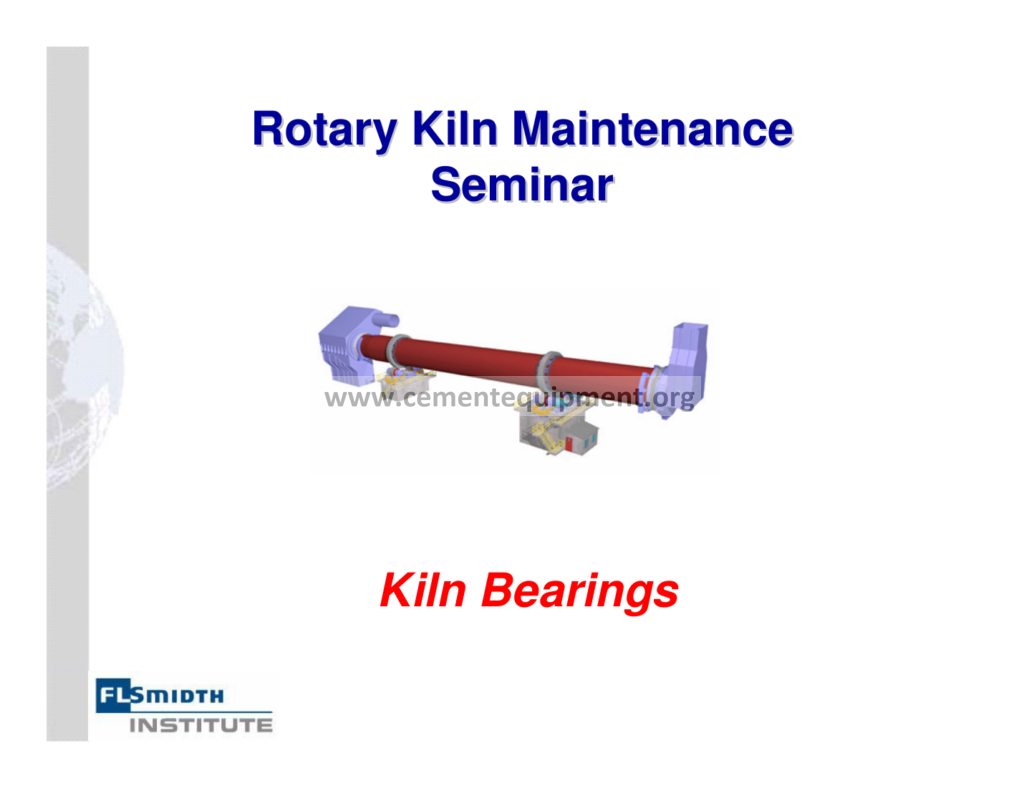
Kiln Bearings: Complete Technical Guide
The kiln bearings are the quiet load carriers of the burning line: each of the four to six support stations of a rotary kiln hangs its hundreds of tons on the bearing assembly beneath the support rollers, and the bearing is the component where the rotating machine meets the standing foundation: the seminar file 304372196, the 60-page kiln bearings seminar of the FLS tradition, teaches the complete bearing story: the type history from the 1958 design era to the 1974 updates, the RA and the RB type bearings, the self-aligning spherical sockets, the bronze liners, the oil scoops and the water cooling jackets: the bearing is the machine part that never stops at full speed and at full load, and the session of the file is the maintenance man’s complete education on the subject.
The Complete Cement Technical Package (931 files including the books, the courses, the Excel tools and the presentations: $249.99 one-time: instant download via the PayPal payment) includes this kiln bearings seminar with the bearing drawings, the clearance tables, the lubrication schedules, the oil types and the maintenance records: the practical reference for the mechanical engineers, the kiln maintenance crews and the reliability teams: this article walks the file: the bearing function, the bearing types, the FLS socket design, the lubrication, the cooling, the seals, the thrust control, the maintenance and the troubleshooting: every section with the numbers of the real kilns and the real bearing shops.
The bearing is the interface between the rotating kiln and the earth: its failure stops the line in minutes, its health runs for decades, and its maintenance is the schedule that the seminar of the file organizes into the weekly, monthly and annual rounds: this page follows the file from the drawdown of the load to the re-metaling of the shell, so the reader inherits the complete bearing-plant engineer’s view of the component that carries the whole kiln.
1. The Bearing Duty: The Loads, the Speeds and the Temperatures of the Kiln Bearings
The kiln bearing works under a combination that few industrial bearings meet: the static load of hundreds of tons, the slow rotation that oscillates between the run and the creep, the radiant heat of the burning zone and the dust of the clinker atmosphere: the bearing of a support station carries the weight of one to two kiln spans, and the design of the bearing family of the file is engineered for that specific duty, not for the general machinery rules of the textbooks.
| Duty parameter | Typical value on the large kilns | Design consequence |
|---|---|---|
| Static load per bearing | 150 to 400 tons per support bearing | large bore sizes, high load rating, slow-speed rating |
| Kiln rotation speed | 1.5 to 4 revolutions per minute | hydrodynamic film at low sliding speed, no fatigue cycles |
| Support roller shaft speed | 6 to 18 rpm at the bearing journals | rolling bearings run on the endless creep, plain bearings on the full film |
| Bearing temperature | 40 to 70 C in service, alarms near 70 C | cooling jackets and heat shields in the design |
| Ambient atmosphere | dusty, hot, occasionally humid | seals, felt rings, closed oil systems |
| Alignment state | micrometer drift over the years | self-aligning sockets to survive the slope changes |
The duty numbers of the table drive every choice of the file: the white metal and the bronze plain bearings win on the load capacity and the misalignment tolerance, the spherical roller bearings win on the efficiency and the cleanliness, and the FLS-type spherical socket bearing combines the two philosophies in the one assembly: the seminar of the file develops the duty calculation, the bearing selection and the rating verification so the reader can reproduce the design logic for his own kiln: the bearing duty is the starting chapter of every bearing seminar, and the file’s version carries the load tables that the maintenance man uses to interpret the measured bearing temperatures.
2. The Bearing Families: The Plain White Metal Bearings and the Rolling Element Bearings
The kiln bearing world is divided into two families that the file compares honestly: the plain bearings with the white metal (babbitt) lining, which the older kilns of the 1958 and the 1960s generations carried, and the rolling element bearings, mostly the spherical roller bearings, which the modern lines and the retrofits prefer: the seminar of the file explains both, because the existing plants still run both and the maintenance man must master the two languages.
- The plain white metal bearing: the split housing carries the bronze or the steel shell lined with the white metal 3 to 6 millimeters thick, the shaft rides on the oil film, and the failure mode is the gradual wiping of the soft metal rather than the sudden seizure: the plain bearing forgives the misalignment and the dirt better than any rolling element, which is why the old kiln designs lasted the decades with the modest oil rings;
- The spherical roller bearing: the two raceways of the inner ring, the concave outer raceway and the barrel rollers allow the self-alignment in the housing, and the modern units carry the same station loads with the lower friction and the simpler lubrication: the rolling bearing demands the clean oil, the true alignment and the controlled clearance, and it repays the discipline with the long intervals between the overhauls;
- The comparison in practice: the plain bearing runs hot but fails slowly (the temperature rises for days before the wipe), the rolling bearing runs cool but fails suddenly (the cage breaks, the roller spalls, the bearing seizes): the maintenance strategy of the file adapts the inspection interval to the family, and the change-out bookkeeping tracks the two populations separately;
- The retrofit path: many plants convert the white metal stations to the spherical roller bearings during the planned stops, and the file’s retrofit chapter covers the housing machining, the adapter sleeve selection, the clearance setting and the oil system conversion: the retrofit pays back in the power savings and the oil consumption, but only where the alignment discipline exists;
The family comparison of the file ends with the decision table: the kiln age, the station load, the alignment history and the maintenance crew capability decide the right family, and the seminar teaches the decision rather than the dogma: the bearing that survives is the one the plant can maintain, and the file’s tables match every family to the maintenance culture that keeps it alive: the two families coexist in the industry, and the complete bearing education of the seminar covers both without prejudice.
3. The FLS Bearing Design: The Self-Aligning Spherical Socket and the RA/RB Type History
The heart of the classic kiln bearing is the self-aligning socket: the housing bore is machined as a sphere, the bearing cartridge carries the matching spherical outline, and the cartridge floats inside the socket so the shaft center line can tilt by the fractions of a degree without crowding the load on one edge: the FLS kilns of the file era (the 1958 to 1974 design generations) standardized this socket geometry, and the RA and the RB type designations in the file name the two generations of the socket bearing.
| Type generations of the file | Design era | Characteristic |
|---|---|---|
| RA type bearings | 1950s to 1960s kilns | spherical socket, bronze lined bushings, oil ring lubrication, thrust collars |
| RB type bearings | 1960s to 1970s kilns | refined socket geometry, improved oil distribution, strengthened pedestals |
| FLS design philosophy | all eras | self-aligning socket + closed oil system + water cooling of the pedestal |
| Fuller style bearings (comparison) | American kilns | straight bore housings, white metal shells, forced circulation as the option |
The socket bearing of the file aligns itself every revolution: the shaft deflection, the foundation settlement and the thermal growth of the shell change the journal angle by the small degrees, and the spherical socket absorbs the change in the metal rather than in the edge load: the seminar chapter on the socket geometry develops the clearance between the cartridge and the housing (typically 0.5 to 1.5 millimeters radial on the large kilns), the machining tolerance of the sphere and the assembly marks, and the maintenance rule that the socket must never be packed with the dried grease: the RA/RB history of the file is the archaeology of the design, and the reader who knows the generations recognizes the kilns of his own plant immediately.
4. The Bearing Housing Anatomy: The Bronze Liners, the Oil Scoop, the Oil Tray and the Level Gage
The classic kiln bearing housing is a small industrial museum of the clever details: the pages of the file name the parts that the young mechanic has never seen in the textbook: the bronze liner, the oil scoop, the oil scraper, the oil tray, the level gage plate, the thrust ring, the heat shield and the felt seal: each part exists because the bearing rotates slowly, carries the tons and must be lubricated without the pumps of the high-speed world: the seminar of the file walks the exploded view part by part.
- The bronze liner: the bearing shell of the classic designs is the cast bronze bushing 20 to 50 millimeters thick, machined to the shaft diameter with the oil grooves cut into the bore: the bronze carries the load with the low friction against the shaft, and the white metal overlay is applied where the soft bearing surface is needed: the liner is the wear part, and its wall thickness is the wear budget of the station;
- The oil scoop: the rotating shaft carries the scoop arms that dip into the oil sump and throw the oil up into the distribution grooves of the bearing: the scoop is the self-pumping device of the classic bearing, and its design (the number of the arms, the immersion depth, the bore of the oil channel) decides whether the bearing receives its 5 to 15 liters per minute without the external pump;
- The oil tray and the oil scraper: the tray catches the oil thrown by the scoop and guides it into the grooves, and the scraper wipes the shaft journal so the oil returns clean to the sump: the tray and the scraper are the small parts whose failure starves the bearing, and the file’s part list carries the replacement intervals;
- The level gage plate: the oil level in the sump is set by the gage plate, and the correct level (typically the center line of the shaft or the mark on the plate) decides the scoop immersion: the level is the first check of the daily round, because the low level starves the scoop and the high level burns the oil;
- The heat shield and the water jacket: the burning-zone radiation reaches the bearing through the pedestal, and the heat shield deflects the radiant flux while the water jacket carries the cooling water around the oil sump: the cooling water of 5 to 20 liters per minute holds the oil below the 70 C line in the hot summer months;
The anatomy chapter of the file is the parts book of the classic bearing: every component with the drawing, the material, the function and the failure signature, so the young mechanic learns the names and the older foreman teaches from the same pages: the bearing that is understood part by part is the bearing that is maintained part by part, and the seminar’s exploded views are the teaching instrument that the field manuals of the modern plants have abandoned: the file preserves the complete education of the classic kiln bearing, and this article inherits its system: the scoop, the tray, the gage and the jacket become the familiar vocabulary of the reader.
5. The Lubrication Systems: The Oil Ring, the Oil Scoop, the Circulation and the Grease
None of the bearing designs of the file survive without the correct oil at the correct level at the correct temperature: the lubrication chapter of the seminar covers the complete menu: the oil ring lubrication of the older housings, the scoop lubrication of the large classic bearings, the forced circulation of the modern stations and the grease of the auxiliary points: the film thickness at the journal is the product of the viscosity and the speed, and the slow kiln bearing demands the high-viscosity oils that the general lubrication books rarely discuss.
| Lubrication method | Typical application | Oil type | Watch points |
|---|---|---|---|
| Oil ring | small kilns, auxiliary drives, older housing designs | ISO VG 460 to 680 mineral oils | ring slip, level, ring tension |
| Oil scoop | classic large FLS-style bearings | ISO VG 460 to 680 | scoop immersion, groove flow, sump level |
| Forced circulation | modern roller bearing stations, large plain bearings | ISO VG 320 to 460 | pump pressure, filter delta P, oil cooler outlet |
| Grease | auxiliary points, seals, thrust faces | NLGI 2 lithium or EP greases | re-grease intervals, bleed, over-greasing |
The oil selection of the file follows the viscosity-temperatures diagram: the kiln bearing oil must maintain the film at the 40 to 60 C sump temperature, and the VG 460 to 680 grades are the standard of the industry: the water ingress from the cooling jacket leaks and the dusty atmosphere contaminate the oil, so the seminar sets the oil change intervals (typically every 6 to 12 months or the quarterly oil analysis results) and the acceptance values for the viscosity, the water content (below 0.1%) and the particle counts: the lubrication record of the file tracks the oil consumption per bearing per year, and the sudden consumption change is one of the earliest failure signals of the bearing: the lubrication discipline is the cheapest insurance of the entire support system, and the file’s schedules turn it into a calendar, not a hope.
6. The Cooling of the Kiln Bearings: The Heat Shields, the Water Jackets and the Oil Coolers
The bearing of the burning zone lives next to a kiln surface that radiates at 200 to 350 C, and the control of the bearing temperature is a survival engineering of its own: the seminar of the file develops the thermal path: the radiant heat from the shell, the conducted heat through the pedestal, the frictional heat of the oil shear and the heat carried by the circulating oil, and the cooling devices that discharge each contribution: the heat shield, the water jacket and the oil cooler are the three instruments of the file’s thermal control.
- The heat shield: the curved steel or aluminum plate between the kiln shell and the bearing pedestal intercepts the radiant flux and re-radiates it away: the shield of the file is sized to the burning zone geometry, and its maintenance is simple (the annual replacement of the warped sections, the daily check of the fixings);
- The water jacket: the pedestal walls of the classic designs carry the internal water passages around the oil sump: the cooling water circulates at 5 to 20 liters per minute with the inlet temperature below 30 C, and the outlet temperature of the jacket (35 to 45 C typical) is the verification point of the daily round: the jacket leaks are the classic contamination source of the bearing oil, so the file’s leak test precedes every oil change;
- The oil cooler: the forced circulation systems pass the oil through the shell-and-tube or the plate coolers before the return to the bearing: the cooler outlet temperature (45 to 55 C typical) sets the bearing temperature, and its fouling raises both the bearing and the alarm margin: the cooler cleaning follows the measured approach temperature of the file’s schedule;
- The temperature limits: the operating band of the file is the 40 to 70 C range, with the alarms at the 65 to 70 C setpoints, the trip decisions above the 75 to 80 C and the investigation triggered by any climb of 5 C above the stabilized trend: the temperature trend is the bearing’s heartbeat, and its chart is the central document of the bearing monitoring;
The cooling practice of the file closes with the summer/winter strategies: the water flow is throttled in the winter to protect the viscosity, the shields are cleaned before the hot season, and the oil coolers are pre-cleaned when the monthly trend shows the rising approach temperature: the bearing temperature is kept in its band by the combination of the passive shields and the active coolers, and the seminar’s thermal chapter gives the numbers that turn the temperature control from the folklore into the calculation: the bearing that runs cooled is the bearing that runs long, and the file’s cooling tables are the reference of the maintenance room.
7. The Thrust Bearings and the Axial Load Control of the Support Stations
The inclined kiln pushes its whole weight toward the discharge end, and the axial components of the roller reactions must be absorbed somewhere: the classic kiln bearing carries the thrust collars on the shaft, and the alignment of the file era distributes the axial load among the stations so that no single thrust face carries the full runaway: the seminar of the file develops the axial equilibrium: the slope of 3 to 4%, the skew of the rollers, the hydraulic thrust systems of the modern kilns and the thrust faces of the bearing assemblies.
| Axial control element | Function | Bearing interface |
|---|---|---|
| Shaft thrust collars | transfer the axial force from the shaft to the housing | bronze thrust faces or hardened steel discs in the housing |
| Skewed support rollers | steer the kiln uphill against the gravity | reduces the steady axial load on the thrust faces |
| Hydraulic thrust rollers | catch the shell at the travel limits | limits the emergency load on the bearing faces |
| Thrust slide pads | lubricated axial support of older designs | greased or oiled faces, replaced at the stops |
The thrust chapter of the file teaches the reading of the axial travel pattern (the rise, the fall and the oscillation of the shell on its tyres) and the correct setting of the skews so the thrust faces carry the minimum steady load: the bearing inspection at the stops checks the thrust face wear (the bronze faces wear 0.5 to 2 millimeters per year on the misaligned kilns and almost nothing on the aligned), and the file’s wear tables tie the observed face state to the correctness of the skew: the thrust control is the meeting point of the mechanical and the process disciplines, and the seminar’s treatment gives the bearing man the full picture: the axial force that he cannot see is measured by the travel, the temperatures and the face wear, and the file teaches all three instruments.
8. The Sealing of the Kiln Bearing: The Felt Rings, the Labyrinths and the Dust Defense
The kiln atmosphere is the enemy of the bearing: the fine clinker dust, the fuel ash and the cooling air currents conspire to grind the journal and the liners, and the bearing seals are the thin line of the defense: the seminar of the file devotes a full chapter to the sealing systems of the classic and the modern housings: the felt rings, the labyrinth grooves, the grease-packed seal chambers and the closed oil systems: the oil that leaves the bearing is the oil that brings the dust back in, and the seal discipline is the leak discipline.
- The felt ring seals: the classic housings carry the felt rings in the retaining grooves at both ends of the bore: the felt wipes the shaft, absorbs the oil mist and blocks the coarse dust: the felt hardens with the heat and the age, and the file’s schedule replaces it at every oil change or at the quarterly intervals on the hot stations;
- The labyrinth seals: the modern housings use the non-contact labyrinth grooves that fling the dust outward by the centrifugal action and the escaping oil mist: the labyrinth needs no replacement but demands the correct clearance (0.5 to 2 mm) and the correct grease packing at the assembly:
- The grease-packed chambers: the seal chambers between the felt and the bearing are packed with the NLGI 2 grease at the stops, and the grease acts as the dirt trap that is flushed out with the fresh grease every stop: the chamber vent prevents the over-pressure that would blow the grease into the bearing;
- The closed oil systems: the forced circulation systems seal the complete oil circuit with the return piping and the tank vents carrying the desiccant breathers: the closed system eliminates the dust entry path of the open sumps, and its seal maintenance is the inspection of the piping joints and the breathers;
The seal chapter of the file ends with the diagnostics of the seal state: the oil on the pedestal base, the dust ring around the shaft, the rising particle counts in the analysis and the darkened oil color all speak of the seal failure, and the file’s seal checklist is the daily and the annual discipline: the bearing that is sealed is the bearing whose oil stays clean, and the clean oil is the precondition of the film that carries the hundreds of tons: the seminar treats the seals as the first line of the bearing defense, and the reader inherits the complete sealing vocabulary of the kiln bearing.
9. The Maintenance of the Kiln Bearings: The Clearances, the Re-Metaling and the Change-Out Procedures
The maintenance chapter of the seminar is its largest and most practical: the schedules, the clearances, the re-metaling and the change-out of the kiln bearings are the operations that the maintenance teams perform every planned stop, and the file documents them with the field procedures that the older seminars never wrote down: the bearing maintenance of the kiln is not the mystery of the specialized shops: it is the disciplined work of the plant crew trained on the file’s procedures.
| Maintenance operation | Typical interval | Acceptance values of the file |
|---|---|---|
| Oil change and oil analysis | every 6 to 12 months | water below 0.1%, viscosity within grade, particles within limit |
| Bearing clearance measurement | during every planned stop | diagonal clearance 0.5 to 1.5 per 100 mm of journal diameter |
| White metal inspection | annual at the stops | no cracking, no wiped zones, no bond failure |
| Re-metaling of the shells | when the lining is scored or wiped | white metal 3 to 6 mm, bond tested, grooves re-cut |
| Roller bearing replacement | every 10 to 15 years or on the condition | clearance class, preload verification, runout after the fit |
| Shaft journal inspection | every major stop | no score marks, no ovality beyond 0.05 mm, surface finish smooth |
The clearances of the file follow the slow-speed rules: the large slow journal runs the hydrodynamic film with the assembled clearance of the order of one to two per thousand of the diameter, and the clearance is measured cold with the feeler gages and the thimble micrometers at the two diagonals, then recorded on the station card: the re-metaling procedure of the seminar covers the removal of the old white metal, the tinning of the shell, the pouring of the fresh babbitt, the machining of the bore and the scraping of the contact: the bond test (the hammer and the chisel) and the final clearance verification close the re-metaling, so the plant can re-line its own bearings with the results of the specialty shops: the change-out of the roller bearings of the modern stations follows the manufacturer procedures with the thermal fitting, the clearance verification and the axial positioning, and the file’s step lists make the procedure reproducible by the trained crew: the bearing maintenance is the core economy of the support system, and the seminar of the file is its complete method.
10. The Monitoring and the Troubleshooting: The Temperature, the Vibration and the Oil Analysis
The bearing announces its story in three instruments: the temperature trend, the vibration signature and the oil analysis, and the final technical chapter of the file teaches the reading of the three together: the single reading is the noise, the trend is the signal, and the confirmation across the three instruments is the diagnosis: the troubleshooting tables of the seminar map the symptoms of the kiln bearings to the causes and the cures in the language of the plant.
- The temperature monitoring: the daily readings plotted on the station chart, the stabilized operating values (45 to 65 C typical) and the alarm triggers (a climb of 5 C above the trend, an absolute value above the 70 C): the rising temperature with the stable oil level points to the load increase or the alignment drift, and the rising temperature with the falling level points to the oil starvation;
- The vibration monitoring: the portable or the online accelerometers on the housings, with the slow-speed bearing signatures dominated by the blade-pass and the low-order harmonics rather than the high-frequency defect frequencies of the fast machines: the trend of the overall level (0.5 to 2 mm/s typical on the healthy stations) and the spectrum changes guide the inspections;
- The oil analysis: the quarterly samples measure the viscosity, the water, the acid number, the particle count and the metals: the rising iron and copper read the wear of the liner and the journal, the rising silicon reads the dust ingress, and the rising water reads the cooling jacket leak: the analysis is the laboratory that sees inside the bearing without the stop;
- The troubleshooting table: the hot bearing with the clean oil, the hot bearing with the dirty oil, the noisy bearing, the leaking bearing, the wiping bearing and the seizing bearing each carry their symptom-cause-cure rows, and the file’s tables rank the checks by the probability and the cost, so the crew investigates in the right order;
The monitoring chapter of the seminar closes with the case sketches of the file: the bearing that ran hot for three weeks and wiped, the bearing that seized after the oil change with the wrong level, and the bearing that failed after the cooling water leak: each case shows the trail from the first log entry to the root cause, and the reader learns the discipline of the evidence: the monitoring instruments of the file are cheap, the log discipline is free, and the failures that they prevent are the weekend-long shutdowns: the bearing that is measured, recorded and analyzed is the bearing whose life the plant controls, and the seminar’s final chapter hands the complete control to the maintenance team.
11. The Frequently Asked Questions
Why does the classic kiln bearing use the self-aligning spherical socket?
Because the kiln is not a rigid straight machine: the shell deflects under its own weight, the foundations settle by the millimeters over the years, and the thermal expansion shifts the support reactions: the spherical socket lets the bearing cartridge tilt by the fractions of a degree and follow the changing shaft angle, so the load stays distributed across the full liner face instead of crowding on one edge: the alignment tolerance that the socket absorbs is exactly the tolerance that would wipe a rigid straight-bore bearing in a season.
What oil does the kiln bearing use, and how often does it change?
The standard of the industry is the mineral oil of the ISO VG 460 to 680 grades, chosen so that the oil film survives the low-speed high-load sliding of the journal: the change interval is every 6 to 12 months, or sooner when the quarterly analysis shows the water above 0.1%, the viscosity falling out of the grade or the particle count crossing the limit: the oil history per station is the cheapest long-term monitor of the bearing, and the file’s records link every change to the analysis results.
What are the first signs that a kiln bearing is failing?
The temperature trend climbs before the failure: a steady rise of 5 C above the stabilized value, a new daily rhythm that follows the kiln load, or an absolute crossing of the 70 C line: the oil analysis follows with the rising iron and copper, the vibration level creeps upward, and the visual rounds catch the oil leaks and the seal dust: the classic white metal bearing gives the days of warning, and the rolling element bearing may give only the noise change, so the monitoring intensity of the file adapts to the family: the sign that is logged is the failure that is caught early.
Can the white metal bearing be re-metaled in the plant?
Yes, the classic practice is a plant skill: the shell is cleaned and tinned, the fresh babbitt is poured at the controlled temperature, the bore is machined to the clearances, and the full-contact scraping verifies the fit with the shaft: the bond is tested by the hammer and the chisel before the machining: the file documents the complete re-metaling procedure with the temperatures, the clearances and the acceptance tests, so the plant crew can produce the bearing quality of the specialty shops with the plant facilities and the plant schedule.
How long does a kiln bearing last?
The well-lubricated, well-aligned classic bearings ran 20 to 40 years with the periodic re-metaling, and the modern spherical roller bearings of the aligned kilns serve 10 to 15 years per installation before the condition-based replacement: the decisive factors are not the bearing itself but the alignment of the support station, the oil discipline and the cooling: the bearing of the seminar lasts as long as the plant’s mechanical culture lasts, and the file’s whole education is the instrument of that culture.
12. Conclusion
The kiln bearings carry the whole burning line silently, and the seminar of the file turns their quiet work into the complete science: the duty of the hundreds of tons, the two bearing families, the self-aligning sockets of the classic FLS design, the bronze liners, the oil scoops, the level gages, the cooling jackets, the thrust faces, the felt seals, the clearances, the re-metaling and the monitoring: the 304372196 file organizes this knowledge as the maintenance seminar that trains the crew and the engineer in one session, and this article has walked its complete path through the component that nobody touches and everybody depends on.
The Complete Cement Technical Package includes the kiln bearings seminar with the bearing drawings, the clearance tables, the lubrication schedules, the cooling settings and the maintenance records: the one-time $249.99 purchase, the instant download and the lifetime access: the mechanical knowledge of the industry, organized for the working engineer: the bearing is the humble component, and the seminar makes it the mastered component: the load carriers of the kiln, documented part by part, maintained schedule by schedule: the quiet science of the hundreds of tons, delivered to the plant.
Get this kiln bearings guide + the full 931-file package
$249.99 — one-time purchase, instant download, lifetime access
This file is part of the Complete Cement Technical Package (931 files) available from cementequipment.org. Respective rights holders; library copy for the licensed single user.