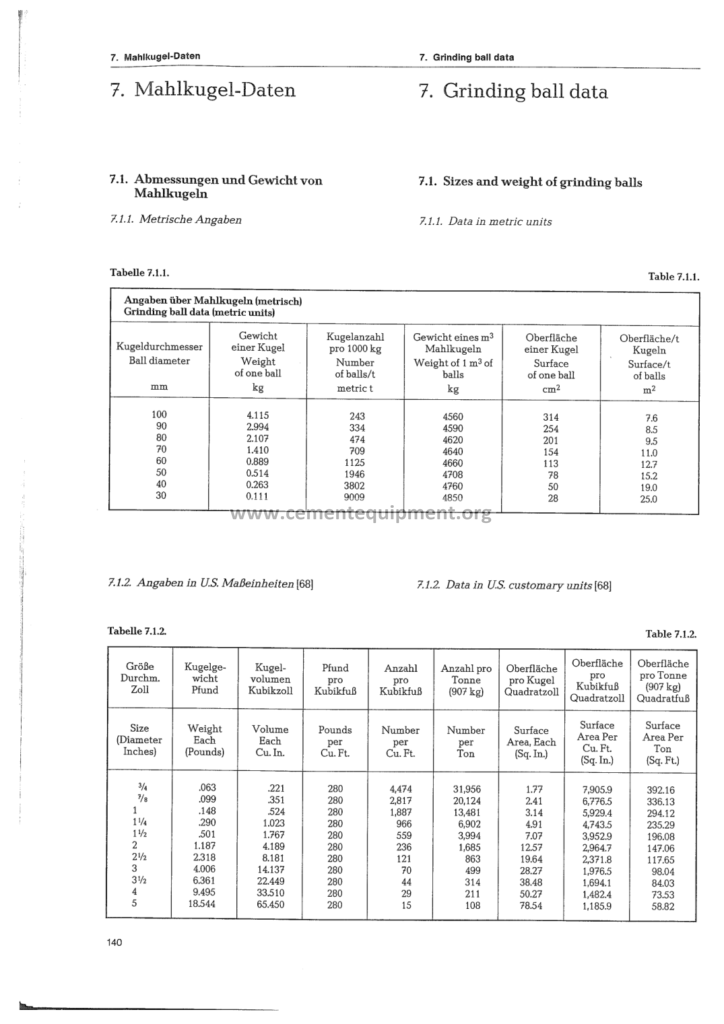
Grinding Ball Data: Complete Technical Guide
The grinding ball data file is the reference card of the mill charge: the document that the plant engineer keeps within the arm’s reach in the maintenance office: the tables of the ball diameters, the compositions, the hardness ranges, the wear rates and the charge calculations: everything the plant needs to answer the five questions of the grinding media: how many balls, what diameter, what material, how long do they last, and what does it cost.
The media of the ball mill are not a passive consumer part: the balls are the working tools of the grinding: between 25 and 40 percent of the volume of the mill is filled with the steel balls, and their size, their quality and their state of wear determine the fineness of the product, the power of the mill, the output per hour and the electricity of the ton: the data file of the grinding balls is the reference book of this invisible machinery: the spherical army of the mill, documented with the numbers.
The Complete Cement Technical Package (931 files: the books, the courses, the Excel tools, the presentations: $249.99 one-time: instant download through the PayPal secure payment) delivers this reference with the companion volumes of the grinding library: the work index, the mill drives, the mill shell, the media tables: this article walks the ball data file: the types of media, the diameters, the charge, the wear, the selection and the daily management of the balls in the plant.
1. The Role of the Grinding Media: The Tools of the Tumbling
The ball mill grinds by the tumbling action: the mill shell rotates around its horizontal axis, the balls rise with the lifters to the turning point and fall back onto the material bed: the size reduction happens by three mechanisms: the impact of the falling balls on the particles, the attrition between the balls and the particles in the cascading zone, and the compaction between the balls in the grinding zone: the three mechanisms of the crushing inside the mill.
The role of the media explains why the ball charge matters so much: the grinding energy is transmitted exclusively through the balls: no balls, no breakage: the following parameters of the charge become the control variables of the plant:
- The charge volume: the fraction of the interior volume of the mill filled with balls: normally 28 to 35% of the total volume: the low charge wastes the mill volume, the high charge wastes the power and the heat;
- The diameters: the mix of the ball sizes: the large balls break the coarse particles, the small balls grind the fines: the graded charge matches the particle size distribution of the feed;
- The density: the forged steel, the high-chromium steel, the ceramic or the natural flint: the mass of the charge and the impact energy per ball;
- The state: the wear, the balls’ deformation and the breakage: the average ball diameter decays, the charge efficiency falls: the monitoring and the supplementary loading;
The four control variables of the charge: this is the content of the ball data file: the tables and the recommendations that turn the charge of the mill from a guess into the calculated engineering figure: the balls: the heart of the finish mill: and the same parameters apply runs of the raw mills, the coal mills, the slag mills: every drum.
2. The Ball Diameters: The Standard Ranges of the Industry
The grinding balls of the cement industry are manufactured in the standard diameters that the international suppliers catalog, and the file tables the full range:
- Small diameters: 15, 17, 20, 25 millimeters: used in the fine grinding compartments and in the high-efficiency classifiers demands of the modern mills;
- Medium diameters: 30, 40, 50, 60 millimeters: the workhorses of the second chambers and the single-compartment fine mills;
- Large diameters: 70, 80, 90, 100 millimeters: the first chambers and the primary grinding of the coarse clinker, and the raw ball mills:
- Extra-large: 110 and 125 millimeters: the large raw mills, the wet mills and the where the coarse feeds demand the heavy impact:
The two-chamber finish mill, the classic layout, carries the coarse balls (60 to 100 mm) in the first chamber and the fine balls (17 to 40 mm) in the second chamber, separated by the intermediate diaphragm: the first chamber receives the clinker as it comes from the pre-grinding, the last chamber delivers the finished fineness: the graded combination of the two chambers is the heart of the ball mill design.
The diameter selection is not the subjective choice: the charts of the suppliers link the ball diameters to the feed size and the product fineness: table of the file provides the selection: the feed at 10 mm ends in the chamber with the balls of 60-90 mm, the feed at 2 mm operates fine with the 30-50 mm charge: the correct ball mix collapses the grinding energy of the system: the correct sizes: the cost: the file documents the two-faced optimality of the plant.
3. The Material of the Balls: The Steel Families
The ball material determines the density, the hardness, the wear and the price: the four families of the industrial media dominate the cement plants:
- The forged steel balls: the most common: forged from the alloyed carbon steel, hardened and tempered: the balance of the toughness (impact resistance) and the hardness (wear resistance): the standard of the highest impact zones: designed for the first chambers;
- The high-chromium cast balls: the alloy of 11 to 28% chromium, the martensitic cast structure: the hardness of 58-65 HRC against the 45-55 of the forgings: the wear per ton of cement 30-50% lower than the forged: the premium of the finish mills: more expensive per ton and longer lasting;
- The low-chromium / white cast iron balls: the mid-range economy: less chromium, lower hardness, acceptable in the raw mills and the mills with the moderate abrasion;
- The ceramic and the flint media: the alumina (Al2O3) balls and the natural flint pebbles: used in the fine grinding zones where the iron contamination of the product is unacceptable (the white cements, some chemical applications): the density of 3.5-3.8 runs slower than the steel: the niche of the specialty;
The table of the file puts the four families side by side: the density, the hardness, the wear index, the price index: the engineer reads the two rows and the selection writes itself: the first chamber, the forged; the finish chambers, the high-chromium; the specialty products: the ceramic: the family and the parameter and the place: the complete selection table of the grinding data.
4. The Charge into the Mill: The Tonne and the Percentage
The quantity of the ball charge is the first of the calculations of the file, and the two classic figures control the mill: the filling degree and the total tonnage:
- The filling degree: the fraction of the internal volume of the mill occupied by the static balls: expressed as a percentage: the measurements by the probe rod at the standstill or by the power drawn: the standard range for the ball mills of the cement: 28-35%: the values below underload the grinding zone, the higher values overload the armor:
- The tonnage: the total mass of the charge: calculated from the internal volume, the filling degree and the bulk density: the total of the initial loading: the synchronisation of the order: the time to install the charge: the table of the file completes the formulas: v × φ × d = the tonnes: the plant order of the media;
- The bulk density: the mass of one cubic meter of the loose balls: approximately 4.5 to 4.9 t/m3 for the steel balls (with the voids between them): the density of the mix of the diameters: the file tables the values: the calculation of the anything:
- The first charge: new mill: the graded charge applied in the layers according to the chamber: the high and the low diameters: each installed in the proportions of the design:
The four formulas of the file: the filling 28-35%, the tonne tables and the bulk densities: the plant that loads the design mass with the design grading and the design family: the design of the first charge is expected to grind at the design rate: the discipline of the start-up, the charge.
5. The Graded Charge: The Distribution of the Diameters
The graded charge is the mix of the ball diameters installed in each chamber: the art of the proportional distribution of the distribution:
- The principle: the coarse particles need the heavy impact: the largest ball sizes attack the incoming feed: the fine particles need the high surface of the impact: the small sizes: the graded charge provides both at every point of the grinding path: the compromise of the two mechanisms;
- The max ball size estimation: the formulas of the file (after Bond life and the empirical tables) derive the maximum ball diameter from the feed size, the work index and the mill conditions: the Russian academic (the table version) gives the classic: d = k × (Wi) ~ the root of the feed size: the tables return the used practical range: a 25 mm feed: the first-chamber mix, the 90, the 80, the 70;
- The grading schemes: the classic two-chamber fills: the first: 30% of 90, 40% of 70 & 30% of 60 in the typical: the second: the graded 40, 30, 25, 20 mm below: the tables per capacity and per material: the file provides the working schemes;
- The adjustment: the graded charge evolves with the wear: the small balls disappear: the periodic sampling (the ball powdering test) and the supplementary loading keep the charge in its gradient: the maintenance of the grade: the quality of the product:
The graded charge is the daily law of the mill: the charging engineers of the plant use the distribution tables of the file to restore the mix when the sample announces the decline: the grade: the pattern: the product fineness follows the charge the way the mill follows the charge: the charge is the soul of the box.
6. The Wear of the Balls: The Rates and the Consumption
The balls wear away with every revolution: the report terms of the industry speak the grams of the media per ton of the product: the consumption:
- The wear rates: the typical reference ranges: the forged balls: 250 to 550 grams per ton of cement; the high chromium: 80 to 200 grams per ton; the raw mills in the abrasiveness of the sand the higher side: the classic table of the file quotes the consumption of the media in the various mills of the various materials: the budget of the media;
- The mechanisms of the wear: the abrasion (the scraping in the cascading zone) and the corrosion (the chemical attack in the grinding atmosphere of the humid and the CO2): the corrosion is the share of the larger portion the corrosion of the balls: the remedies: the additives of the grinding aid inhibit the corrosion:
- The factors: the abrasiveness of the feed (the quartz of the clinker piece), the moisture (the corrosive), the mill temperature, the ball metal: the table of the factors of the wear: the engineer estimates his own rates from the reference:
- The breakage: the faulty balls fracture: the broken cages and the fragments reduce the grinding area and the classify the diaphragm: this and the returns: the systematic audit: the abundant instrument of the mathematical data:
The wear of the steward is one of the largest variable costs of the finish grinding: for a 100 t/h mill running the 7000 hours per year: the 200 grams per ton: 14,000 tons of the balls per year per mill: the cost of the media multiples the million dollars: the wear table of the formula is the starting point of the plant’s purchasing and the investment: the number and the money: the media: the second largest consumable of the cement plant after the refractories.
7. The Hardness of the Media: The Value in the Numbers
The hardness of the ball metal is the measured quality that the tables of the file rank:
- Hardness scales: the Rockwell C (HRC) and the Brinell (HB): the ball of the forged steel: 45-55 HRC: the high-chromium: 58-65 HRC: the measurements of the file: the relationship of the hardness and the wear: the harder the eater, the lower the consumption: the wear curve: the file: the direct law with the diminishing the returns:
- The balance with the toughness: the hardest balls (65 HRC) are the most brittle: they fracture under the giant impacts: the first chamber balls need the balanced hardness (50-55): the fine chamber balls (no heavy impacts) may rise to the 60-65: the selection table of the file explicitly ties the hardness to the chamber: the nuance of the steel:
- The testing: the samples of the deliveries: the hardness test in the lab, the impact test: the acceptance criteria of the supplier: the QA: the file provides the testing summary:
The hardness table of the data file is the quality gate: the delivered balls: the certificate of the hardness: the acceptance of the plant: the forged and the chromium edge: the hardness rules the ball, the ball rules the mill: the control through the numbers: the data file: the bridge of the markets.
8. The Ball Charge Management: The Daily and the Annual Loop
The plants with the disciplined media management follow the yearly loop of the charge, and the file documents each step of the cycle:
- The weekly sampling: the ball pick: the mill: the sample of the balls from the compartments: the measured distribution: the average ball size trend: the log of the charge: the file’s paragraph: the forms:
- The monthly observation: the constant power and the output decline signal the degradation: the media consumption of the month: the supplementary load:
- The quarterly measurement: the fill level: the measured with the mill standstill (the reference from the central axis) or the power curve: the added: the balance of the charge:
- The annual lot: the chamber opened: the total charge sorted: the finest of the smallest: the balls < 15 mm removed: the screening: the addition of the news to the gradient: the complete relaunched: the golden restocking:
- The quality audit: the supplier’s balls on the arrival receive the dimensional and the metallurgic check: the good: the return: the standards: they: the purchase order: the datasheet:
The cycle of the charge is the discipline that keeps the mill on its design: the matrix of the plant which feeds into the Excel management tools of the package: the ball stock: the purchase plan: the balance: the file describes the complete run of the circle and the plants of the grinding engineers run it the same every year: the charge of the mill: the scheduled, measured and the controlled.
9. The Supplementary Loading: The Tops-Up Mathematics
Between the annual lots, the plant tops up the charge with the single-size balls, and the top-up logic is one of the classical tasks of the file:
- The principle: the worn charge shifts to the fine sizes: the top-up of the missing sizes: the addition of the large diameters at the determined frequency restores the leadership: the volumes of the file:
- The top-up quantity: equal to the consumption of the media between the two top-ups: the simple plan: the wear rate × the tons since the last top: the balance preserved: the ball level constant in the mill:
- The top-up diameter: the classical rule: the top-up ball: the largest diameter of the graded charge (or per the formula of the mean): the fine balls are not replaced one by one: the broken large balls become the small: the single-size top-up of the large — the classic economy:
- The top-up equalization: alternatively the calculated mix of the missed sizes: the more refined method of the modern suppliers: the MA (the mercury age) curves: the table of the method: the inclusion: the pays to size:
The supplementary loading: the majority of the year: the compact formulas of the file turn the maintenance paperwork into the two-line calculation: the weekly production × the wear per ton = the top-up mass: practical, the operational, the file: the assistant of the maintenance head.
10. The Ball and the Product: The Fineness, the Power and the Temperature
The charge decisions affect the three faces of the product, the power and the mill: the file’s notes list the interplays that the operator crosses:
- The fineness: the finer the graded charge, the higher the Blaine of the product: the operator modifies the product by the top with the small balls: the lever of the fineness: the cheap velocity vs the classifier:
- The power: the mill’s power consumption follows the charge mass: the kilowatt per ton of the product: the charge reduced: the power reduced: the optimum is the fill that gives the maximum of the production per kilowatt: the file tables the optimum zone
- The temperature: the high filling and the fine media raise the mill temperature above the 110-120°C (the gypsum dehydration: the false set: the pack-around): the mill: the charge philosophy must balance the heat: the auxiliary: the watering:
- The cement quality: the correct ball state secures particle size distribution of the cement: the strength, the water demand: the media: the quality: the test laboratory and the ball data: the two pages the same:
the operator of the milling machine reads the three faces of the mill. the ball: the fineness, the power, the temperature: the adjustments of the medium: the fastest lever in vertical of the plant: each: the file’s correlation tables: the compact: the documented: the engineer’s quick decisions.
11. The Purchasing of the Balls: The Data of the Supplier
The file closes the purchasing guide of the medium: the sheet of the quality data the plant uses against the supplier:
- The specification: the nominal diameter and tolerance (e.g. 80 ± 1.5 mm), the hardness range, the composition (C 0.6-1.0%, Cr 8-28%, the balance the steel), the density, the acceptance: the datasheet parameters the file
- The certificates: the manufacturing certificate, the hardness certificates of the heat: the quality control: the factory: the third party: the inspection:
- The packaging and transport: the tonnage bags of the ball: the protection on the shipping: the port: the warehouse: the major order volume:
- The price comparisons: the cost per ton of the delivered ball vs the wear lifetime: the real economy: the expensive high-chromium: the longer: the real cost per ton of cement: the table: the purchase:
The purchase guided the file’s data: the plant orders with the measured numbers: the acceptance: the quality assurance of the ball: the long-term contract of the 10,000 tons: the precious economics of the grinding of the package: the complete: the package, the ball data of the industry.
12. The Economics of the Media: The Cost Table
The ball data file also carries the financial page that the maintenance and the purchasing managers read first: the total cost of the grinding media is visible in the four lines of the account:
- The purchase price: the international ball quotations per ton: the forged steel 700-1000 US$ per ton, the high-chromium 1100-1500 US$ per ton: the market range that the file tables with the caution of the regional variation;
- The consumed volume: the annual consumption in the tons: the average wear fatten the tonnage of the produced cement: 80 to 550 grams per ton depending on the family and the feed: the multiplication of the plant million tons of cement, the consumption of the years;
- The stock cost: the capital of the warehouse: the working capital of the tonnages stored against the delivery times of the shipments: the planner balances the stock level of the file;
- The total per ton of cement: the single competitive number: the purchase price multiplied by the consumption per ton: the forged at 0.9 US$ per kg consuming 350 g/t: 0.32 US$ per ton of cement: the chromium at 1.3 US$/kg consuming 150 g/t: 0.20 US$ per ton: the high-chromium wins by the arithmetic alone;
The economics calculation is the final argument of the database file: the engineer who compares the options with the total-cost line chooses the same steel the accounting recommends: the combination of the numbers of the file: the purchase, the account, the maintenance: the ball management complete.
13. The Frequently Asked Questions
How often should the plant top up the balls?
The rule of thumb of the practice: the weekly or the monthly balance: the plants: the weekly tonnage: the wear rate = the consumption: the large plants top up the weekly, the mid-size the monthly: the event of the mill: the smallest: the full annual reload — the schedule of the file.
The forged or the high-chromium for the finish mill?
The decision table of the file helps the plant choose: the mill with the large first chamber and the coarse feed (the primary grinding) keeps the forged balls in the first compartment for the toughness against the repeated heavy impacts; the finish chambers (the blaine-sensitive second compartments) prefer the high-chromium for the half consumption; the laboratory of the plant compares the two over the trial season of the months: the sample weight measurement per ton of the finished product decides: the family that wins the measured trial takes the contract of the year: the empirical rule of the plant, the numbers of the file.
The high-chromium wins the finish chambers on the total cost: the price premium against the double-trip life: the exact math in each plant: the electricity of the transport: the shake: for the first chambers with the knocks, the forged (the tougher) and the chromium: the decision rule: chamber, energy, feed: the file’s table.
How I know the remaining the charge without the stop?
The operational non-invasive: the power-measurement method (the mill power curve: the charge) and the running sound: the measurement with the stop (the probes) the accurate: the file gives the calibration charts: the power method: the weekly, the probe, the quarterly geometry: the mill does not light the daily.
Why the balls break in the mill — the supplier’s fault?
The breakage is the combination: the low quality of the steel, the high hardness (brittle), the oversized balls vs the feed, the very high fall from the worn liner, the thermal shock: the inspection of the breakage pattern distinguishes: the cracks: the supplier; the ball distortion: the mill: the section of the file: the diagnosis: the evidence: the plant that keeps the breakage statistics of the chamber can assign the cause by the pattern of the fragments: the flat fragments speak of the impact against the armor, the cracked halves of the metallurgy, the spalling of the corrosion: the observed fragments tell the story of the mill, and the corrective follows the story.
Does the file contain the calculation sheets of the ball?
The package includes the Excel tools that accompany the grinding library: the charge calculators, the wear and the top-up tables, the purchasing specifications: the automation of the file’s formulas: the 931 files of the package: the tools: the businesses of the media: the cost of the plan: the complete: the calculation.
13. Conclusion
The ball data file brings the small number of the mill into the engineering light: the diameter, the hardness, the density, the grade and the wear: the twenty millimeters of the steel that carry the milling: the grinding media: the tool of the tumbling: tidier than any liner, the conductor of the quality and the cost.
The plant that treats its balls as the engineering material: does the same with its fineness and its power: the balanced charge: the optimized power and the expected cost: the file of the ball data: the tables and the Excel: the Complete Cement Technical Package: the $249.99: the instant: the download: the same day: the grinding library: the complete 931: the media, the mills, and the engineer: the purchase.
The Complete Cement Technical Package: the entire milling library: the Bond index, the drives, the shell, the balls: one payment: the library: the manual: the professional: the power: the order of your mill: the purchase with the PayPal below: the balls of your mill, managed like the design day one.
Get this ball data file + the full 931-file package
$249.99 — one-time purchase, instant download, lifetime access
This file is part of the Complete Cement Technical Package (931 files) available from cementequipment.org. Respective rights holders; library copy for the licensed single user.