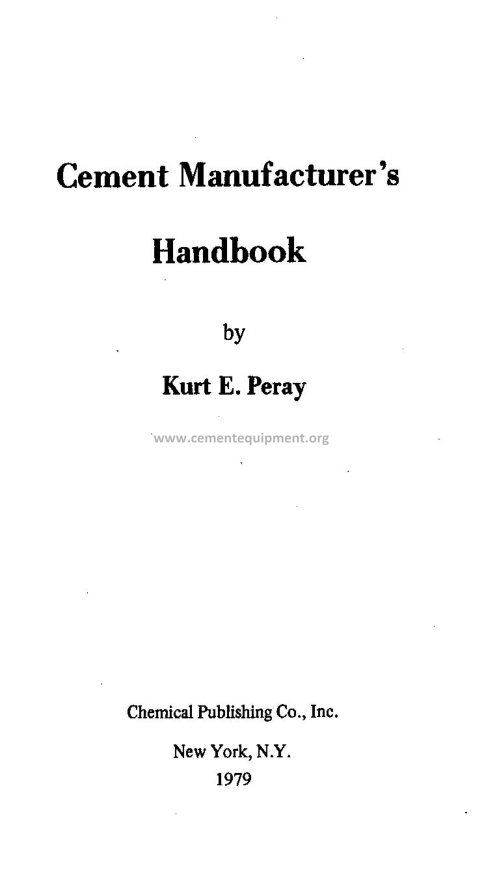
Cement Manufacturer S Handbook: Complete Technical Guide
The Cement Manufacturer’s Handbook is the classic operating reference of the cement plant: the book by Kurt E. Peray, the American process engineer of the long career in the cement industry, presents the practical side of the cement manufacture in the form of formulas, tables, graphs and procedures: the cement plant man who knows where to find the answer to the kiln question, the mill question, the quality question and the maintenance question: the handbook was published for the plant-level engineer and it stayed on the desk of the process departments for decades: this volume of the package is the PDF of that handbook, complete with its tables and its charts.
The Complete Cement Technical Package (931 files including the books, the Excel tools, the courses and the presentations: $249.99 one-time: instant download via the PayPal payment) includes this Cement Manufacturer’s Handbook PDF with its chapters on the raw materials, the kiln, the mills, the fuels, the quality, the refractory and the utilities: the plant engineer reads the quick numbers, the shift supervisor checks the calculation method, and the management keeps the reference of the whole plant: this article walks the handbook: its structure, its key formulas, its operational chapters and the way the professional uses it day by day.
Why the handbook format survives: the cement plant is a 24/7 operation where the question arrives at 2 in the morning: the moisture of the coal, the LOI of the feed, the fineness of the cement, the kiln feed rate, the cooling water demand: the engineer who must answer without the internet needs the compact reference with the formula, the table and the worked example on the same page: the handbook of Peray is exactly that: the sum of the practical know-how of the cement plant of the late twentieth century, written by a man who worked the kilns: this page follows the handbook: the raw materials first, the pyro second, the finish third, the quality and the maintenance last.
1. The Structure of the Handbook: How to Use It
The first chapter teaches the use of the book itself: the handbook is organized as a sequence of practical topics, each with the formula, the reference data and the method of the calculation:
- The chapters of the process: the raw materials and the quarry, the crushing and the grinding, the kiln feed, the burning, the cooling, the finish grinding, the storage and the shipping: the order of the book follows the flow of the plant: the reader of the section of his problem finds the formula near the process description;
- The format of the sections: each section opens with the principle (a short paragraph), continues with the formulas and the tables (the constants, the conversion factors, the typical values), and closes with the worked example: the example is the key of the handbook: the engineer substitutes his own numbers into the same calculation;
- The index discipline: the handbook assumes the reader uses the index: the engineer who knows the name of his parameter finds the page: the book also carries the alphabetical tables of the abbreviations, the units and the symbols: the package user reads the whole PDF once and returns to the chapters for life;
The chapters of the book span the whole factory: the handbook of the cement manufacturer is not a chemistry textbook and not a machinery catalog: it is the operation manual of the plant written in the language of the numbers: the formulas of the handbook are the arithmetic of the process: the engineer of the plant lives in those arithmetic pages.
2. The Raw Materials and the Quarry: The Numbers of the Feed
The handbook opens with the raw side: the materials that enter the plant and the calculations that govern the mix:
- The raw material data: the limestone analysis (CaCO3, MgO, the alkalis, the SiO2, the Fe2O3, the Al2O3, the SO3), the clay and the sand and the iron ore: the handbook tables carry the typical ranges of the cement raw materials and the limits of the harmful components (the magnesia under 5%, the SO3 under 3.5%, the chlorides under 0.05% in the ordinary Portland clinker);
- The mix proportioning: the three-component and the four-component mixes: the equations of the target LSF (the lime saturation factor), the SM (the silica modulus) and the IM (the alumina/iron modulus): the handbook gives the formulas: LSF = CaO / (2.8 SiO2 + 1.2 Al2O3 + 0.65 Fe2O3), with the targets of the modern plants typically 0.92-0.98, the SM 2.2-2.8 and the IM 1.3-1.7: the mixing calculation is the daily arithmetic of the raw mill department;
- The moisture and the loss on ignition: the LOI of the raw materials and the moisture of the feed: the formulas of the dry feed equivalent: the handbook gives the factor tables: the raw feed moisture 6-12% in the dry process, the dried meal moisture 0.5-1.0% at the kiln feed;
- The crushing and the storage: the reduction ratios of the crushers, the screen sizes, the stockpile capacities and the reclaim methods: the tables of the bulk densities and the angle of repose of the materials: the civil of the storage calculated with the handbook:
The raw material chapter teaches the essential discipline: the raw mix of the plant is a recipe: the recipe is calculated, checked and adjusted on the analysis of the feed: the handbook carries the same formulas that the modern software automates, and the engineer who understands the formula can verify the software: the raw material quality is the foundation of the clinker quality.
3. The Raw Grinding and the Fineness
The handbook treats the raw grinding with the operational and the dimensional formulas:
- The mill power and the capacity: the ball mill power formula (the bond work index method, the D/L ratio, the critical speed, the filling degree), the capacity estimates of the mills: the handbook gives the simplified forms of the bond formula used in the plant work: the kWh per ton of the grinding of the raw meal 20-35 kWh/t typical;
- The fineness of the raw meal: the 90 micron and the 200 micron residue, the Blaine surface area, the fineness modules: the raw meal residue targets: 12-15% on the 90 micron and 1-3% on the 200 micron for the modern kilns: the formula of the residue correction of the separator;
- The classifier circuits: the closed circuit with the dynamic separator, the circulation factor and the separator efficiency: the formulas of the separator performance: the fine product, the coarse return, the efficiency 60-80% of the first-generation and the 90%+ of the third-generation:
- The drying and the moisture: the moisture evaporated in the mill, the gas flow and the temperature budget of the raw mill drying: the calculation of the water evaporated from the feed moisture to the meal moisture: the heat of the evaporation as the basis of the mill gas temperature:
The grinding section demonstrates the handbook’s approach: no machine is bought on a guess: the mill is sized with the bond index of the material and the power of the target fineness, the separator is chosen on the efficiency, and the circuit is balanced with the circulation factor: the formulas of this chapter are the same ones used in the project Excel tools of the package, and the engineer who masters the chapter masters the mill.
4. The Kiln Feed and the Chemistry of the Meal
The burning section starts with the kiln feed: the chemistry control of the meal entering the preheater:
- The kiln feed targets: the LSF, the SM, the IM of the kiln feed, the calculated C3S, C2S, C3A and C4AF (the Bogue calculation): the handbook gives the Bogue formulas and the worked examples: the C3S of the typical Portland clinker 55-70%, the C3A 5-12%, the C4AF 8-12%;
- The liter weight and the free lime: the clinker liter weight test (the 2.8-3.2 g/cm3 range) and the free lime of the clinker (0.5-1.5% for the well-burned clinker): the handbook links the free lime to the burning conditions and the burnability of the meal;
- The burnability: the factors of the burnability: the fineness of the meal, the mineralogy of the raw, the alkali: the burnability index and the empirical relations of the book: the meal that burns well protects the refractory and the fuel;
- The LOI of the feed: the loss on ignition of the dry meal 33-37%: the feed-to-clinker factor 1.55-1.70: the formulas of the kiln feed required for the clinker production: the daily planning of the kiln feed silo level:
The chemistry chapter of the handbook is the bridge between the laboratory and the kiln: the daily XRF of the feed and the clinker is interpreted with the formulas of this section: the operator learns to read the chemistry of his clinker as the diagnostic of the burning: the free lime high means the under-burning, the C3S low means the blend error: the handbook gives the table of the diagnosis.
5. The Burning: The Kiln Operation and the Combustion
The heart of the handbook: the kiln operation with the formulas of the combustion and the heat:
- The combustion air: the theoretical air of the fuel (the stoichiometric), the excess air (typically 5-15% for the kiln), the O2 at the kiln inlet and the kiln exit: the formulas: the air per kg of the coal (the carbon, the hydrogen, the sulfur) and the flue gas analysis:
- The flame and the temperature: the adiabatic flame temperature, the effect of the excess air and the secondary air temperature: the kiln burning zone temperature 1350-1450 C, the flame temperature 1800-2000 C: the handbook relates the flame temperature to the clinker quality and the refractory life;
- The heat consumption: the calculation of the specific heat consumption of the kiln: the total heat input minus the heat of the product and the losses divided by the clinker production: the handbook gives the heat balance format of the kiln: the typical dry process 3.0-3.6 GJ/t;
- The kiln operating parameters: the kiln speed (1-4 rpm), the filling degree, the residence time of the material, the nose ring and the chain sections (the wet and the long dry kilns), the ID fan draft and the kiln inlet pressure: the handbook tables of the typical parameters by the kiln type:
The burning chapter closes with the control: the operator runs the kiln on the combination of the feed rate, the fuel rate, the ID fan, the kiln speed and the cooler: the handbook gives the logic of the adjustment and the limits of each handle: the stable kiln, the round the clock operation: the chapter that the shift engineer reads more than once.
6. The Fuels and the Combustion Engineering
The fuel section of the handbook covers the energy side of the plant:
- The fuel analysis: the coal analysis (the moisture, the volatile matter, the fixed carbon, the ash, the sulfur, the calorific value), the coke and the alternative fuels: the formulas of the calorific value (the Dulong type formulas and the moisture corrections), the typical coal of the cement plant: the 20-30 MJ/kg:
- The combustion calculations: the air required, the flue gas volume, the flame temperature, the specific fuel consumption of the kiln: the worked examples of the coal rate per ton of clinker (typically 90-140 kg/t dry coal): the handbook tables of the combustion air per kg of the fuel by the fuel type:
- The mill drying and the safety: the coal mill drying with the kiln gas, the moisture of the pulverized coal (0.5-2%), the fineness of the coal (the residue 1-2% on the 90 micron for the kiln firing), the coal mill safety (the inertization, the CO monitoring, the temperature limits): the handbook is the early document of the coal mill safety practice:
- The alternative fuels of the era: the fuel oil, the natural gas and the solid fuels: the handbook dates from the era of the oil and the coal, and the modern reader extends the methods to the waste-derived fuels: the calorific value, the ash and the moisture calculations are the same:
The fuel section of the handbook is the energy audit in miniature: the plant engineer calculates the fuel consumption, the air, the flue gas and the losses with the tables of the chapter: the modern energy manager of the plant uses the same formulas in the spreadsheet: the combustion arithmetic of the handbook is the foundation of the energy management of the plant.
7. The Cooler and the Clinker Handling
The handbook covers the cooling of the clinker and the clinker handling between the kiln and the finish mills:
- The cooler types and the balance: the grate cooler, the planetary cooler, the rotary cooler: the cooling air quantity, the secondary air temperature and the tertiary air: the cooler efficiency formulas: the clinker temperature at the cooler discharge (80-120 C with the modern grate cooler):
- The clinker quality checks: the clinker liter weight, the free lime, the microscopy of the clinker (the C3S crystals, the periclase, the belite clusters): the handbook gives the interpretation of the clinker texture: the well-formed C3S crystals of the proper size:
- The clinker storage: the clinker silo and the stockpile, the reclaim, the aging of the clinker (the better grinding after the cooling and the aging): the storage calculations of the capacity and the bridge prevention:
- The gypsum and the additives: the gypsum (the SO3 control 2.5-3.5% in the cement, the natural gypsum vs the anhydrite, the hemihydrate dehydration in the mill): the limestone and the slag additions: the cement recipe calculations: the handbook tables of the standard cement types:
The cooler and the clinker handling chapters complete the pyro section: the clinker quality is verified in the clinker, the cooling is optimized for the grindability, and the cement recipe is calculated with the additives: the handbook gives the whole chain of the numbers from the kiln hood to the mill inlet.
8. The Finish Grinding and the Cement Quality
The finish section of the handbook is the largest: the cement grinding with the quality control:
- The cement mill operation: the power, the capacity and the fineness of the cement: the formulas of the ball mill power and the separator: the typical fineness of the Portland cement: the Blaine 300-400 m2/kg and the residue 1-8% on the 45 micron, the specific surface by the fineness class:
- The strength development: the cement strength (the 2-day, 7-day and 28-day compressive strength), the water demand and the setting time (the Vicat test): the handbook links the strength to the C3S, the fineness and the SO3: the early strength depends on the C3S and the fine fraction, the late strength on the C2S:
- The gypsum optimization: the SO3 optimum of the cement: the setting time regulation, the water demand and the strength: the optimum SO3 2.5-3.5% for the typical Portland: the handbook describes the procedure of the gypsum optimization tests:
- The mill temperature and the cement quality: the mill temperature control (the water injection, the 100-120 C limit), the dehydration of the gypsum to the hemihydrate, the pack set and the flowability of the cement: the storage and the dispatch of the finished cement:
The quality section of the handbook also covers the concrete: the water-cement ratio, the workability, the aggregates: the handbook was written for the cement manufacturer who must understand the customer: the cement quality is judged in the concrete, and the handbook teaches the cement engineer the concrete side of his product: the compression cubes, the slump, the bleeding.
9. The Refractory and the Kiln Maintenance
The refractory chapter of the handbook serves the plant’s longest campaign:
- The refractory zones: the preheater, the calciner, the kiln inlet, the transition zone, the burning zone, the nose ring, the cooler: the refractory types: the magnesia bricks of the burning zone, the high alumina in the transition, the castables in the preheater: the handbook tables of the refractory selection by the zone:
- The refractory wear and the life: the thermal, the chemical and the mechanical wear: the alkali attack, the sulfate attack, the coating formation and the cycling: the brick life of the burning zone (typically 6-12 months), the causes of the premature failure: the handbook gives the failure diagnosis: the spalling, the cracking, the erosion:
- The relining procedures: the bricking methods, the heat-up schedules of the new lining, the ramming and the gunning repairs: the drying and the heat-up of the new refractory (the 50 C/hour controlled rise, the holding periods): the handbook is the early reference of the kiln heat-up practice:
- The mechanical maintenance of the kiln: the kiln shell alignment, the tire and the roller wear, the ovality measurements, the kiln alignment surveys: the handbook covers the basics of the kiln geometry: the shell creep, the thrust, the roller adjustments:
The refractory chapter is the favorite of the maintenance engineers: the refractory failure is the largest single cause of the unplanned kiln stops, and the handbook arms the plant with the diagnosis tables: the chemistry of the raw feed, the fuel and the refractory interact in the burning zone, and the engineer who masters the chapter controls the campaigns of his kiln.
10. The Utilities: The Power, the Water and the Compressed Air
The plant services receive their chapters: the power, the water and the air of the plant:
- The electric power: the motors of the mills, the fans, the compressors, the total plant power per ton of cement (95-120 kWh/t typical), the power factor correction, the peak demand management: the formulas of the motor current, the horsepower and the kWh: the loading and the efficiency of the motors:
- The water systems: the cooling water of the kiln and the mills, the bearing cooling, the process water and the dust suppression: the water consumption of the plant per ton of cement (the 500-1000 liters/t typical), the water treatment and the recirculation: the formulas of the cooling duty and the flow:
- The compressed air: the plant air system, the receivers, the drying, the instrument air: the air consumption of the pneumatic conveying and the bag house cleaning: the compressor power and the free air delivery: the typical air consumption of the cement plant (50-200 Nm3/min for the medium plant):
- The fans: the fan laws (the flow, the pressure, the power with the speed), the fan selection and the efficiency: the ID fans of the kiln and the mills, the bag house fans, the cooler fans: the damper and the speed control:
The utility chapters close the plant circuit: the handbook gives the numbers of the services that the process engineer often neglects: the power bill of the plant is read with the formulas of the chapter, the cooling water is sized with the tables, and the compressed air system is audited with the consumption figures: the utilities are the hidden cost of the cement and the handbook keeps them visible.
11. The Quality Control and the Laboratory
The laboratory chapter of the handbook standardizes the plant testing:
- The raw material testing: the XRF (in the later editions) and the wet chemistry of the limestone, the clay and the additives: the sampling procedures: the composite samples of the shift: the preparation of the fused beads and the pressed pellets:
- The meal and the clinker testing: the fineness tests, the LOI, the free lime titration, the liter weight, the Bogue calculation: the clinker microscopy: the sample of the clinker every 2-4 hours in the plant practice:
- The cement testing: the fineness, the setting time (the Vicat and the Gillmore), the soundness (the Le Chatelier), the strength (the mortar cubes 2, 7, 28 days), the water demand, the false set and the pack set tests: the handbook gives the procedures and the acceptance limits per the standards of its era:
- The process control of the lab: the shift reports, the control charts, the target and the tolerance: the laboratory of the cement plant operates the quality loop: sample, analyze, correct the mix: the handbook teaches the shift lab of the plant:
The quality chapter closes with the product standards: the Portland cement types and the composition limits of the era: the modern reader compares with the EN 197 and the ASTM C150 of today: the fundamentals of the testing (the sampling, the preparation, the calibration) remain the same: the quality department of the plant runs on the methods of the handbook to this day.
12. The Troubleshooting and the Problem Tables
The most used part of the handbook in the field: the troubleshooting of the plant problems:
- The kiln problems: the ring formations, the snowmen, the coating loss, the kiln dust cycles, the erratic burning: the causes and the remedies table: the raw mix problems, the fuel problems, the draft problems: the handbook: the classic table of the kiln troubles with the probable causes and the corrective actions:
- The mill problems: the low output, the high power, the coarse product, the classifier problems, the bearing and the gearbox troubles: the remedies: the media charge, the separator settings, the feed control:
- The quality problems: the low strength, the false set, the flash set, the rapid loss of the slump, the abnormal setting: the table of the causes: the SO3, the alkali, the temperature of the cement, the gypsum dehydration:
- The equipment problems: the fans, the compressors, the feeders, the packers: the preventive maintenance and the inspection checklists of the handbook: the planned maintenance schedules of the major equipment:
The troubleshooting chapters of the handbook are the reason the book stayed on the desk: the plant problem arrives with the symptom, and the engineer needs the table from the symptom to the cause to the fix: the handbook gives the tables for the kiln, the mill and the quality: the modern CMMS and the expert systems of the kiln control automate part of the logic, but the tables of the handbook remain the readable summary of the decades of the plant experience.
13. The Frequently Asked Questions
What is the difference between this handbook and the cement chemistry books of the package?
The chemistry books (the Taylor, the Lea) explain the science of the cement: the reactions, the hydrates, the microstructure: the handbook of Peray explains the operation: the formulas, the tables, the calculations of the plant day: the two families complement each other: the engineer of the plant uses the handbook at the desk and the chemistry books in the laboratory, and the package contains both.
Are the formulas of the handbook still valid for the modern plants?
Yes, in the fundamentals: the Bogue calculation, the fineness tests, the combustion stoichiometry, the kiln heat balance, the mill power and the gypsum optimization are the same arithmetic that the modern software executes: the specific numbers (the consumption of the old wet kilns, the typical coal, the standard grades) changed with the technology, and the reader adapts the tables: the formulas of the book are the skeleton of the modern spreadsheets of the package.
Can the plant engineer use the handbook without the chemistry background?
Yes: the handbook is written for the practical man: the formulas are given with the worked examples and the constants are tabulated: the engineer substitutes his numbers and reads the result: the chemistry chapters of the package (the cement chemistry books) deepen the understanding, but the handbook works alone as the ready reference of the plant.
Does the book cover the alternative fuels and the modern environmental control?
The original handbook predates the era of the alternative fuels and the environmental permits: the modern reader extends the combustion and the heat balance methods to the waste-derived fuels: the emission control chapters of the package (the dust collection, the gas analysis) and the environmental books complete the picture: the arithmetic of the fuels in the handbook is the basis of the modern fuel substitution calculations.
What is the target audience of the handbook?
The plant people: the process engineers, the production managers, the quality engineers, the shift supervisors and the maintenance engineers: the handbook serves the generalist who must answer across the whole plant, and the specialist who needs the reference of the neighboring department: the university student of the cement technology also reads it as the bridge between the theory and the plant.
Why does the package include the handbook if the package already has the textbooks?
Because the handbook is the operational layer: the package’s mission is the complete library of the cement engineer: the science (the chemistry, the materials), the engineering (the design, the process) and the operation (the handbook, the troubleshooting, the Excel tools): the engineer who owns all the layers answers any question of the plant: the handbook is the layer of the daily questions.
14. Conclusion
The Cement Manufacturer’s Handbook: the classic of the plant desk: the formulas and the tables of the raw mix, the kiln, the mills, the fuels, the quality, the refractory and the utilities: the worked examples of the calculations the engineer makes every week: the troubleshooting tables of the problems that stop the plant: the book of the plant man written by the plant man: Kurt E. Peray’s handbook remains the standard reference of the cement plant operation, and this PDF of the package brings it to the modern desk.
The Complete Cement Technical Package (931 files including the books, the Excel tools, the courses and the presentations: $249.99 one-time: instant download via the PayPal payment) includes this handbook PDF with the other books of the library: the rotary kiln book of the same author, the chemistry textbooks, the design handbooks, the Excel calculators of the plant: everything the cement professional needs between the two covers of the digital library: the one-time price opens the whole package: the cement plant of the operator and the knowledge of the industry: the click on the “Buy” brings the library to the screen.
Get this Cement Manufacturer’s Handbook + the full 931-file package
$249.99 — one-time purchase, instant download, lifetime access
This file is part of the Complete Cement Technical Package (931 files) available from cementequipment.org. Respective rights holders; library copy for the licensed single user.