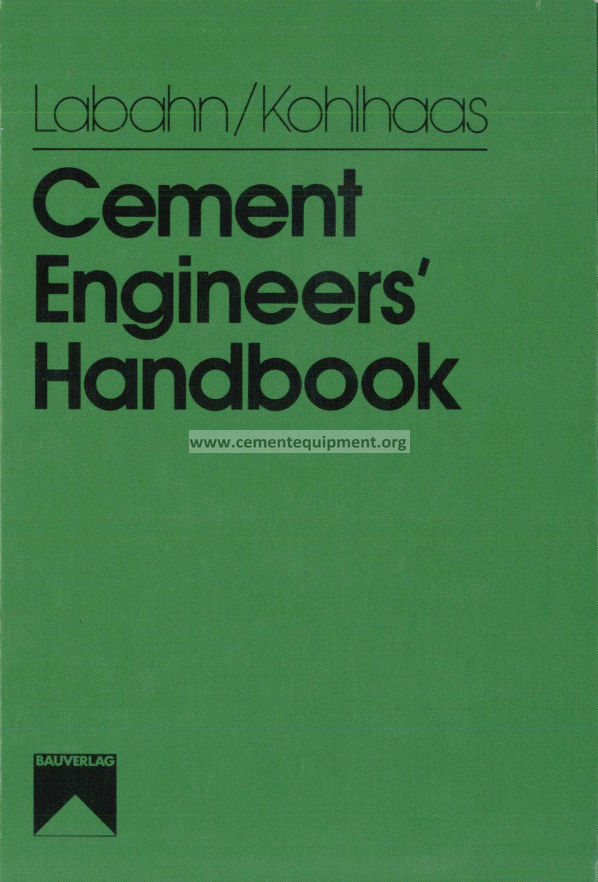
Cement Engineer S Handbook: Complete Technical Guide
The Cement Engineers’ Handbook, originated by Otto Labahn and developed by Bernhard Kohlhaas with a team of German cement specialists, is one of the great classic reference works of the industry: first published in 1954, updated through the sixth German edition and translated into English by C. van Amerongen, the handbook covers the cement plant from the geology of the raw materials to the laboratory equipment, the firefighting and the personnel requirements, chapter by chapter, written by the experts of the German cement industry of the golden engineering era. It is the European counterpart of the American, the Indian and the corporate manuals of the library: the systematic engineering of the well-equipped plant.
This digital edition is part of the Complete Cement Technical Package of cementequipment.org (931 files: books, courses, Excel tools and presentations, $249.99 one-time, instant download after PayPal payment). This guide walks the reader through the sections of the handbook with their verified contents and authors, and positions the German classic in the professional library.
1. The Book and Its German Origin
The handbook was conceived as the comprehensive engineering reference of the cement industry in the German production tradition: the first edition appeared in 1954, and the successive German editions expanded with the industry (the text of the sixth German edition is the base of the English translation): the editor Bernhard Kohlhaas (of the German cement organization) assembled a team of engineers with a single rule: every chapter is written by the specialist of the field, and every chapter carries at its beginning the name of its author and a list of the literature references for the deeper study: the German rigour of the citation is present from the first page. The translations and the international editions carried the work to the whole industry, and the handbook remains one of the most respected references of the profession: the book written by the engineers who built the German cement industry of the 20th century.
2. The Structure of the Volume: From A to P
The English edition divides the handbook into sixteen lettered sections, each with its numbered chapters and authors: the verified map of the volume includes:
- A. Introduction.
- B. Raw materials: the raw materials and the quarrying methods, the exploration of the deposit (the boreholes, the reserve calculation), the quarrying itself, the storage, the blending beds and the sampling stations.
- C. Cement chemistry and cement quality: the chemistry block by D. Knofel (the Knaufel of the German cement research): the whole field from the historical introduction to the cement standards.
- D. Manufacture of cement: from the material preparation to the cement silos: the crushing, the classification, the grinding, the raw meal silos, the burning technology, the clinker storage.
- E. Packing and loading for despatch.
- F. Handling and feeding systems: the continuous conveyors.
- G. Process engineering and automation.
- H. Environmental protection and industrial safety.
- I. Maintenance and wear.
- K. Workshops and the spare parts store.
- L. Water supply and the compressed air.
- M. Personnel requirements.
- N. Lubricants.
- O. Firefighting equipment.
- P. Laboratory equipment.
With this structure, the handbook covers the plant completely: the material, the machine, the control, the environment, the services and the laboratory: the engineering administration of the cement factory in one work.
3. Section B: The Quarry and the Raw Materials
The raw materials section of the handbook is a complete extraction unit course:
- The geology and the exploration: the identification of the deposits (the chapters of H.-U. Schafer: “Raw materials and quarrying methods, exploration, boreholes, evaluation of the borehole results, calculation of the reserves”): the methodology of the deposit evaluation that the cement industry uses before the project: the chapter is a full curriculum of the limestone exploration.
- The quarrying of the raw material: the guidelines of the quarrying, the overburden, the breaking out of the rock (the drilling and blasting), the loading, the haulage, the mobile crushing plants underground and in the quarries, the site restoration: the quarry operation of the plant as the German industry practiced it.
- The raw materials storage, the blending beds, the sampling stations: the bed blending theory, the machinery of the stockpiles (the stackers and reclaimers), the homogenization, the sampling stations of the raw materials: the discipline of the constant chemistry of the feed.
Here the reader finds the German method of the reserves: the boreholes grid, the evaluation, the calculation: the standard that the European projects of the era followed, still the basis of the modern deposits valuations.
3.1 The Blending Theory and the Sampling Stations: The German Rigour of the Feed
The third block of the raw material section deserves a dedicated look, because it is one of the great teaching parts of the handbook: the bed blending theory: the mathematics of the homogenization of the stockpile: the layers, the reservation retravoirs, the statistics of the variation reduction between the quarry and the mill: the chapter “machinery and process engineering methods” describes the stacking and the reclaiming machines of the German practice (the bow stackers, the longitudinal and the circular beds, the full width reclaimers, the end reclaimers), the influence curves and the selection of the machines by the homogenization efficiency; and the sampling stations: the design of a trustworthy sampling of the high-flow streams: the hammer samplers, the falling locations and the division (the Jones riffle of the raw), the representativity of the sample that the laboratory bases its report on. The German school of the feed chemistry is the reason the German plants of the era ran with the LSF standard deviations that the industry praised: the chapters give the reader exactly that school.
3.2 The Chemistry in Practice: The Knobl Chapters in Plant Language
The chemistry section of Knauf is not only a textbook: it is the daily tool of the laboratory: several of its pages deserve the attention of the plant reader in particular: the judging of the clinker quality: the tests and the observations that the chemist applies at the gate of the cooler: the free lime, the density, the appearance, the petrography: the chapter gives the criteria in the German order: the mill atmosphere chapter: the moisture and its control by the water injection and the ventilation, with the effects on the strength and the storage; the hydration chapter: the setting and the hardening quantified: the liberation of the heat of the phases and their strengths at the ages: the table of the reader that explains the behavior of the concrete on the site; and the cement testing chapter: the fineness screens (the 200/90), the setting of the Vicat, the soundness of the Le Chatelier and the strength of the prisms: the practical laboratory of the German quality: the same tests of the modern norms, executed in the classical method of the volume.
The chemistry section, authored by D. Knauf, is a textbook of the cement chemistry of the European tradition, in the detailed chapters:
- The historical introduction of the cement chemistry;
- The raw materials and the raw mix: the proportioning and the analysis;
- The chemical, physical and mineralogical aspects of the cement burning: the seven stages of the burning per the German school: the drying, the dehydration of the clay minerals, the decomposition of the carbonates, the solid reactions below the sintering, the reactions in the presence of the liquid phase (the sintering), the reactions during the cooling, and the factors affecting the burning process: a perfect roadmap of the clinkerisation chemistry;
- The portland cement clinker: the clinker phases and the judging of the clinker quality;
- The finish grinding: the materials involved, the fineness and the particle size distribution, the mill atmosphere (the moisture and its control), the grinding aids;
- The storage of the cement: in the works and on the construction site;
- The hydration of the cement: the setting, the hardening, the strength: the hydration of the clinker phases and of the slag and the pozzolanic cements;
- The relations between the chemical reactions, the phase content and the strength: the chapter of the microstructure-translation of the German research;
- The types, the strength classes, the designation and the quality control of the cements: the classification, the constituents, the supply and the identification, the quality control, the suggestions for the use;
- The cement testing: the fineness, the setting times, the soundness, the strength, the heat of hydration, and the cement standards: the summary of the norms of the era.
This section alone is a complete course of the cement chemistry and the cement quality; its depth reflects the author’s dual formation in the laboratory and the plant: the same subject of the section C contrasts with the international texts by the crisp German systematization.
5. Section D: The Manufacture of the Cement
The manufacture section is the largest of the handbook, and it walks the complete production chain with the German engineering:
- The material preparation (Schneider and Binder): the primary reduction (the crushers), the size classification (the screens), the grinding (the ball mills and the circuits), the roller mills, and the grinding and drying of the coal: the full preparation technology with the German machinery practice.
- The raw meal silos (Klein): the silo types: the batchwise homogenization, the continuous blending, the combined systems: the aerated silos and the blending efficiency of the day.
- The cement burning technology (Steinbiss, Xeller, Steinbiss, Opitz): the kiln systems; the preheaters and the precalcining; the clinker cooling; the firing technology; the refractory linings: the complete pyro block, with the German write of the thermal engineering.
- The clinker storage (Kohlhaas): the forms of the storage, the selection, the design, the filling and the discharging of the silos and the storage buildings and the outdoor stockpiles.
- The cement silos (Klein): the large-capacity silos: the design and the discharge of the product.
This section is the German counterpart of the machinery sections of the international references: the design and the operation of the actual equipment, with the references of the German literature of the era.
5.1 The Burning Technology: The Kiln School of the German Section
The pyro block of the manufacture section is the section of the German thermal engineering, and the reader receives the classical and the modern in one sequence: the kiln systems chapter (Steinbiss): the wet and the dry systems, the Lepol grate, the long dry kiln, the suspension preheater kilns and the precalciner kilns: the evolution of the burning technology with the heights and the temperatures of each system; the preheaters and the precalcining chapter: the cyclone stages, the gas distribution, the calcination in the riser: the chapter of the capacities of the modern tower; the clinker cooling chapter (Xeller): the planetary coolers and the grate coolers, the air distribution and the heat recovery: the numbers of the cooling and the recovery of the secondary air; the firing technology chapter: the burners and the flames: the primary air, the momentum, the flame adjustment; the refractory linings chapter: the brick types, the zones, the selection and the life of the lining: this section reads as the German monograph of the pyro lines, chapter by chapter, with the references: the technical formation of the burners of the German school, in the book.
5.2 The Raw Mill and the Cement Mill in the Handbook
Beyond the pyro, the preparation chapters of the section give the milling of the German practice: the size reduction chapters (the primary crushing and the stages of the sizes) with the secondary and the tertiary crushers; the classification (the screens of the first sizes, the residues of the mills); the grinding chapter: the ball mills: the grinding bodies, the partition walls, the dynamics, the circuits with the separators, the moisture; the roller mills: the table and the rollers, the adjustment and the drying; the coal grinding and drying: the vertical coal mill with the hot gas, the fineness and the explosion limits: for the mill engineer of the plant, these chapters are the mill school of the classic: the Austrian-German practice of the machinery, complete with the process approach.
6. Section E: The Packing and the Despatch
The packing section (Schwake, Bomke, Schafer) covers the end of the line:
The packing section (Schwake, Bomke, Schafer) covers the end of the line: the types of the packaging (the valve bags, the machine packing), the despatch of the cement: the despatch in the sacks, the bulk loading, the loading of the clinker and the crushed stone, the “big bag” despatch, the shrink wrapping, and the automation of the despatch procedures: the German industry organized the logistics of the cement: the rail and the road of the period, with the automation chapter of the era.
7. Section F: The Handling and the Feeding Systems
The conveyors section (Mechtold) is the most systematic catalog of the handling technologies in the package: the belt and the steel band conveyors, the bucket elevators (belt, chain, swing), the chain conveyors (flight, continuous-flow, apron), the vibratory conveyors, the screw conveyors, the pneumatic conveyors, the feeders, and the weighing equipment: chapter by chapter with the machinery data and the selection: the reference of the maintenance and design of the handling of the plant: the conveyor that the plant’s maintenance had today is described with the theory and the care.
8. Section G: The Process Engineering and the Automation
The automation section (Schmiedgen) is the bridge to the modern control: the measurement and the process control (the instruments, the closed loops), the programmable controllers, the monitoring and the operation, the process computers (the development, the control center, the hardware and software, the microprocessors), and the process control system: the German process engineering formalized the control as it was arriving in the plants; reading the section today shows the origin of the DCS and the intelligence of the plant, and the process control system chapter closes with the philosophy of the loop: measure, decide, set: the eternal triangle of the process that the modern era only accelerated.
8.1 The Handling Technology in Depth: The Conveyor Chapters as the Reference of the Section
Among the sections of the handbook, the conveyors (F) is the one that the maintenance and the methods engineers of the plants consult chapter by chapter: the belt conveyors with the idlers, the tension, the drive and the capacity tables; the bucket elevators with the chains and the buckets of the clinker duty; the pneumatic conveyors: the dense and the lean phase, the air velocities and the pressures; the feeders in front of every machine (the apron, the table, the rotary vane); and the weighing equipment: the belt weighers and the feeders of the proportioning: every chapter gives the machinery data of the German practice, the selection rules and the maintenance clues: the handbook section is the complete annex of the handling systems of the modern plants: the engineer who masters it troubleshoots the conveyors of his line with the same understanding as the conveyor supplier.
8.2 The Services in the Service: The Numbers of the Water, the Air and the Laboratory
The service sections of the volume carry the numbers that the plant staff inherits: the water supply: the estimated quantities of the works (the process water, the cooling water, the domestic), the quality of the raw water and the treatment, the supply systems, the cooling water circuits and the water storage, the waste water disposal of the plant; the compressed air: the supply, the receivers and the distribution; the lubrication: the types of the lubricants, the storage rules of the drums, the issue registers and the distribution points and the consumption tables of the plant: the classic lubrication management that the modern plants rediscovered with the oil analysis; the firefighting: the equipment of the plant: the extinguishers, the hydrants, the protection of the conveyors and the coal storage; and the laboratory: the outline specification of the rooms of the quality laboratory: the sample preparation room, the wet chemical room, the X-ray, the physical tests room, the equipment list with the instruments, the general apparatus and the chemicals: the complete budget of the laboratory of the plant: the section that the quality managers quote to the management for the money of their labs.
9. Section H: The Environmental Protection and the Industrial Safety
The environment and safety section (Funke) covers the emission control of the German period: the prevention of the air pollution (the de-dusting of the plants, the ESP and the filters of the era), the noise control of the plants, the ground vibrations of the rock blasting; and the industrial safety: the accident prevention regulations, the promotion of the safety, the safety rules: the responsibility of the German industry, formalized.
10. The Services Sections: The Complete Plant Administration
What distinguishes this handbook from every other title of the industry is its administration sections: the sections that the engineering books do not cover:
- I. Maintenance and wear: the maintenance plan, the spares and the renewable parts planning, the costs of the maintenance, the wear problems: the maintenance economy of the plant.
- K. The workshops and the spare parts store: the design of the maintenance shop of the plant and its stock.
- L. The water supply and the compressed air: the estimated quantities, the raw water, the supply systems, the cooling water circuits, the waste water disposal: and the compressed air supply: the utilities of the plant.
- M. The personnel requirements: the staffing of the plant: how many, what skill: the management of the personnel in the classic plant.
- N. The lubricants: the types, the storage, the handling, the distribution, the consumption: the lubrication management.
- O. The fire fighting equipment: the fire protection of the plants: the fixtures.
- P. The laboratory equipment: the outline specification of the laboratory rooms, the laboratory equipment and the apparatus, the measuring instruments, the general laboratory apparatus and the chemicals: the complete specification of the quality laboratory of the plant.
These chapters are the sections that the plant manager, the maintenance chief and the project staff use and have used for lifetime: no other single volume of the package covers the plant administration in this depth.
11. Who Uses the Handbook
| User | Use of the handbook |
| Plant engineers | Manufacture, handling, maintenance chapters |
| Quality departments | The chemistry and cement testing chapters of the C section |
| Project managers | The design of the plant: the stores, the workshops, the utilities |
| Environmental teams | The H section: the prevention of the emissions of the era |
| Automation staff | The G section: the process, the computers, the control systems |
| Students | The complete German tradition of the cement engineering |
The handbook is the complete instrument of the engineer: the technical and the administration both.
12. The European Classic in the Complete Package
In the library the German handbook completes the European side of the profession:
- With Duda’s Data Book: the two German documents share the systematization; the Duda gives the data tables and the world survey; the Labahn/Kohlhaas gives the engineering text and the administration: the German pair of the shelf.
- With the chemistry of Lea and Taylor: the English science of the material meets the German chemistry chapters of the same subject: the comparison of the two schools is a lesson of the engineering history.
- With the FLS and the Holderbank files: the Anglo-Danish and Swiss tradition of the partnerships: the German tradition of the handbook: the three schools of the industry meet in the library.
- With the Deolalkar design book: the design and the layout from the Indian tradition, the design and the administration from the German: the two sides of the project.
The Complete Package thus gives the professional the heritage of the whole industry: the German, the British, the Swiss, the Danish, the American and the Indian: the world of the cement engineering, page by page, and the reader who compares the same subject across the traditions (the mill, the kiln, the laboratory) receives the formation in comparative engineering that no single school provides: the package as the university of the industry.
12. The Digital Edition
The digital edition in the package is the complete handbook with its 400+ pages of the scanned text, the figures, the drawings and the tables of the German original: the pages navigate with the PDF readers, the keyword search works on the text pages of the edition, and the book opens on any device: the desk, the classroom or the tablet of the plant: the engineering reference at the same speed as a modern e-book, with the depth of the classical printed volume.
These later chapters (from the raw mill to the laboratory) close the loop of the handbook: the specification, the operation and the support of the plant of the German tradition: after reading them, the engineer walks any plant of the world and recognizes its organs, its numbers and its departments in the systematic of the book: the missing chapter of the plant’s complete formation is supplied by these pages.
13. Frequently Asked Questions
Is the handbook technical or administrative?
Both: the technical sections (the chemistry, the manufacture, the conveyors, the automation) cover the process and the machinery; the administrative sections (the maintenance, the workshop, the water, the laboratory, the personnel, the lubricants, the fire) cover the services that keep the plant running: the German completeness of the book is its signature, and the plant manager who reads the administration sections receives the formation that the operational books of the industry do not give.
Which chapter do the plant staff open most?
The experience of the users: the maintenance and wear chapters for the mechanical staff, the cement chemistry and testing chapters for the quality, the conveyors for the maintenance of the handling, and the laboratory specification for the managers of the quality departments: the distribution of the opens is itself the proof of the completeness of the volume: every department finds its chapter, with the German depth of the subject.
The book was written between the 1950s and the 1980s: is it still current?
The chemistry of the cement, the physics of the process and the engineering of the conveyors and the filters of the era are the same of the installed plant of today; the automation of the section G is the ancestor of the DCS; the modern reader uses the book as the source of the base and compares the German practice with the modern control: the package updates the practice with the modern titles and the tools.
How does the package deliver it?
With the full library of the Complete Package: 931 files (the books, the courses, the tools, the presentations), for a one-time $249.99 via PayPal: the e-mail brings the instant download, the license is lifetime: the German classic, the chemistry of Lea, the data of Duda, the courses of the leaders and the Excel tools: the whole profession: the German engineering of the handbook, digitized and delivered with the complete documentation of the industry, searchable on the screen of the engineer’s desk or the tablet of the plant.
14. Conclusion
The Cement Engineers’ Handbook of Labahn and Kohlhaas is the great work of the German engineering of the cement: the sixteen sections from the geology of the quarry to the firefighting equipment, the chemistry of the clinker and the conveying of the cement, the automation and the personnel: the book of the German profession, with the systematic of its school, the references of its authors and the administration of its plants: a complete engineering classic that cannot be missing the desk of the engineer of the era, and that the Complete Cement Technical Package places in the complete library: the German book next to the English, the Swiss and the American: the whole world of the cement engineering: $249.99, one-time, instant download, lifetime access: the classic lives in your finger.
The cement engineer handbook collects the essential data and the calculation methods of the cement industry in one reference: the chemistry of the raw materials and the clinker, the mill and the kiln calculations, the quality control, the plant equipment and the practical tables that the cement engineer consults daily in the plant and the office.
Get this handbook + the full 931-file package
$249.99 — one-time purchase, instant download, lifetime access
This file is part of the Complete Cement Technical Package (931 files) available from cementequipment.org. Contents © respective rights holders; library copy for the licensed single user.