Anchor Systems in Castable or Brick Lining in Different Vessels
TO Download this post and all the books and excel sheets and my personal notes and presentations I collected about cement industry in the last 30 years click the below paypal link

Introduction
Anchoring plays a crucial role in the stability and longevity of refractory linings in industrial vessels. This post explores different types of anchor systems, their materials, layout, welding techniques, and the effects of corrosion, embrittlement, and insulation on anchorage.
1. Anchor Types
Metallic – Fixed
- Standard REVA-W anchoring
- Other types upon customer agreement
Metallic – Flexible
- Metallic wave anchoring (REVA-W)
- RHA anchors bridge insulation
- Preassembly using Lasche
Ceramic Anchors
- Prefabricated components, including concrete anchoring and expansion joints
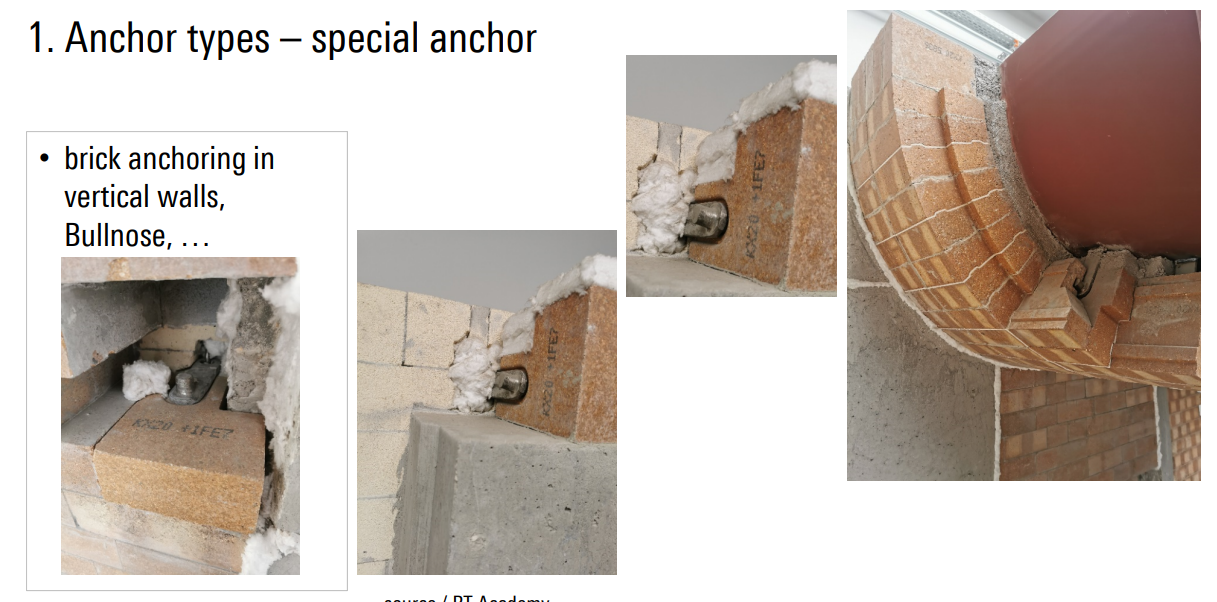
Special Anchors
- Used for brick anchoring in vertical walls, bullnose applications, etc.
2. Anchor Materials and Selection Criteria
When selecting anchor materials, consider:
- Expected thermal and mechanical loads
- Chemical exposure
- Professional installation and welding quality
Material Temperature Resistance:
| Material | Max Temperature (°C) | Properties |
|---|---|---|
| 1.4301 / AISI 304 | < 750°C | Inexpensive, suitable for constant temperatures |
| 1.4835 / 1.4828 / 1.4841 | < 1150°C | Good creep rupture strength, corrosion resistance |
| 1.4876 | < 1100°C | Good resistance to high thermo-chemical loads |
| 2.4633 / ALLOY 602 | < 1200°C | Excellent corrosion resistance and creep strength |
| Ceramic | > 1200°C | High-temperature resistant |
Anchor Cap Color Codes for Alloy Identification:
- White – 1.4301
- Red – 1.4828
- Brown – 1.4835 / 253MA
- Blue – 1.4837 / 1.4841 / 1.4845
- Green – 1.4876 / 2.4633
- Orange – 2.4856
3. Anchor Layout & Distance
Roof Anchors
- 90° angle to each other
- Anchor distance:
- <150mm lining thickness → 200mm (25 pieces/m²)
-
150mm lining thickness → 250mm (16 pieces/m²)
Wall Anchors
- 90° angle to each other
- Anchor distance:
- <150mm lining thickness → 200mm (25 pieces/m²)
-
150mm lining thickness → 250mm (16 pieces/m²)
Zyclon Cone / Bottom Anchors
- 90° angle to each other
- Anchor distance: 330mm (9 pieces/m²)
4. Welding Electrode Selection
Factors to consider:
- Chemical exposure
- Professional welding techniques (manual electrode, stud/bolt welding)
Material Combinations for Welding Electrodes:
| Electrode Type | Suitable for |
|---|---|
| RTEL U | Universal applications |
| RTEL FN | Cast iron elements |
| RTEL B | Structural steel |
| RTEL NG | Nickel-cast materials |
| RTEL N | Nickel-based applications |
5. Corrosion in Anchor Systems
Electrochemical Corrosion
Occurs due to reactions with surrounding substances, leading to material degradation.
High-Temperature Corrosion (Scaling)
- Caused by molten salts, gases, and electrolytic reactions.
Types of Corrosion:
- Surface corrosion: Can increase volume and create internal tension in refractory linings.
- Internal corrosion: Weakens metal structure, reducing creep rupture strength.
- Stress corrosion: Occurs at grain boundaries due to chemical exposure and mechanical stress.
- Chemical corrosion (Laboratory Tests):
- KCl (800°C, oxidizing)
- K₂SO₄ (1100°C, oxidizing)
- K₂SO₄ (1100°C, reducing)
6. Embrittlement of Anchor Materials
Factors Causing Embrittlement:
- Chi-Phase (475°C Embrittlement):
- Forms at 400-550°C in steels with >15% chromium.
- Sigma-Phase Embrittlement:
- Occurs at 600-900°C, reducing chromium and molybdenum in metal structure.
- Cold deformation accelerates sigma-phase formation.
- Nitrogen and carbon can reduce sigma-phase formation.
7. Effect of External Insulation on Anchorage
- Best practice: Maximum internal insulation to prevent external corrosion.
- Case study:
- Märker Zement – Mascoat Usage (July 2021): Applied to calciner falling ducts.
- Risks of external insulation:
- Clinker dust buildup
- Insulation deterioration and failure
Conclusion
Proper selection of anchor types, materials, layout, welding, and insulation methods ensures the longevity and performance of refractory linings in industrial vessels. Considering factors like temperature, corrosion, and embrittlement can help optimize anchor system efficiency.
TO Download this post and all the books and excel sheets and my personal notes and presentations I collected about cement industry in the last 30 years click the below paypal link
Excellent explanation of anchor systems in refractory linings! In our experience with stud bolts and high-temperature fasteners, proper anchoring is crucial to ensure lining longevity and structural integrity—especially in rotary kilns and reactors. This post is a great resource for engineers working on heavy-duty lining systems. Appreciate the clarity!